What you'll learn
- Attach -ㅂ시다 or -읍시다 to a verb stem and say it with natural pronunciation.
- Handle ㄹ-stems and the common irregular verbs.
- Make a negative suggestion with -지 맙시다.
- Choose between -(으)ㅂ시다, -자 and -(으)ㄹ까요?.
- Avoid the mistake of using it with a senior.
Before you start: you should know how to find a verb stem and the question ending -(으)ㄹ까요?, which this lesson compares with. Audio plays only when you press a button.
What Does -(으)ㅂ시다 Grammar Mean?

-(으)ㅂ시다 grammar means "let's (do this)" in the formal speech level. It is a suggestion that includes the speaker: both of you, or all of you, will do the action. Because the speaker does not ask a question, the suggestion sounds decided and a little firm.
Two examples show the idea.
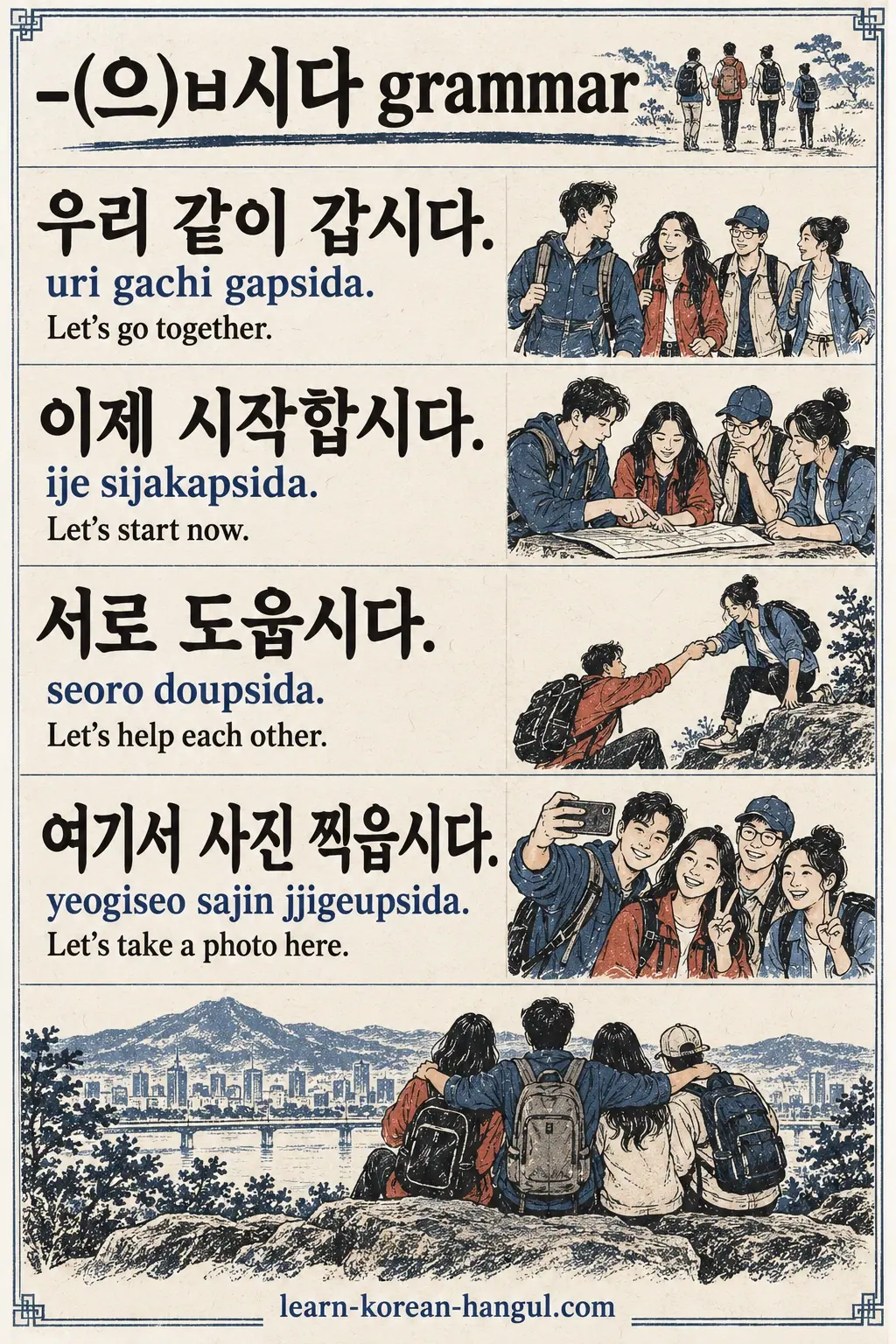
우리 같이 갑시다.
uri gachi gapsida.
Let's go together.
이제 시작합시다.
ije sijakapsida.
Let's start now.
You often hear -(으)ㅂ시다 from a teacher, a team leader or a speaker who is addressing a group. The first sentence is said [우리 가치 갑씨다], with the spelling 같이 pronounced [가치]. Learner textbooks group the ending with the formal endings. The standard dictionary (표준국어대사전) labels it 하오체, an older level between formal and polite, which is one reason it does not sound respectful enough for a senior. Next comes the formation rule.
How Do You Form -(으)ㅂ시다?
-(으)ㅂ시다 is formed by dropping 다 from the dictionary form of a verb and adding -ㅂ시다 or -읍시다, depending on the last sound of the stem. A stem that ends in a vowel takes the short form, and a stem that ends in a consonant takes the form with 읍. The ㅂ attaches to the last syllable of a vowel stem, which is why 가 becomes 갑.
| Dictionary form | Stem | Ending added | Suggestion | Meaning |
|---|---|---|---|---|
| 가다 | 가 | -ㅂ시다 | 갑시다 | Let's go. |
| 하다 | 하 | -ㅂ시다 | 합시다 | Let's do it. |
| 만나다 | 만나 | -ㅂ시다 | 만납시다 | Let's meet. |
| 먹다 | 먹 | -읍시다 | 먹읍시다 | Let's eat. |
| 앉다 | 앉 | -읍시다 | 앉읍시다 | Let's sit. |
| 읽다 | 읽 | -읍시다 | 읽읍시다 | Let's read. |
| 만들다 | 만들 | -ㄹ dropped, -ㅂ시다 | 만듭시다 | Let's make. |
The table shows one pattern with two endings. The next parts take the stem types one at a time.
Stems Ending in a Vowel
A vowel stem takes -ㅂ시다 directly, so the ㅂ joins the last syllable: 가다 becomes 갑시다, 모이다 becomes 모입시다, and 기다리다 becomes 기다립시다. Verbs that end in 하다 become -합시다.
- 이제 시작합시다. (ije sijakapsida.) [이제 시자캅씨다] = "Let's start now."
- 조금만 기다립시다. (jogeumman gidaripsida.) [조금만 기다립씨다] = "Let's wait just a little."
Stems Ending in a Consonant
A consonant stem takes -읍시다, with 읍 as a linking syllable: 먹다 becomes 먹읍시다, and 앉다 becomes 앉읍시다. The final consonant of the stem moves to the next syllable when you speak.
- 점심은 같이 먹읍시다. (jeomsimeun gachi meogeupsida.) [점시믄 가치 머급씨다] = "Let's have lunch together."
The ㅅ in 시다 sounds tense after the ㅂ of -ㅂ/읍, so the ending is said [씨다]: 갑시다 is [갑씨다], and 먹읍시다 is [머급씨다]. This follows the 국립국어원 standard pronunciation rules (표준 발음법). The spelling does not show it, and Revised Romanization also writes plain s, as in gapsida.
점심은 같이 먹읍시다.
jeomsimeun gachi meogeupsida.
Let's have lunch together.
Do ㄹ-Stems and Irregular Verbs Change?
ㄹ-stems drop their ㄹ before -ㅂ시다, because the ㄹ disappears before ㄴ, ㅂ and ㅅ. So 만들다 becomes 만듭시다, 살다 becomes 삽시다, and 열다 becomes 엽시다. Other irregular verbs follow their usual rule.
- ㄷ-irregular verbs change ㄷ to ㄹ before 으. 듣다 becomes 들읍시다, and 걷다 becomes 걸읍시다.
- ㅂ-irregular verbs change ㅂ to 우. 돕다 becomes 도웁시다.
- ㅡ-stems and 르-verbs keep their stems before ㅂ. 쓰다 becomes 씁시다, and 부르다 becomes 부릅시다.
- 마시다 and similar vowel stems. 마시다 becomes 마십시다, so the ㅂ attaches to 시.
서로 도웁시다.
seoro doupsida.
Let's help each other.
Adjectives do not normally take the suggestion ending, because you cannot propose "let's be tall." With the formation clear, one sentence can be built step by step.
Worked Example: Building a Sentence with -(으)ㅂ시다

-(으)ㅂ시다 grammar works the same way every time, so a five-step routine is enough. Follow it with a team leader who wants to take a photo of the group.
- Start with the dictionary form. The verb is 찍다 (to take a photo).
- Drop 다 to find the stem. The stem is 찍. It ends in a consonant.
- Choose the ending. A consonant stem takes -읍시다, so you get 찍읍시다.
- Add the object. The object is 사진 ("a photo"). The place is 여기서 ("here").
- Put it together. 여기서 사진 찍읍시다. (yeogiseo sajin jjigeupsida.) [여기서 사진 찌급씨다] = "Let's take a photo here."
Sentence
Let's take a photo here.
Show answer
여기서 사진 찍읍시다
You will know it worked if the verb is in its stem form and the ending is -읍시다 after a consonant. The most common slip is writing 찍ㅂ시다 or 찍시다, which skips the 읍. The next question is which tenses and sentence types work.
Which Tenses and Sentence Types Work with -(으)ㅂ시다?

-(으)ㅂ시다 works only as a present-time suggestion with action verbs. A suggestion is about the future, so no tense marker goes inside it. Other meanings come from changing the ending.
| Meaning | Form | Example |
|---|---|---|
| Formal "let's" | -(으)ㅂ시다 | 시작합시다. (Let's begin.) |
| Negative "let's not" | -지 맙시다 | 가지 맙시다. (Let's not go.) |
| Casual "let's" | -자 | 같이 가자. (Let's go together.) |
| Polite question | -(으)ㄹ까요? | 같이 갈까요? (Shall we go together?) |
| Formal statement | -ㅂ니다/습니다 | 같이 갑니다. (We go together.) |
| Reported suggestion | -자고 하다 | 가자고 했어요. (He or she suggested going.) |
The negative uses 말다: 가지 맙시다 (gaji mapsida) is said [가지 맙씨다]. A statement such as 갑니다 looks very close to 갑시다, but 니 makes it a statement and 시 makes it a suggestion. The pattern for tenses is simple: there is none.
How Is -(으)ㅂ시다 Different from -자?

-(으)ㅂ시다 and -자 both mean "let's", but they belong to different speech levels. -(으)ㅂ시다 is formal and firm. -자 is casual and used among close friends. A third neighbour, -(으)ㄹ까요?, is a polite question.
-(으)ㅂ시다
let's: formal and firm
-자
let's: casual, for close friends
-(으)ㄹ까요?
shall we: a polite question
| Comparison | -(으)ㅂ시다 | -자 | -(으)ㄹ까요? |
|---|---|---|---|
| Speech level | formal | plain or casual (해라체/반말) | polite (해요체) |
| Feels like | leading, firm | friendly, relaxed | gentle, open |
| Best listener | equals, juniors, a group | friends, siblings | anyone, including seniors |
| Example | 같이 갑시다. | 같이 가자. | 같이 갈까요? |
Use -(으)ㅂ시다 for a firm, formal suggestion to equals or juniors, -자 for friends, and -(으)ㄹ까요? when you want to ask rather than lead.
The casual form is taught in -자, and the question form in -(으)ㄹ까요?. The page on -(으)ㅂ시다 vs -(으)ㄹ까요 vs -자 compares all three on one table. A common rule of thumb: speakers use -(으)ㅂ시다 when they lead, -자 when they chat and -(으)ㄹ까요? when they ask. These contrasts lead to a few variations.
Variations and Edge Cases of -(으)ㅂ시다
-(으)ㅂ시다 has four common variations. Each one shows how real speakers use it.
- Replies. To agree, say 좋아요 ("Good") or 그럽시다 [그럽씨다] ("Yes, let's do that"). To decline politely, say 다음에 해요 ("Let's do it next time").
- Slogans and speeches. 힘냅시다 ("Let's cheer up") and 같이 합시다 ("Let's do it together") appear on posters, in campaigns and in speeches.
- Short calls to action. 자, 갑시다! ("Now, let's go!") is a common way to start moving. Often 자 comes first. At dinner, 한잔 마십시다 ("Let's have a drink") invites the table to drink together.
- Respectful variant. A rarer variant, -(으)십시다, adds the honorific -(으)시- and is heard from older speakers. It is less common than -(으)ㅂ시다.
Think of the three this way: 가자 for friends, 갑시다 to lead equals, juniors or a group, and 갈까요? to ask anyone, including seniors. The honorific system that sits behind the more respectful forms is explained in honorific -(으)시-, and the wider picture is in Korean Speech Levels.
What Mistakes Do Learners Make with -(으)ㅂ시다?

Learners usually mix up the register, the stem form or the pattern. Four mistakes appear again and again.
- Using it with a senior. A student who says 선생님, 같이 갑시다 sounds like a leader. Use 같이 갈까요? or 같이 가시겠어요? instead.
- Forgetting 읍. 먹ㅂ시다 and 먹시다 are wrong. A consonant stem needs 읍: 먹읍시다.
- Forgetting to drop ㄹ. 만들읍시다 and 만들ㅂ시다 are wrong. The ㄹ drops: 만듭시다.
- Mixing it with the statement. 갑니다 means "I go", and 갑시다 means "Let's go". One sound separates a statement from an invitation.
A quick check: Is the listener an equal, a junior or a group? Is the stem handled correctly (vowel, consonant, ㄹ)? Does the ending end in 시다? If all three answers are yes, the suggestion is sound.
The practice set below tests these four points.
Practice and Answers
Try the four items before you read the answer key. Cover the answers with your hand.
- Choose the form. Complete: 여기 ___. (앉시다 / 앉읍시다 / 앉ㅂ시다)
- Fix the error. A sign says 우리 같이 만들읍시다. Correct it for 만들다.
- Make a negative. How do you say "Let's not eat here"? Use 먹다.
- Choose the register. You want to suggest lunch to a friend. Which ending is natural?
Practice · 5
Which form means "Let's eat" for 먹다?
Show answer
먹읍시다
The stem 먹 ends in a consonant, so it takes -읍시다: 먹읍시다.
What is the formal "Let's make it" for 만들다?
Show answer
만듭시다
ㄹ-stems drop the ㄹ before ㅂ: 만들다 becomes 만듭시다.
You are a junior employee. You want to suggest starting the meeting to your manager. Which is best?
Show answer
회의를 시작할까요?
-(으)ㄹ까요? is a question and sounds respectful. -(으)ㅂ시다 sounds like leading, and -자 is casual.
How do you say "Let's not go"?
Show answer
가지 맙시다.
The negative suggestion uses 말다: 가지 맙시다.
Which sentence is a suggestion, not a statement?
Show answer
같이 갑시다.
시다 makes a suggestion: 갑시다 means "Let's go." 갑니다 and the past forms are statements.
Answer key
- 앉읍시다. The stem 앉 ends in a consonant, so 읍 links the ending.
- 만듭시다. The ㄹ of 만들 drops before the ㅂ.
- 여기서 먹지 맙시다. (yeogiseo meokji mapsida.) The negative uses 말다.
- -자: 점심 같이 먹자. With a close friend, the casual -자 is natural. 점심 먹읍시다 would sound like a team leader.
If you can complete items 1 to 3 without the key, you can read and use most suggestions. The final section points to the next lessons.
What Should You Learn Next after -(으)ㅂ시다 Grammar?
After -(으)ㅂ시다 grammar, learn the casual and the polite alternatives. This lesson teaches the formal suggestion and does not cover the whole formal level. Those lessons live on separate pages.
- Start with the casual -자.
- Learn the polite question in -(으)ㄹ까요?.
- Read Suggestions and Requests to see every suggestion and request ending in one place.
- Return to the Beginner Grammar list for the other patterns at this level.
With these steps, the choice becomes automatic: use -(으)ㅂ시다 to lead, -자 with friends and -(으)ㄹ까요? to ask.
Frequently Asked Questions
What does -(으)ㅂ시다 mean?
-(으)ㅂ시다 means "let's" in the formal speech level. It invites the listener to do something together with the speaker. 같이 갑시다 means "Let's go together," and 시작합시다 means "Let's begin." It is firmer than a question and is common in meetings, speeches and slogans.
How do I attach -(으)ㅂ시다 to a verb?
Drop 다. After a vowel stem add -ㅂ시다: 가다 becomes 갑시다. After a consonant stem add -읍시다: 먹다 becomes 먹읍시다. A stem ending in ㄹ drops it first: 만들다 becomes 만듭시다. The ending attaches to action verbs, not to ordinary adjectives.
Can -(으)ㅂ시다 be used in the past tense?
No. A suggestion looks forward, so -(으)ㅂ시다 has no past form. To talk about a suggestion that someone made, use a quotation: 가자고 했어요 means "He or she suggested going." For a negative suggestion, use -지 맙시다, which means "let's not."
Is -(으)ㅂ시다 used in speech or only in writing?
Both. You hear it in meetings, classes, military and sports settings, and in speeches that urge everyone to act. You read it on posters and slogans, such as 힘냅시다 ("Let's cheer up"). Among friends, people say -자 instead, and to a senior they prefer a softer question.
What is the most common mistake with -(으)ㅂ시다?
The most common mistake is using it with a superior. -(으)ㅂ시다 sounds commanding, as if the speaker is leading, so a student who says it to a teacher can seem rude. Use -(으)ㄹ까요? or -(으)시겠어요? instead. A second mistake is mixing 갑시다 with the statement 갑니다.