
Key facts
- A speech level is a set of sentence endings. The same message ends differently in formal, polite, casual and plain speech.
- Honorifics such as -(으)시- are a separate system: they respect the subject, not the listener.
- This set contains 6 lessons at level A1 and above.
Listen to the same message, "I go", in four levels.
The next section defines the topic and shows the four forms side by side.
What Are Korean Speech Levels?
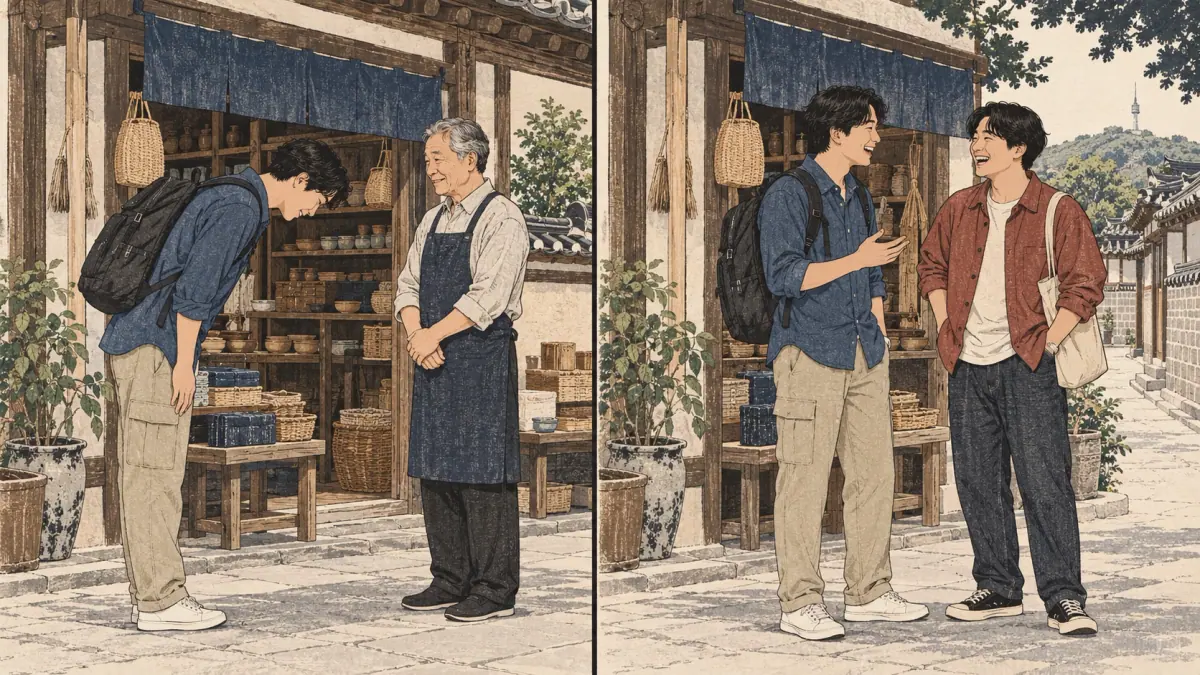
Korean speech levels are the sentence-ending styles that tell the listener how respectful and how close the speaker is. In Korean, the style is called 체 (che, "style"), and each level has a name built from a model verb. The ending, not the vocabulary, carries the level.
| Level | Korean name | "I go" | "Do you go?" | Typical use |
|---|---|---|---|---|
| Formal | 하십시오체 | 갑니다 | 갑니까? | news, announcements, service, presentations |
| Polite | 해요체 | 가요 | 가요? | everyday speech with most people |
| Casual | 해체 (반말) | 가 | 가? | close friends, younger people, family |
| Plain | 해라체 | 간다 | 가니? | written narration, books, notes |
Pronunciation: 갑니다 is [감니다] (gamnida), 갑니까 is [감니까] (gamnikka), and 간다 is [간다] (ganda). The four forms mean the same thing; only the relationship changes. Grammar books count six or seven levels, depending on how they treat rare and archaic styles, and the lesson on the seven Korean speech levels lists them all.
Honorifics work on a different axis. The infix -(으)시- makes the subject of a sentence respected: 선생님이 오세요 ("The teacher is coming") honors the teacher, whatever the speech level. The lesson on Korean honorifics covers it. For the wider area, see Korean grammar. The next section gives a route through the lessons.
Where Should You Start with Korean Speech Levels?
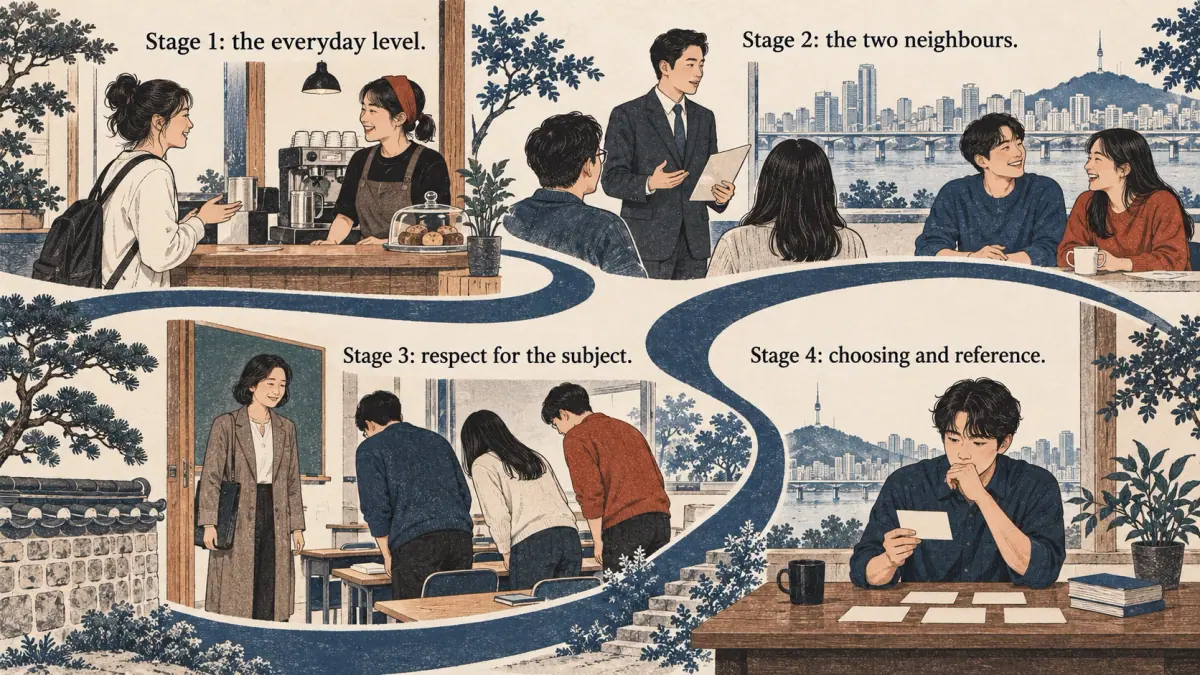
Start with polite speech, then learn the two levels that sit on either side of it, and finish with the decision rules. Four stages cover the whole set.
- Stage 1: the everyday level. Read Polite Speech (-요), which teaches the ending you will use with almost everyone.
- Stage 2: the two neighbours. Read Formal Polite Speech for the -ㅂ니다 style, then Casual Speech (Banmal) for friends.
- Stage 3: respect for the subject. Read Korean honorifics for -(으)시- and special words.
- Stage 4: choosing and reference. Read which Korean speech level to use, then the overview of the seven Korean speech levels.
Who can skip ahead? A learner who already forms 가요 and 먹어요 correctly can start at stage 2. A learner who has not met Korean verb endings should first read basic Korean grammar, because every level builds on the verb-final sentence pattern. The next section describes each lesson.
Browse by Topic
Each lesson below has a short description, one example sentence with Revised Romanization (RR, the official Latin spelling, shown only as an aid) and audio.
Polite Speech (-요)
This lesson set teaches the everyday 해요체 style: how -아요/어요 is formed, when it fits, how question pitch works and how it mixes with formal endings. Example: 같이 가요. (gachi gayo.) "Let us go together." Spoken [가치 가요].
Formal Polite Speech
This lesson set teaches the -ㅂ니다/습니다 style used in news, service and presentations. It covers the endings, the question form and the situations where formal speech is expected. Example: 감사합니다. (gamsahamnida.) "Thank you." Spoken [감사함니다].
Casual Speech (Banmal)
This lesson set teaches 반말 (banmal), the casual style used with close friends and younger people. It shows how to form it by dropping 요 and when it is safe to switch. Example: 밥 먹었어? (bap meogeosseo?) "Did you eat?" Spoken [밥 머거써].
Korean Honorifics
This lesson set teaches the subject-respecting infix -(으)시- and the special honorific words, such as 드시다 for "to eat" and 계시다 for "to be". Example: 선생님이 오세요. (seonsaengnimi oseyo.) "The teacher is coming." Spoken [선생니미 오세요].
Which Korean Speech Level to Use
This lesson gives a decision procedure: who the listener is, how old, how close and in what setting. It ends with a quick table you can use in the first minute of a conversation. Example: 만나서 반가워요. (mannaseo bangawoyo.) "Nice to meet you." Spoken [만나서 반가워요].
Seven Korean Speech Levels
This lesson is a reference to the traditional list of levels, including the rare 하오체, 하게체 and archaic styles that you may meet in historical dramas and older books. Example: 가십시오. (gasipsio.) "Please go (very formal)." Spoken [가십씨오].
The next section helps you choose a lesson for your own sentence.
Which Lesson Fits Your Sentence?
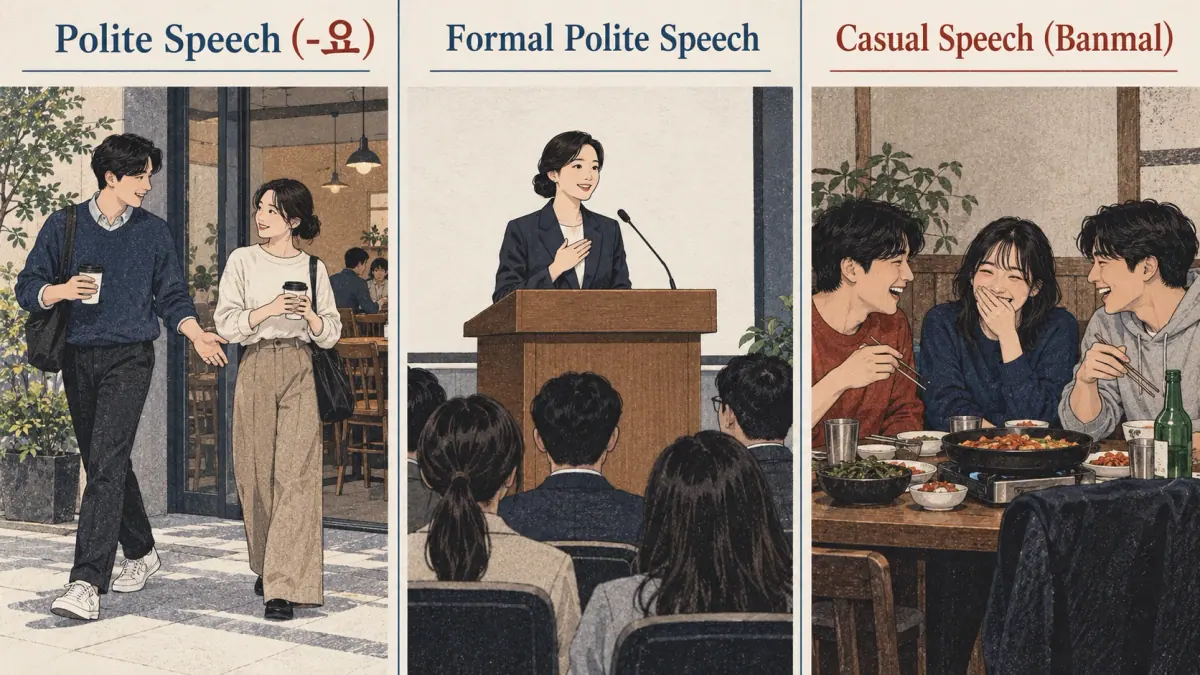
Match the situation you are in to the lesson in the table.
| If you want to say... | Open | Why |
|---|---|---|
| "Let us go together" to a shop owner or colleague | Polite Speech (-요) | -아요/어요 fits most listeners |
| "Thank you" in a speech or announcement | Formal Polite Speech | -ㅂ니다 is the formal ending |
| "Did you eat?" to a close friend your age | Casual Speech (Banmal) | dropping 요 gives banmal |
| "The teacher is coming" with respect | Korean honorifics | -(으)시- respects the subject |
| a choice between two levels | which Korean speech level to use | a decision guide by listener |
| a word like 하오체 from a drama | seven Korean speech levels | a reference to rare styles |
The next section shows the most useful contrast in the set.
How Do You Choose between Formal, Polite and Casual Speech?
Choose polite speech when you are unsure, formal speech for public or official situations, and casual speech only with people who have invited it or who are clearly younger and close. The table compares the three main levels on the questions learners ask first.
| Question | Formal 하십시오체 | Polite 해요체 | Casual 해체 |
|---|---|---|---|
| Typical listener | audience, customers, superiors | strangers, colleagues, elders | close friends, children |
| Ending of 먹다 | 먹습니다 | 먹어요 | 먹어 |
| Sounds | distant, official | friendly, respectful | intimate, direct |
| Risk | stiff in chat | none in most settings | rude to strangers |
Pronunciation: 먹습니다 is [먹씀니다] (meokseumnida), and 먹어요 is [머거요] (meogeoyo). Foreign learners are usually forgiven for being too polite and not for being too casual, so polite speech is the safe starting point. The decision rules, with age and setting, are in which Korean speech level to use. The next section lists the mistakes to avoid first.
Which Mistakes Come First?
Four mistakes appear in most beginner sentences in this area.
- Believing you must master all seven levels. Three levels cover almost all conversation. Learn polite, formal and casual first, and treat the rest as reference.
- Using banmal with a stranger because the person looks young. Casual speech needs an invitation or a clear friendship. Say 가요, not 가.
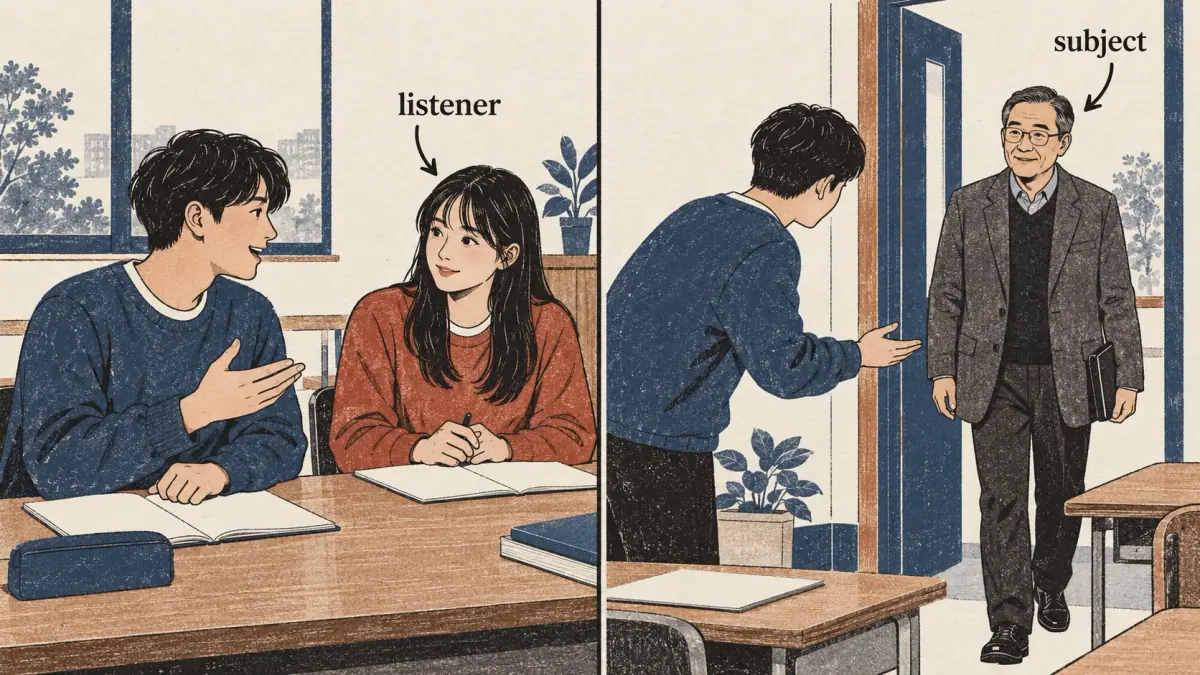
- Mixing up honorifics and speech levels. 선생님이 와요 is polite but does not honor the teacher. 선생님이 오세요 does both.
- Choosing the ending by the topic and not by the listener. The level depends on who you speak to, not on what you say.
Each lesson in the set explains these in detail. The next section shows what the set leaves out.
Scope of This Set
The Korean speech levels set covers sentence endings, honorifics and the choice of level. It does not cover vocabulary pairs such as 밥 and 진지, which belong to vocabulary lessons, or the tense endings, which are in Korean tenses.
All Korean text, spoken forms and audio on this page were machine-generated and reviewed and signed off by Min-ji Park on 15 October 2026. The next section shows how to practise.
How Do You Practise Korean Speech Levels?

Practise Korean speech levels by saying one sentence in three levels and checking the endings. A short routine works well across a week.
- Read one lesson and say its model sentences aloud with the audio.
- Write five sentences about your day in polite speech, then change each to formal and casual.
- Take the grammar quizzes to check the endings.
- Review the forms with the grammar flashcard decks.
- Print a grammar worksheet and fill it in by hand.
- Check how a verb changes with the Korean verb conjugator.
Each lesson ends with a practice set and an answer key, so you can check your work immediately. After finishing the set, continue to the other lessons in Korean grammar.
Frequently Asked Questions
What Are the Speech Levels in Korean?
Korean speech levels are sentence-ending styles that show respect and closeness to the listener. The three used most are formal 하십시오체 (갑니다), polite 해요체 (가요) and casual 해체 (가). Grammar books also list plain 해라체 (간다) and rarer styles. The level depends on who you speak to, not on what you say.
Which Korean Speech Level Should a Beginner Learn First?
Learn polite speech (해요체, -아요/어요) first. It suits strangers, shop staff, colleagues and anyone older, so it is the safe default in nearly every situation. Then add formal -ㅂ니다 for announcements and service, and casual speech for friends who invite it. Learners are rarely blamed for being too polite.
What Is the Difference between Speech Levels and Honorifics?
Speech levels respect the listener through the sentence ending. Honorifics respect the person the sentence is about, through -(으)시- or special words. 선생님이 와요 is polite but does not honor the teacher, and 선생님이 오세요 honors the teacher while staying polite. The two systems combine in one sentence.
How Many Speech Levels Does Korean Have?
Traditional grammar lists six or seven levels, depending on whether the archaic style is counted. Three or four matter for modern conversation: formal, polite, casual and, in writing, plain. The names come from model verbs, such as 하십시오체 and 해요체. The lesson on the seven levels lists them all.