
What you'll learn (about 25 minutes, no prerequisites)
- Give the name, starting sound and ending sound of any of the 19 consonants.
- Sort the 9 contrast letters into aspirated and tense, and pair each with its plain partner.
- Predict how a consonant sounds at the end of a syllable.
- Read three sample blocks, 각, 밖 and 낮, using the chart.
| Korean | Name | Romanization | Family | Sound |
|---|---|---|---|---|
| ㄱ | 기역 (giyeok) | g / k | plain | g in "go", softer at the start of a word |
| ㄴ | 니은 (nieun) | n / n | other | n in "no" |
| ㄷ | 디귿 (digeut) | d / t | plain | d in "do" |
| ㄹ | 리을 (rieul) | r / l | other | quick tap between r and d |
| ㅁ | 미음 (mieum) | m / m | other | m in "me" |
| ㅂ | 비읍 (bieup) | b / p | plain | b in "boy" |
| ㅅ | 시옷 (siot) | s / t | plain | s in "sun" |
| ㅇ | 이응 (ieung) | none / ng | other | silent |
| ㅈ | 지읒 (jieut) | j / t | plain | j in "jam" |
| ㅊ | 치읓 (chieut) | ch / t | aspirated | ch in "cheese" with a puff |
| ㅋ | 키읔 (kieuk) | k / k | aspirated | k in "kite" with a puff |
| ㅌ | 티읕 (tieut) | t / t | aspirated | t in "top" with a puff |
| ㅍ | 피읖 (pieup) | p / p | aspirated | p in "pin" with a puff |
| ㅎ | 히읗 (hieut) | h / t | other | h in "hat" |
| ㄲ | 쌍기역 (ssanggiyeok) | kk / k | tense | k with a tight throat |
| ㄸ | 쌍디귿 (ssangdigeut) | tt / none | tense | t with a tight throat |
| ㅃ | 쌍비읍 (ssangbieup) | pp / none | tense | p with a tight throat |
| ㅆ | 쌍시옷 (ssangsiot) | ss / t | tense | s said with tension |
| ㅉ | 쌍지읒 (ssangjieut) | jj / none | tense | j with a tight throat |
Korean Consonants Chart: All 19 Letters
The Korean consonants chart below lists each of the 19 letters once. The first table is a grid: rows show where in the mouth you make the sound, and columns show the series. Plain consonants have light breath, aspirated consonants have a strong puff of air, and tense consonants have a tight throat and no puff.
| Place in the mouth | Plain | Aspirated | Tense |
|---|---|---|---|
| Back of the tongue | ㄱ | ㅋ | ㄲ |
| Tongue tip | ㄷ | ㅌ | ㄸ |
| Lips | ㅂ | ㅍ | ㅃ |
| Tongue blade (hissing) | ㅅ | none | ㅆ |
| Flat tongue on the palate | ㅈ | ㅊ | ㅉ |
Five more letters do not fit the grid: ㄴ, ㅁ, ㅇ, ㄹ and ㅎ. They have no aspirated or tense partner.
The second table gives the details. "Start" means the letter opens a syllable and a vowel follows. "End" means the letter closes a syllable as a batchim (받침), the consonant written under a block. Revised Romanization (RR), South Korea's official Latin spelling, appears only as a learning aid.
| Letter | Name | Series | RR start / end | Sound at the start | Sound at the end |
|---|---|---|---|---|---|
| ㄱ | 기역 (giyeok) | plain | g / k | g in "go", softer at the start of a word | [k] |
| ㄴ | 니은 (nieun) | other | n / n | n in "no" | [n] |
| ㄷ | 디귿 (digeut) | plain | d / t | d in "do" | [t] |
| ㄹ | 리을 (rieul) | other | r / l | quick tap between r and d | [l] |
| ㅁ | 미음 (mieum) | other | m / m | m in "me" | [m] |
| ㅂ | 비읍 (bieup) | plain | b / p | b in "boy" | [p] |
| ㅅ | 시옷 (siot) | plain | s / t | s in "sun" | [t] |
| ㅇ | 이응 (ieung) | other | none / ng | silent | [ŋ], ng in "sing" |
| ㅈ | 지읒 (jieut) | plain | j / t | j in "jam" | [t] |
| ㅊ | 치읓 (chieut) | aspirated | ch / t | ch in "cheese" with a puff | [t] |
| ㅋ | 키읔 (kieuk) | aspirated | k / k | k in "kite" with a puff | [k] |
| ㅌ | 티읕 (tieut) | aspirated | t / t | t in "top" with a puff | [t] |
| ㅍ | 피읖 (pieup) | aspirated | p / p | p in "pin" with a puff | [p] |
| ㅎ | 히읗 (hieut) | other | h / t | h in "hat" | [t], rare and usually merges with the next sound |
| ㄲ | 쌍기역 (ssanggiyeok) | tense | kk / k | k with a tight throat | [k] |
| ㄸ | 쌍디귿 (ssangdigeut) | tense | tt / none | t with a tight throat | never final |
| ㅃ | 쌍비읍 (ssangbieup) | tense | pp / none | p with a tight throat | never final |
| ㅆ | 쌍시옷 (ssangsiot) | tense | ss / t | s said with tension | [t] |
| ㅉ | 쌍지읒 (ssangjieut) | tense | jj / none | j with a tight throat | never final |
The sound hints are approximate. English has no exact match for the tense series or for the tap ㄹ, so use the audio in each cell as the final guide. The audio is generated and awaits review by a Korean specialist.
With the chart in front of you, the next step is learning how to read it.
How Do You Read the Consonants Chart?
Read the chart row by row: name, series, start sound, end sound. The name is what you say when spelling a letter aloud. The series tells you how much breath the letter carries. The start and end columns tell you what the letter does inside a block.
Follow these steps for any letter:
- Find the letter in the grid and note its series (plain, aspirated or tense).
- Look up its row in the detail table.
- Say the start sound with the vowel ㅏ, for example 카 for ㅋ.
- Say the end sound alone, for example [k].
- Play the audio and compare.
You will know it worked when you can say the name, the start sound and the end sound of one letter without looking, then repeat it with the next letter in the row. The most common slip is skipping the end sound. Learners remember how ㄱ opens a block but forget that it closes a block as [k].
Start sounds also shift slightly inside a word. The four plain letters ㄱ, ㄷ, ㅂ and ㅈ are soft at the very start of a word, such as 가방 (bag), and they turn voiced, closer to g, d, b and j, between vowels, as in the second syllable of 아기 (baby) and 바다 (sea). The aspirated and tense letters do not voice in this way. That is one more reason the chart separates the series: the plain letters are the only ones that move.
Names are used to spell words aloud, for example when you tell someone how to write your name. Most follow a pattern: the letter's sound plus ㅣ, then a syllable that starts with a vowel and ends with the letter. Three names are irregular: 기역 for ㄱ, 디귿 for ㄷ and 시옷 for ㅅ. The lesson on Korean consonant names lists every name with audio.
The next question is why the chart is grouped in rows.
Why Are the Consonants Grouped in Rows?
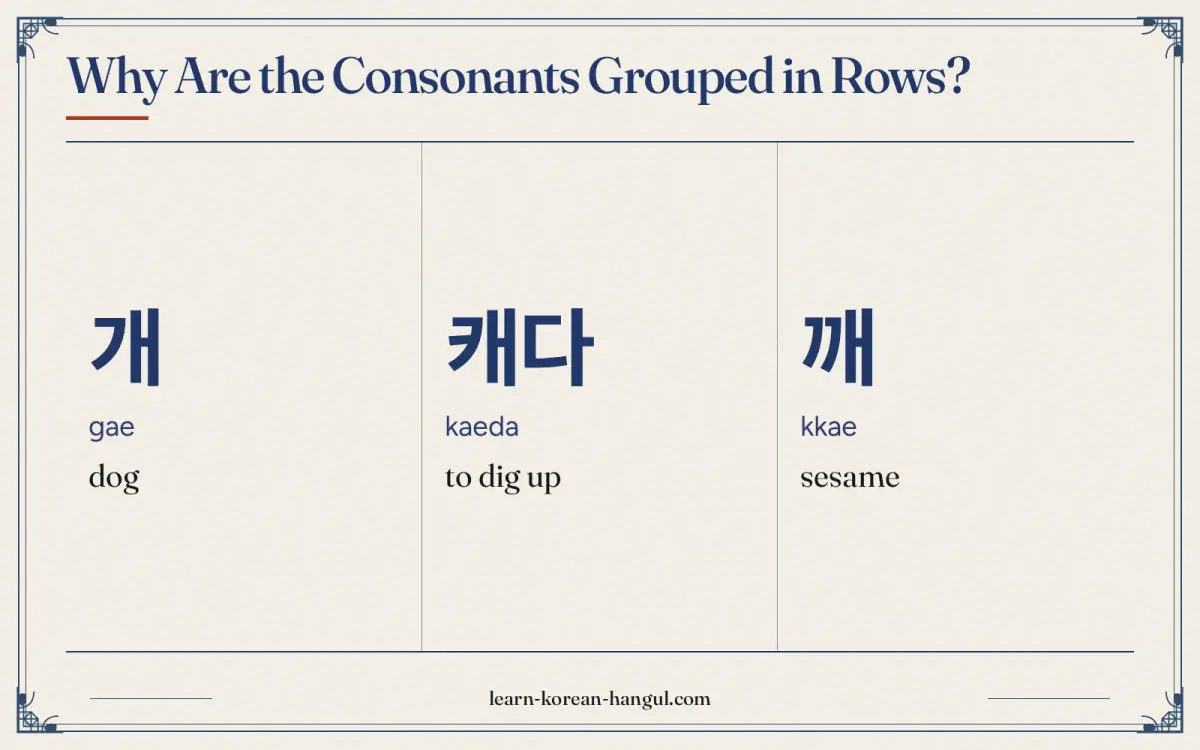
The consonants are grouped in rows by place in the mouth, because the letters in each row share a shape family. Hangul was designed so that the shape of a letter shows how it is made. The letter ㄱ represents the back of the tongue, ㄴ the tongue tip, ㅁ the lips and ㅅ the teeth, according to the 1446 commentary 훈민정음 해례본 (Hunminjeongeum Haerye). Each stronger sound adds a stroke: ㄱ becomes ㅋ, ㄷ becomes ㅌ, ㅂ becomes ㅍ and ㅈ becomes ㅊ. Tense sounds double the plain letter: ㄱ becomes ㄲ.
The rows therefore show a pattern you can use. If you know ㄱ, you can predict ㅋ by adding a stroke and ㄲ by doubling. That is a better learning order than the dictionary order, which spreads the family across the alphabet.
Which Consonants Have Three Versions?
Four places have three versions: the back of the tongue (ㄱ ㅋ ㄲ), the tongue tip (ㄷ ㅌ ㄸ), the lips (ㅂ ㅍ ㅃ) and the flat tongue (ㅈ ㅊ ㅉ). The fifth place, the tongue blade, has two versions, ㅅ and ㅆ, and no aspirated letter.
Back of Tongue: Plain, Aspirated, Tense
| Korean | Romanization | Meaning | Sound |
|---|---|---|---|
| 개 | gae | dog | |
| 캐다 | kaeda | to dig up | |
| 깨 | kkae | sesame |
Tongue Tip: Plain, Aspirated, Tense
| Korean | Romanization | Meaning | Sound |
|---|---|---|---|
| 달 | dal | moon | |
| 탈 | tal | mask | |
| 딸 | ttal | daughter |
Lips: Plain, Aspirated, Tense
| Korean | Romanization | Meaning | Sound |
|---|---|---|---|
| 불 | bul | fire | |
| 풀 | pul | grass; glue | |
| 뿔 | ppul | horn |
Flat Tongue: Plain, Aspirated, Tense
| Korean | Romanization | Meaning | Sound |
|---|---|---|---|
| 자다 | jada | to sleep | |
| 차다 | chada | to kick; to be cold | |
| 짜다 | jjada | to be salty |
Each triple changes word meaning, so hearing them matters:
| Plain | Aspirated | Tense | Meanings |
|---|---|---|---|
| 개 | 캐다 | 깨 | dog / to dig up / sesame |
| 달 | 탈 | 딸 | moon / mask / daughter |
| 불 | 풀 | 뿔 | fire / grass / horn |
| 자다 | 차다 | 짜다 | to sleep / to be cold / to be salty |
Press the triple buttons in the chart to hear each set in a row. For the fuller explanation, see plain, tense and aspirated sounds.
The rows explain the groups. The next section explains why the same letter can sound different.
Why Does a Consonant Sound Different at the End?
A consonant sounds different at the end of a syllable because Korean allows only seven final sounds: [k], [n], [t], [l], [m], [p] and [ŋ]. This is the neutralization rule in the South Korean standard pronunciation rules (표준 발음법), published by the National Institute of Korean Language (국립국어원). Letters that are distinct at the start of a syllable merge at the end.
| Final sound | Letters that make it | Example |
|---|---|---|
| [k] | ㄱ ㅋ ㄲ | 책 [책], 부엌 [부억] |
| [n] | ㄴ | 산 [산] |
| [t] | ㄷ ㅅ ㅆ ㅈ ㅊ ㅌ ㅎ | 옷 [옫], 꽃 [꼳] |
| [l] | ㄹ | 물 [물] |
| [m] | ㅁ | 밤 [밤] |
| [p] | ㅂ ㅍ | 밥 [밥], 앞 [압] |
| [ŋ] | ㅇ | 강 [강] |
The final sound is "unreleased": you form the sound but hold it without a puff. This is why the aspirated puff of ㅋ, ㅌ, ㅍ and ㅊ disappears at the end. The puff returns when a vowel follows, as in 꽃이 [꼬치].
The tense letters ㄸ, ㅃ and ㅉ never appear as final consonants, a fact many charts leave out. Among the tense letters, only ㄲ and ㅆ occur as finals, as in 밖 (outside) and 있다 (to exist). For the complete rule, see the 7 final sounds.
The romanization letters also change by position. ㄱ is "g" at the start and "k" at the end; ㄷ is "d" and "t"; ㅂ is "b" and "p"; and ㄹ is "r" at the start and "l" at the end. The Hangul does not change. Only the Latin letters follow the sound.
Now put the chart to work on three real blocks.
Worked Example: Reading 각, 밖 and 낮
The way to read a block with a final consonant is to split it into start, vowel and end, then use the chart for each. This example uses three blocks that look different but end in similar sounds.
Block 1: 각 (gak, "each").
- Start: ㄱ, a soft [g] at the start.
- Vowel: ㅏ, "a" as in "father".
- End: ㄱ, [k] from the final-sound table.
- Join: 각 [각] (gak).
Block 2: 밖 (bak, "outside").
- Start: ㅂ, [b].
- Vowel: ㅏ.
- End: ㄲ, which is [k] in the final position.
- Join: 밖 [박] (bak). The doubled ㄲ is written, but only [k] is heard.
Block 3: 낮 (nat, "daytime").
- Start: ㄴ, [n].
- Vowel: ㅏ.
- End: ㅈ, which is [t] in the final position.
- Join: 낮 [낟] (nat).
You will know it worked when you read all three aloud and recognise that 각 and 밖 end the same way while 낮 ends in [t]. If a vowel follows, the final consonant moves across: 낮이 is pronounced [나지], with the ㅈ sound returning. This is liaison (연음), described in the lesson on liaison.
The example shows how the chart works. The next section lists where learners go wrong.
Common Misreadings of the Korean Consonants Chart
Learners most often misread the chart in six ways. Each has a fix.
| Misreading | Why it happens | Fix |
|---|---|---|
| Reading ㅇ as "o" or "ng" at the start | Seeing the circle as a letter sound | At the start, ㅇ is silent; it only fills the slot |
| Treating ㄹ as always "r" | Chart shows r first | Say a quick tap between vowels and [l] at the end |
| Pronouncing every final letter fully | Reading 옷 as "ot-s" | Use the final-sound table: 옷 is [옫] |
| Confusing ㅊ with ㅈ | Similar shape | Look for the extra top stroke and listen for the puff |
| Expecting an aspirated ㅅ | Grid looks like it has a gap | ㅅ has no aspirated partner; ㅆ is the tense one |
| Reading RR as the spelling | Latin letters look familiar | Read Hangul first; RR follows sound, not spelling |
Common misconception: Learners often assume that the double letters ㄲ, ㄸ, ㅃ, ㅆ and ㅉ are held longer or said twice. Actually, they are single sounds made with a tight throat; the doubling in the shape only tells you the series. Length is not the main difference; tension is.
Limitation: this chart shows letters one at a time. It does not show sound changes between neighbouring syllables, such as nasalization and tensification, which are taught in the pronunciation lessons. It also does not show how ㅎ merges with the next sound.
Next, practise with the chart.
Practice with the Chart
Do these exercises with the chart open, then close it and try again.
Exercise 1: Name and sound. Say the name and the start sound of ㅂ, ㅍ and ㅃ.
Exercise 2: Sort. Put these letters into plain, aspirated and tense: ㄷ ㅌ ㄸ ㅈ ㅊ ㅉ.
Exercise 3: End sound. What sound does each letter make at the end of a syllable? ㅅ, ㅍ, ㅋ, ㅇ, ㄹ.
Exercise 4: Read. Read these aloud and write the sound in brackets: 밥, 꽃, 밖, 강.
Exercise 5: Listening. Play 불 / 풀 / 뿔 in random order five times and write which you heard. Four out of five means you are ready to move on.
Practice · 8
How many consonant letters does Korean have?
Show answer
19: 14 basic and 5 double
The chart lists 19 consonant letters: 14 basic and 5 double.
Which set is plain, aspirated and tense, in that order?
Show answer
ㄷ, ㅌ, ㄸ
For the tongue tip, ㄷ is plain, ㅌ is aspirated and ㄸ is tense.
What sound does ㅅ make at the end of a syllable?
Show answer
[t]
Korean allows only seven final sounds, and ㅅ merges into [t]: 옷 is [옫].
How does ㅇ sound at the start of a syllable?
Show answer
It is silent
At the start ㅇ is silent and only fills the slot; it sounds like ng only at the end.
Which consonant never appears as a final consonant?
Show answer
ㅃ
ㄸ, ㅃ and ㅉ never appear as finals; ㄲ and ㅆ do, as in 밖 and 있다.
How is 밖 pronounced?
Show answer
[박]
Final ㄲ is [k], so 밖 is [박]: the doubled letter is written, but only [k] is heard.
Which consonant has no aspirated partner?
Show answer
ㅅ
The tongue blade has only ㅅ and the tense ㅆ; ㄱ, ㅂ and ㅈ have ㅋ, ㅍ and ㅊ.
What is the Korean name of ㄱ?
Show answer
기역
ㄱ is 기역, one of the three irregular names (with 디귿 and 시옷); 지읒 is ㅈ and 키읔 is ㅋ.
Answers to the Practice
- ㅂ is 비읍 with [b]; ㅍ is 피읖 with a puffed [p]; ㅃ is 쌍비읍 with a tight, no-puff [p].
- ㄷ plain, ㅌ aspirated, ㄸ tense; ㅈ plain, ㅊ aspirated, ㅉ tense.
- ㅅ [t], ㅍ [p], ㅋ [k], ㅇ [ŋ], ㄹ [l].
- 밥 [밥] (rice), 꽃 [꼳] (flower), 밖 [박] (outside), 강 [강] (river).
- A score of 4 or 5 means you hear the difference. Below 4, replay slowly and repeat.
For more practice, use the Hangul worksheets.
What to Learn Next
After the consonants chart, learn the vowels and the consonant lessons in detail. The best next step is the Korean vowels chart, which gives all 21 vowels the same treatment. When you want one letter at a time, with audio and writing practice, open the Korean consonant lessons. Every consonant name is listed there too, and the other tools are collected on all Hangul charts.
Scope of this page: the chart covers the 19 consonants and their start and end sounds. It does not cover vowels, full sound-change rules or stroke order. Those live in the linked lessons.
The Korean consonants chart is a reference you can print and keep: the 19 letters, three series, and seven final sounds.
Frequently Asked Questions
Why is ㄹ written r and l?
Because ㄹ is one letter with two sounds. Between vowels it is a quick tap close to a soft r or d, and at the end of a syllable it is an l. Revised Romanization follows the sound, so ㄹ is written r before a vowel and l at the end or before another consonant, as in 달 (dal).
Do I need to know the consonant names?
Not to read Korean. You need the sounds. Names such as 기역 and 디귿 are used when you spell a word aloud, read a letter in a textbook, or ask how a word is written. Learn them after you can read simple blocks; the chart gives each name with audio.
Is ㅎ aspirated?
This site does not count ㅎ among the four aspirated letters ㅋ ㅌ ㅍ ㅊ. It is a breathy h sound, not a stop with a puff. It does cause aspiration when it meets ㄱ, ㄷ, ㅂ or ㅈ, as in 축하 [추카]. Some books call it aspirated for that reason.
Can I download the consonants chart?
Print the HTML tables above as a reference to the letters, names and sounds. The audio buttons only work on the web page.