안녕하세요. 처음 뵙겠습니다. 저는 김수진입니다. / 안녕하세요. 저는 마이클 스미스예요. 만나서 반가워요. / 저도 반가워요. 마이클 씨는 어느 나라 사람이에요? / 저는 미국에서 왔어요. 수진 씨는요? / 저는 한국 사람이에요. 서울에서 왔어요. / 아, 서울에서 왔어요? 저는 지금 서울에 살아요. / 마이클 씨는 학생이에요? / 네, 대학생이에요. 수진 씨도 학생이에요? / 네, 저도 대학생이에요. 우리는 같은 반이에요. / 정말요? 잘 부탁드려요.
What you'll learn
- State each speaker's name and country after hearing the dialogue.
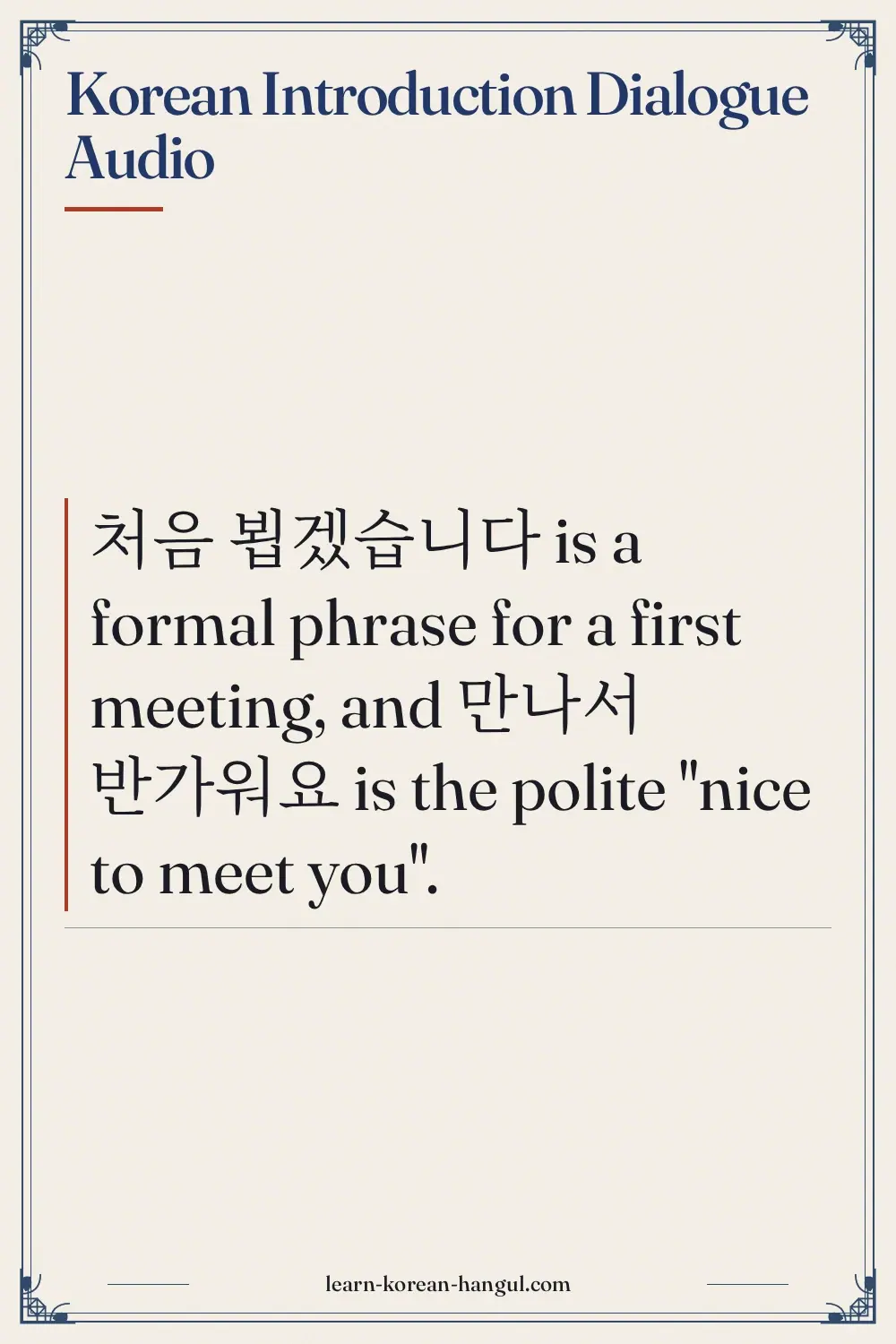
- Tell the formal 처음 뵙겠습니다 from the polite 만나서 반가워요.
- Hear 에서 after a country as "from" in 미국에서 왔어요.
- Follow Korean name order: family name first, as in 김수진.
Before you start: you need to read Hangul and recognise 안녕하세요. Time: about 20 minutes. Level: A1. The transcript stays hidden until you have listened once.
Key facts
- Every line uses the polite or formal style, so the dialogue suits a first day of class.
What Is a Korean Introduction Dialogue Audio Set?
A Korean introduction dialogue audio set is a recording of two people meeting for the first time, with questions that check what you heard. This one has Sujin, a Korean student, and Michael, an exchange student from the United States, who exchange names, countries and jobs.
The dialogue mixes two registers on purpose. Sujin opens with the formal 처음 뵙겠습니다, then switches to the polite 반가워요. Hearing both in one conversation shows that politeness is a scale, not a switch. The phrases are taught in introduce yourself in Korean, and this page trains your ear for them.
Before you listen, note why the opening lines are hard to catch.
What Makes This Dialogue Hard to Follow by Ear?
The opening lines carry long polite words that run together. 처음 뵙겠습니다 has seven syllables, and the name that follows it, 김수진입니다, has a tricky ending. English speakers also listen for the name at the start, but a Korean introduction puts it near the end, between 저는 and the ending 입니다 or 예요.
| What you see | What you hear | Where learners slip |
|---|---|---|
| 김수진입니다 | [김수지님니다] | The ㄴ of 진 moves to the next block, then ㅂ before ㄴ becomes ㅁ |
| 뵙겠습니다 | [뵙껟씀니다] | ㄱ and ㅅ become tense after a stop, and ㅂ before ㄴ becomes ㅁ |
| 미국에서 | [미구게서] | The ㄱ of 국 moves to the next block |
| 대학생이에요 | [대학쌩이에요] | ㅅ becomes tense ㅆ after ㄱ |
The first and third rows are liaison, a rule of the standard pronunciation rules (표준 발음법) of the National Institute of Korean Language (국립국어원). The second and fourth show tensification (된소리되기) after a stop. Hearing these as rules, not as exceptions, lets you predict them.
Here is how to practise.
How Does the Dialogue Practice Work?
The method uses two listens before any reading.
- Listen once at normal speed. Do not pause. Aim to catch two names and two places.
- Listen again slowly. Replay any line you missed up to three times.
- Open the transcript. Compare, and mark the lines you misheard.
- Replay only the marked lines. Then play the whole dialogue again.
You will know it worked when you can give each speaker's name and country with no transcript. A common mistake is to listen for the word 이름 (name), which never appears; the names come inside 저는 ...입니다 and 저는 ...예요. If the speech is too fast, understand spoken Korean shows how to find your bottleneck.
Start with the gist.
First Listen: the Gist
Play the normal-speed audio once. Answer in English.
- Are the speakers meeting for the first time?
- Where is each speaker from?
Gist means the main points, not every word. If you could not answer, listen once more before moving on.
The second listen checks the details.
Second Listen: the Details
Play the slow recording and answer.
- What are the two full names, and which comes first, family or given name?
- Where does Michael live now?
- What do both speakers study or do?
안녕하세요. 처음 뵙겠습니다. 저는 김수진입니다. / 안녕하세요. 저는 마이클 스미스예요. 만나서 반가워요. / 저도 반가워요. 마이클 씨는 어느 나라 사람이에요? / 저는 미국에서 왔어요. 수진 씨는요? / 저는 한국 사람이에요. 서울에서 왔어요. / 아, 서울에서 왔어요? 저는 지금 서울에 살아요. / 마이클 씨는 학생이에요? / 네, 대학생이에요. 수진 씨도 학생이에요? / 네, 저도 대학생이에요. 우리는 같은 반이에요. / 정말요? 잘 부탁드려요.
Question 3 is the usual stumbling block, because 마이클 스미스 follows English order and 김수진 follows Korean order. The transcript will show the answers.
Transcript, Translation and Key
Read the transcript after both listens. Each line has its own clip.
Two New Classmates Introduce Themselves
Sujin
안녕하세요. 처음 뵙겠습니다. 저는 김수진입니다.
annyeonghaseyo. cheoeum boepgetseumnida. jeoneun gimsujinimnida
Hello. Nice to meet you. I am Kim Sujin.
Michael
안녕하세요. 저는 마이클 스미스예요. 만나서 반가워요.
annyeonghaseyo. jeoneun maikeul seumiseuyeyo. mannaseo bangawoyo
Hello. I am Michael Smith. Nice to meet you.
Sujin
저도 반가워요. 마이클 씨는 어느 나라 사람이에요?
jeodo bangawoyo. maikeul ssineun eoneu nara saramieyo
Nice to meet you too. Which country are you from, Michael?
Michael
저는 미국에서 왔어요. 수진 씨는요?
jeoneun migugeseo wasseoyo. sujin ssineunyo
I came from the United States. And you, Sujin?
Sujin
저는 한국 사람이에요. 서울에서 왔어요.
jeoneun hanguk saramieyo. seoureseo wasseoyo
I am Korean. I came from Seoul.
Michael
아, 서울에서 왔어요? 저는 지금 서울에 살아요.
a, seoureseo wasseoyo? jeoneun jigeum seoure sarayo
Oh, you came from Seoul? I live in Seoul now.
Sujin
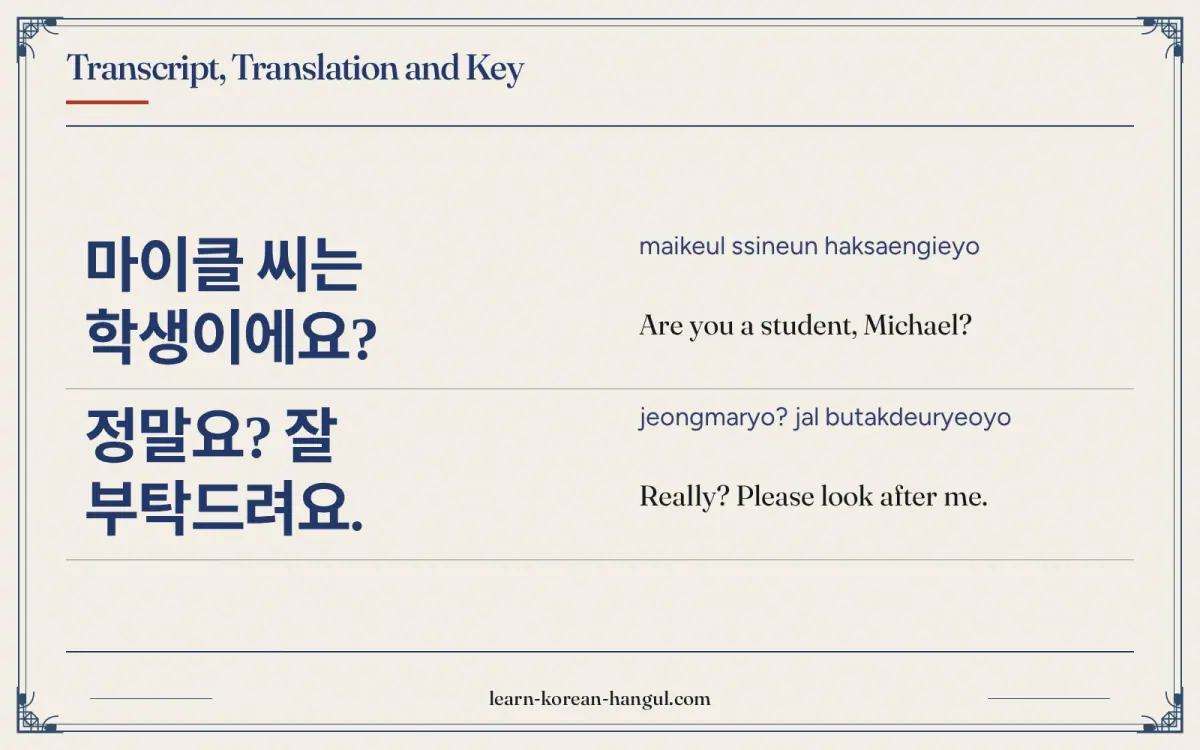
마이클 씨는 학생이에요?
maikeul ssineun haksaengieyo
Are you a student, Michael?
Michael
네, 대학생이에요. 수진 씨도 학생이에요?
ne, daehaksaengieyo. sujin ssido haksaengieyo
Yes, I am a university student. Are you a student too, Sujin?
Sujin
네, 저도 대학생이에요. 우리는 같은 반이에요.
ne, jeodo daehaksaengieyo. urineun gateun banieyo
Yes, I am a university student too. We are in the same class.
Michael
정말요? 잘 부탁드려요.
jeongmaryo? jal butakdeuryeoyo
Really? Please look after me.
Answer key
- Yes. 처음 뵙겠습니다 means "I meet you for the first time".
- Michael is from the United States (미국). Sujin is from Korea (한국), and from Seoul.
- 김수진 (family name 김, given name 수진) and 마이클 스미스 (given name first, in English order).
- In Seoul: 저는 지금 서울에 살아요.
- Both are university students (대학생), and they are in the same class (같은 반).
Line-by-Line Notes
- Line 1, 저는 김수진입니다. 입니다 is the formal "I am". Sujin chooses the formal style because this is a first meeting.
- Line 2, 마이클 스미스예요. After a vowel, 이에요 shortens to 예요. A foreigner may keep given-name-first order.
- Line 3, 어느 나라 사람이에요? Literally "Which country person are you?" This is the standard way to ask nationality.
- Line 4, 미국에서 왔어요. 왔어요 is the past of 오다 (to come), so the sentence reads "came from the United States".
- Line 10, 잘 부탁드려요. A set phrase for the start of a relationship, here "please treat me well".
Now the sound changes in these lines.
Which Sound Changes Are Hidden in the Dialogue?
Four written forms sound different from their spelling. Play each one alone.
Two of the four, 김수진입니다 and 뵙겠습니다, end with the nasal change ㅂ + ㄴ → ㅁ, so 입니다 is heard as [임니다] and 습니다 as [씀니다]. Korean nasalization shows the pattern with more examples. Every formal sentence ending in -습니다 or -입니다 has it, so you will hear it constantly.
Country names are also worth a short drill, because they sit right before 에서. 미국 and 영국 end in ㄱ, which moves onto 에서 ([미구게서], [영구게서]); 호주 ends in a vowel, so nothing moves (호주에서). Play these three and say each aloud.
Next, the contrast at the centre of the dialogue gets a worked example.
Worked Example: 처음 뵙겠습니다.
Two phrases carry the greeting, and each fits a different moment.
처음 뵙겠습니다.
cheoeum boepgetseumnida
Nice to meet you (formal, for a first meeting).
- Hear the sound. You hear [처음 뵙껟씀니다].
- Split the written form. 처음 (the first time) + 뵙- (humble verb "to meet") + -겠- (will) + -습니다 (formal ending). The literal sense is "I will meet you for the first time".
- Place it. Use it at an interview, a work meeting or a first meeting with elders.
The polite alternative is warmer and common between peers.
만나서 반가워요.
mannaseo bangawoyo
Nice to meet you (polite).
- Split it. 만나- (meet) + -아서 (because, as) + 반가워요 (I am glad), from 반갑다 whose ㅂ becomes 우 before a vowel.
Sujin uses both, which is realistic: a formal opening, then a relaxed polite answer. A common error follows when learners pick the wrong one.
What Mistakes Do Learners Make Here?
Learners often assume one phrase fits every introduction. Four slips are common.
- Using 처음 뵙겠습니다 with a classmate your age. It is correct but stiff. Between peers, 만나서 반가워요 is more natural.
- Writing 에서 as 에 after a country. 미국에 왔어요 would mean "came to the United States". 미국에서 왔어요 means "came from the United States".
- Putting the given name first for a Korean name. Say 김수진, family name first. Calling Sujin "Sujin Kim" in English order is fine in English, but Korean says 김수진 씨.
- Adding 씨 to your own name. 씨 is for other people. Say 저는 마이클이에요, never 저는 마이클 씨예요.
Check yourself with the short set below.
Practice and Answer Key
- Which phrase is formal: 처음 뵙겠습니다 or 만나서 반가워요?
- How does Michael say that he came from the United States?
- What is Sujin's family name?
- Complete the pattern: 저는 호주 ___ 왔어요.
Answers
- 처음 뵙겠습니다 is formal. 만나서 반가워요 is polite.
- 저는 미국에서 왔어요.
- 김.
- 에서: 저는 호주에서 왔어요.
Where to Go Next
Replay the dialogue tomorrow with the transcript hidden and see whether you still hear both names. Then continue with Korean shopping dialogue audio, which adds prices. To say the lines yourself, try Korean conversation practice. All dialogues are listed in Korean audio dialogues.
What this page does not cover. It does not teach the full particle system or the verb 이다, and it uses a text-to-speech voice, so a real speaker may sound different.
Come back to this Korean introduction dialogue audio whenever you want to check that a first meeting still sounds clear.
Frequently Asked Questions
What is 처음 뵙겠습니다?
처음 뵙겠습니다 is a formal phrase said at a first meeting. It means "I meet you for the first time", with 뵙다 as the humble verb for meeting. It fits interviews, business and elders. Between classmates, 만나서 반가워요 is friendlier. Neither needs a reply beyond 만나서 반갑습니다 or the same phrase.
Why 에서 after a country?
The particle 에서 marks the place something starts from, so 미국에서 왔어요 means "came from the United States". Compare 에, which marks a destination: 미국에 왔어요 means "came to the United States". With the verb 오다 (to come), the choice between 에서 and 에 changes the direction completely.
Which name comes first?
In Korean the family name comes first, so 김수진 is family name 김 and given name 수진. Most family names are one syllable and given names are often two. Foreign names are usually kept in their own order, so Michael Smith is introduced as 마이클 스미스, given name first.
How do I say where I am from?
Use 저는 [country]에서 왔어요, "I came from [country]", or 저는 [country] 사람이에요, "I am a person of [country]". For example, 저는 영국에서 왔어요 or 저는 호주 사람이에요. Both are polite and common. The second one states your nationality, while the first states where you travelled from.