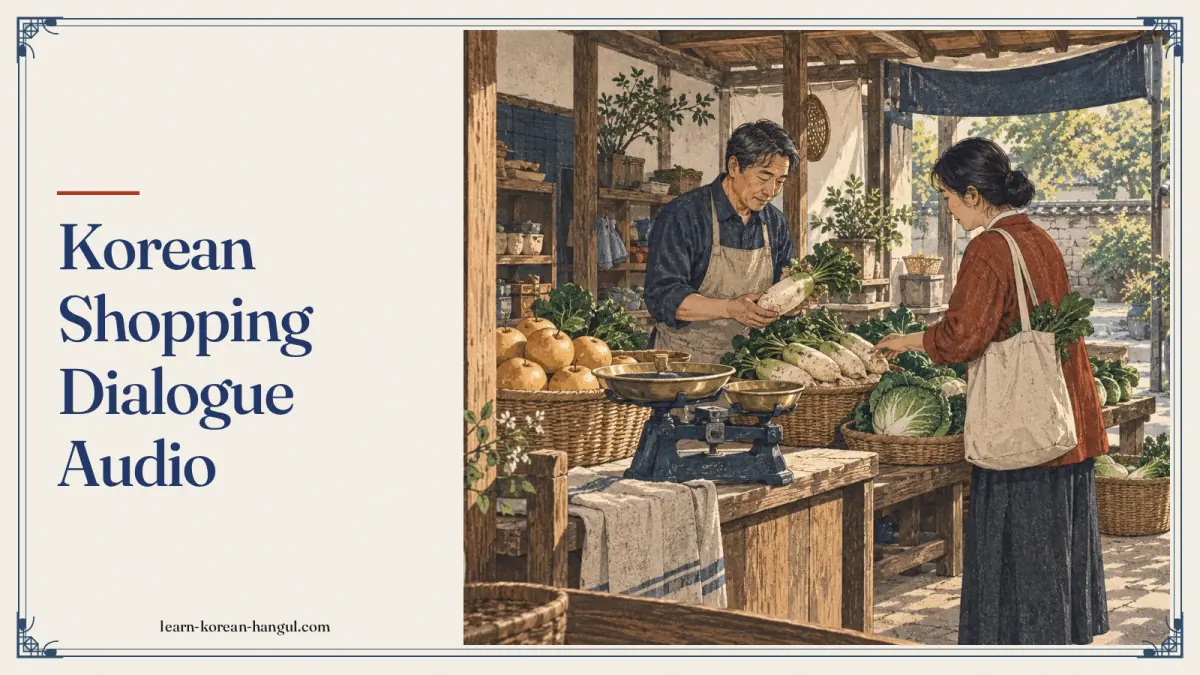
저기요, 이거 얼마예요? / 만 이천 원이에요. / 다른 색 있어요? / 네, 파란색하고 검은색 있어요. / 파란색 좀 보여 주세요. / 네, 여기 있어요. 몇 개 필요하세요? / 한 개요. 더 큰 사이즈도 있어요? / 아니요, 이게 제일 커요. / 아, 그래요? 그럼 조금 더 생각해 볼게요. / 네, 천천히 보세요.
What you'll learn
- State the price and the colour question after hearing the dialogue.
- Hear 만 이천 원 as 12,000 and not as 2,000.
- Tell 얼마예요? (how much) from 몇 개예요? (how many).
- Decline politely with 조금 더 생각해 볼게요.
Before you start: you need to read Hangul and know the Sino-Korean numbers up to 100. Time: about 20 minutes. Level: A1. The transcript stays hidden until you have listened once.
What Is a Korean Shopping Dialogue Audio Set?
A Korean shopping dialogue audio set is a recording of a customer and a shop assistant, with questions that check whether you caught the price, the options and the decision. This one is set in a clothes shop, with a customer who asks the price, the colours and the size.
The listening goal is concrete: you must hear one number correctly. Many everyday prices in Korea run into the tens of thousands of won, so 만 이천 원 (12,000) and 이천 원 (2,000) are different amounts, and missing the first word changes the price by a factor of six. The phrases are listed in Korean shopping phrases, and the number system is explained in Korean money numbers.
First, see what makes the price hard to hear.
What Makes This Dialogue Hard to Follow by Ear?
Large Korean numbers are grouped by 만 (10,000), not by thousands. English speakers listen for "thousand" and miss 만, which is a single short syllable that sounds like "man". Spoken fast, 만 이천 원이에요 also blends into one string of sounds.
| What you see | What you hear | Where learners slip |
|---|---|---|
| 이천 원이에요 | [이처눠니에요] | The ㄴ of 천 and the ㄴ of 원 each move to the next block |
| 몇 개 | [멷깨] | ㅊ becomes a ㄷ sound, then ㄱ becomes tense |
| 파란색하고 | [파란새카고] | ㄱ and ㅎ merge into ㅋ |
| 검은색 | [거믄색] | The ㅁ of 검 moves to the next block |
The first and fourth rows are liaison (연음), the second is tensification after a stop, and the third is aspiration (격음화); all are covered by the standard pronunciation rules (표준 발음법) of the National Institute of Korean Language (국립국어원).
Next is the routine.
How Does the Dialogue Practice Work?
Two listens come before any reading.
- Listen once at normal speed. Do not pause. Aim to write down the price as digits.
- Listen again slowly. Replay any line you missed up to three times.
- Open the transcript. Compare it with your notes.
- Replay the marked lines. Then play the whole dialogue once more.
You will know it worked when you write 12,000 without hesitation. The usual mistake is to write 2,000 because the word 만 was never heard. If a clip is too fast even when slow, understand spoken Korean shows how to find your bottleneck.
Begin with the gist.
First Listen: the Gist
Play the audio once. Answer in English.
- What does the customer ask in the first line?
- Does the customer buy the item in the end?
Gist means the overall outcome. Replay the clip if you are not sure, then move on.
The second listen focuses on the numbers and options.
Second Listen: the Details
Play the slow recording and answer.
- What is the price, in digits?
- Which two colours does the assistant offer?
- What does the assistant say about the size?
저기요, 이거 얼마예요? / 만 이천 원이에요. / 다른 색 있어요? / 네, 파란색하고 검은색 있어요. / 파란색 좀 보여 주세요. / 네, 여기 있어요. 몇 개 필요하세요? / 한 개요. 더 큰 사이즈도 있어요? / 아니요, 이게 제일 커요. / 아, 그래요? 그럼 조금 더 생각해 볼게요. / 네, 천천히 보세요.
If question 3 was hard, the problem is almost always 만. Check the transcript to see.
Transcript, Translation and Key
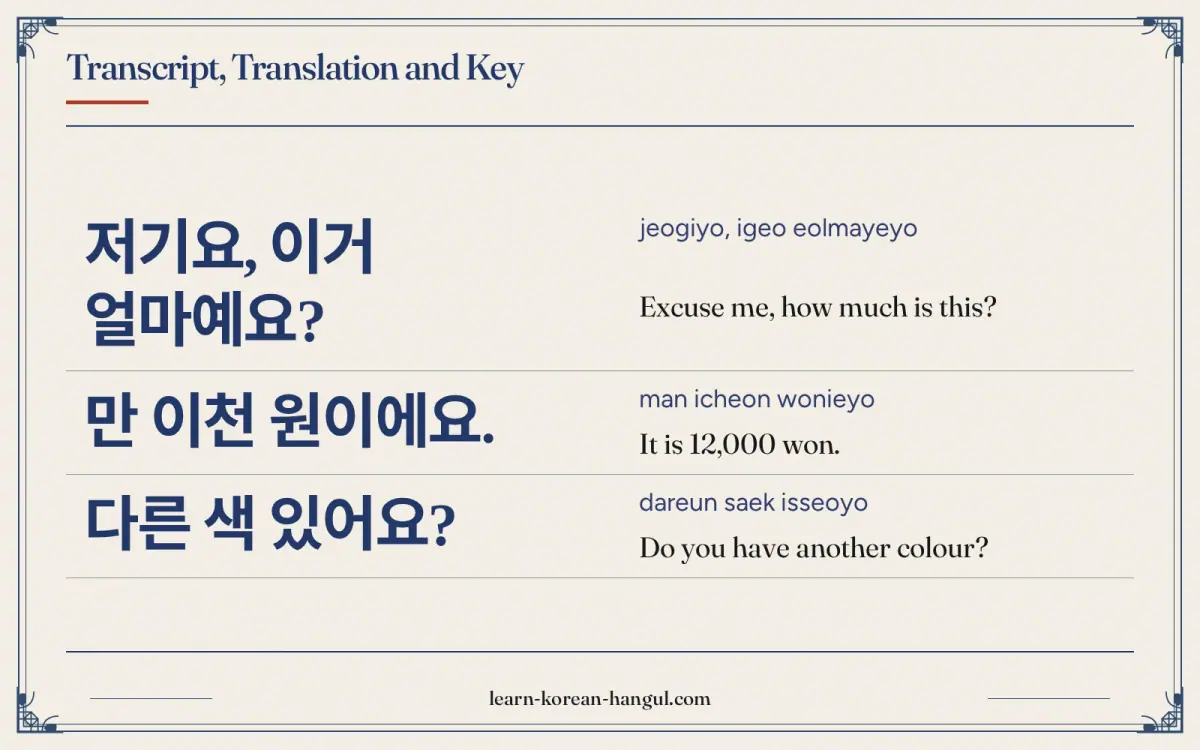
Read the transcript after both listens. Each line has its own clip.
Asking the Price in a Clothes Shop
Customer
저기요, 이거 얼마예요?
jeogiyo, igeo eolmayeyo
Excuse me, how much is this?
Assistant
만 이천 원이에요.
man icheon wonieyo
It is 12,000 won.
Customer
다른 색 있어요?
dareun saek isseoyo
Do you have another colour?
Assistant
네, 파란색하고 검은색 있어요.
ne, paransaekhago geomeunsaek isseoyo
Yes, we have blue and black.
Customer
파란색 좀 보여 주세요.
paransaek jom boyeo juseyo
Please show me the blue one.
Assistant
네, 여기 있어요. 몇 개 필요하세요?
ne, yeogi isseoyo. myeot gae piryohaseyo
Yes, here you are. How many do you need?
Customer
한 개요. 더 큰 사이즈도 있어요?
han gaeyo. deo keun saijeudo isseoyo
One, please. Do you have a bigger size too?
Assistant
아니요, 이게 제일 커요.
aniyo, ige jeil keoyo
No, this is the biggest.
Customer
아, 그래요? 그럼 조금 더 생각해 볼게요.
a, geuraeyo? geureom jogeum deo saenggakae bolgeyo
Oh, I see. Then I will think about it a little more.
Assistant
네, 천천히 보세요.
ne, cheoncheonhi boseyo
Sure, take your time to look.
Answer key
- 이거 얼마예요?, "How much is this?"
- No. The customer says 조금 더 생각해 볼게요, "I will think about it", which is a polite way to leave without buying.
- 12,000 won (만 이천 원).
- Blue (파란색) and black (검은색).
- There is no bigger size: 이게 제일 커요, "this is the biggest".
Line-by-Line Notes
- Line 1, 저기요. The usual way to call a shop assistant. It means "excuse me" and is used to get the attention of staff or strangers.
- Line 3, 다른 색. 다른 means "other, different", so 다른 색 is "another colour".
- Line 5, 보여 주세요. 보이다 (to show) + 주세요 (please do for me).
- Line 7, 한 개요. The 요 added to a noun makes it polite and short: "one, please".
- Line 9, 생각해 볼게요. Literally "I will try thinking". Shoppers use it to defer without refusing.
The sound changes in these lines are next.
Which Sound Changes Are Hidden in the Dialogue?
Four written forms sound different from their spelling. Play each one alone.
Each change is regular. A final consonant before a vowel moves to the next block (이천 원이에요, 검은색). A final ㅊ before a consonant is pronounced as ㄷ, and ㄱ after it turns tense (몇 개). A ㄱ next to ㅎ merges into ㅋ (색하고). Knowing these rules helps you predict the sounds, even in words you have not met yet.
Next, the question at the centre of the dialogue gets a worked example.
Worked Example: 이거 얼마예요?
이거 얼마예요? is the question you will use most in a shop.
이거 얼마예요?
igeo eolmayeyo
How much is this?
- Name the thing. 이거 is the spoken short form of 이것, "this thing". Point at the item as you say it.
- Ask the amount. 얼마 means "how much" and asks for a price or an amount.
- Close it politely. 예요 is the polite "is" after a vowel. Together they ask "How much is this?"
Now hear the assistant's reply and note the number. The price is read in Sino-Korean numbers with 원.
Compare it with the number learners often write when they miss the first word.
The assistant also asks how many, using a different question word.
몇 개 필요하세요?
myeot gae piryohaseyo
How many do you need?
- Pick the right question word. 얼마 asks "how much" for a price. 몇 asks "how many" and needs a counter such as 개. So 얼마예요? is a price question and 몇 개예요? is a count question.
Learners often mix the two, so the next section lists the usual slips.
What Mistakes Do Learners Make Here?
Learners often assume that 만 is only a small word that can be skipped. Four slips are common.
- Hearing 만 이천 원 as 이천 원. 만 means 10,000. Without it the price falls from 12,000 to 2,000 won. Listen for the word before 이천.
- Saying 일만 이천 원. Korean drops 일 before 만, so 만 이천 원 is the normal form.
- Using native numbers for the price. Money uses Sino-Korean numbers, so 12 won is 십이 원, never 열두 원, and 12,000 won is 만 이천 원.
- Asking 몇 예요? for a price. 몇 needs a counter, so ask 얼마예요? for money and 몇 개예요? for items.
Test these in the practice set below.
Practice and Answer Key
- How do you write 12,000 won in Hangul?
- Which question asks the price: 얼마예요? or 몇 개예요?
- Write the full answer to "Do you have another colour?"
- What does 조금 더 생각해 볼게요 tell the assistant?
Answers
- 만 이천 원.
- 얼마예요?
- 다른 색 있어요? is the question. The assistant's answer in the dialogue is 네, 파란색하고 검은색 있어요.
- The customer will think about it and is not buying now.
Where to Go Next
Play the dialogue again tomorrow, hide the transcript and write the price. When it feels easy, continue with Korean directions dialogue audio, which moves from prices to streets. For real prices on printed tags, try price tags and receipts. All dialogues are listed in Korean audio dialogues.
What this page does not cover. It does not cover bargaining at markets, discounts or paying, and it uses a text-to-speech voice, so a real assistant may speak faster.
Return to this Korean shopping dialogue audio when you want to check that you still hear 만 before 이천.
Frequently Asked Questions
What does 만 mean?
만 means 10,000. Korean groups large numbers by 만, not by thousands, so 12,000 is 만 이천 (one 만, two thousand) and 100,000 is 십만 (ten 만). Spoken fast, 만 is one short syllable that English speakers often miss. When you hear a price, listen for 만 first, then the thousands.
How do I ask for another colour?
Ask 다른 색 있어요? (dareun saek isseoyo), which means "Do you have another colour?" 다른 is "other", 색 is "colour" and 있어요 is "is there". To ask to see one, name the colour and add 좀 보여 주세요, as in 파란색 좀 보여 주세요, where 좀 (a little) softens the request.
Why 이거 and not 이것?
이거 is the spoken short form of 이것, "this thing". In a shop, speakers say 이거 얼마예요? with a pointing gesture. 이것 is more common in writing and in careful speech, where you may hear 이것은 얼마예요?. Both are correct; the shop dialogue uses the everyday spoken form.
How do I say 12,000 won?
Say 만 이천 원 (man icheon won). 만 is 10,000 and 이천 is 2,000. Do not say 일만, because Korean drops 일 before 만. Money always uses Sino-Korean numbers, so native numbers like 열둘 are wrong here. On a receipt it is usually written 12,000원, with no space before 원.