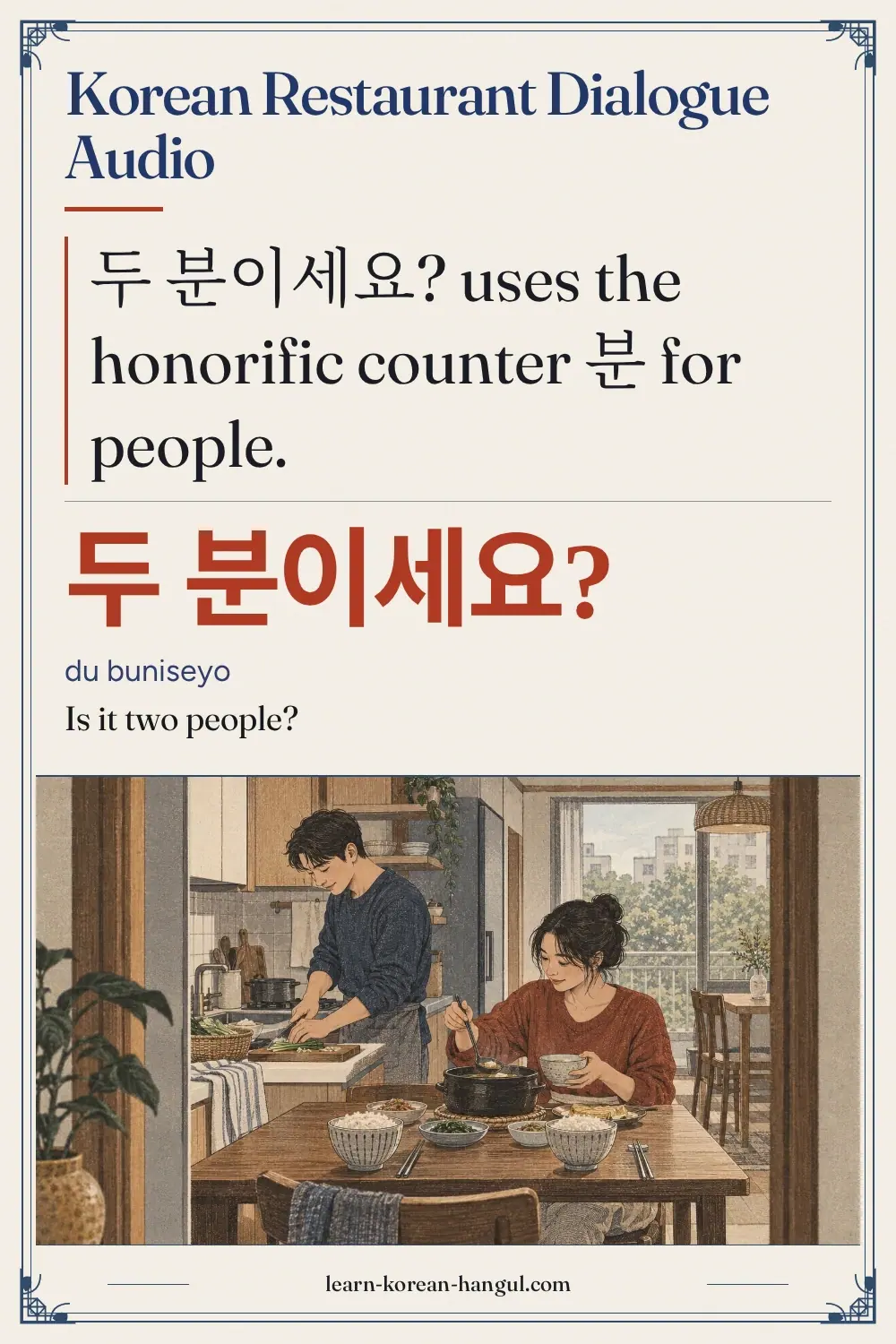
어서 오세요. 두 분이세요? / 네, 두 명이에요. / 이쪽으로 앉으세요. 주문하시겠어요? / 불고기 이 인분 주세요. / 네. 맵게 해 드릴까요? / 아니요, 맵지 않게 해 주세요. / 알겠습니다. 음료는 뭐 드릴까요? / 물 한 병 주세요. / 저기요, 김치 좀 더 주세요. / 네, 바로 가져다 드릴게요. / 잘 먹었습니다. 얼마예요? / 이만 육천 원이에요. 카운터에서 계산해 주세요.
What you'll learn
- State the number of people, the dish, the portions and the spice request after hearing the dialogue.
- Tell the server's counter 분 from the diner's counter 명.
- Hear 이 인분 as "two portions", with a Sino-Korean number.
- Ask for a mild dish with 맵지 않게 and for a refill with 좀 더.
Before you start: you need to read Hangul and know the numbers one to ten in both systems. Time: about 20 minutes. Level: A2. The transcript stays hidden until you have listened once.
What Is Korean Restaurant Dialogue Audio?
Korean restaurant dialogue audio is a clip of a server and customers, with questions that check whether you caught the party size, the order and the payment. This one covers the whole meal, from the door to the counter, so it holds the lines you will hear in most Korean restaurants.
The listening goal is practical. The server speaks in honorific forms, such as 두 분이세요 and 주문하시겠어요, that beginners may not have practised yet. The phrases are collected in Korean restaurant phrases, and the dishes are explained in how to read a Korean menu.
First, see what makes a restaurant hard to follow by ear.
What Makes This Dialogue Hard to Follow by Ear?
Servers speak politely and quickly, and the counters change with the speaker. The server asks about people with 분, the diner answers with 명, and the dish is counted in 인분. The sound changes also hide word boundaries.
| What you see | What you hear | Where learners slip |
|---|---|---|
| 두 분이세요 | [두 부니세요] | The ㄴ of 분 moves to the next block |
| 음료는 | [음뇨는] | ㄹ after ㅁ is said as ㄴ |
| 맵지 않게 | [맵찌 안케] | ㅈ is tense after ㅂ, and ㅎ merges with ㄱ |
| 앉으세요 | [안즈세요] | The ㅈ of ㄵ moves to the next block and the ㄴ stays |
The first and fourth rows are liaison (연음), the second is a consonant assimilation, and the third combines tensification (된소리되기) with aspiration (격음화). In 앉으세요, the ㅈ links to 으 because a vowel follows, while the ㄴ stays behind. All are covered by the standard pronunciation rules (표준 발음법) of the National Institute of Korean Language (국립국어원).
Next is the routine.
How Does the Dialogue Practice Work?
Two listens come before any reading.
- Listen once at normal speed. Do not pause. Write the number of people and the number of portions.
- Listen again slowly. Replay any line you missed up to three times.
- Open the transcript. Compare it with your notes.
- Replay the marked lines. Then play the whole dialogue once more.
You will know it worked when you can say, without the transcript, who ordered what and how it should taste. The usual mistake is to mix up the two counters. If a clip is too fast even when slow, understand spoken Korean shows how to find your bottleneck.
Begin with the gist.
First Listen: the Gist
Play the audio once. Answer in English.
- What do the diners order?
- Do they want the dish spicy?
Gist means the overall outcome. Replay the clip if you are not sure, then move on.
The second listen focuses on the details.
Second Listen: the Details
Play the slow version and answer.
- How many people are in the party?
- How many portions do they order?
- What drink do they order?
- What do they ask for more of?
어서 오세요. 두 분이세요? / 네, 두 명이에요. / 이쪽으로 앉으세요. 주문하시겠어요? / 불고기 이 인분 주세요. / 네. 맵게 해 드릴까요? / 아니요, 맵지 않게 해 주세요. / 알겠습니다. 음료는 뭐 드릴까요? / 물 한 병 주세요. / 저기요, 김치 좀 더 주세요. / 네, 바로 가져다 드릴게요. / 잘 먹었습니다. 얼마예요? / 이만 육천 원이에요. 카운터에서 계산해 주세요.
If question 4 was hard, the number is the short word before 인분. Check the transcript to see.
Transcript, Translation and Key
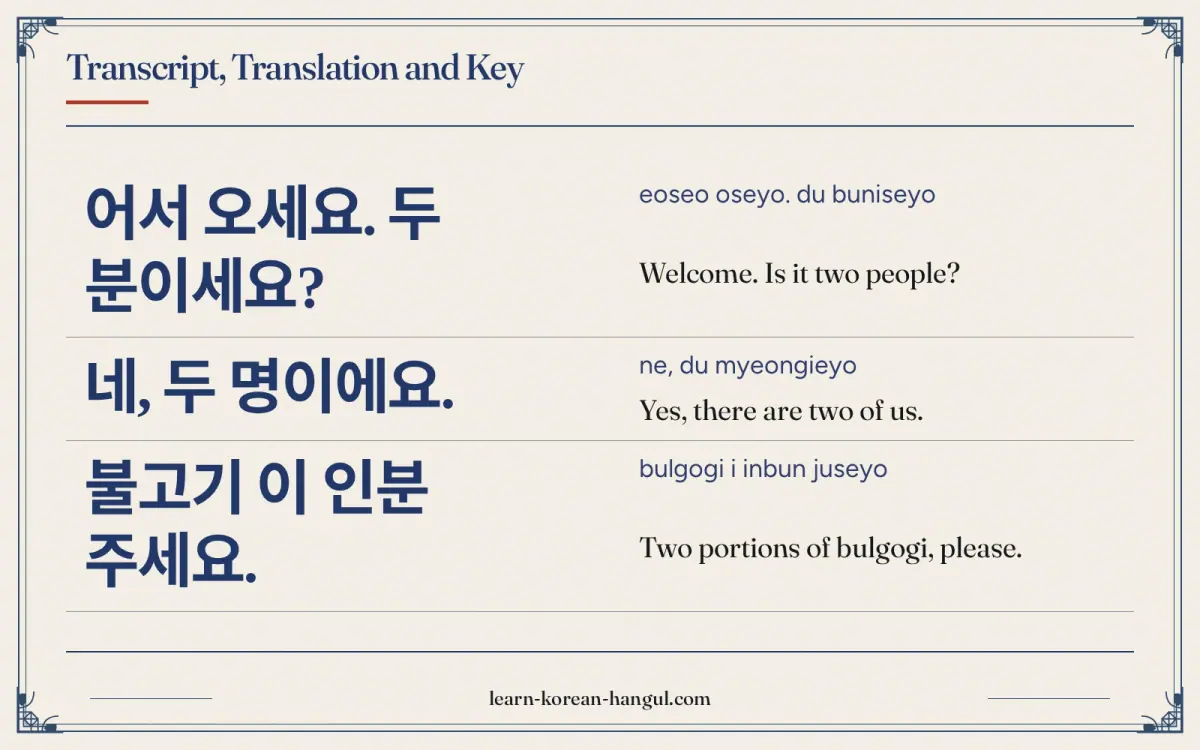
Read the transcript after both listens. Each line has its own clip.
Ordering Bulgogi for Two
Server
어서 오세요. 두 분이세요?
eoseo oseyo. du buniseyo
Welcome. Is it two people?
Diner
네, 두 명이에요.
ne, du myeongieyo
Yes, there are two of us.
Server
이쪽으로 앉으세요. 주문하시겠어요?
ijjogeuro anjeuseyo. jumunhasigesseoyo
Please sit this way. Would you like to order?
Diner
불고기 이 인분 주세요.
bulgogi i inbun juseyo
Two portions of bulgogi, please.
Server
네. 맵게 해 드릴까요?
ne. maepge hae deurilkkayo
Yes. Shall I make it spicy?
Diner
아니요, 맵지 않게 해 주세요.
aniyo, maepji anke hae juseyo
No, please make it not spicy.
Server
알겠습니다. 음료는 뭐 드릴까요?
algetseumnida. eumnyoneun mwo deurilkkayo
Understood. What would you like to drink?
Diner
물 한 병 주세요.
mul han byeong juseyo
A bottle of water, please.
Diner
저기요, 김치 좀 더 주세요.
jeogiyo, gimchi jom deo juseyo
Excuse me, could we have more kimchi?
Server
네, 바로 가져다 드릴게요.
ne, baro gajyeoda deurilgeyo
Yes, I will bring it right away.
Diner
잘 먹었습니다. 얼마예요?
jal meogeotseumnida. eolmayeyo
Thank you for the meal. How much is it?
Server
이만 육천 원이에요. 카운터에서 계산해 주세요.
iman yukcheon wonieyo. kaunteoeseo gyesanhae juseyo
It is 26,000 won. Please pay at the counter.
Answer key
- Bulgogi (불고기).
- No. They ask for it not spicy (맵지 않게).
- Two people (두 명).
- Two portions (이 인분).
- A bottle of water (물 한 병).
- Kimchi (김치).
Line-by-Line Notes
- Line 1, 어서 오세요. The standard welcome from staff. It is not a question.
- Line 3, 주문하시겠어요? "Would you like to order?". The -시- is honorific and -겠- softens the question.
- Line 5, 해 드릴까요? 드리다 is the humble form of 주다. The server uses it for what they do for the customer.
- Line 9, 저기요. The usual way to call staff over. It is used instead of a name.
- Line 11, 잘 먹었습니다. "I ate well" or "Thank you for the meal". It is said at the end of a meal.
The sound changes in these lines are next.
Which Sound Changes Are Hidden in the Dialogue?
Four written forms sound different from their spelling, and 먹었습니다 has one more. Play each one alone.
In 맵지 않게, the ㅈ after ㅂ is tense, and the ㅎ of 않 joins the ㄱ of 게 into one ㅋ sound, giving [맵찌 안케]. In 음료는, the ㄹ after ㅁ is said as ㄴ, so you hear [음뇨는]. In 먹었습니다, the ㅆ closes the syllable as a ㄷ sound, the ㅅ after it is tense, and the ㅂ is said as ㅁ, so you hear [머걷씀니다]. These rules are regular, so they help even with new words.
Next, the first question gets a worked example.
Worked Example: 두 분이세요?
The server's first question shows how Korean counts people with respect.
두 분이세요?
du buniseyo
Is it two people?
- Read the counter. 분 is the honorific counter for people. It means "person (respected)". The server uses it for the customers.
- Read the number. 두 is the native Korean "two" before a counter.
- Read the ending. 이세요 is the honorific form of 이에요, "is".
Now hear how the diner answers for themselves.
두 명이에요.
du myeongieyo
There are two of us.
- Switch the counter. The diner uses 명, the plain counter for people. It is used for oneself.
- Keep the number. Both counters take the same native number 두. The difference is only respect.
The dish is counted in a third way.
불고기 이 인분 주세요.
bulgogi i inbun juseyo
Two portions of bulgogi, please.
- Use a Sino-Korean number. 인분 means "portion" and takes Sino-Korean numbers: 일 인분, 이 인분, 삼 인분. So "two portions" is 이 인분, not 두 인분.
- Add 주세요. 주세요 means "please give". It makes the order polite.
The spice request needs one more pattern.
맵지 않게 해 주세요.
maepji anke hae juseyo
Please make it not spicy.
- Read -지 않게. 맵다 (to be spicy) plus -지 않다 (not) plus -게 gives "so that it is not spicy". 해 주세요 means "please make it".
Finally, a request you can use at any table.
좀 더 means "a little more". 좀 softens the request. Learners often mix the counters, so the next section lists the usual slips.
What Mistakes Do Learners Make Here?
Learners often assume that 분 and 명 are two spellings of one word. Actually, they differ in respect, because 분 raises the person counted. Four slips are common.
- Answering 두 분이에요 about yourself. Use 두 명이에요, because you do not raise yourself.
- Saying 두 인분. 인분 takes Sino-Korean numbers, so say 이 인분.
- Saying 맵지 with a plain ㅈ. The ㅈ is tense after ㅂ: [맵찌]. The next word 않게 then sounds like [안케], so listen for the ㅋ.
- Staying silent when you need service. Call staff with 저기요, as in line 9, instead of waiting to be noticed.
Test these in the practice set below.
Practice and Answer Key
- How does a server ask "Is it three people?" politely?
- How do you answer for yourself if there are three of you?
- Write the order "Three portions of bulgogi, please".
- How do you ask for a mild dish?
Answers
- 세 분이세요?
- 세 명이에요.
- 불고기 삼 인분 주세요.
- 맵지 않게 해 주세요.
Where to Go Next
Play the dialogue again tomorrow, hide the transcript and write the order. When it feels easy, continue with Korean dictation, which asks you to type what you hear. Counting people is explained in the Korean counter for people. All dialogues are listed in Korean audio dialogues.
What this page does not cover. It does not cover table-top grilling, ordering by tablet or allergy requests.
Return to this Korean restaurant dialogue audio when you want to check that you still hear 분 and 명 apart.
Frequently Asked Questions
What is the difference between 분 and 명?
Both count people. 분 is the honorific counter, used for the person you are speaking to or for someone you respect, such as a customer. 명 is the plain counter, used for yourself or for people in general. A server asks 두 분이세요?, and the diner answers 두 명이에요. Both use the native number 두.
What is 인분 counting in 이 인분?
인분 counts portions of food, not people. One 인분 is the amount for one person, so 불고기 이 인분 is two servings of bulgogi. Menus often list the price per 인분, and some dishes are sold from two portions up.
How do I ask for less spicy food?
Say 맵지 않게 해 주세요 (maepji anke hae juseyo), "Please make it not spicy." You can also say 안 맵게 해 주세요 with the same meaning. If you want it a little spicy, say 조금 맵게 해 주세요. The word 맵다 (to be spicy) becomes 매워요 in a statement.
Why is 이 used in 이 인분?
인분 is counted with Sino-Korean numbers, the system that comes from Chinese: 일, 이, 삼, 사. So "two portions" is 이 인분, with 이 meaning two. This is different from 명 and 분, which take native numbers such as 한, 두, 세. A native number such as 두 would be wrong before 인분.