
Korean Counter for People: the Essentials
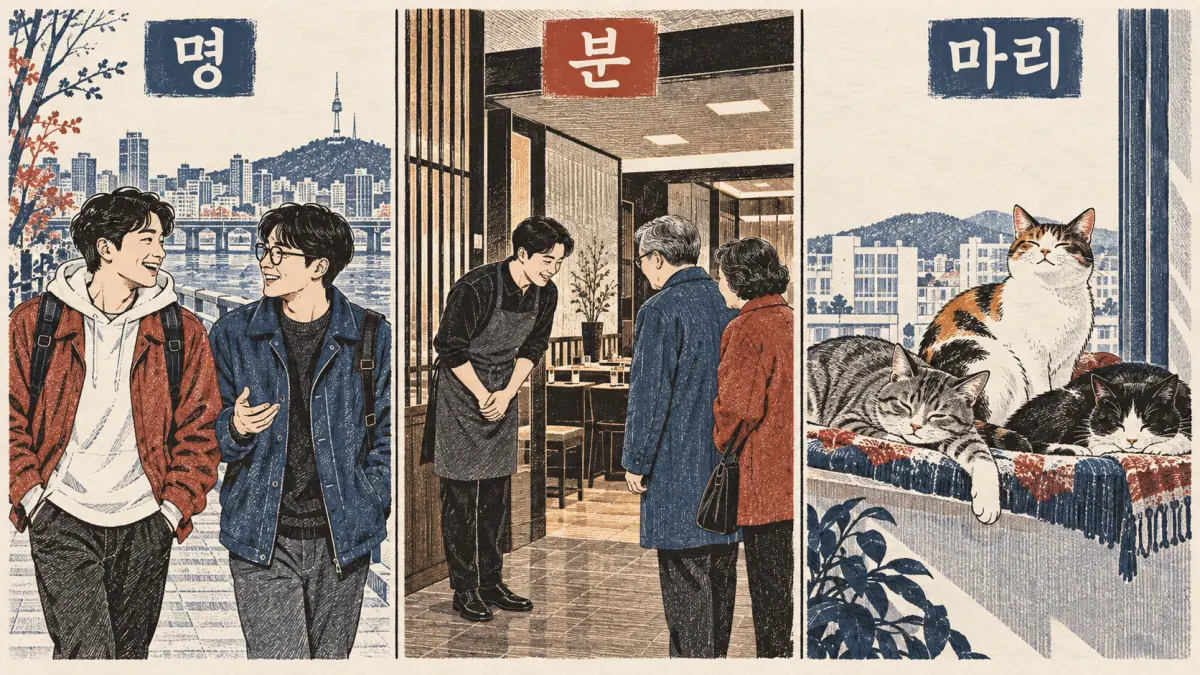
A Korean counter is a small word that follows a number and shows what kind of thing is being counted. The Korean counter for people depends on how much respect you want to show, and animals have a counter of their own. The pattern is always the same: noun, native number, counter, as in 학생 세 명 (three students).
| What you count | Counter | Example | Meaning |
|---|---|---|---|
| People, neutral | 명 | 친구 두 명 | two friends |
| People, respectful | 분 | 손님 두 분 | two guests |
| People, as a noun | 사람 | 두 사람 | two people |
| Animals, fish, insects | 마리 | 고양이 세 마리 | three cats |
The numbers also follow one rule. Use native Korean numbers (하나, 둘, 셋) up to 99, and use Sino-Korean numbers (일, 이, 삼) from 100 on: 백 명 is 100 people. Five native numbers shorten before a counter: 한, 두, 세, 네 and 스무. So 20 people is 스무 명, not 스물 명.
The next section lists each lesson in this group with a short description of what it teaches.
What Pages Are in This Group?
Four pages cover this group: one for each counter, plus a comparison page that helps you choose between the people counters. Read them in the order below.
People
The 명 counter lesson teaches the default way to count people. It lists the number forms from one to ten with audio, explains the shortened forms such as 스무 명, and teaches the question 몇 명이에요? with a restaurant dialogue. Start here if you are new to counters.
The 분 counter lesson teaches the respectful form. It shows when staff, announcers and teachers use 분, why a speaker never uses it for a group that includes themselves, and how 몇 분이세요? differs from 몇 명이에요?. Read it after 명.
The page on how to count people in Korean compares 명, 분 and 사람 in one place. It gives a decision table by situation, covers groups of 100 or more, and helps you choose when you are not sure which counter fits.
Animals
The 마리 counter lesson teaches the animal counter. It covers pets, birds, fish and insects, explains the sound-alike trap between 개 (dog) and 개 (counter), and shows why a whole fried chicken is 치킨 한 마리. Learn it after 명 so that you keep the two counters apart.
With the pages in view, the next question is how to decide in the moment.
When Do You Choose 명, 분 or 사람?

Choose 명 by default, 분 when you want to show respect to the people you count, and 사람 when you need the plain noun for a person. The table gives a verdict for each situation.
| Situation | Best choice | Example |
|---|---|---|
| Counting your friends or family | 명 | 가족 네 명 |
| A host asking a guest | 분 | 몇 분이세요? |
| A guest answering the host | 명 | 두 명이에요. |
| A teacher or elder you respect | 분 | 선생님 두 분 |
| A neutral count, like a news report | 명 | 학생 스무 명 |
| A noun phrase with a number | 사람 | 두 사람이 왔어요. |
An important rule explains the second and third rows. The speaker never uses 분 for themselves or for a group that includes themselves, because honorifics raise other people, not the speaker. Respected people outside that group, such as your own parents, can still take 분: 부모님 두 분. So the host asks 몇 분이세요?, and the guest replies 두 명이에요.
Expert tip: 명 is never wrong, but it can sound slightly flat when you address a customer. If you work in a shop or restaurant, learn 분 early.
How Do You Ask How Many People?

To ask how many people, use 몇 명이에요? with friends and peers, and 몇 분이세요? with guests and elders. The word 몇 means "how many". Both questions get the same kind of answer: a native number plus 명.
| Speaker | Question | Typical answer |
|---|---|---|
| Friend to friend | 몇 명이에요? | 세 명이에요. |
| Host to guest | 몇 분이세요? | 두 명이에요. |
| Teacher to class | 학생이 몇 명 있어요? | 스무 명 있어요. |
| Shop assistant to customer | 몇 분이세요? | 네 명이에요. |
Animals use the same question with a different counter: 고양이가 몇 마리 있어요? (How many cats are there?).
Animals: Fish, Insects, Birds and Livestock
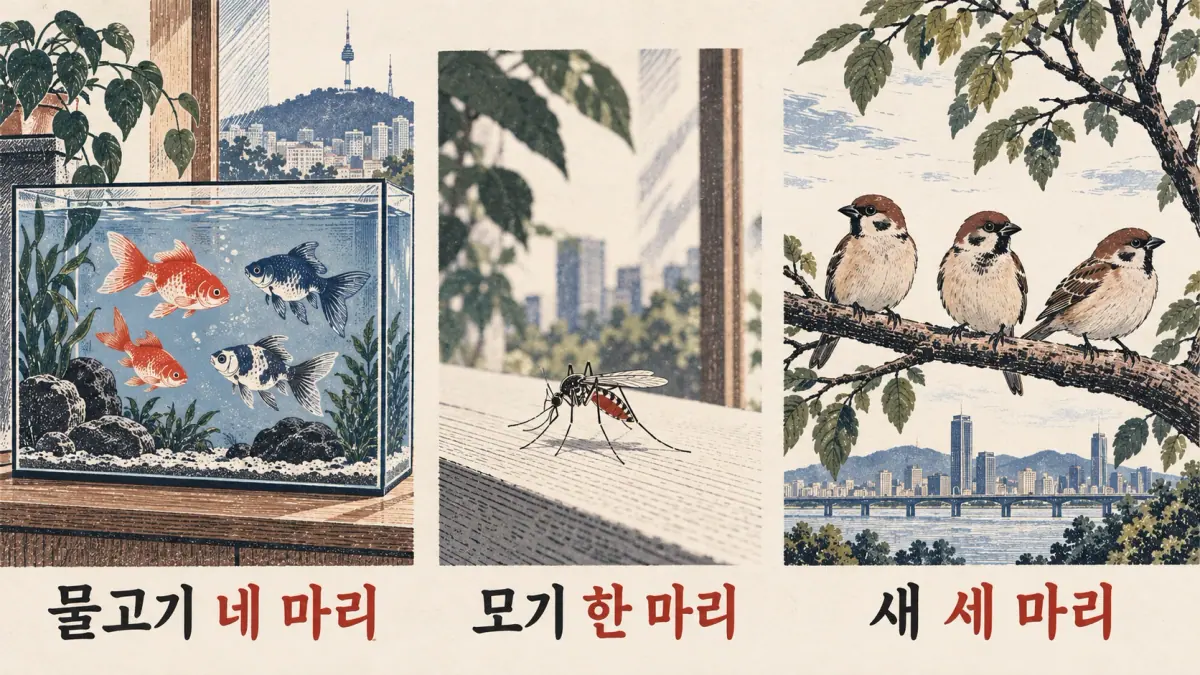
Every living animal takes 마리, whatever its size. Fish, insects, birds, pets and farm animals are all counted the same way: 물고기 네 마리, 모기 한 마리, 새 세 마리. In formal farm statistics, the Sino-Korean counter 두 (頭) may appear for cattle, but conversation uses 마리.
Two cautions apply. People never take 마리, and cooked cuts of meat do not either. A whole cooked animal is the exception: 치킨 한 마리 means one whole chicken.
Which Mistakes Should You Avoid with These Counters?
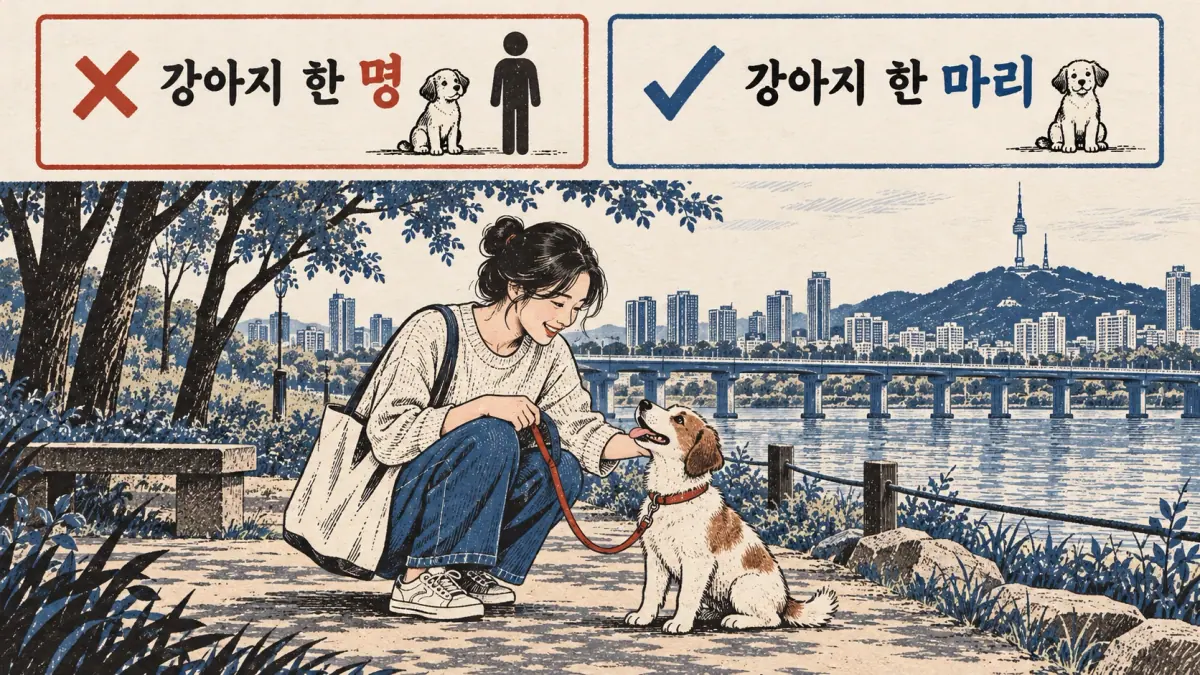
Four mistakes cover most errors with people and animal counters, and each one has a quick fix.
- Using Sino-Korean numbers. Wrong: 이 명. Right: 두 명.
- Using a full number form. Wrong: 하나 명, 스물 명. Right: 한 명, 스무 명.
- Using 명 for animals. Wrong: 강아지 한 명. Right: 강아지 한 마리.
- Using 분 about yourself. Wrong: 저희는 두 분이에요. Right: 저희는 두 명이에요.
Each fix comes from the same habit: pick the counter by category first, then the number form.
What This Group Does Not Cover
This group covers people and animals only. Objects, food, drinks and time have their own groups, and the guides below pick up where this one stops:
- Objects such as books and cars are in Counting Things, starting with the default counter 개.
- Cups, bottles and servings are in Counting Food and Drinks.
- Years of age use the 살 counter and are covered in Age in Korean.
For the whole counter system, return to Korean Counters, or read how counters sit in a sentence in how Korean counters work.
Where to Start
If you are new to counting, learn 명 first, 마리 second and 분 third. In that order, you cover most situations you will meet. If you already know 명, go straight to the how to count people page to practise the choices, because the Korean counter for people depends on the setting more than on the number.
Frequently Asked Questions
How do I count a family in Korean?
Say the family noun and a native number with 명: 가족 네 명 means a family of four, and 우리 가족은 다섯 명이에요 means our family is five people. You can also ask 식구가 몇 명이에요? Use 분 when you ask about someone else's family with respect, as in 가족이 몇 분이세요?
Which counter is used for a baby?
Use 명 for a baby, exactly as for any other person: 아기 한 명 means one baby. Nothing about age changes the counter, and 분 would sound odd for an infant. Parents describe a baby's age in months with 개월, but the number of babies is still counted in 명.
Can I use 명 for animals?
No. 명 is only for people, so 고양이 두 명 is a mistake. Count animals with 마리: 고양이 두 마리. Owners may feel their pet is family, but the counter does not change with feeling. The only common overlap is a joke or a cartoon in which an animal acts like a person.
What is the polite way to ask how many people?
Ask 몇 분이세요? when you speak to a customer, guest or elder, for example at a restaurant door. Among friends, ask 몇 명이에요? The answer always uses 명, such as 두 명이에요, because a speaker does not use the honorific counter for a group that includes themselves.