Before you start
- Time: about 30 minutes a day for four weeks, with one rest day a week.
- Difficulty: beginner, A1 and up.
- Cost: free, using the audio sets on this site.
- You need: a device with audio, a transcript for each clip and a notebook or notes app for the log.
- Prerequisite: you can read Hangul. Test your level first with Korean Listening Levels.
- Outcome: follow a four-week plan of about 30 minutes a day and log minutes, material and comprehension.
Key Facts
- The plan is 30 minutes a day: 10 minutes of intensive listening and 20 minutes of relaxed listening.
- Week 1 uses slow audio with a transcript, and week 4 uses natural-speed audio without one.
- A log records minutes, material and a 1 to 5 comprehension score.
- Rest one day a week, and drop one level if your score stays below 3 for a full week.
- The plan is a method suggestion, not a research-tested programme.
Last updated: 2026-10-09. The Korean text, romanization and audio scripts on this page are generated drafts that still await review by a Korean specialist.
What Is a Korean Listening Routine?
A Korean listening routine is a repeating schedule that sets the amount, type and difficulty of your daily listening. It answers three questions in advance: how long, with what material and how to check progress. Without a routine, most learners listen when they feel motivated, choose material that is too hard and stop after a week.
The routine on this page has four weeks and one daily pattern. It uses the audio sets on this site for weeks 1 and 2, so you need no outside material at the start. The pattern rests on two kinds of listening, which the next section defines.
Why a Mixed Routine?
A mixed routine combines intensive and relaxed listening because each trains a different skill. Intensive listening is replaying a short clip many times with a transcript until you catch every word. Relaxed listening is playing easier audio at normal speed without stopping, to follow the meaning and absorb rhythm.
Intensive work fixes details: sounds, endings and contractions. Relaxed work builds stamina and a feel for the flow. Doing only the first is slow and tiring, and doing only the second leaves the details unfixed. The split here is 10 minutes intensive and 20 minutes relaxed, a ratio that is a practical suggestion rather than a research result. Each day follows the same four steps.
How Is Each Daily Session Built?
Each daily session has four steps and takes about 30 minutes. The steps are the same in every week, and only the material changes.
Step 1: Pick Today's Material
Choose one short clip for intensive listening and one longer source for relaxed listening. Use the week table below to decide.
Success checkpoint: you know your two items before you press play, and the choice took under a minute.
Common mistake: browsing for something perfect. Decide in advance and write the plan for the week on one page.
Step 2: Intensive Listening (10 minutes)
Work on one clip of 20 to 40 seconds in three loops.
- Blind: listen twice without the transcript and write what you catch.
- With the transcript: listen again while reading, and mark the words you missed.
- Replay: listen to the missed parts again, then once more without the text.
Success checkpoint: you can follow the clip without the transcript by the end of the loop.
Common mistake: reading the transcript first. That turns listening into reading, and you lose the test of what your ear can do.
Step 3: Relaxed Listening (20 minutes)
Play easier audio without stopping or replaying. Aim to follow the topic, not every word. In the early weeks, keep a transcript open in case you lose the thread.
Success checkpoint: after the session you can say in one sentence what the audio was about.
Common mistake: choosing audio that is too hard to follow, which makes this block passive. If you cannot give the topic, drop a level.
Step 4: Log It (under 1 minute)
Write the date, the minutes, the material and a comprehension score from 1 to 5. The log is explained below, after the plan.
Success checkpoint: one row is filled every day you study.
Common mistake: skipping the log because you feel tired. One row takes less than a minute, and it is the only record of progress. The week-by-week plan comes next.
Four-Week Plan at a Glance
The plan moves from slow, supported audio to natural-speed audio without help. Each week has a goal, and the daily time stays at 30 minutes.
| Week | Intensive (10 min) | Relaxed (20 min) | Transcript | Goal |
|---|---|---|---|---|
| 1 | Beginner sound drills and A1 dictation | Slow audio of short dialogues | Visible throughout | Hear every word at slow speed |
| 2 | Level 3 sentences, blind first | Natural-speed dialogues | After the first listen | Follow natural speed with help |
| 3 | Contraction and sound-change clips | Dialogues and a podcast | After the first listen | Cope with reduced speech |
| 4 | Natural-speed clips, blind | Natural-speed audio | None | Follow without support |
Take one rest day each week. On that day, do nothing, or listen to music in Korean for pleasure. The next sections give the details of each phase.
Week 1: Slow Audio with a Transcript
Week 1 uses slow audio with a transcript so that you hear the sound of every word. For intensive listening, use the drills in Korean listening for beginners and the Korean Sentence Dictation for Beginners set. For relaxed listening, replay the simplest dialogue in Korean audio dialogues with the transcript open.
Goal for the week: you can say the topic of three different slow clips without the transcript.
What to expect: you will understand words but lose the sentence, which is normal. Your score is likely to be 2 or 3. The log tells you when it rises, and the next phase makes the speed natural.
Weeks 2 and 3: Add Natural Speed
In weeks 2 and 3, move to natural-speed dialogues, and open the transcript only after the first listen. Natural speed is faster and contains contractions and sound changes. Learn the common ones in Spoken Korean Contractions, because they are the most frequent cause of confusion at this stage.
- Week 2: use the Korean audio dialogues at natural speed, one dialogue a day, and replay the hardest lines in your intensive block.
- Week 3: add one podcast episode or short audio from the Korean podcasts list for relaxed listening, choosing material you can follow about 70 to 90 percent of.
Goal for the weeks: your score is 3 or higher on most days. Next, remove the support.
Week 4: Natural Speed without a Transcript
Week 4 removes the transcript. Do the intensive loop blind, and check the text only at the end of the session. For relaxed listening, use the same sources as week 3. Add one drama scene on two days, using the method in Korean Drama Listening Practice.
Goal for the week: you follow a natural-speed clip and give its topic with no help.
At the end of week 4, retest three clips with the one-minute test from the levels lesson and compare with week 1. Now that the plan is clear, the log needs a closer look.
How Do I Keep a Listening Log?
Keep the log as one table row per session, with five columns. The log shows progress when you cannot feel it.
| Date | Minutes | Material | Level | Score (1 to 5) |
|---|---|---|---|---|
| 3 Oct | 30 | Dialogue 2, podcast clip | 3 | 3 |
The score scale is simple:
- 1: you caught almost nothing.
- 2: you caught single words.
- 3: you followed the topic with gaps.
- 4: you followed most of it.
- 5: you followed everything.
Add up minutes and average the scores each week. The skip rule protects you from frustration: if your score stays below 3 for a full week, drop one level and repeat the week. If it is 5 for the whole week, move up one level. This scale is a self-rating, not a test. The next section shows how to read the rows.
Reading Your Log: Four Patterns
After two weeks the log shows one of four patterns, and each has a clear action. The scores below are examples, not data from learners.
| Pattern (weekly averages) | What it means | Action |
|---|---|---|
| 2, then 3, then 3, then 4 | Steady gain | Keep the plan and retest in week 4 |
| 2, 2, 2 | Material is too hard | Apply the skip rule and drop one level |
| 5, 5, 5 | Material is too easy | Move up one level |
| Swings between 1 and 5 by material | Uneven vocabulary or speakers | Sort rows by material and fix the weak topic |
The fourth pattern is common when a learner mixes a familiar topic, such as food, with an unfamiliar one, such as work. A low score on one topic often means missing vocabulary and not weak hearing, so add a short word list before the next session. Keep the log honest: score what you understood, not what you hoped. A worked day makes the pattern concrete.
Sample Day: Week 1, Day 1
Here is one session so that the steps are concrete.
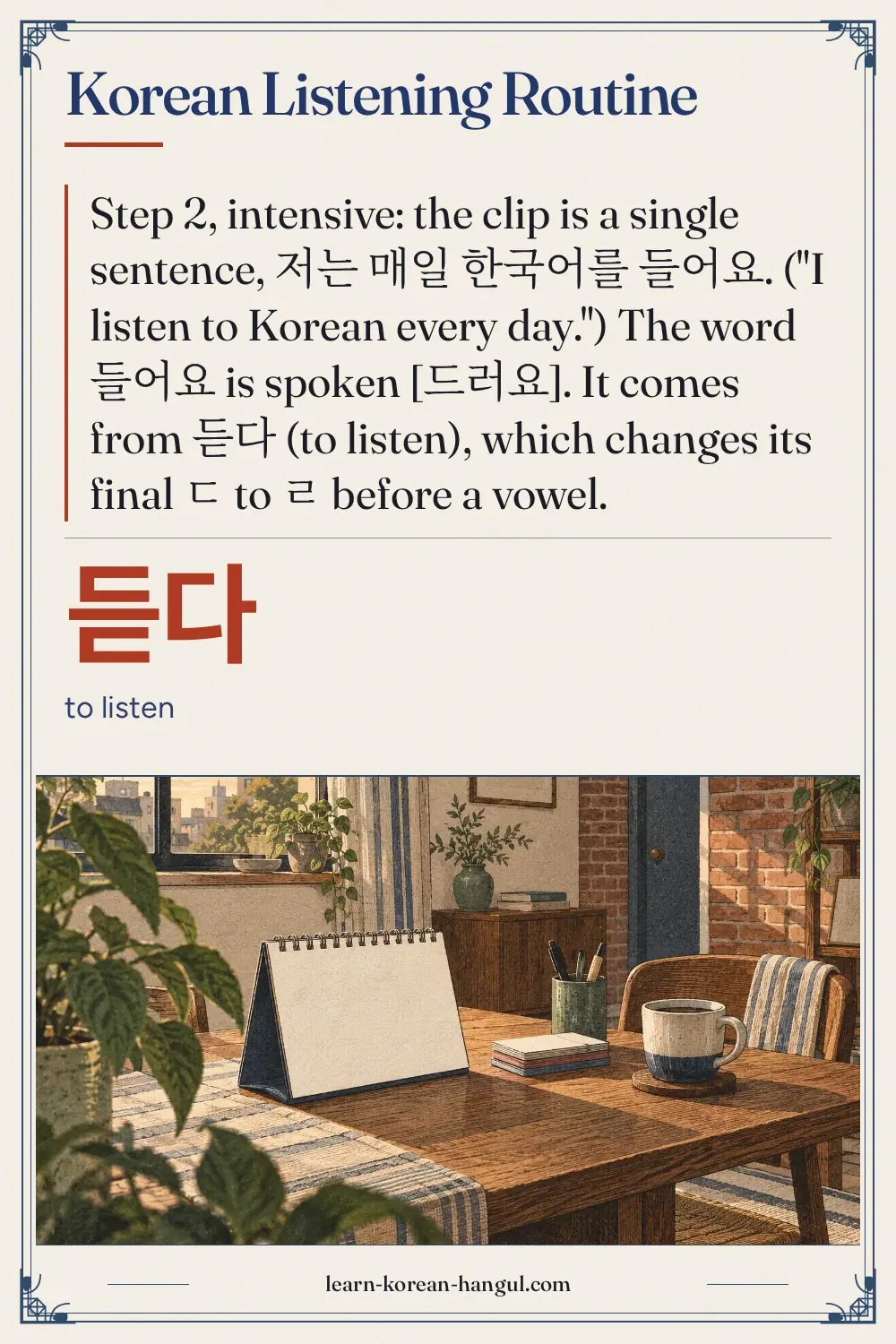
Step 2, intensive: the clip is a single sentence, 저는 매일 한국어를 들어요. ("I listen to Korean every day.") The word 들어요 is spoken [드러요]. It comes from 듣다 (to listen), which changes its final ㄷ to ㄹ before a vowel.
Loop 1: listen twice and write what you catch, for example 매일 and 한국어. Loop 2: read the transcript and notice 들어요. Loop 3: replay the whole sentence once more without the text. Revised Romanization (RR) is a learning aid only: jeoneun maeil hangugeoreul deureoyo.
Step 3, relaxed: play the simplest dialogue for 20 minutes, or loop it, and say the topic afterwards.
Step 4, log: write 30 minutes, level 3, score 3. After week 1 you might be able to understand a sentence such as the one below.
It means "Today I understood more than yesterday." Its verb is 알아듣다 (to understand by ear), and it follows the same ㄷ-to-ㄹ change as 듣다. A routine succeeds on small gains like that one, so the common failures are worth knowing.
What Are the Most Common Mistakes and How Do You Fix Them?
Most routines fail for a handful of reasons.
- Starting too hard. Fix: test a clip first and pick the 70 to 90 percent zone.
- Changing the plan every day. Fix: write the week on one page and do not edit it.
- Reading the transcript first. Fix: always do a blind listen first.
- Listening for hours on weekends. Fix: keep 30 minutes a day and rest one day.
- No log. Fix: one row, under a minute, every session.
- Ignoring the skip rule. Fix: if your score is below 3 for a week, drop a level.
How Do I Adapt the Routine?
Three adaptations cover most situations.
- Short on time: use 15 minutes, with 5 intensive and 10 relaxed. Stretch the plan to eight weeks.
- Commuting: do relaxed listening on the move and intensive listening at a desk.
- More advanced: start in week 2 and add a drama scene twice a week.
Whatever you choose, keep the log, the blind listen first and the rest day.
Honest Ranges for Progress
Progress varies, and no schedule guarantees a result. A reasonable aim after four weeks of regular sessions is that slow audio feels easier and your average score rises by about one point. That is a modest target, not a promise. If your score has not changed, check the material level before you extend the time. A small gain after four weeks is a good reason to continue, and it leads to the next lesson.
Where to Go Next
After the Korean listening routine, test your clips and choose the next material with Korean Listening Levels. Add sentence writing with Korean dictation practice, and return to the Listening Strategies section for the other lessons.
This guide covers a four-week plan for beginners. It does not cover TOPIK listening preparation, speaking practice or pronunciation drills. The plan is a method suggestion and not a research-tested programme.
Frequently Asked Questions
How long should I listen to Korean each day? About 30 minutes is a sound target for the plan on this page: 10 minutes of close listening and 20 minutes of easier audio. If time is short, 15 focused minutes still help. Regular short sessions are easier to keep than occasional long ones, and a daily log shows whether the time is working.
Is background listening useful? It helps with familiarity but teaches little on its own. Background audio exposes you to rhythm and common words, yet you cannot learn what you do not attend to. Use it as a supplement after your 30 minutes, and treat relaxed listening, where you pay attention to the story or topic, as the main practice.
Should I use subtitles? Use a transcript or subtitles in the early weeks, then remove them. Week 1 pairs slow audio with a transcript, weeks 2 and 3 use the transcript only after a first blind listen, and week 4 drops it. English subtitles are best kept for story-based material, and Korean text works best for study.
What if I miss a day? Skip the missed session and carry on with the next day, because the plan has one built-in rest day and does not need makeup time. Do not double up. If you miss three or more days in a row, repeat the previous week before moving on, so that your comprehension score does not drop.