What you will learn
- Recognise 15 spoken contractions by ear and give the full form of each.
- Predict a new contraction from the pattern.
- Choose between full and short forms by register.
- Write the full form of ten contracted sentences from audio.
Before you start: know the topic and object particles from Korean topic and subject particles. Time: about 30 minutes with audio.
Key Facts
- Contractions merge a noun with a particle: 이것은 becomes 이건.
- Pronouns often contract: 나는 becomes 난, 저는 becomes 전 and 너는 becomes 넌.
- Question words contract: 무엇을 becomes 뭘 and 무엇이 becomes 뭐가.
- Contractions are normal in speech and chat, and less common in formal writing.
- The 15 pairs in this lesson include 이건, 이게, 난, 전, 넌, 뭘 and 어디서.
Last updated: 2026-10-09. The Korean text, romanization and audio scripts on this page are generated drafts that still await review by a Korean specialist.
What Are Spoken Korean Contractions?
Spoken Korean contractions are short forms (준말, junmal) in which two or more syllables are merged into fewer. The most frequent kind joins a noun or pronoun with the particle that follows it. The full form 이것은 ("as for this") has three syllables, and the contracted form 이건 has two.
Contractions are not slang. The Standard Korean Language Dictionary (표준국어대사전) of the National Institute of Korean Language (국립국어원) lists many of them as shortened forms of the longer word. What they carry is a register, a level of formality: they suit speech, chat and informal writing. The table lists the 15 pairs of this lesson, grouped in four patterns.
| Pattern | Full form | Short form | RR (short) | Meaning |
|---|---|---|---|---|
| A. 것 + particle | 이것은 | 이건 | igeon | this (topic) |
| A | 이것이 | 이게 | ige | this (subject) |
| A | 이것을 | 이걸 | igeol | this (object) |
| A | 그것은 | 그건 | geugeon | that (topic) |
| A | 그것이 | 그게 | geuge | that (subject) |
| B. Pronoun + particle | 나는 | 난 | nan | I (topic) |
| B | 저는 | 전 | jeon | I, polite (topic) |
| B | 너는 | 넌 | neon | you (topic) |
| B | 저를 | 절 | jeol | me, polite (object) |
| C. Question word | 무엇을 | 뭘 | mwol | what (object) |
| C | 무엇이 | 뭐가 | mwoga | what (subject) |
| C | 어디에서 | 어디서 | eodiseo | where, at/from |
| D. Other | 그러면 | 그럼 | geureom | then, if so |
| D | 아니야 | 아냐 | anya | no, it isn't |
| D | 나를 | 날 | nal | me (object) |
Fifteen pairs look like a lot, but Pattern A and B follow one rule, shown next. First, here is why the forms trip up learners.
Why Contractions Confuse Learners
Learners study the full forms, so the short ones sound like new words. A textbook teaches 저는 학생이에요, and the learner hears 전 학생이에요 and does not connect them. The particle that marked the topic has disappeared into the pronoun.
The second problem is that contractions are everywhere in everyday speech, in dramas, chat and conversation, but rare in graded audio, which keeps the full forms. The result is a gap between classroom Korean and real Korean. Hearing both forms side by side closes it, which is the plan of the next section.
Which Noun and Particle Contractions Are Common?
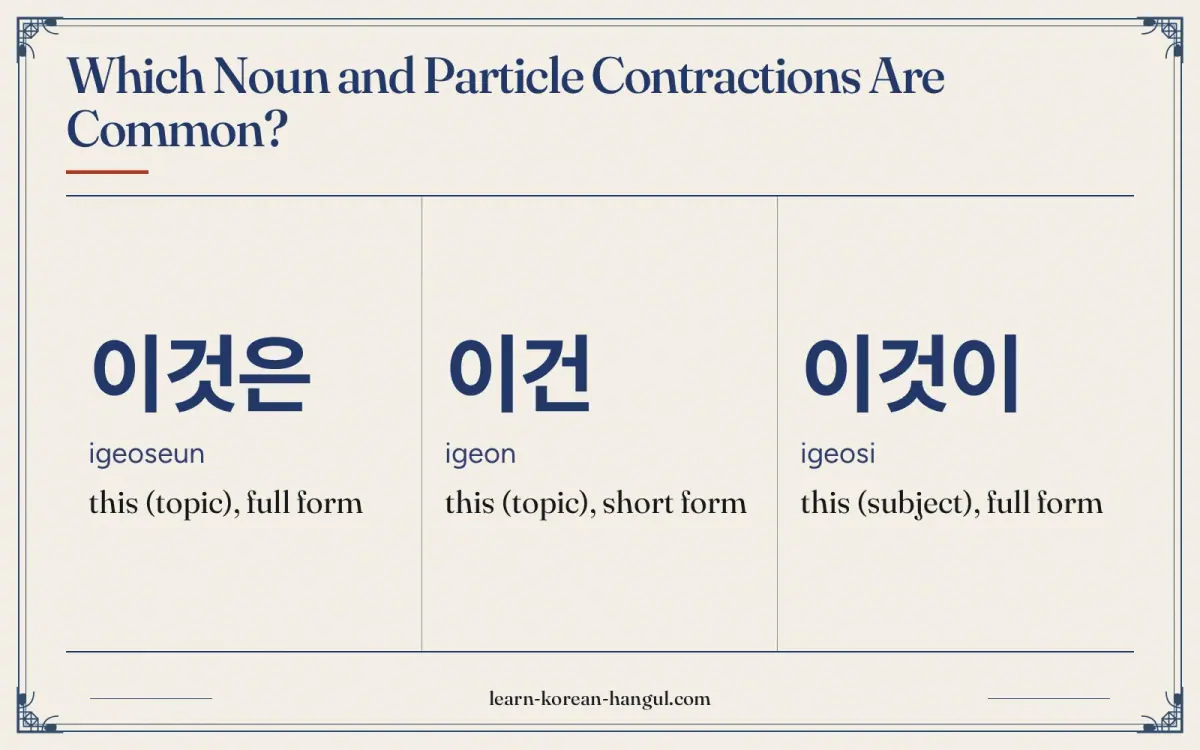
The most common contractions are those of 것 (thing) with a particle: 이것은 to 이건, 이것이 to 이게, 이것을 to 이걸 and the same for 그것. In speech 것 is often said as 거, and the particle then merges with it: 이거 + 는 gives 이건. Listen to five pairs, full form first and short form second.
The Short Form Drops One Syllable and the ㄴ Moves to the End of 거
| Korean | Romanization | Meaning | Sound |
|---|---|---|---|
| 이것은 | igeoseun | this (topic), full form | |
| 이건 | igeon | this (topic), short form |
이게 Is a Fixed Short Form of 이것이
| Korean | Romanization | Meaning | Sound |
|---|---|---|---|
| 이것이 | igeosi | this (subject), full form | |
| 이게 | ige | this (subject), short form |
The ㄴ of 는 Moves under the Vowel of 나
| Korean | Romanization | Meaning | Sound |
|---|---|---|---|
| 나는 | naneun | I (topic), full form | |
| 난 | nan | I (topic), short form |
무엇을 Shrinks to 뭘
| Korean | Romanization | Meaning | Sound |
|---|---|---|---|
| 무엇을 | mueoseul | what (object), full form | |
| 뭘 | mwol | what (object), short form |
에서 Shrinks to 서
| Korean | Romanization | Meaning | Sound |
|---|---|---|---|
| 어디에서 | eodieseo | where (at), full form | |
| 어디서 | eodiseo | where (at), short form |
Notice that 이게 and 그게 are fixed short forms. They are not made by moving a final consonant. Learn them as words. Pattern B and C work differently, as explained next.
How Do Pronoun and Question-Word Contractions Work?
Pronoun contractions follow one mechanical rule: when a word ends in a vowel and the particle starts with ㄴ or ㄹ plus ㅡ, the ㅡ drops and the consonant moves to the bottom of the previous block. The rule gives 나 + 는 = 난, 저 + 는 = 전, 너 + 는 = 넌, 나 + 를 = 날 and 저 + 를 = 절.
| Word + particle | Drop the ㅡ | Result |
|---|---|---|
| 나 + 는 | 나 + ㄴ | 난 |
| 저 + 는 | 저 + ㄴ | 전 |
| 너 + 는 | 너 + ㄴ | 넌 |
| 나 + 를 | 나 + ㄹ | 날 |
| 저 + 를 | 저 + ㄹ | 절 |
Question words follow their own path. The word 무엇 (what) has the short form 뭐, and 무엇을 becomes 뭘. In 무엇이 → 뭐가, the word is shortened to 뭐, and the subject particle takes the form 가 because 뭐 ends in a vowel. Likewise 어디에서 shrinks the particle to 어디서. Because the rule is mechanical, you can predict new forms.
How Do I Predict a New Contraction?
You can predict a contraction by applying the vowel-plus-ㄴ/ㄹ rule to any word that ends in a vowel. Take the word, add 는 or 를, drop the ㅡ and move the consonant down. The method is shown below, and each result is a real spoken form.
| Full form | Short form | Meaning |
|---|---|---|
| 우리는 | 우린 | we (topic) |
| 우리를 | 우릴 | us (object) |
| 거기는 | 거긴 | there (topic) |
| 이거는 | 이건 | this (topic) |
| 저거는 | 저건 | that over there (topic) |
The rule has limits. If the word ends in a consonant, the particle is 은 or 을 and there is no merger, so 책은 stays 책은. The rule also does not make a form standard. Test unfamiliar short forms by listening for them in real speech before you use them. The next question is when to use them.
Which Contractions Are Standard and Which Are Speech-Only?
The short forms in this lesson are standard Korean: the Standard Korean Language Dictionary lists them, or their base word, as shortened forms (뭐가 is the short form 뭐 plus the particle 가). They differ in register. Use the table as a guide, and confirm with a style guide if you write for publication.
| Register | Examples | Where you see them |
|---|---|---|
| Natural in speech and chat | 이건, 이게, 이걸, 난, 넌, 뭘, 뭐가, 어디서 | Conversation, messages, dramas |
| Common in informal writing | 이건, 이게, 전, 그럼 | Blogs, personal notes, dialogue in fiction |
| Prefer full forms | 이것은, 저는, 무엇을 | Reports, essays, official letters, news |
| Very casual only | 아냐, 날 | Close friends, same-age speakers |
Politeness matters as much as length. 전 (from 저는) is polite enough for strangers, while 난 and 넌 belong to casual speech between friends. The next section covers the cases in which to avoid them.
When Should You Avoid Contractions?
Avoid contractions in formal writing, in careful speech to elders and in the first lines of a formal email. Use the full form when you want to be clear and a short form when you want to sound natural. A good rule is to match the people around you: if they say 이건, you can too.
Also avoid contractions when the sound could be confused. In a noisy room, 절 (from 저를) and 전 (from 저는) differ only in the final consonant. If the listener may mishear, say the full form. The worked example shows the main mechanism once more.
Verb Contractions You Already Write
Verb endings contract too, and these mergers belong to ordinary spelling, not only to speech. When a vowel-final verb stem meets -아 or -어, the vowels can merge: 보아요 becomes 봐요, 되어요 becomes 돼요 and 마시어요 becomes 마셔요. With 가다 the merger is obligatory, so the stem 가 plus -아요 is always 가요. The Hangul Orthography (한글 맞춤법), Articles 34 to 36, says to write a merged form as it is spoken.
| Full form | Merged form | Meaning |
|---|---|---|
| 가아요 (not used) | 가요 | (I) go |
| 보아요 | 봐요 | (I) see |
| 되어요 | 돼요 | (it) becomes |
| 마시어요 | 마셔요 | (I) drink |
| 하여요 | 해요 | (I) do |
This is a different family from the pronoun pairs above. Full verb forms such as 보아요 and 되어요 are also standard, but they sound bookish, so everyday writing uses 봐요 and 돼요. A frequent spelling error is 되요 for 돼요: the ending -어 is still there, merged into ㅙ. Keep the two families apart in your mind: pronoun and particle pairs are speech and chat forms, and verb vowel mergers are ordinary spelling. The worked example returns to the main pattern.
Worked Example: 이것은 → 이건
The full form 이것은 means "as for this". It becomes 이건 in speech. Follow the steps.
- Split the full form: 이것 + 은. The noun is 이것, and 은 is the topic particle.
- Say 것 as 거: speech shortens 이것 to 이거, so the word is 이거 + 는.
- Merge: drop the ㅡ of 는 and move the ㄴ under the 거: 거 + ㄴ = 건.
- Write the result: 이건.
- Check: the three syllables 이-것-은 are now two, 이-건.
You will know it worked when you hear [이건] with a clear ㄴ at the end and no extra vowel. Revised Romanization (RR) helps with reading only: igeon mwoyeyo? Learners make some predictable errors, so the next section lists them.
Common Learner Mistakes
Learners often treat contractions as sloppy speech. The common mistakes follow.
- Mistake 1: hearing a new word. Learners often hear 전 as a different word from 저는. Actually it is the same pronoun plus the topic particle, because the ㄴ moved down.
- Mistake 2: writing 이건 as 이것은 in chat. Learners often write the full form everywhere. Actually chat uses the short form, so the full form can sound stiff.
- Mistake 3: mixing 절 and 전. Learners often confuse 저를 and 저는. Actually the final consonant decides the particle: ㄹ marks the object, ㄴ marks the topic.
- Mistake 4: misreading 게. Learners often take 이게 as 이 plus the ending -게 or the noun 게 (crab). Actually after 이 or 그 it is the short form of 이것이 or 그것이, so the meaning is "this" or "that".
- Mistake 5: using 난 or 넌 with elders. Learners often copy dramas. Actually these forms are casual, and elders expect polite speech.
Expert tip: when a pronoun sounds new, try putting 는 or 를 back in. If the restored form makes sense, you have heard a contraction. Test this with the quiz.
Listening Quiz and Answer Key
Play each clip. Write the full form of the sentence, using the pairs from this lesson.
Answer key
| Item | Full form | Meaning |
|---|---|---|
| 1 | 이것은 뭐예요? | What is this? |
| 2 | 이것이 얼마예요? | How much is this? |
| 3 | 나는 커피 마실게. | I'll have coffee. |
| 4 | 저는 학생이에요. | I am a student. |
| 5 | 너는 어디 가? | Where are you going? |
| 6 | 무엇을 먹을래요? | What will you eat? |
| 7 | 어디에서 만날까요? | Where shall we meet? |
| 8 | 그러면 내일 봐요. | Then see you tomorrow. |
| 9 | 이것을 주세요. | Please give me this. |
| 10 | 그것은 아니에요. | That is not so. |
Nine or ten correct means you recognise the main set. Seven or eight is enough to continue; repeat the quiz after a day. Now plan your next step.
Where to Go Next
After spoken Korean contractions, set up regular practice with the Korean Listening Routine. If you want to see how contractions mix with other causes of missed speech, read Understand Spoken Korean. Natural fillers and answers are listed in Korean filler words, and writing in a chat or email style is covered in Korean emails and letters. Return to the Listening Strategies section for all lessons.
This lesson covers 15 common shortened forms. It does not cover every spoken reduction, slang or regional speech.
Frequently Asked Questions
Are spoken Korean contractions correct Korean? Yes. Forms such as 이건, 난 and 뭘 are listed as shortened forms (준말) in the Standard Korean Language Dictionary of the National Institute of Korean Language. They are standard, not slang. What changes is the register: they suit speech, chat and informal writing, while formal documents usually prefer the full forms.
Can I use contractions in writing? In informal writing, yes: messages, chat, blog posts and the dialogue of stories all use them. In formal writing, such as reports, essays and official letters, use the full forms unless a style guide says otherwise. If you are unsure, write the full pronoun or particle form, because it is never wrong.
Which contractions should I learn first? Learn the ones that appear in the first conversations: 이건, 이게, 이걸 and 그건, then 난, 전 and 넌, then 뭘 and 뭐가. They cover the most common questions, such as 이게 뭐예요? Add 어디서 and 그럼 next. The rest follow the same pattern.
Do contractions change the meaning? No. A contraction keeps the meaning and the grammar role of the full form, so 이건 still marks the topic and 이걸 still marks the object. Some short forms sound like other words, such as 절 (me, object) and 절 (temple), so context decides which one you hear.