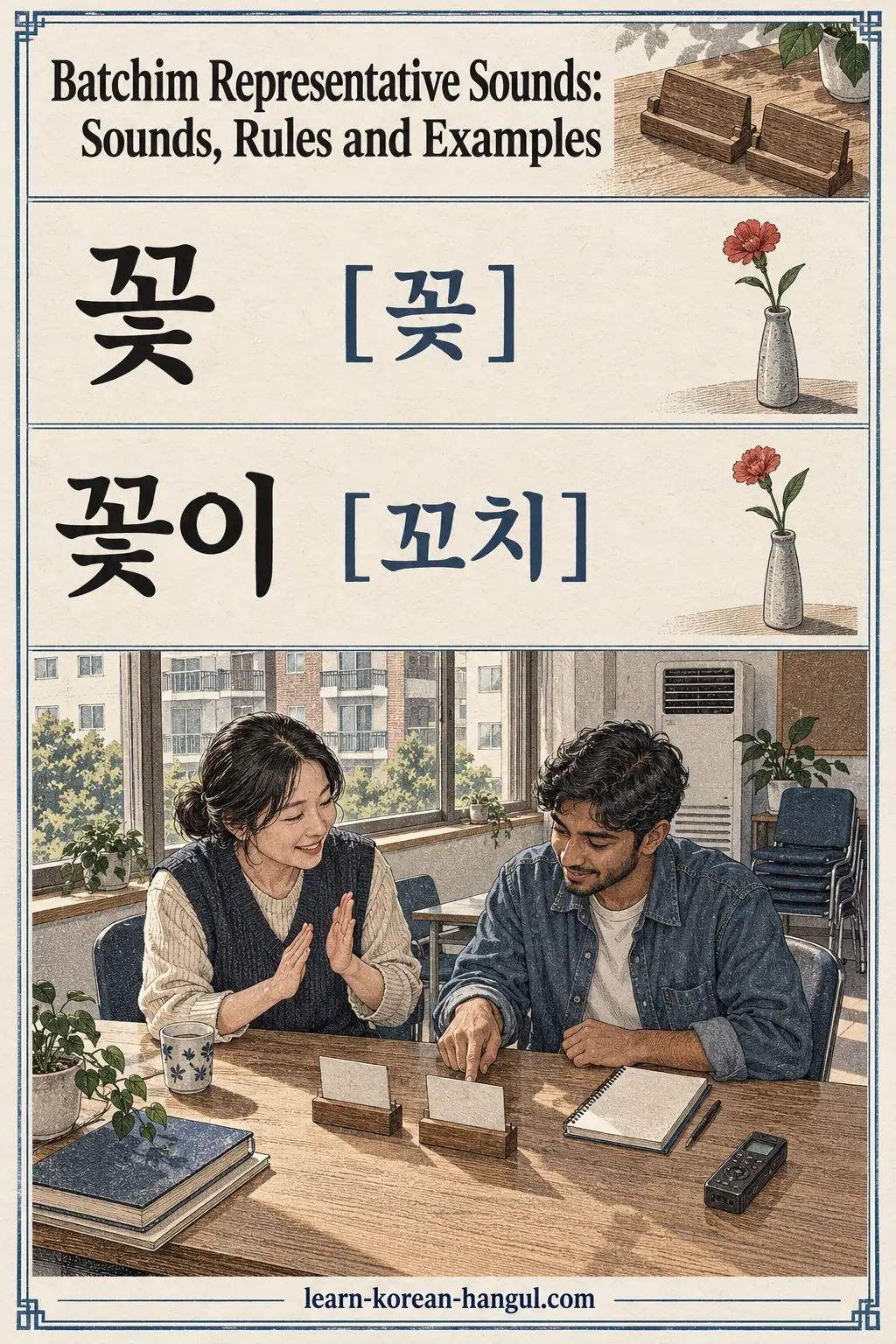
Batchim representative sounds (대표음, daepyoeum) are the seven sounds, [ㄱ], [ㄴ], [ㄷ], [ㄹ], [ㅁ], [ㅂ] and [ㅇ], that every Korean final consonant is reduced to before a pause or another consonant. With one short lookup table, you can say the final sound of all 27 batchim spellings, including 부엌, 옷, 낮 and 꽃.
What you'll learn
- Name the seven representative sounds and give one word for each.
- Sort any single batchim letter into its group and say the result, for example 부엌 [부억] and 앞 [압].
- Explain why 낮, 낫, 낯 and 낱 sound identical on their own.
- Decide when the reduction applies and when a following vowel cancels it.
Prerequisites: you can read basic syllable blocks and you have met Korean Unreleased Consonants, the "swallowed" ㄱ, ㄷ and ㅂ at the end of a syllable. Estimated time: 25 minutes.
What Are Batchim Representative Sounds?

Batchim representative sounds are the seven consonant sounds that Korean allows at the end of a syllable. A batchim (받침, "support") is the consonant written at the bottom of a syllable block, such as ㄱ in 국 or ㅊ in 꽃. Korean spelling allows many different letters in that slot, but speech allows only seven sounds there. Each sound "represents" a group of letters, which is why Korean grammars call it 대표음, the representative sound.
Here is the idea in one example. The words 박 (gourd) and 밖 (outside) are both pronounced [박] on their own, because ㄱ and ㄲ, together with ㅋ, share one representative sound, [ㄱ].
The official source is the Standard Pronunciation Rules (표준 발음법), part of the Standard Language Regulations (표준어 규정) maintained by the National Institute of Korean Language (국립국어원). Article 8 says that only ㄱ, ㄴ, ㄷ, ㄹ, ㅁ, ㅂ and ㅇ are pronounced as final sounds. Article 9 lists which letters reduce to [ㄱ], [ㄷ] and [ㅂ]; final ㅎ is treated separately in Article 12.
Why Does Korean Need Only Seven Final Sounds?
Korean needs only seven final sounds because Korean final stops are unreleased. When an English speaker says "cat", the tongue often lets go of the t with a small burst of air. A Korean speaker closing 곧 holds the tongue against the ridge behind the teeth and stops there. Without a release, there is no puff of air and no hissing, so the features that make ㅌ, ㅅ or ㅈ different from ㄷ cannot be heard. Only the place of closure survives: the back of the tongue ([ㄱ]), the tongue tip ([ㄷ]) or the lips ([ㅂ]).
The four other sounds, [ㄴ], [ㄹ], [ㅁ] and [ㅇ], can be held without a burst, so they keep their identity. The process of losing the differences is called neutralization. Once you know this mechanism, the groups below stop looking like a list to memorize and start looking like a map of the mouth.
Why English Speakers Struggle with Final Consonants
English speakers struggle because English keeps many different sounds at the end of a word. "Bat", "bad", "bath", "bass" and "batch" are five words with five different endings. A learner who transfers this habit tries to say 옷 (clothes) with an s at the end, or 꽃 (flower) with a ch. Native listeners hear an extra syllable, something like "ot-seu" or "kko-chi", and the word can sound foreign or even like a different word.
The opposite problem also appears. Learners who read Revised Romanization see "ot" for 옷 and "kkot" for 꽃 and assume the romanization is a typo. In fact, it is honest: Revised Romanization writes the final sound, and both words end in [ㄷ]. The fix is to stop asking "which letter is written?" and start asking "which group does that letter belong to?" The next section gives you the groups.
The Seven Representative Sounds at a Glance
The seven representative sounds group the 16 single batchim letters as follows. Three letters, ㄸ, ㅃ and ㅉ, never appear as batchim, so they are not in the table.
| Representative sound | Revised Romanization | Letters in the group | Example | Spoken |
|---|---|---|---|---|
| [ㄱ] | k | ㄱ ㅋ ㄲ | 부엌 (kitchen) | [부억] |
| [ㄴ] | n | ㄴ | 산 (mountain) | [산] |
| [ㄷ] | t | ㄷ ㅅ ㅆ ㅈ ㅊ ㅌ ㅎ | 옷 (clothes) | [옫] |
| [ㄹ] | l | ㄹ | 물 (water) | [물] |
| [ㅁ] | m | ㅁ | 밤 (night) | [밤] |
| [ㅂ] | p | ㅂ ㅍ | 앞 (front) | [압] |
| [ㅇ] | ng | ㅇ | 방 (room) | [방] |
Rule
final ㄱ ㅋ ㄲ → [ㄱ]; final ㄷ ㅅ ㅆ ㅈ ㅊ ㅌ ㅎ → [ㄷ]; final ㅂ ㅍ → [ㅂ]
Each of these sounds has its own lesson in the seven final sounds, with more words and audio. On this page, the focus is the reduction itself: how a written letter turns into one of the seven.
Which Batchim Letters Become ㄱ, ㄷ and ㅂ?
Three of the seven representative sounds collect several letters each: [ㄱ] takes three letters, [ㄷ] takes seven and [ㅂ] takes two. These are the groups that change pronunciation, so they are the groups worth learning by heart.
The ㄱ Group: ㄱ, ㅋ and ㄲ
The ㄱ group contains the three letters made at the back of the mouth. All three are said as an unreleased [ㄱ]: the back of the tongue rises, touches the soft palate and holds.
- 국 (soup) → [국]
- 부엌 (kitchen) → [부억]
- 밖 (outside) → [박]
- 닦다 (to wipe) → [닥따]
The letter name 키읔 shows the rule on itself: it is said [키윽].
The ㄷ Group: Seven Letters, One Sound
The ㄷ group is the largest. Seven letters, ㄷ ㅅ ㅆ ㅈ ㅊ ㅌ ㅎ, are said as an unreleased [ㄷ], with the tongue tip pressed on the ridge behind the upper teeth.
- 곧 (soon) → [곧]
- 옷 (clothes) → [옫]
- 있다 (to exist) → [읻따]
- 낮 (daytime) → [낟]
- 꽃 (flower) → [꼳]
- 밭 (field) → [받]
A simple memory aid: start with ㄷ itself, add the s-pair ㅅ ㅆ, then the j-pair ㅈ ㅊ, then the breathy pair ㅌ ㅎ. Count them on your fingers; if you reach seven, you have the whole group.
ㅎ is a special member. It almost never closes a word in real vocabulary, and inside words it usually fuses with the next sound instead of reducing. The edge-case section below explains it.
The ㅂ Group: ㅂ and ㅍ
The ㅂ group contains the two lip letters. Both are said as an unreleased [ㅂ]: the lips close and stay closed.
- 밥 (rice) → [밥]
- 앞 (front) → [압]
- 숲 (forest) → [숩]
- 잎 (leaf) → [입], which sounds the same as 입 (mouth)
Which Letters Never Change?
ㄴ, ㄹ, ㅁ and ㅇ never change, because each is its own representative sound. 산 is [산], 물 is [물], 밤 is [밤] and 방 is [방]. These four sounds are nasals or a liquid, and they can be held without a burst of air, which is why the reduction does not touch them. Four of your seven sounds therefore need no rule at all. The real work is the three groups above, and the clearest proof that they are real is a set of words that collapse into one sound.
Why Do 낮, 낫 and 낟 Sound the Same?

낮, 낫 and 낟 sound the same because ㅈ, ㅅ and ㄷ all belong to the ㄷ group, so each word ends in [ㄷ] when said alone. Two more words join them: 낯 (face) and 낱 (a single piece). Five spellings, five meanings, one pronunciation: [낟].
| Word | Final letter | Meaning | Said alone |
|---|---|---|---|
| 낟 | ㄷ | grain (as in 낟알) | [낟] |
| 낫 | ㅅ | sickle | [낟] |
| 낮 | ㅈ | daytime | [낟] |
| 낯 | ㅊ | face | [낟] |
| 낱 | ㅌ | a single piece | [낟] |
The same thing happens with 빗 (comb), 빚 (debt) and 빛 (light), which are all [빋] alone, and with 입 (mouth) and 잎 (leaf), which are both [입]. Korean listeners tell these words apart from context, or from the next syllable. That second clue is the key to the next idea: a vowel after the batchim brings the original letter back. Before that, there is one more spelling type to reduce.
How Do Double Batchim Reduce to Seven Sounds?

Double batchim reduce to the same seven sounds by first dropping one of their two letters, then applying the groups above. A double batchim (겹받침) is a pair of different consonants written together at the bottom of a block, such as ㄺ in 닭. Korean has 11 of them, and Articles 10 to 12 of the Standard Pronunciation Rules say which letter is kept.
| Double batchim | Letter usually kept | Example | Spoken |
|---|---|---|---|
| ㄳ | first (ㄱ) | 넋 (soul) | [넉] |
| ㄵ | first (ㄴ) | 앉다 (to sit) | [안따] |
| ㄶ | first (ㄴ) | 많다 (to be many) | [만타] |
| ㄺ | second (ㄱ) | 닭 (chicken) | [닥] |
| ㄻ | second (ㅁ) | 삶 (life) | [삼] |
| ㄼ | first (ㄹ) | 여덟 (eight) | [여덜] |
| ㄽ | first (ㄹ) | 외곬 (single path) | [외골] |
| ㄾ | first (ㄹ) | 핥다 (to lick) | [할따] |
| ㄿ | second (ㅍ → [ㅂ]) | 읊다 (to recite) | [읍따] |
| ㅀ | first (ㄹ) | 싫다 (to dislike) | [실타] |
| ㅄ | first (ㅂ) | 값 (price) | [갑] |
Two cautions apply. ㄶ and ㅀ contain ㅎ, which fuses with a following ㄷ to make ㅌ, so 많다 is [만타], not [만다]. And ㄼ has a famous exception: 밟다 (to step on) is [밥따]. Both cases are covered in double batchim. For this lesson, the point is simpler: every one of the 27 batchim spellings ends up as one of seven sounds.
What Happens When a Vowel Follows?

When a vowel follows, the batchim is not reduced: the original consonant moves to the next syllable and is pronounced in full. Korean writes a syllable that starts with a vowel with a silent ㅇ, as in 이 or 에. That empty slot pulls the batchim forward, a process called Korean liaison (연음).
| Alone | Reduced | With a vowel ending | Spoken |
|---|---|---|---|
| 꽃 | [꼳] | 꽃이 (the flower, subject) | [꼬치] |
| 옷 | [옫] | 옷을 (clothes, object) | [오슬] |
| 낮 | [낟] | 낮에 (in the daytime) | [나제] |
| 부엌 | [부억] | 부엌에 (in the kitchen) | [부어케] |
| 앞 | [압] | 앞에 (in front) | [아페] |
This is why Korean can afford so many homophones. 낮에 [나제] and 낫에 [나세] differ clearly, because the ㅈ and ㅅ come back as soon as a vowel arrives. The rule for learners is: reduce before a pause or a consonant; release the full letter before a vowel.
One limit matters here. Liaison carries the original letter only when the next syllable is a grammatical ending or particle, such as 이, 을 or 에. When the next part is a separate word or a word root starting with a vowel, the reduced sound moves over instead: 맛없다 (tasteless) is [마덥따], not [마섭따]. That case belongs to a later lesson; the worked example below stays with the common pattern.
Worked Example: Reading 부엌 and 부엌에

Follow these four steps for 부엌 (kitchen), the word many textbooks use to test this rule.
- Find the batchim. The second block, 엌, has ㅋ at the bottom.
- Check what follows. Nothing follows: the word ends here, so the reduction applies.
- Find the group. ㅋ is made at the back of the mouth, so it belongs to the ㄱ group.
- Say the representative sound. Close the back of the tongue against the soft palate and hold it, with no puff: [부억].
Now add the particle 에 (in, at): 부엌에.
- Find the batchim. It is still ㅋ.
- Check what follows. A vowel follows, written with silent ㅇ.
- Apply liaison instead. The ㅋ moves to the next syllable with its full aspirated sound.
- Say it. [부어케], with a clear puff of air on 케.
You'll know you have it when 부엌 ends in a silent stop that sounds like the end of 국, and 부엌에 has a breathy 케 that sounds like the start of 커피.
Edge Cases: ㅎ, Letter Names and Casual Speech
Three situations surprise learners who already know the basic groups.
ㅎ at the end of a syllable. ㅎ rarely ends a word. The clearest case is its own name, 히읗, which is said [히읃]. Inside words, ㅎ usually fuses or disappears: 좋다 [조타] (fusion with ㄷ, called aspiration), 놓는 [논는] (becomes [ㄴ] before ㄴ) and 좋아요 [조아요] (silent before a vowel). Treat ㅎ as a ㄷ-group member only when nothing follows it.
Letter names. The names of the consonants follow their own rule (Article 16). Before a vowel, 키읔이 is [키으기], as expected, but 디귿이 is [디그시] and 히읗이 is [히으시], with [ㅅ] instead of the written letter. This is a fixed exception for letter names only.
Casual speech. In relaxed Seoul speech, some speakers move a reduced or simplified sound across in liaison, saying 꽃이 as [꼬시] or 부엌에 as [부어게]. These forms are common in everyday talk, but they are not the standard pronunciation. Learn the standard forms first; you will recognize the casual ones easily once the rule is clear.
Common Mistakes with Batchim Representative Sounds
Mistake 1: pronouncing the written letter. Learners often assume 옷 ends in an s sound; actually it ends in an unreleased [ㄷ], because a final ㅅ cannot hiss without a release. Fix: hold your tongue on the ridge and stop the air.
Mistake 2: adding a vowel. Learners often say 꽃 as "kko-chi" to make the ㅊ audible; actually the word has one syllable, [꼳]. Fix: say 꼳 and 꽃 one after the other until they feel identical.
Mistake 3: reducing before a vowel. Learners who have just learned the rule often say 꽃이 as [꼳이]; actually a following vowel restores the full ㅊ, giving [꼬치]. Fix: look one block ahead before you speak.
Mistake 4: releasing the final stop. Even with the right group, English speakers often release [ㄱ], [ㄷ] or [ㅂ] with a small burst, so 밥 sounds like "bab-uh". Fix: close the lips and keep them closed for a moment after the word.
Mistake 5: forgetting that ㅆ is in the ㄷ group. Because ㅆ looks "strong", learners expect a strong ending in 있다. Actually ㅆ follows the same rule as ㅅ: 있다 is [읻따].
These five mistakes all come from one cause: reading the letter instead of the sound. The practice set below checks each of them.
Practice: Reduce 12 Batchim

Exercise 1. Write the spoken form of each word said alone.
- 밖
- 숲
- 빚
- 밭
- 넋
- 닭
- 삶
- 값
- 여덟
- 키읔
Exercise 2. Do these pairs sound the same when said alone? Answer yes or no.
- 빗 / 빛
- 입 / 잎
- 낫 / 낙
- 낮 / 낯
Exercise 3. Say each phrase, then check: is the batchim reduced, or does liaison apply?
- 옷이
- 꽃병 (flower vase)
- 앞에
Answers.
Exercise 1: 1 [박], 2 [숩], 3 [빋], 4 [받], 5 [넉], 6 [닥], 7 [삼], 8 [갑], 9 [여덜], 10 [키윽].
Exercise 2: 1 yes, both [빋]. 2 yes, both [입]. 3 no: [낟] versus [낙]. 4 yes, both [낟].
Exercise 3: 1 liaison, [오시]. 2 reduced, because a consonant follows: [꼳뼝], where the ㅂ also becomes tense. 3 liaison, [아페].
If you missed more than two answers in Exercise 1, return to the table of seven sounds and say each group aloud before trying again. Mixed drills with audio continue in Korean batchim practice.
Where to Go Next
The next lesson, How to Pronounce Korean Batchim, turns these groups into a five-step routine for any word, including words where the next syllable starts with ㄴ, ㅁ, ㄹ or ㅎ. Exercise 3 hinted at that: the tense ㅃ in 꽃병 comes from tensification, which the routine adds on top of the reduction.
This lesson does not cover tensification, nasalization, aspiration or every double batchim exception. Those rules start from the representative sound you learned here, so each later lesson will ask you to reduce first. The full set of topics is in Batchim Pronunciation.
In short, batchim representative sounds turn 27 written endings into seven spoken ones: [ㄱ], [ㄴ], [ㄷ], [ㄹ], [ㅁ], [ㅂ] and [ㅇ]. Reduce before a pause or a consonant, and let a following vowel bring the full letter back.
Frequently Asked Questions
How many final consonant sounds are there in Korean? Korean has seven final consonant sounds: [ㄱ], [ㄴ], [ㄷ], [ㄹ], [ㅁ], [ㅂ] and [ㅇ]. There are 16 single batchim letters and 11 double batchim, but all 27 spellings are pronounced with one of these seven sounds when a pause or a consonant follows. Article 8 of the Standard Pronunciation Rules states the number.
Why is 꽃 pronounced 꼳? 꽃 (flower) ends in ㅊ, and ㅊ belongs to the ㄷ group. At the end of a syllable, Korean cannot release the puff of air that makes ㅊ sound like ㅊ, so only the tongue position remains: the tip touches the ridge behind the teeth, which is [ㄷ]. Before a vowel, the ㅊ returns: 꽃이 [꼬치].
Is ㅎ at the end of a word pronounced? Almost never as an h sound. ㅎ rarely ends a word; the letter name 히읗 is said [히읃], with a [ㄷ] ending. Inside words, a final ㅎ usually merges with the next consonant (좋다 [조타]), becomes [ㄴ] before ㄴ (놓는 [논는]), or goes silent before a vowel (좋아요 [조아요]).
What is neutralization in Korean pronunciation? Neutralization is the loss of a sound contrast in a certain position. In Korean, plain, tense and aspirated consonants contrast at the start of a syllable, but at the end of a syllable the contrast disappears. ㄱ, ㅋ and ㄲ all become [ㄱ], so 박 (gourd) and 밖 (outside) sound identical when said alone.
Does Revised Romanization show representative sounds? Yes, mostly. Revised Romanization writes the sound, not the letter, at the end of a syllable, so 부엌 is bueok, 옷 is ot, 꽃 is kkot and 앞 is ap. This makes romanization a useful check for single words, but it does not show tensification, so read the Korean, not the letters.