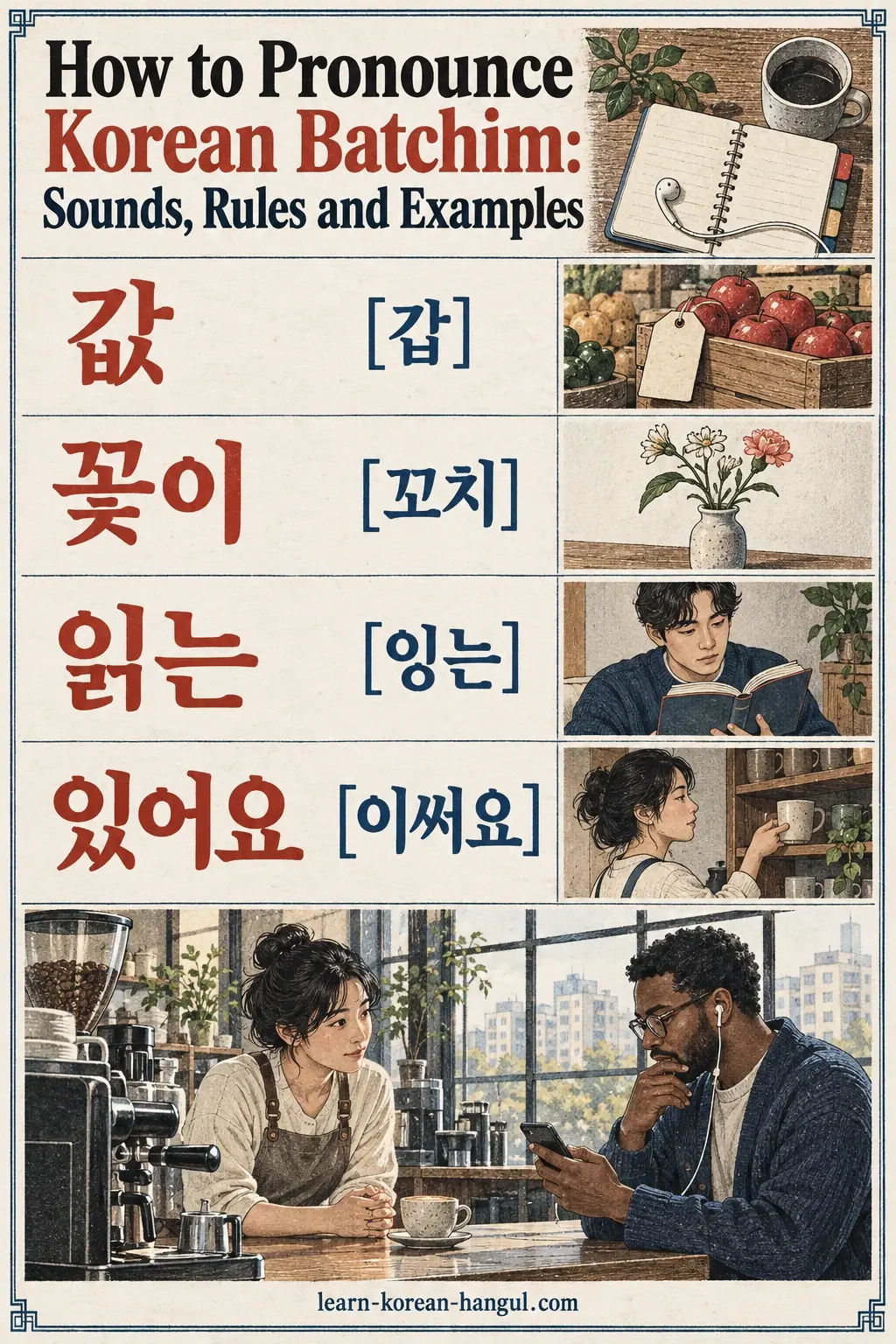
How to pronounce Korean batchim comes down to a five-step routine: find the final consonant, simplify a double batchim, reduce it to one of seven sounds, check the next syllable, then apply the matching change. This lesson takes about 30 minutes, and the routine works on words you have never seen, such as 값, 꽃이, 읽는 and 있어요.
What you'll learn
- Run the five steps on any written word and predict its spoken form.
- Choose the right sound change from the first sound of the next syllable.
- Pronounce 값, 꽃이, 읽는 and 있어요 correctly and explain why each sounds that way.
- Recognize the word types where the routine needs an extra rule.
Prerequisites: you know the seven groups from Batchim Representative Sounds. Estimated time: 30 minutes, plus practice.
What Does It Mean to Pronounce Korean Batchim Correctly?
Pronouncing Korean batchim correctly means saying the final consonant of each syllable the way its position and its neighbour require, not the way it is spelled. A batchim (받침) is the consonant written at the bottom of a syllable block, like ㅂ in 밥 or ㄺ in 읽. Two facts decide how it sounds: which letter is written, and what comes right after it.
Compare three forms of the word 꽃 (flower):
- 꽃 alone is [꼳]: the ㅊ is reduced.
- 꽃이 is [꼬치]: the ㅊ moves to the vowel and is fully heard.
- 꽃만 (only flowers) is [꼰만]: the reduced sound becomes [ㄴ] before ㅁ.
One letter, three pronunciations. A list of rules tells you each fact separately; the routine below tells you which fact to use first.
Why Do English Speakers Struggle with Batchim?
English speakers struggle because English spelling trains the eye to read each letter where it stands. In "cats" or "act", the t sits at the end of its syllable and is said as t. Korean pushes and pulls final consonants: they jump forward to a vowel, change to a nasal before ㄴ or ㅁ, or harden the next consonant.
A second difficulty is order. The rules interact, and applying them in the wrong order gives wrong results. For 읽는, a learner who looks only at the ㄹ may say [일른], which is a real-sounding but wrong form. The routine fixes the order: simplify, reduce, then look ahead.
How to Pronounce Korean Batchim in Five Steps

The five steps for pronouncing batchim are: find it, simplify it, reduce it, look ahead and apply the change. Use them in this order every time until they become automatic.
- Find the batchim. Locate the consonant at the bottom of the block.
- Simplify a double batchim. If two different letters sit there, decide which one is pronounced.
- Reduce to one of seven sounds. Map the letter to [ㄱ], [ㄴ], [ㄷ], [ㄹ], [ㅁ], [ㅂ] or [ㅇ].
- Look at the next syllable. Note whether it starts with a vowel, ㄴ or ㅁ, ㄹ, a plain stop such as ㄱ ㄷ ㅂ ㅅ ㅈ, or ㅎ.
- Apply the change and say it. Use the decision table in the next section.
Rule
find → simplify → reduce → look ahead → apply
Step 1: Find the Batchim
Every syllable block has a top consonant, a vowel and sometimes a bottom consonant. Only the bottom one is a batchim. In 있어요, the batchim is ㅆ in 있; 어 and 요 have none. A checkpoint: you'll know you found it when you can point to exactly one letter (or one letter pair) under a vowel.
Step 2: Simplify a Double Batchim
A double batchim (겹받침) is two different consonants in the bottom slot, such as ㅄ in 값 or ㄺ in 읽. Before a pause or a consonant, only one of them is said. Most keep the first letter (값 → 갑), while ㄺ, ㄻ and ㄿ usually keep the second (닭 → 닥). The full list is in double batchim.
Before a vowel, skip the simplification: the first letter stays and the second moves forward, as in 읽어요 [일거요]. Tense letters such as ㅆ and ㄲ are single letters, not double batchim.
Step 3: Reduce to One of Seven Sounds
Map the letter to its group. ㄱ ㅋ ㄲ become [ㄱ]; ㄷ ㅅ ㅆ ㅈ ㅊ ㅌ ㅎ become [ㄷ]; ㅂ ㅍ become [ㅂ]; ㄴ ㄹ ㅁ ㅇ stay as they are. If a vowel follows, do not reduce: go straight to Step 5 and apply liaison. The lookup table is in representative sounds.
Step 4: Look at the Next Syllable
Check only the first sound of the next block. Silent ㅇ means a vowel follows. Otherwise, sort the consonant into one of four bins: ㄴ or ㅁ, ㄹ, a plain obstruent (ㄱ ㄷ ㅂ ㅅ ㅈ), or ㅎ. If nothing follows, the word ends and you say the reduced sound, unreleased.
Step 5: Apply the Change and Say the Word
Find the row in the decision table below and say the result. The aim is to say the whole word in one smooth movement, not syllable by syllable. Check yourself against the audio until the spoken form feels natural.
How Do You Decide What Happens Next?

You decide what happens next by matching the reduced batchim with the first sound of the next syllable. The table covers the cases you meet in the first year of study. The names in the third column link to full lessons; you can use the sound change cheat sheet for a printable version.
| Batchim (after Step 3) | Next sound | What happens | Name | Example |
|---|---|---|---|---|
| any | nothing (end of word) | say the reduced sound, unreleased | reduction | 값 [갑] |
| any letter | vowel (silent ㅇ) of a particle or ending | the original letter moves forward | liaison (연음) | 꽃이 [꼬치] |
| [ㄱ], [ㄷ], [ㅂ] | ㄴ or ㅁ | becomes [ㅇ], [ㄴ], [ㅁ] | nasalization | 읽는 [잉는] |
| [ㄴ] | ㄹ | both become [ㄹ] | lateralization | 신라 [실라] |
| [ㅁ], [ㅇ] | ㄹ | ㄹ becomes [ㄴ] | nasalization | 종로 [종노] |
| [ㄱ], [ㄷ], [ㅂ] | ㄱ ㄷ ㅂ ㅅ ㅈ | next consonant becomes tense | tensification | 학교 [학꾜] |
| [ㄱ], [ㄷ], [ㅂ] | ㅎ | merges into ㅋ ㅌ ㅍ | aspiration | 축하 [추카] |
| written ㅎ | ㄱ ㄷ ㅈ | merges into ㅋ ㅌ ㅊ | aspiration | 좋다 [조타] |
| written ㅎ | vowel | ㅎ is silent | ㅎ deletion | 좋아요 [조아요] |
| written ㄷ, ㅌ | 이 | becomes [지], [치] | palatalization | 같이 [가치] |
Notice two patterns. First, the left column mostly needs only three values, [ㄱ], [ㄷ] and [ㅂ], because those are the sounds that change. Second, the four sonorant batchim ㄴ, ㄹ, ㅁ and ㅇ rarely change at all, except when ㄹ is involved. Most of your attention belongs on stop finals.
Worked Examples: 값, 꽃이, 읽는 and 있어요

Each example runs the full routine so you can see which step does the work.
값 (price)
- Batchim: ㅄ.
- Double batchim before a pause: keep the first letter, ㅂ.
- ㅂ belongs to its own group: [ㅂ].
- Nothing follows.
- Say [갑] with closed lips and no release.
Add the subject particle and the result changes: 값이 is [갑씨]. Before a vowel, ㅂ stays and ㅅ moves forward, where it becomes tense.
꽃이 (the flower)
- Batchim: ㅊ.
- Single letter, nothing to simplify.
- A vowel follows, so skip the reduction.
- Next sound: vowel 이.
- Liaison: ㅊ moves forward. Say [꼬치].
읽는 (reading)
- Batchim: ㄺ.
- ㄺ before a consonant usually keeps ㄱ.
- ㄱ is already [ㄱ].
- Next sound: ㄴ.
- Nasalization: [ㄱ] becomes [ㅇ]. Say [잉는].
있어요 (there is; I have)
- Batchim: ㅆ.
- ㅆ is one tense letter, not a double batchim.
- A vowel follows, so skip the reduction.
- Next sound: vowel 어.
- Liaison: ㅆ moves forward with its tense sound. Say [이써요].
You'll know the routine works when 있다 ([읻따]) and 있어요 ([이써요]) both feel natural: the same stem, reduced in one and released in the other.
When Does the Routine Give the Wrong Answer?

The routine gives the wrong answer in a small set of word types where a word boundary, a hidden sound or a fixed exception overrides the regular steps. These cases are worth knowing as categories, so you can recognize them and look them up.
- A new word starts with a vowel. Liaison carries the reduced sound, not the letter, when the vowel begins a separate word or root. 맛없다 (tasteless) is [마덥따] and 겉옷 (outer clothes) is [거돋]. 맛있다 is the famous double case: both [마딛따] and [마싣따] are standard, and [마싣따] is the everyday form.
- ㄴ insertion. In some compounds, an [ㄴ] appears before 이, 야, 여, 요 or 유: 한여름 (midsummer) is [한녀름].
- Sino-Korean ㄹ. After ㄹ in Sino-Korean words, ㄷ ㅅ ㅈ become tense: 갈등 (conflict) is [갈뜽]. The routine would not predict this, because ㄹ is not a stop.
- Fixed exceptions. 밟다 (to step on) is [밥따], although ㄼ normally keeps ㄹ.
When a word ends up in one of these categories, trust the audio and the dictionary over the routine. The Standard Korean Language Dictionary (표준국어대사전) of the National Institute of Korean Language lists the standard pronunciation in brackets for words with irregular readings.
How Long until the Routine Becomes Automatic?
For many learners, the routine typically stops feeling like five steps after a few weeks of daily reading aloud, because the same patterns repeat in high-frequency words. Fluent speakers do not run steps; they recognize chunks such as 습니다 [슴니다], -고 after a stop [꼬] and 있어요 [이써요] as single sound shapes.
You can speed this up on purpose. Collect the endings you meet most often, such as -는, -고, -다, -어요 and -습니다, and practise each one after the three stop groups. That handful of endings gives you the sound shapes you will hear most often, so the routine is needed only for new words.
Which Batchim Mistakes Do Learners Make Most Often?
The five batchim mistakes learners make most often are reading letter by letter, reducing before a vowel, splitting tense letters, skipping nasalization in polite endings and releasing final stops.
Reading letter by letter. Learners often assume each block is said separately; actually Korean links syllables, so the batchim of one block depends on the next. Fix: read two blocks at a time.
Reducing before a vowel. Learners often say 꽃이 as [꼳이]; actually a vowel restores the full letter, [꼬치]. Fix: run Step 4 before Step 3 whenever the next block starts with ㅇ.
Simplifying a tense letter. Learners often treat ㅆ in 있어요 or ㄲ in 밖에 as two letters and drop one; actually they are single tense letters and move whole: [이써요], [바께].
Skipping nasalization in polite endings. Learners often say 합니다 as [합니다]; actually it is [함니다], because [ㅂ] meets ㄴ. This is the most frequent case of the rule, so it is worth correcting early.
Releasing final stops. Learners often add a puff or a vowel to 값 or 밥; actually final [ㄱ], [ㄷ] and [ㅂ] are held without a release.
The practice set below targets each of these mistakes.
Practice: Run the Routine on Eight Words

Exercise 1. Write the spoken form. Then name the step or rule that did the work.
- 밥만 (only rice)
- 앉아요 (sit)
- 없다 (to not exist)
- 국물 (broth)
- 닭이 (the chicken)
- 좋고 (good and)
- 옷장 (wardrobe)
- 감사합니다 (thank you)
Exercise 2. Which word in each pair has a batchim that is reduced, and which has liaison?
- 밖 / 밖에
- 젊다 / 젊어요
Answers.
Exercise 1: 1 [밤만], nasalization. 2 [안자요], double batchim before a vowel. 3 [업따], Step 2 keeps ㅂ, then tensification. 4 [궁물], nasalization. 5 [달기], double batchim before a vowel. 6 [조코], aspiration. 7 [옫짱], reduction then tensification. 8 [감사함니다], nasalization.
Exercise 2: 1 밖 is reduced, [박]; 밖에 has liaison, [바께]. 2 젊다 is reduced to [점따] (ㄻ keeps ㅁ, then the ㄷ becomes tense after the verb stem); 젊어요 has liaison, [절머요].
More drills with audio are in Korean Batchim Practice.
Where to Go Next
Continue with Korean Batchim Practice, where you apply the routine to mixed words and short sentences with audio. If a step felt shaky, return to its lesson: Step 2 to double batchim, Step 3 to representative sounds, and Step 5 to the rule pages in the cheat sheet. You can also check a word with the Korean sound change checker.
This lesson does not teach each sound change in depth, the pitch and rhythm of whole sentences, or dialect pronunciation. Those topics sit elsewhere in Batchim Pronunciation and the wider pronunciation section.
In short, how to pronounce Korean batchim is a matter of order: find the batchim, simplify it, reduce it, look at the next sound, and apply the one change that pairing calls for.
Frequently Asked Questions
Do I need to memorise every batchim rule? No. Most words are handled by three pieces of knowledge: the seven representative sounds, liaison before a vowel, and the four common changes before a consonant. Learn those through the five-step routine. Rarer rules, such as ㄴ insertion or the exceptions for 밟다, can be learned word by word as you meet them.
Why is 있어요 pronounced 이써요? 있어요 has the tense letter ㅆ as its batchim, and the next syllable starts with a vowel. Before a vowel, Korean does not reduce the batchim. The whole ㅆ moves to the next syllable and keeps its tense sound, so 있어요 is said [이써요]. Said alone, the stem 있 would end in [ㄷ].
What happens to a double batchim before a vowel? Before a vowel, both letters of a double batchim are heard. The first letter stays in its syllable and the second moves forward: 읽어요 is [일거요] and 앉아요 is [안자요]. If the second letter is ㅅ, it becomes tense, so 값이 is [갑씨]. Double batchim with ㅎ lose the ㅎ: 많아요 [마나요].
Does the routine work across two words? Yes, when the two words are spoken as one phrase without a pause. 밥 먹어요 is said [밤머거요], with nasalization across the space. When there is a pause, each word is reduced on its own. Speakers tend to link words more in fast speech, so the same phrase can sound slightly different at two speeds.
Can Revised Romanization tell me how a batchim sounds? Only partly. Revised Romanization records liaison, nasalization, palatalization and some aspiration, so 읽는 is ingneun and 같이 is gachi. It does not record tensification, so 학교 is written hakgyo although it is said [학꾜]. Use the routine on the Korean spelling and treat romanization as a rough check.