What you'll learn
- List the seven letters that end in the ㄷ sound and read each one in a real word.
- Close the tongue tip against the ridge behind the upper teeth without releasing air.
- Predict which letter comes back before a vowel: 옷이 [오시], 낮이 [나지], 꽃이 [꼬치], 밭이 [바치].
- Say 있다 [읻따] and 좋다 [조타] without guessing from the spelling.
Prerequisites: you can read Hangul blocks and know that a batchim is the consonant written under a syllable. Time: about 25 minutes.
Key facts
- Seven letters end in this one sound: ㄷ ㅅ ㅆ ㅈ ㅊ ㅌ ㅎ.
- Before ㄴ or ㅁ the sound becomes n: 닫는 [단는].
- Final ㅎ fuses with a following ㄱ, ㄷ or ㅈ into an aspirated sound: 좋다 [조타].
Listen to the group first. Every clip below ends in the same sound.
The sound is easy to say. The difficulty is that seven spellings hide it, as the next section explains.
Why English Speakers Struggle with the ㄷ Batchim
English speakers struggle with the ㄷ batchim because Korean writes this one sound in seven different ways and the spelling gives no hint. English readers expect "s" to be an "s". In 옷, the ㅅ under the vowel is not an "s" at all, and 꽃 does not end in a "ch" sound.
Two habits cause errors. First, learners pronounce the letter they see, so 옷 becomes "ohs" or "oss". Second, they add a vowel after the consonant: "o-su" for 옷, or "kkot-chi" for 꽃. Both break the rule that the syllable must stop at the tongue.
A third problem is listening. When a native speaker says [옫], English ears often hear an unfinished "o" because there is no final burst to mark the end. Training the ear on the clipped ending is as important as training the mouth.
The fix is a fixed picture: all seven letters, in the closed position, are the same [t̚]. The next section lists the letters one by one.
Which Letters Make the Final ㄷ Sound?

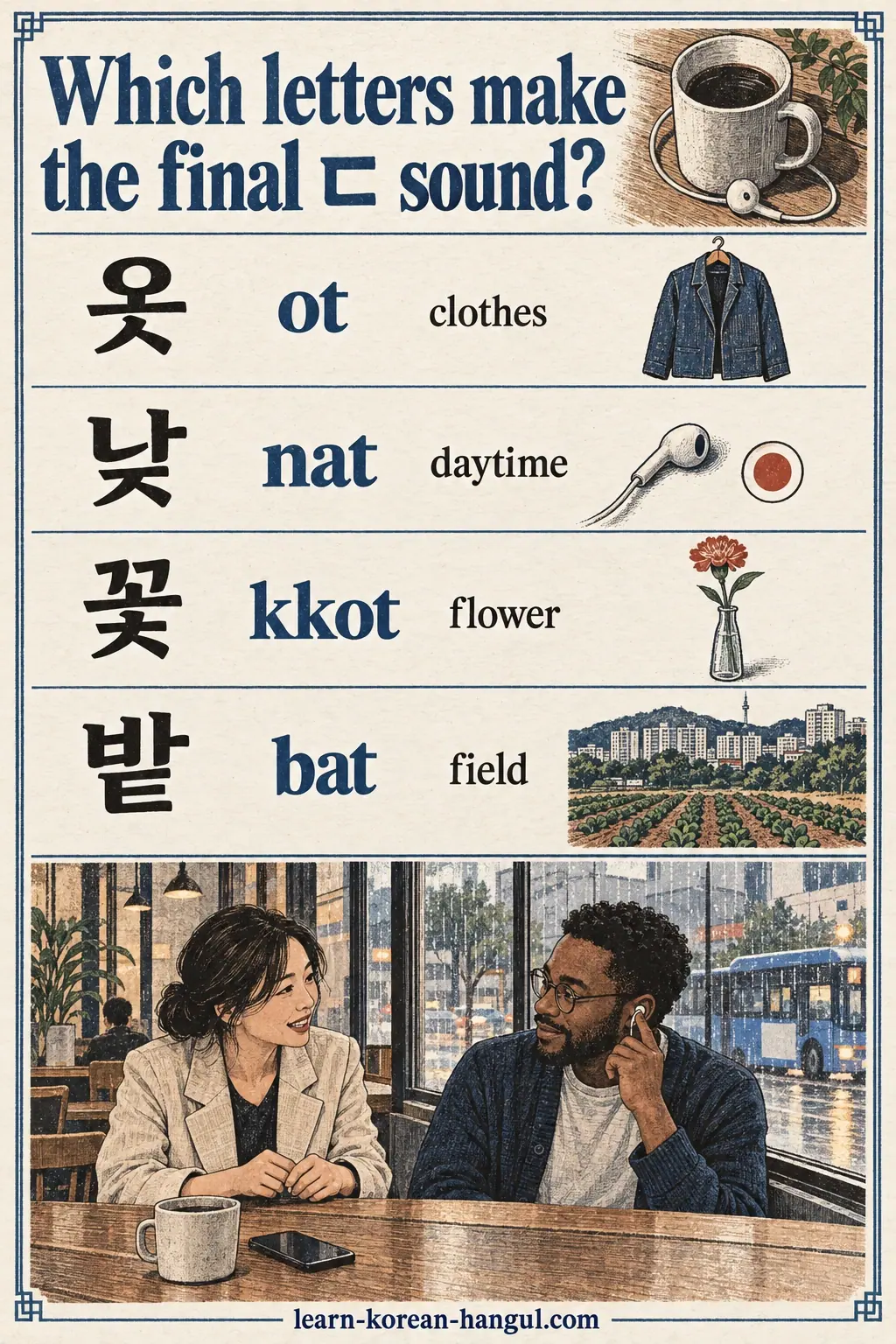
Seven letters make the final ㄷ sound: ㄷ, ㅅ, ㅆ, ㅈ, ㅊ, ㅌ and ㅎ. Alone, or before most consonants, every one of them is said [t̚]. Final ㅎ is the exception before a consonant, with its own rules shown later in this lesson. The table gives one real word for each letter.
| Letter | Name | Word | Spoken | RR (aid) | Meaning |
|---|---|---|---|---|---|
| ㄷ | 디귿 | 곧 | [곧] | got | soon |
| ㅅ | 시옷 | 옷 | [옫] | ot | clothes |
| ㅆ | 쌍시옷 | 있다 | [읻따] | itda | to exist, to have |
| ㅈ | 지읒 | 낮 | [낟] | nat | daytime |
| ㅊ | 치읓 | 꽃 | [꼳] | kkot | flower |
| ㅌ | 티읕 | 밭 | [받] | bat | field |
| ㅎ | 히읗 | 히읗 | [히읃] | hieut | the name of the letter ㅎ |
A simple way to remember seven letters is to group them by how the letter is made when it is not final. ㄷ and ㅌ are plain and aspirated tongue stops. ㅅ and ㅆ are the hissing pair. ㅈ and ㅊ are the affricates (a stop followed by a hiss). ㅎ is the breathy outlier.
The letter names are useful in themselves, because several of them show the rule. The name 시옷 is said [시옫], and 지읒 is said [지읃]. Each name ends in the letter that it names, but the final sound is always the ㄷ sound. Article 9 of the Standard Pronunciation Rules (표준 발음법, 국립국어원) reduces final ㅅ, ㅆ, ㅈ, ㅊ and ㅌ to the representative sound [ㄷ]. Final ㅎ is handled separately in Article 12, and Article 16 gives the letter name 히읗 as [히읃].
The letters ㄵ ㄶ do not belong here. They are double batchim and reduce to ㄴ, which is taught in ㄴ Batchim. The next section shows how to make the sound.
How Do You Pronounce the ㄷ Batchim?
To pronounce the ㄷ batchim, touch the tongue tip to the ridge behind the upper front teeth and hold it there without releasing air. Practise with 옷 in five steps.
- Say 오 with a relaxed, open mouth.
- Lift the tongue tip to the gum ridge directly behind the upper teeth.
- Press lightly so the air is blocked, and keep the lips relaxed.
- Hold for about one beat. Your cheeks should not puff out.
- Lower the tongue silently. No "uh" or "su" should follow.
You'll know it worked when the word stops at the tongue. A listener should hear [옫], not "ossuh".
Self-checks. The tissue test works here as well: hold a thin tissue five centimetres from the mouth and say 옷. It should not move. For the hold test, say 꽃 and keep the tongue on the ridge for a full second. If the tongue slips down at once, the hold was too short.
옷
The gesture is the same one used for ㄱ and ㅂ, with a different place of closure. The general idea is in Korean Unreleased Consonants. Next, look at what happens when a vowel follows and the tongue must release.
Which Letter Returns before a Vowel?

Before a vowel, the original letter returns and moves to the start of the next syllable. This is liaison. Since seven letters share one closed sound, the vowel is the only moment when you can hear which letter was written. Treat it as a listening test for the spelling.
| Written | Spoken | The returning sound | RR (aid) |
|---|---|---|---|
| 옷이 | [오시] | ㅅ | osi |
| 낮이 | [나지] | ㅈ | naji |
| 꽃이 | [꼬치] | ㅊ | kkochi |
| 밭이 | [바치] | ㅌ, then palatalized | bachi |
| 있어요 | [이써요] | ㅆ | isseoyo |
| 굳이 | [구지] | ㄷ, then palatalized (adverb: insistently) | guji |
| 히읗이 | [히으시] | ㅎ becomes ㅅ in the letter name | hieusi |
Two cases need a warning. First, 밭이 is [바치], not [바티]. When final ㅌ or ㄷ meets a particle or suffix that begins with 이, they palatalize (the tongue moves toward the hard palate) and become ㅊ or ㅈ. This is a separate rule, taught in palatalization. Second, the name of the letter 히읗 is a special case: the Standard Pronunciation Rules give 히읗이 as [히으시] and not [히으히].
The general linking rule is in Korean liaison. With these two warnings, the spelling is a reliable guide again: before a vowel, say the letter you see. The next section covers the consonants that change the sound instead.
What Changes before ㄴ and ㅁ?

Before ㄴ or ㅁ, the ㄷ sound becomes n. The tongue is already on the ridge for ㄷ, and ㄴ uses the same spot, so the stop turns into a nasal hum. This is nasalization, set out in Article 18 of the Standard Pronunciation Rules.
| Written | Spoken | What happens | RR (aid) |
|---|---|---|---|
| 닫는 | [단는] | ㄷ + ㄴ becomes ㄴ + ㄴ | danneun |
| 옷만 | [온만] | ㅅ reduces to ㄷ, then to ㄴ | onman |
| 있는 | [인는] | ㅆ reduces to ㄷ, then to ㄴ | inneun |
| 꽃나무 | [꼰나무] | ㅊ reduces to ㄷ, then to ㄴ | kkonnamu |
| 낮만 | [난만] | ㅈ reduces to ㄷ, then to ㄴ | nanman |
Before a plain ㄱ, ㄷ, ㅂ, ㅅ or ㅈ, the ㄷ sound stays a closed stop, and the next consonant becomes tense. 있다 is [읻따], 옷장 is [옫짱], 낮잠 is [낟짬], and 꽃다발 is [꼳따발]. The tight second sound is called tensification.
When the batchim is ㅎ itself and ㄱ, ㄷ or ㅈ follows, the two fuse into an aspirated sound. 좋다 is [조타] and 놓다 is [노타]: ㅎ joins the following ㄷ into ㅌ. The reverse order fuses too, so a ㄷ-group batchim before ㅎ becomes ㅌ: 못하다 is [모타다]. After a vowel, ㅎ is silent: 좋아요 is [조아요]. This answers a very common question about final ㅎ, which is covered again in the FAQ.
Having seen the rules, the next section applies all of them to a single word.
Worked Example: 옷
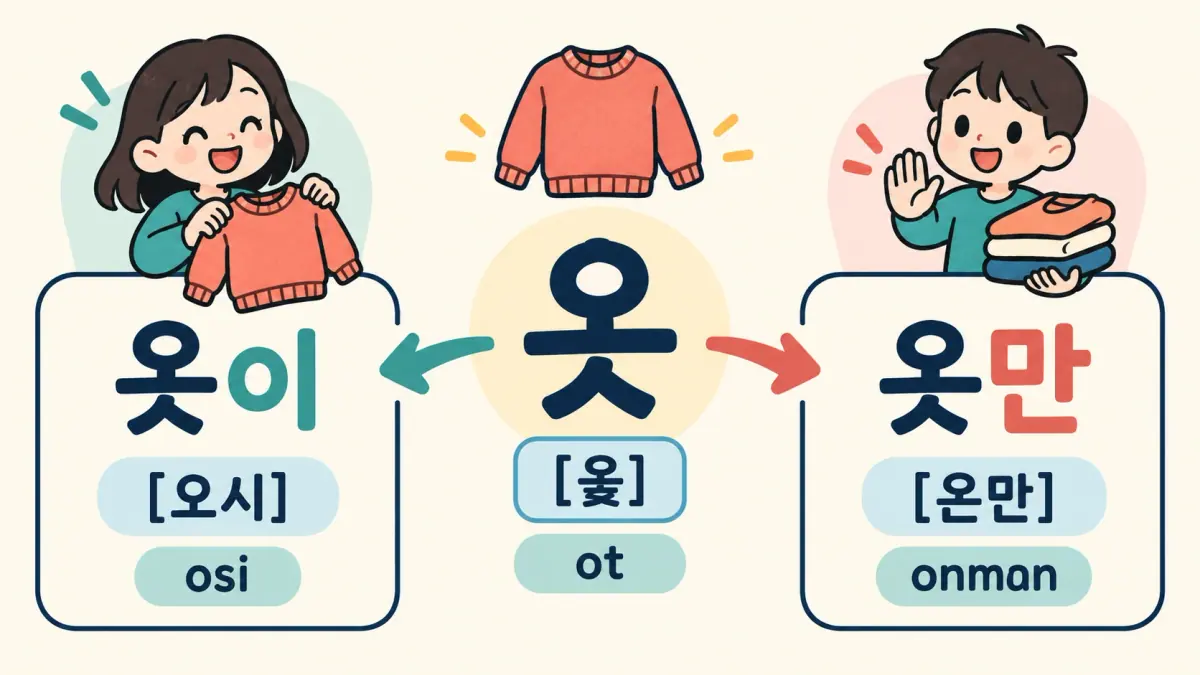
옷 (clothes) is a good worked example because ㅅ is the most common member of the ㄷ group, and the word appears in all three situations: alone, before a vowel, and before a consonant.
Step 1: read the blocks. 옷 has the silent ㅇ as a placeholder, ㅗ as the vowel, and ㅅ as the batchim.
Step 2: say it alone. The ㅅ at the end reduces to the ㄷ sound: [옫]. RR writes ot.
Step 3: add a vowel. With 이, 옷이 becomes [오시]. The ㅅ moved across and was released as a hiss.
Step 4: add a nasal. With 만 (only), 옷만 becomes [온만].
Step 5: add a plain consonant. With 도 (also), 옷도 becomes [옫또].
| Form | Spoken | Which rule |
|---|---|---|
| 옷 | [옫] | unreleased final ㄷ sound |
| 옷이 | [오시] | liaison |
| 옷만 | [온만] | nasalization |
| 옷도 | [옫또] | tensification |
Compare 옷 [옫] with 온 [온]. Both put the tongue on the ridge. In 옷 the air is blocked. In 온 the air hums through the nose. Pinch your nose to test: only 온 changes. The pair 옷 and 온 helps train the ear for the difference between a stop and a nasal.
The next section lists where learners go wrong.
Common Learner Mistakes with the ㄷ Batchim
Learners often assume one of four things about the ㄷ batchim, and each one has a clear correction.
Learners often assume ㅅ at the end is an "s". Actually it is the closed [t̚], because the Standard Pronunciation Rules reduce every final ㅅ to the ㄷ sound. Fix: say 옷 and check that your tongue stays on the ridge and no hissing air escapes.
Learners often assume ㅊ and ㅈ at the end make a "ch" or "j" sound. Actually both reduce to [t̚] before a consonant or at the end of a word, because affricates need a following vowel to be released. Fix: say 꽃 and 낮, and compare the endings. They should be identical.
Learners often assume ㅎ at the end is breathed. Actually final ㅎ is not breathed at all. Alone it is [ㄷ], before a vowel it is silent, and before ㄱ ㄷ ㅈ it makes an aspirated sound with the next letter. Fix: practise 좋다 [조타] and 좋아요 [조아요] side by side.
Learners often assume similar spellings sound different. Actually 낮, 낫 and 낯 are all [낟]. Context and particles tell them apart. Fix: link each to its meaning with the particle: 낮이 [나지] (daytime), 낫이 [나시] (sickle), 낯이 [나치] (face).
One honest limit: this lesson shows Seoul Standard Korean. Fast speech can shorten the closure, and some words carry extra rules, such as the way 맛있다 is said in two accepted ways. For learning, the clean closed ending is the best target.
The next section gives you tasks to test yourself.
Practice and Answer Key

Complete the four tasks, then check the key.
Task 1. Write the spoken form: 곧, 옷, 낮, 꽃, 밭.
Task 2. Write the spoken form with the particle 이: 옷이, 낮이, 꽃이, 밭이.
Task 3. Write the spoken form: 닫는, 있다, 좋다, 좋아요.
Task 4. Which word is said differently from the other three? 낮, 낫, 낯, 낮이.
Practice · 8
Which group of letters all end in the same unreleased [t̚] sound at the end of a syllable?
Show answer
ㄷ, ㅅ, ㅆ, ㅈ, ㅊ, ㅌ and ㅎ
Seven letters make the ㄷ batchim: ㄷ, ㅅ, ㅆ, ㅈ, ㅊ, ㅌ and ㅎ. Alone, each is said with the tongue tip closed on the ridge.
How is 옷 (clothes) said on its own?
Show answer
[옫]
Final ㅅ reduces to the ㄷ sound, so 옷 is [옫]. The ㅅ only comes back when a vowel follows, as in 옷이 [오시].
How is 꽃이 pronounced?
Show answer
[꼬치]
Before a vowel the original letter returns and moves across, so the ㅊ of 꽃 is released: 꽃이 [꼬치].
How is 밭이 pronounced?
Show answer
[바치]
The ㅌ links to 이 and palatalizes into ㅊ, so 밭이 is [바치], not [바티].
있는 is said [인는]. Which rule turns the ㄷ sound into n?
Show answer
Nasalization: before ㄴ or ㅁ the ㄷ sound becomes n
ㅆ reduces to the ㄷ sound, and before ㄴ the ㄷ sound becomes n. This is nasalization (Article 18).
What happens to the final ㅎ in 좋다 [조타]?
Show answer
It fuses with the following ㄷ into aspirated ㅌ
Final ㅎ fuses with a following ㄱ, ㄷ or ㅈ into an aspirated sound, so 좋다 is [조타].
What happens to the final ㅎ in 좋아요 [조아요]?
Show answer
It is silent
After a vowel, and before one, final ㅎ is silent: 좋아요 is [조아요].
Which one is said differently from the other three: 낮, 낫, 낯, 낮이?
Show answer
낮이
낮, 낫 and 낯 are all [낟] alone. 낮이 is [나지] because the ㅈ is released before the vowel.
Answer key
- 곧 [곧], 옷 [옫], 낮 [낟], 꽃 [꼳], 밭 [받].
- 옷이 [오시], 낮이 [나지], 꽃이 [꼬치], 밭이 [바치].
- 닫는 [단는], 있다 [읻따], 좋다 [조타], 좋아요 [조아요].
- 낮이. It is [나지], with the ㅈ released before a vowel. The other three are all [낟].
Listening drill. Ask a friend, or play the audio, and listen for the returning letter. If you hear [꼬치], the spelling is 꽃이. If you hear [오시], the spelling is 옷이. Writing the spelling from the sound is the fastest way to learn which letter is which.
The next section sends you on to the following lesson.
Where to Go Next
After the ㄷ batchim, continue with ㄹ Batchim, the only final sound that is a liquid and not a stop or a nasal. To see how the seven letters behave at the start of a syllable, compare the plain, tense and aspirated tongue stops in ㄷ ㄸ ㅌ difference. The parent page is The 7 Final Sounds, and the aspiration rule for ㅎ is explained in Korean aspiration rule.
This lesson does not cover double batchim (11 spellings), the full set of tensification rules, or regional variation. Those topics have their own lessons in the Pronunciation hub.
About this page. Last updated 2026-10-09. The Korean text, spoken forms and audio on this page were machine-generated and reviewed and signed off by Min-ji Park on 15 October 2026. Standard Korean follows the National Institute of Korean Language (국립국어원) Standard Pronunciation Rules, and romanization follows the Revised Romanization of Korean (2000).
Frequently Asked Questions
Why is 꽃 pronounced 꼳? 꽃 is pronounced [꼳] because ㅊ cannot end a Korean syllable. At the end of a word or before a consonant, ㅊ reduces to the representative sound ㄷ [t̚]. When a vowel follows, ㅊ returns: 꽃이 is [꼬치]. The ㄷ batchim covers this reduction for all seven letters.
Is final ㅎ pronounced? Final ㅎ is not pronounced as a breath. Alone it is the closed [ㄷ], as in the letter name 히읗 [히읃]. Before a vowel it is silent, so 좋아요 is [조아요]. Before ㄱ, ㄷ or ㅈ it fuses into aspiration, so 좋다 is [조타].
How do I say 있다? 있다 is said [읻따]. The ㅆ closes as the ㄷ sound, and the ㄷ after it becomes tense. Say 이, press your tongue tip on the ridge, hold for a beat, then say 따 with a tight start. Revised Romanization writes itda and does not show the tense sound.
What is the difference between 낮 and 낫? 낮 (daytime) and 낫 (sickle) sound identical alone: both are [낟]. They differ only in spelling and meaning, and the difference shows when a vowel follows: 낮이 is [나지] and 낫이 is [나시]. Listen for the returning letter, and use context to choose the meaning of the ㄷ batchim word.