What you'll learn
- Say final ㄹ as a clear, light [l] in 물, 달, 말 and 한글.
- Tell final ㄹ apart from the tap ㄹ between vowels, as in 나라.
- Predict the linked forms: 말이 [마리], 물이 [무리], 한글이 [한그리].
- Name the double batchim that reduce to ㄹ: ㄼ, ㄽ, ㄾ and ㅀ.
Prerequisites: you can read Hangul blocks and know what a batchim is. Time: about 20 minutes.
Key facts
- Final ㄹ is [l], not an English r: 물 [물], 달 [달].
- Before a vowel in the next syllable, final ㄹ links as a tap: 말이 [마리].
Listen to five words that end in the light l.
The sound itself is familiar to English speakers. The challenge is controlling it, as the next section explains.
Why English Speakers Struggle with the ㄹ Batchim
English speakers struggle with the ㄹ batchim because the letter "l" at the end of an English word is darker than Korean final ㄹ. In "ball" or "pool", the back of the tongue pulls toward the throat. This is often called a dark l, and it colours the vowel before it.
Korean final ㄹ is lighter. The tongue tip touches the ridge behind the upper teeth, and the back of the tongue stays relaxed. If you say "pool" with a dark l, a Korean listener may still understand 풀 (grass), but the vowel quality will sound off.
The second problem is the opposite habit. Because the Revised Romanization writes ㄹ as "r" between vowels and "l" at the end, learners decide that Korean ㄹ is an "r" sound and say 물 as "mur". The result sounds like a different word.
The third problem is speed. A learner who has learned the tap for 나라 may tap the tongue and then leave it, so 달 ends with a drifting "da-ruh". Final ㄹ keeps contact for a full beat.
The next section describes exactly what the light l sounds like.
What Does Final ㄹ Sound Like?

Final ㄹ sounds like a light English "l" with the tongue tip held on the ridge behind the upper teeth, while air flows around the sides of the tongue. Linguists call this a lateral (air passes at the sides). The sound is not a stop, so the air is not blocked completely.
| Written | Spoken | RR (aid) | Meaning |
|---|---|---|---|
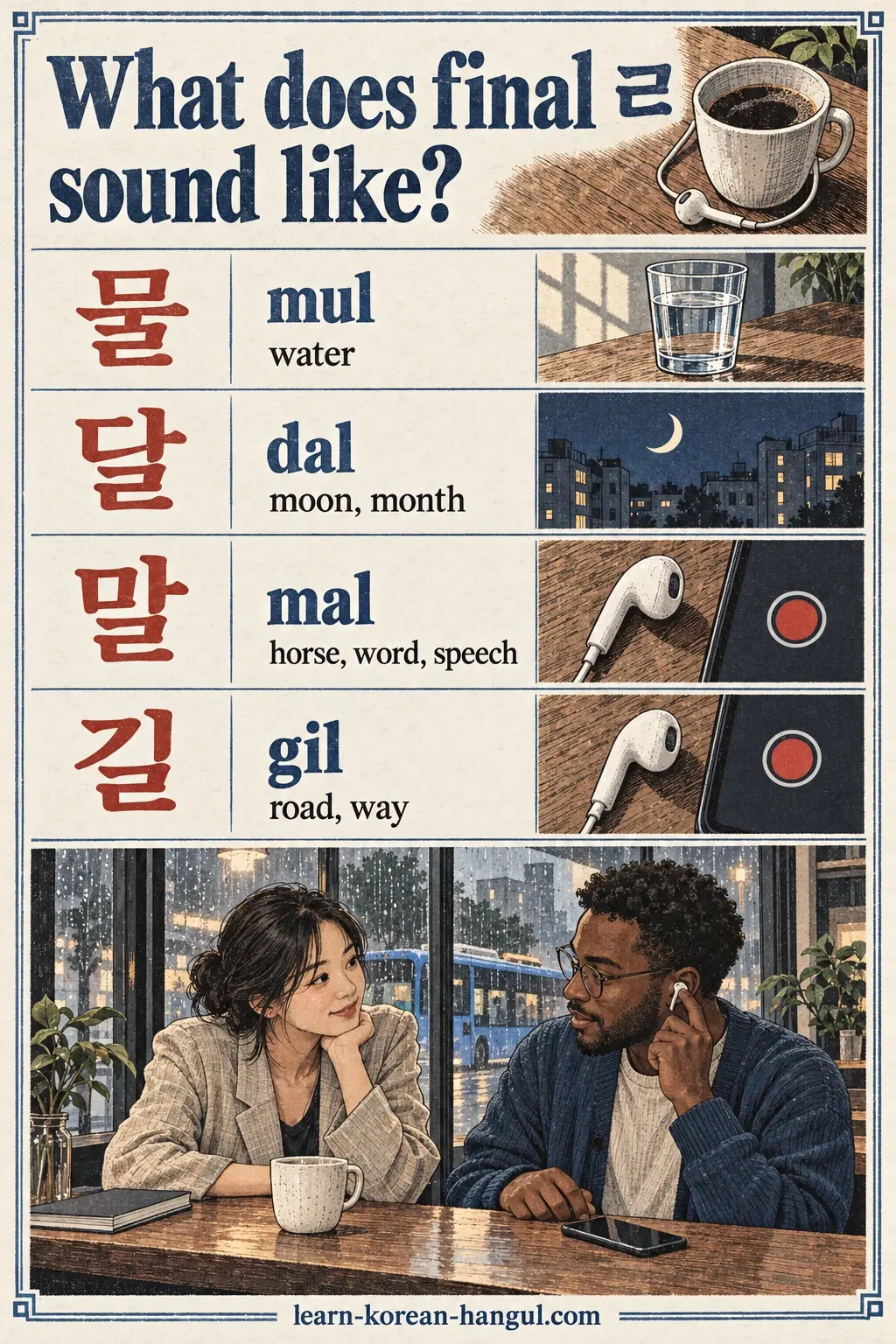
| 물 | [물] | mul | water |
| 달 | [달] | dal | moon, month |
| 말 | [말] | mal | horse, word, speech |
| 한글 | [한글] | hangeul | the Korean alphabet |
| 일 | [일] | il | work, day, one thing |
| 길 | [길] | gil | road, way |
Article 8 of the Standard Pronunciation Rules (표준 발음법, 국립국어원) lists ㄹ among the seven representative final sounds, and it is the only one of the seven that is a liquid. Three of the seven are stops (ㄱ ㄷ ㅂ), three are nasals (ㄴ ㅁ ㅇ), and ㄹ is the one lateral. The overview is in The 7 Final Sounds.
Here is a quick test. Say 물 and hold the final sound without stopping. You should be able to keep a steady "lll" for a second, because air keeps flowing around the tongue. If the sound cuts off, you have made a stop, which is a different final sound.
Final ㄹ also stays a held [l] before most consonants, with no change in the sound. 얼굴 (face) is [얼굴], 멀다 (to be far) is [멀다], and 알고 (knowing) is [알고]. The tongue lands on the ridge and stays there while the next consonant begins. A practical tip follows from this: if you can say 물 well, you can say 얼굴 well, because the final l in each word is the same sound.
The next section compares this sound with the tap.
How Is Final ㄹ Different from ㄹ between Vowels?
Final ㄹ is a held [l], and ㄹ between two vowels is a quick tap. A tap is a single fast touch of the tongue tip against the ridge, like the "tt" in American English "butter". Korean uses one letter for both sounds, and position decides which.
| Position | Example | Spoken | Sound |
|---|---|---|---|
| End of a syllable | 물 | [물] | held [l] |
| Between vowels | 나라 | [나라] | tap |
| Between vowels | 마리 | [마리] | tap |
| Start of a word | 라면 | [라면] | tap or light l |
| End followed by ㄹ | 설날 | [설랄] | held [l] twice |
The pair 말 and 마리 shows the difference. 말 is [말], one syllable with a held l. 마리 is [마리], two syllables with a tap. A third useful pair is 달 (moon) and 다리 (leg, bridge). The first ends with a held l. The second has the tap in the middle.
Revised Romanization reflects this: ㄹ is written "r" before a vowel and "l" elsewhere. So 나라 is nara, 물 is mul, and 설날 is seollal. The longer comparison with English sounds is in ㄹ versus l. The next section looks at what happens when a vowel follows a final ㄹ.
What Changes before a Vowel?

Before a vowel, final ㄹ moves to the start of the next syllable and becomes a tap. This is liaison. A closed [l] with a held tongue turns into a quick tap, because the letter now sits between two vowels.
| Written | Spoken | Pattern | RR (aid) |
|---|---|---|---|
| 말이 | [마리] | 말 + 이 becomes 마 + 리 | mari |
| 물이 | [무리] | 물 + 이 becomes 무 + 리 | muri |
| 달이 | [다리] | 달 + 이 becomes 다 + 리 | dari |
| 물을 | [무를] | 물 + 을 becomes 무 + 를 | mureul |
| 한글이 | [한그리] | 한글 + 이 becomes 한그 + 리 | hangeuri |
| 일은 | [이른] | 일 + 은 becomes 이 + 른 | ireun |
Look at 한글 and 한글이. The first ends in a held l: [한글]. The second links the ㄹ to the final 이 and taps: [한그리]. Many learners expect "han-geul-i". Standard speech has the tap, and the syllable boundary moves.
A useful note: 달이 [다리] sounds the same as 다리 (leg, bridge). Only the context tells which one is meant. This is one reason Korean speakers rely on grammar and situation, and not on sound alone.
For a longer account of this linking, see Korean liaison. Next, the double batchim that end in ㄹ.
Which Double Batchim End in ㄹ?

Four double batchim reduce to ㄹ: ㄼ, ㄽ, ㄾ and ㅀ. The table below shows ㄼ, ㄾ and ㅀ, because ㄽ appears in very few common words. In each pair, the ㄹ is the left-hand letter and the right-hand letter is dropped. The table shows a real word for each.
| Double batchim | Word | Spoken | RR (aid) | Meaning |
|---|---|---|---|---|
| ㄼ | 여덟 | [여덜] | yeodeol | eight |
| ㄼ | 넓다 | [널따] | neolda | to be wide |
| ㄾ | 핥다 | [할따] | halda | to lick |
| ㅀ | 싫다 | [실타] | silta | to dislike |
| ㅀ | 잃다 | [일타] | ilta | to lose |
The spoken forms above follow the rule that the left letter, ㄹ, is pronounced. Two things need care. First, ㄼ is the one pair with exceptions: 밟다 is said [밥따], and the pronunciation of 넓- has its own forms in some compounds, such as 넓죽하다 [넙쭈카다]. Second, ㅀ has an extra rule for the ㅎ: 싫다 is [실타] because the ㅎ is not said as its own sound but merges with the following ㄷ into aspirated ㅌ.
Full coverage of each pair is in the double batchim lessons, including double batchim ㄼ. The next section applies the sound to one word.
Worked Example: 물

물 (water) is a good worked example because it is a daily word with a clear vowel, and it appears in every situation: alone, before a vowel, and before a consonant.
Step 1: read the blocks. 물 has ㅁ as the first consonant, ㅜ as the vowel, and ㄹ as the batchim.
Step 2: say the first part. ㅁ is a nasal, so close the lips and hum: [무].
Step 3: add the final l. Lift the tongue tip to the ridge and let air flow around the sides: [물]. RR writes mul.
Step 4: hold it. Keep the contact for about one beat. The sound should be steady and clean, not a stop.
Step 5: add a vowel. With 이, 물이 becomes [무리], with a tap.
Step 6: add a consonant. With 만 (only), 물만 stays [물만], and the tongue stays on the ridge for ㄹ before ㅁ.
| Form | Spoken | Which rule |
|---|---|---|
| 물 | [물] | held final l |
| 물이 | [무리] | liaison with a tap |
| 물을 | [무를] | liaison with a tap |
| 물만 | [물만] | l before a nasal, no change |
Compare 물 [물] with 문 [문] (door). Both put the tongue tip on the ridge. In 물 the air flows around the sides. In 문 the air goes through the nose. Pinch your nose to test: only 문 changes. This pair is a core drill for telling ㄹ from ㄴ, and it connects to nasal and liquid minimal pairs.
The next section covers common errors.
Common Learner Mistakes with the ㄹ Batchim
Learners often assume one of four things about the ㄹ batchim. Each has a reason and a fix.
Learners often assume final ㄹ is an English r. Actually final ㄹ is a light lateral [l]. Fix: touch the ridge behind the upper teeth and hold. If your tongue curls back, you are saying an r.
Learners often assume the tongue must drop right away. Actually final ㄹ keeps contact for a full beat. Fix: hold 달 for a count of one, then release gently. Ending too fast makes it sound like "da".
Learners often assume final ㄹ keeps the dark English quality. Actually Korean final ㄹ is lighter, with the back of the tongue relaxed. Fix: say 물 with a smile. A slight smile lifts the tongue front and keeps the back from pulling.
Learners often assume ㄹ never changes. Actually it taps before a vowel (말이 [마리]), and it can change the sounds near it. A ㄴ after ㄹ becomes ㄹ: 설날 [설랄]. Fix: check what follows the ㄹ before you say it.
An honest limit: this lesson describes Seoul Standard Korean. Speakers vary in how dark or light the final ㄹ is, and the tap is sometimes described as a flap. The light, held [l] is the clearest target for learners.
The next section lets you test yourself.
Practice and Answer Key

Complete the four tasks, then check the key.
Task 1. Write the spoken form: 물, 달, 말, 일, 한글.
Task 2. Write the spoken form with a particle: 말이, 물이, 달이, 한글이.
Task 3. Say each word aloud and mark it L (held l) or T (tap): 나라, 달, 마리, 설날.
Task 4. Which word does not end in the sound [l]? 물, 문, 달, 말.
Practice · 8
What does final ㄹ sound like in 물 (water)?
Show answer
A light, held [l] with the tongue tip on the ridge behind the upper teeth
Final ㄹ is a light lateral [l]: the tongue tip stays on the ridge while air flows around the sides.
How is 말이 pronounced?
Show answer
[마리], with a tap
Before a vowel, final ㄹ moves to the next syllable and becomes a tap: 말이 [마리].
In which word is ㄹ a quick tap rather than a held [l]?
Show answer
나라
ㄹ between two vowels is a tap, as in 나라. At the end of a syllable, as in 달, 물 and 한글, it is a held [l].
How is 한글이 pronounced?
Show answer
[한그리]
The final ㄹ links to 이 and taps, so the syllable boundary moves: 한글이 [한그리].
In 설날, what happens to the ㄴ after ㄹ?
Show answer
It becomes ㄹ, so the word is [설랄]
A ㄴ after ㄹ becomes ㄹ, so 설날 is [설랄], with the l held twice.
How is the double batchim ㅀ handled in 싫다 [실타]?
Show answer
The ㄹ is said, and the ㅎ merges with the following ㄷ into ㅌ
In ㅀ the left letter ㄹ is pronounced, and the ㅎ fuses with the following ㄷ into aspirated ㅌ: [실타].
Which word does not end in the sound [l]?
Show answer
문
문 ends in the nasal [n]. 물, 달 and 말 all end in the light, held [l].
달이 (the moon, as subject) sounds the same as which word?
Show answer
다리
달이 links to [다리], so it sounds like 다리 (leg, bridge). Only context tells them apart.
Answer key
- 물 [물], 달 [달], 말 [말], 일 [일], 한글 [한글].
- 말이 [마리], 물이 [무리], 달이 [다리], 한글이 [한그리].
- 나라: T (tap). 달: L. 마리: T. 설날: L, L (both ㄹ are held, because 설날 is [설랄]).
- 문. It ends in the nasal [n]. The other three end in the light l.
If you missed no more than two of the fourteen items, move on. If task 3 was hard, repeat 달 and 다리 in pairs.
Where to Go Next
After the ㄹ batchim, continue with ㅁ Batchim, where the lips close and air goes through the nose. If you want the rule that turns ㄴ into ㄹ after a final ㄹ, read liquidization. The parent page is The 7 Final Sounds.
This lesson does not cover the full double batchim list (11 spellings), ㄹ-dropping verb forms, or regional variation. Those topics have their own lessons or belong to the grammar hub.
About this page. Last updated 2026-10-09. The Korean text, spoken forms and audio on this page were machine-generated and reviewed and signed off by Min-ji Park on 15 October 2026. Standard Korean follows the National Institute of Korean Language (국립국어원) Standard Pronunciation Rules, and romanization follows the Revised Romanization of Korean (2000).
Frequently Asked Questions
Is final ㄹ r or l? Final ㄹ is an l. It is a light [l], made with the tongue tip on the ridge behind the upper teeth and air flowing around the sides. Between two vowels the same letter is a quick tap, as in 나라. Revised Romanization writes l at the end of a syllable, so 물 is mul.
Why is 말이 pronounced 마리? 말이 is pronounced [마리] because the final ㄹ links to the next vowel. The Standard Pronunciation Rules move a final consonant to the start of the following syllable when that syllable begins with a vowel. At that point ㄹ sits between two vowels, so it becomes a tap.
How do I say 한글? 한글 is said [한글]. Say 한 with the tongue tip on the ridge, then 글 with a soft, plain ㄱ and a clear ㅡ vowel, and finish by touching the ridge for a held l. Revised Romanization writes hangeul. With the particle 이, 한글이 becomes [한그리], with a tap.
Do I need a tap in 달? You do not need a tap in 달 alone. At the end of a word ㄹ is a held [l], not a tap. The tap appears only when a vowel follows, as in 달이 [다리]. Practise the held version first, then the linked forms, to master the ㄹ batchim.