Glide Semivowel Meaning in Korean
Say "yes" slowly. Before the "e" there is a short "y" sound that glides into the vowel. Say "wet" and the "w" does the same. Those two sounds are glides. They are also called semivowels, because they are made like vowels but cannot carry a syllable alone.
Korean has two glides. The table shows them with the vowels that start with each.
| Glide | IPA | Sounds like | Vowel letters |
|---|---|---|---|
| y-glide | [j] | English "y" in "yes" | ㅑ ㅕ ㅛ ㅠ ㅒ ㅖ |
| w-glide | [w] | English "w" in "wet" | ㅘ ㅝ ㅙ ㅞ |
The vowels ㅟ and ㅚ also begin with a w-glide when spoken as diphthongs. The standard pronunciation rules list them among the ten simple vowels and allow the diphthong pronunciation ([wi], [we]). Most speakers use the diphthong. The vowel ㅢ is the odd one out: it moves from ㅡ toward ㅣ, and phoneticians disagree on whether it is best described as a glide plus ㅣ or as ㅡ plus a glide.
Korean calls a glide 반모음 (banmoeum), which means "half vowel".
How Are Glides Written in Hangul?
The y-glides are the easiest to see. Take a basic vowel and add one short stroke. Adding a stroke to ㅏ gives ㅑ, to ㅓ gives ㅕ, to ㅗ gives ㅛ and to ㅜ gives ㅠ. The extra stroke means "put a y before this vowel". The w-glide has no single mark. Instead, it is written by joining two vowels: ㅗ or ㅜ before another vowel, as in ㅘ (ㅗ+ㅏ) and ㅝ (ㅜ+ㅓ).
Two facts follow. First, a glide never stands alone in Hangul. There is no letter for "y" or "w" by itself. Second, in every combined vowel except the disputed ㅢ, the glide comes right before the main vowel in the same syllable, never after it. That is why 야구 (yagu, baseball) starts with a glide and 강 (gang) does not.
Glide Versus Diphthong
The nearest confusable term is the diphthong, which is the whole combination.
| Feature | Glide | Diphthong |
|---|---|---|
| What it is | one short sound | glide plus vowel together |
| Carries a syllable | no | yes, as a unit |
| Korean example | the [j] in 야 | the whole sound of 야 |
| Length | shorter than a full vowel | about one vowel long overall |
| Written as | a stroke or a joined letter | one vowel letter |
In other words, a glide is a building block, and a diphthong is what you build. See diphthong for the whole structure.
What Are Examples of a Glide?
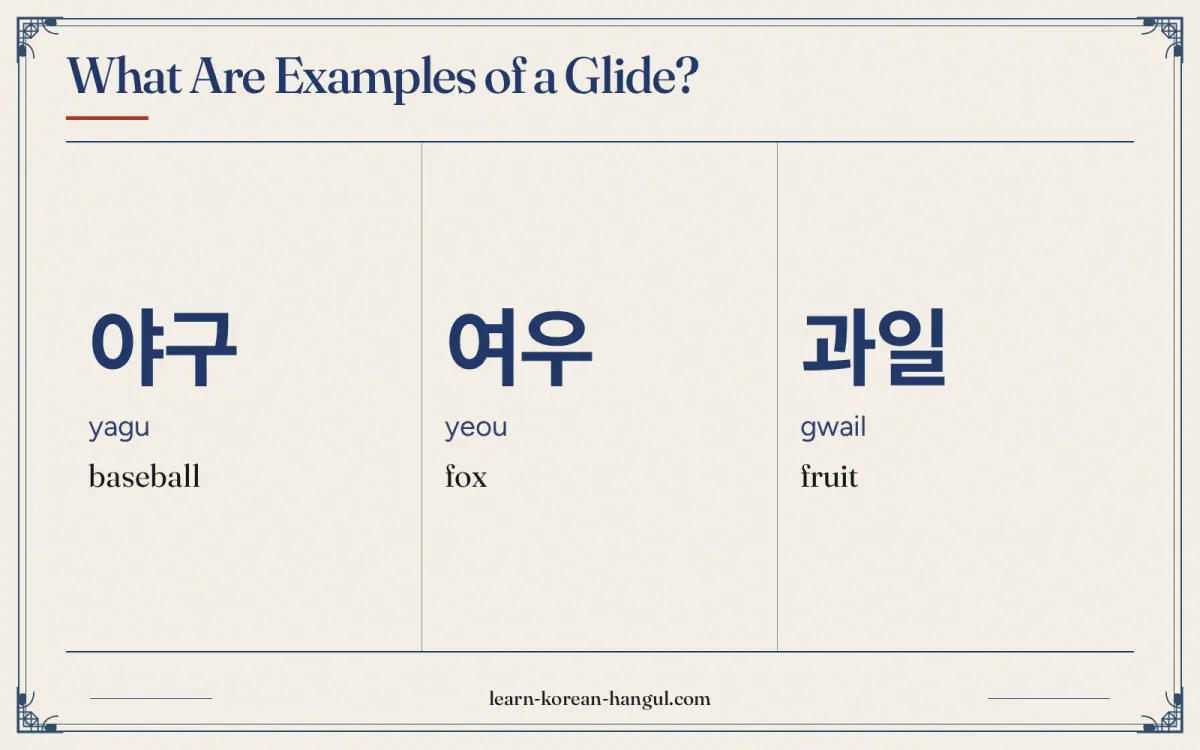
Four words show both glides.
야구
yagu
baseball
여우
yeou
fox
과일
gwail
fruit
뭐
mwo
what
Listen for the short y or w at the start of the vowel. It lasts about as long as it takes to move the lips or tongue, and it is much shorter than the vowel after it.
What Do Learners Get Wrong about Glides?
The usual error is to treat the glide as a full separate sound. A learner reading ㅑ as "ee-ah" says two syllables. In Korean it is one beat: the "y" slides into the vowel.
- Sounding the glide too long. In 과일 the [w] is quick. Say "gwa", not "goo-ah".
- Dropping the glide. Saying ㅛ as ㅗ changes the word: 요리 (yori, cooking) and 오리 (ori, duck) are two different words.
- Using English "j" for the y-glide. The Korean y-glide is the "y" of "yes". The English letter "j" stands for a different sound.
For fuller drills, see the lessons on y-glide vowels and w-glide vowels. This page does not cover how the glide interacts with consonants, such as why 져, 쪄 and 쳐 are spoken [저], [쩌] and [처] (Standard Pronunciation Rules, Article 5).
Frequently Asked Questions
What is a glide? A glide, or semivowel, is a very short vowel-like sound that slides into the next vowel and cannot form a syllable alone. Korean has two: the y-sound [j], heard at the start of 야, and the w-sound [w], heard at the start of 와. They are the building blocks of the Korean diphthongs.
Is y a vowel in Korean? No. Korean has no letter for y by itself. The y-sound is written by adding a stroke to a basic vowel, so ㅏ becomes ㅑ. Phoneticians count it as a glide, a half vowel that only exists as part of a combined vowel. Each combined letter is one syllable beat, not two.
What is 반모음? 반모음 (banmoeum) is the Korean term for glides. It means "half vowel", because the sound behaves like a vowel but cannot carry a syllable alone. Learners can use the English word glide, which the lessons use throughout. The Korean term is useful later, because Korean grammar books describe the vowels ㅑ ㅕ ㅛ ㅠ by it.
How long is a glide? A glide is clearly shorter than a full vowel. In 야 the [j] is a quick slide that lasts about as long as the tongue takes to move, and the vowel follows at normal length. Making the glide too long splits the sound into two syllables, which sounds foreign in Korean.
Related Terms and Lessons
Glide meaning is the foundation of diphthong. The practical lessons are y-glide vowels and w-glide vowels. All terms are listed in the Korean Pronunciation Glossary.