Prosody Meaning in Korean
Sounds come in two layers. The first layer is the individual consonants and vowels, which linguists call segmentals. The second layer is the music laid over them, which is prosody. If you say "really?" flat and then "really?" with a rising voice, the letters are the same and only the prosody differs.
Prosody has three parts. The table shows what Korean does in each.
| Part | What it is | What Korean does |
|---|---|---|
| rhythm | the timing of syllables | often described as syllable-timed, with each syllable of fairly similar length |
| stress | one syllable made prominent in a word | no word stress in Standard Seoul Korean; no syllable is louder by rule (some regional dialects, such as Gyeongsang, use word pitch instead) |
| intonation | the rise and fall of pitch across a phrase | works through accentual phrase units and sentence-final tones |
The rhythm description is common in textbooks, but measurement studies disagree on whether any language is strictly syllable-timed, so treat it as a tendency.
Why Does Prosody Matter for Learners?
Prosody explains why a learner with perfect consonants and vowels can still sound foreign. Much of a foreign accent is prosodic. Listeners judge naturalness by rhythm and melody before they notice a single wrong letter.
Two practical points follow:
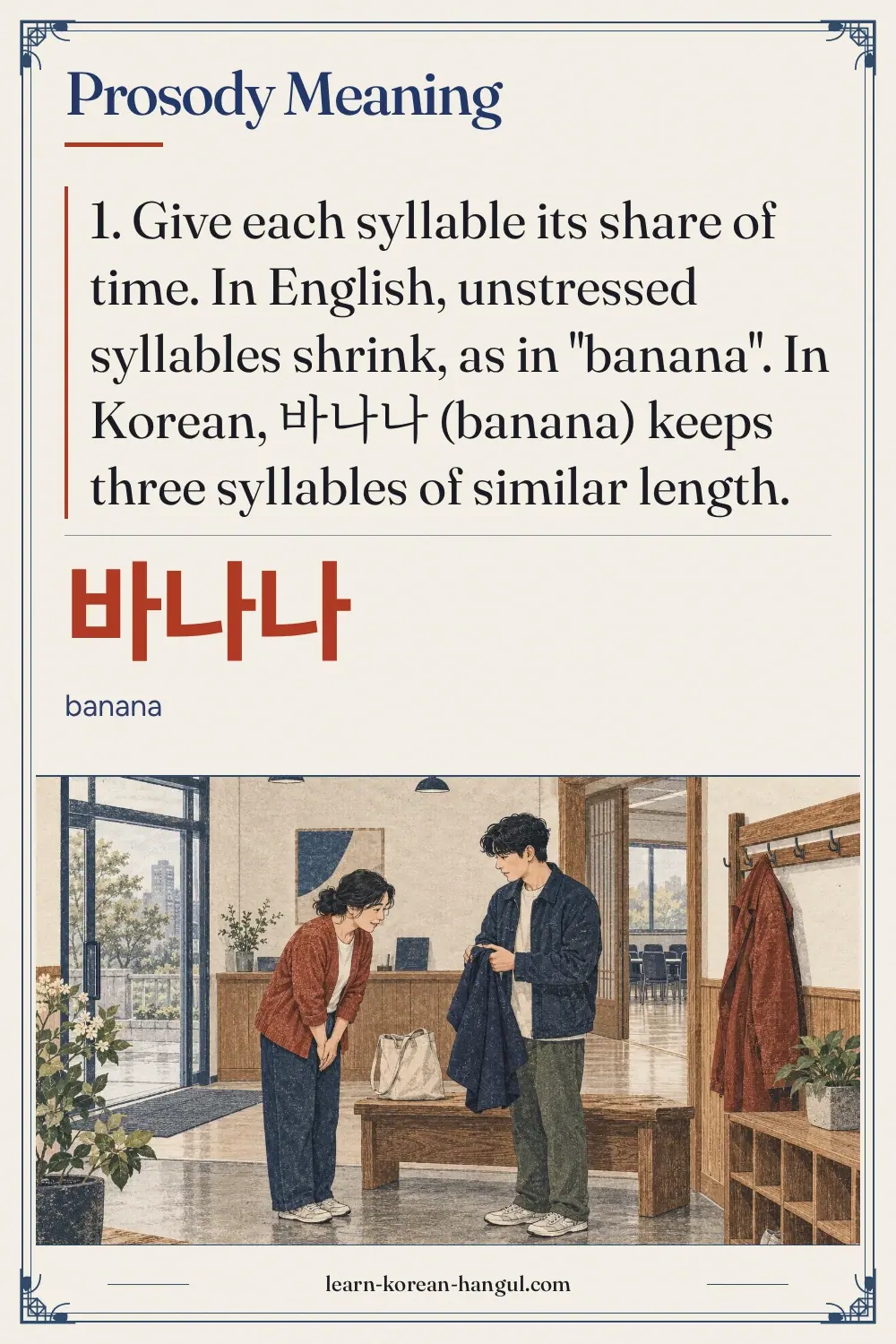
- Give each syllable its share of time. In English, unstressed syllables shrink, as in "banana". In Korean, 바나나 (banana) keeps three syllables of similar length.
- Match the sentence-final tone. A statement falls, and a question rises. Even when the words are identical, the meaning changes with the final tone.
The lesson on Korean intonation teaches the tones in order.
Prosody Versus Segmental Sounds
The nearest confusable idea is the segmental, the individual sound.
| Feature | Segmental | Prosody |
|---|---|---|
| Unit | one consonant or vowel | a syllable group, phrase or sentence |
| Written in Hangul | by letters | mostly by punctuation, such as ? |
| Example | the ㄱ in 가 | the rise on 먹었어요? |
| Learned from | the alphabet lessons | listening and imitation |
Hangul writes segmentals only. Almost no prosody is on the page, which is why you have to listen for it.
What Are Examples of Prosody?
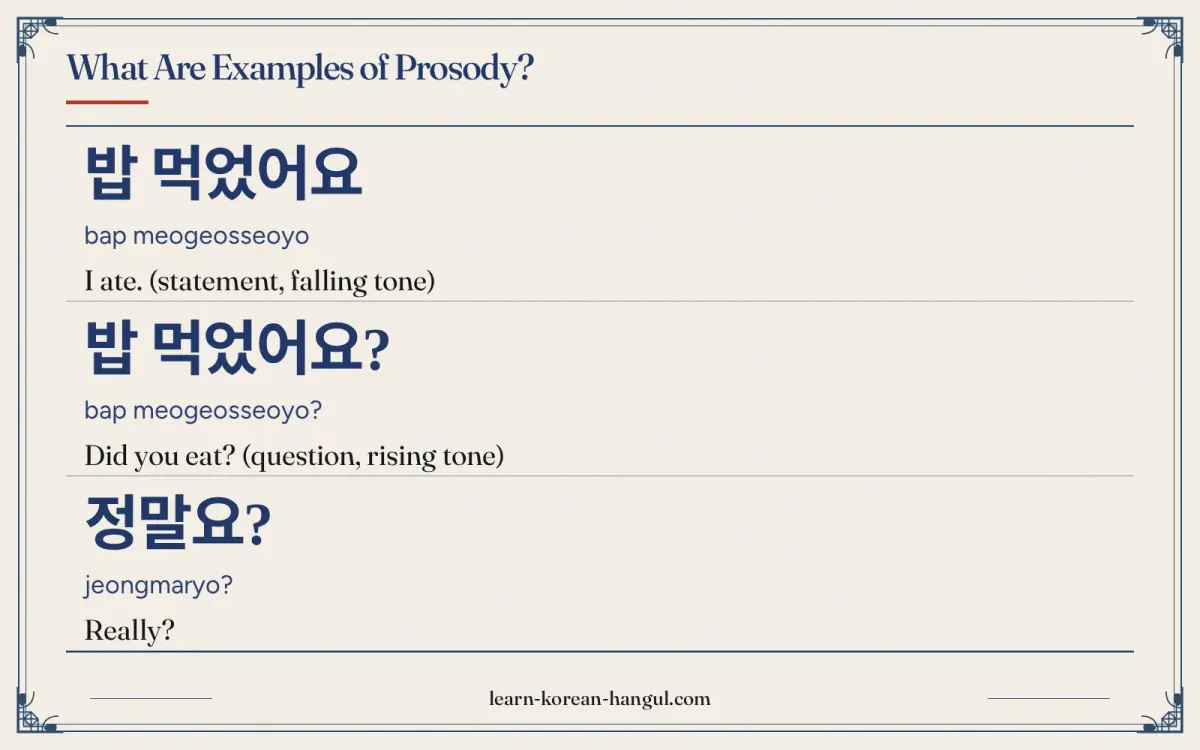
The same words with two different final tones show prosody at work.
밥 먹었어요
bap meogeosseoyo
I ate. (statement, falling tone)
밥 먹었어요?
bap meogeosseoyo?
Did you eat? (question, rising tone)
정말요?
jeongmaryo?
Really?
Only the melody distinguishes the first two. This is the clearest case of prosody doing a grammar job in Korean, since written Korean marks it only with the question mark.
What Do Learners Get Wrong about Prosody?
The commonest error is to carry English stress into Korean, stressing one syllable of each word. A second is to read Korean as flat, because no stress marks guide you.
- Assuming prosody is a luxury. Wrong tones can turn a statement into a question.
- Overlooking the phrase. Korean melody works on word groups, not on single words.
- Copying stress from a romanization. Revised Romanization shows no stress, because Standard Korean has no word stress to show.
This entry defines the term and does not teach intonation patterns. For the question of stress in Korean words, see pitch accent, which compares pitch-based word systems.
Frequently Asked Questions
What is prosody? Prosody is the rhythm, stress and intonation of speech, the melody laid over individual consonants and vowels. It decides whether a sentence sounds like a statement or a question and whether speech sounds natural. Hangul records the segmental sounds, so prosody must be learned by listening.
Does Korean have prosody? Yes, every language does. Korean has no word stress, so its prosody is built from syllable rhythm, accentual phrases and sentence-final tones. A statement such as 밥 먹었어요 falls at the end, and the same words as a question rise. The pitch of the whole phrase carries that meaning.
Is prosody harder than sounds? It can be, because it is not written. Learners can see ㄱ and ㅏ on the page, but nothing on the page shows the melody. It also takes longer to notice. The good news is that Korean prosody has no stress to master, so the main task is to listen for phrase melody and final tones.
What is a segmental? A segmental is an individual consonant or vowel, the unit that letters represent. Prosody is the opposite layer, which spreads over several segmentals. Learning the alphabet teaches segmentals, and listening practice teaches prosody. The two are learned together, because every real word has both.
Related Terms and Lessons
Prosody meaning leads into accentual phrase and pitch accent. The full lessons are in Korean intonation. All terms are listed in the Korean Pronunciation Glossary.