
Accentual Phrase Meaning in Korean
Say "I went to school" in Korean: 학교에 갔어요. The speech does not run flat. It rises and falls in small waves, and each wave covers a short group of syllables. That group is the accentual phrase, often shortened to AP.
An AP usually contains one content word and the particles or endings that attach to it. So 마리아가 (Maria-ga, "Maria" plus the subject particle) is one AP, and 학교에 (hakgyo-e, "to school") is another.
Research on Seoul Korean describes a typical pitch pattern. A four-syllable AP often goes low, high, low, high, written LHLH. The first high falls on the second syllable and the second high falls on the last syllable.
마  리  아  가
L   H   L   H
That pattern is typical, not a fixed rule. Short phrases compress it, and long phrases repeat it. When the first sound of the phrase is tense, aspirated, ㅅ or ㅎ, research reports that the first tone is often high instead of low. 학교에 is an example: it starts with ㅎ, so its first syllable is often already high. The pattern also varies with speaker and style.
What System Describes the Pattern?
Researchers use K-ToBI, short for Korean Tones and Break Indices, to label pitch and phrase breaks in Korean speech. It records the tone of each syllable and the strength of the break after each phrase. The accentual phrase is its smaller unit. K-ToBI is a research tool. You do not need it to learn Korean.
Accentual Phrase Versus Intonational Phrase
The larger unit is the intonational phrase, abbreviated IP.
| Feature | Accentual phrase | Intonational phrase |
|---|---|---|
| Size | a word plus its particles | one or more APs |
| Ends with | a small pitch rise or fall | a clear pause and a final tone |
| Example | 학교에 | 학교에 갔어요 |
| Job | groups a word | groups a clause or sentence |
Several APs form one IP. In 학교에 갔어요, there are two APs, 학교에 and 갔어요, and one IP. The final tone of the IP is where a question rises or a statement falls.
What Are Examples of an Accentual Phrase?
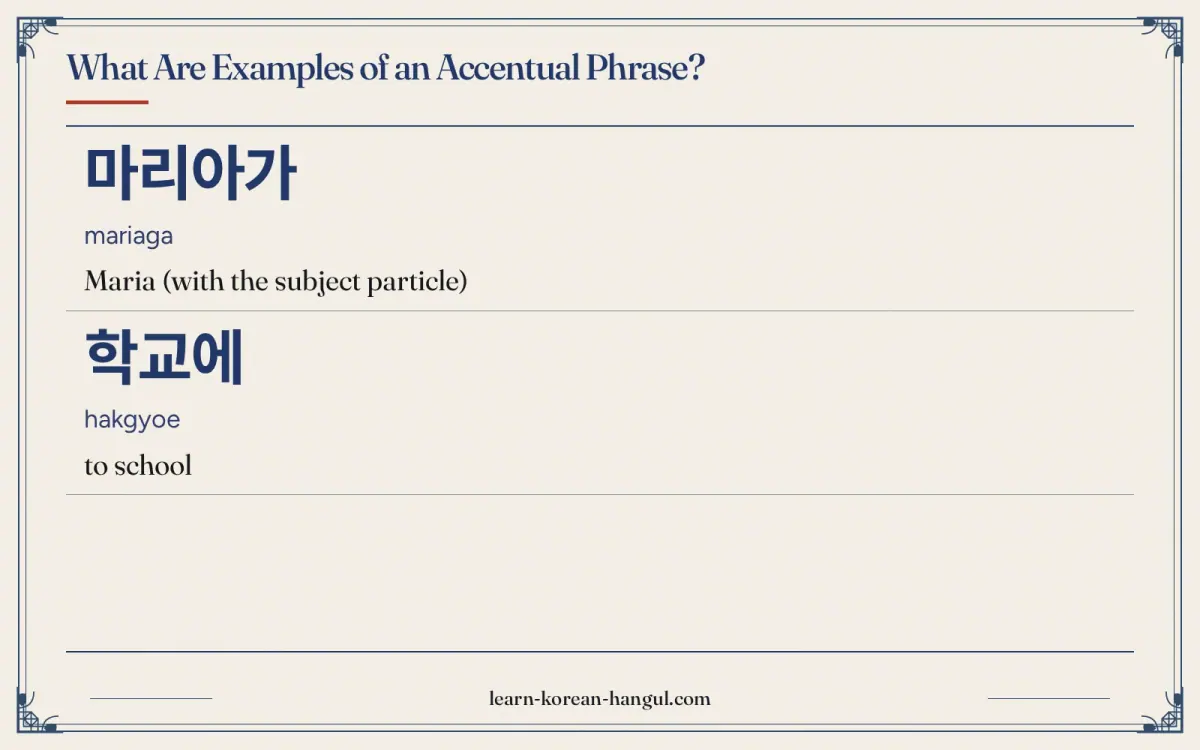
Two phrases show the typical shape.
마리아가
mariaga
Maria (with the subject particle)
학교에
hakgyoe
to school
Listen for the small rise toward the end of each phrase, then the drop at the phrase boundary. If you hear the sentence as a string of small hills instead of a flat line, you have found the accentual phrases.
What Do Learners Get Wrong about the Accentual Phrase?
The common error is to put English-style stress on one syllable. English stress is loud and long on one syllable of each word. Seoul Korean has no such word stress. The prominence comes from the pitch pattern over the whole phrase.
- Stressing the first syllable. A heavy stress on 마 in 마리아가 sounds foreign.
- Separating the particle. Reading 학교 and 에 as two units breaks the phrase.
- Expecting the same pitch in every dialect. The pattern is described for Seoul speech. Gyeongsang speakers use a different system, discussed under pitch accent.
Learners do not need to master the accentual phrase to be understood. It matters for natural rhythm and for advanced listening.
Marked as an advanced entry, this page covers one unit only. It does not describe sentence-final tones or focus. For the lesson, see the Seoul accentual phrase.
Frequently Asked Questions
What is an accentual phrase? An accentual phrase is a short group of syllables, usually one word plus its particles, with a typical pitch pattern in Seoul Korean. A four-syllable phrase often runs low, high, low, high. Phrases group the speech into small waves of pitch, which gives Korean its natural melody.
What is K-ToBI? K-ToBI stands for Korean Tones and Break Indices, a system researchers use to label the pitch and phrase breaks of Korean speech. It marks the tone of syllables and the strength of the break after each phrase. It is a research tool, and learners can follow every lesson on this site without it.
Is it the same in all dialects? No. The accentual phrase pattern is described for Seoul Korean. The Gyeongsang dialect uses a different system in which individual words carry pitch patterns, which is called pitch accent. Other regional dialects vary as well, so a pattern that fits Seoul speakers should not be assumed for every speaker.
Do learners need it? Not at the start. Learners are understood without it, because in Seoul Korean the phrase pitch pattern does not tell one word from another. It helps later, for sounding natural and for listening to fast speech. A good first step is to say a word and its particle as one unit, with a gentle rise, not as two separate words.
Related Terms and Lessons
Accentual phrase meaning belongs under prosody, the study of rhythm and melody. The contrasting system is pitch accent, and the practical lesson is the Seoul accentual phrase. All terms are listed in the Korean Pronunciation Glossary.