Key facts
- The release comes back before a vowel: 밥 is unreleased, but 밥이 is pronounced [바비].
- An unreleased stop is not silent; the closure is made and only the burst is missing.
Unreleased Stop Meaning in Korean

A stop is a consonant made by blocking the air completely. A normal stop has three phases: closing the mouth, holding the closure, and releasing it with a small burst. An unreleased stop skips the third phase. The mouth stays closed and the sound simply ends.
Korean has three unreleased stops, named by the part of the mouth that closes:
| Mouth part | Final sound | IPA | Example |
|---|---|---|---|
| back of the tongue | ㄱ | [k̚] | 책 (book) |
| tongue tip | ㄷ | [t̚] | 옷 (clothes), pronounced [옫] |
| lips | ㅂ | [p̚] | 밥 (rice) |
Hear the final ㅂ in 밥.
The Korean term for this class of sound is 불파음 (bulpaeum, "non-burst sound"). Many different final letters end in one of these three stops, a process described on the page about final consonant neutralization. Next, the sound that unreleased stops are most often confused with.
Unreleased Versus Released Stops
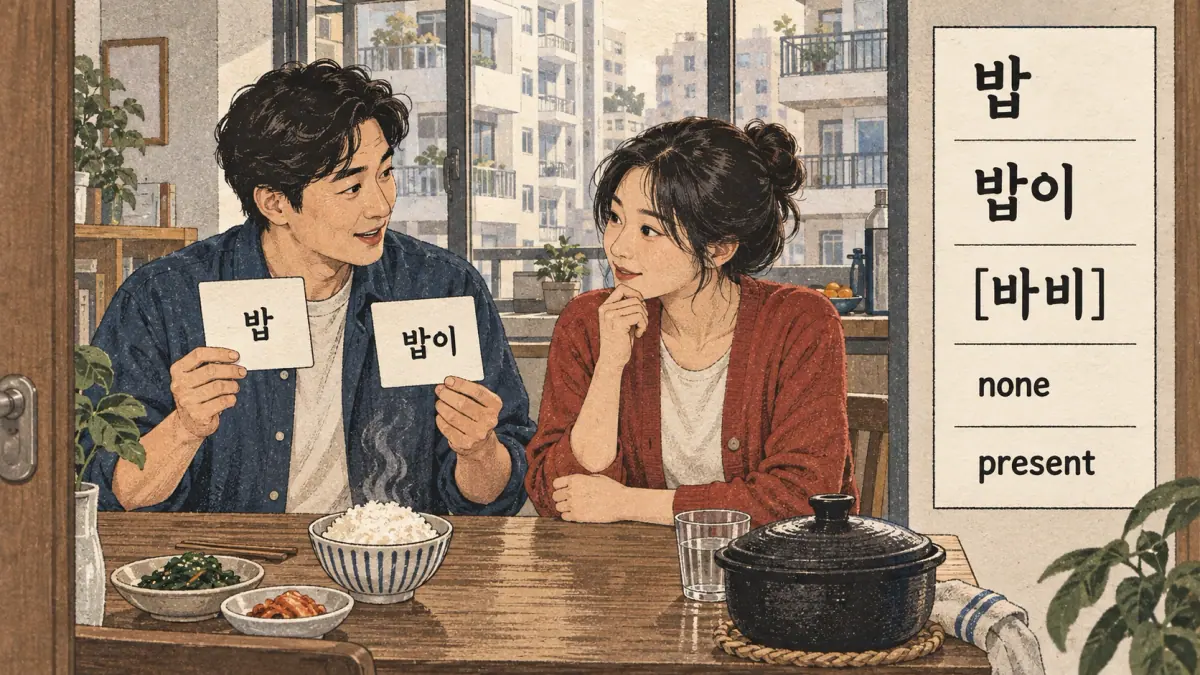
An unreleased stop is a stop at the end of a syllable with no burst, while a released stop has a burst and, in Korean, appears before a vowel. The same letter can be both, depending on the next sound.
| Feature | Unreleased stop | Released stop |
|---|---|---|
| Burst of air | none | present |
| Position in Korean | end of a syllable | start of a syllable |
| Example | 밥, final [p̚] | 밥이 [바비] |
| Next sound | silence or a consonant | a vowel |
The example in the last row shows the key rule. When a vowel follows, the final consonant moves to the next syllable and is released: 밥이 is pronounced [바비], with the lips opening into the vowel. When nothing follows, the lips stay closed. The examples below let you hear it.
What Are Examples of Unreleased Stops?

Four words show the contrast between closed and opened endings.
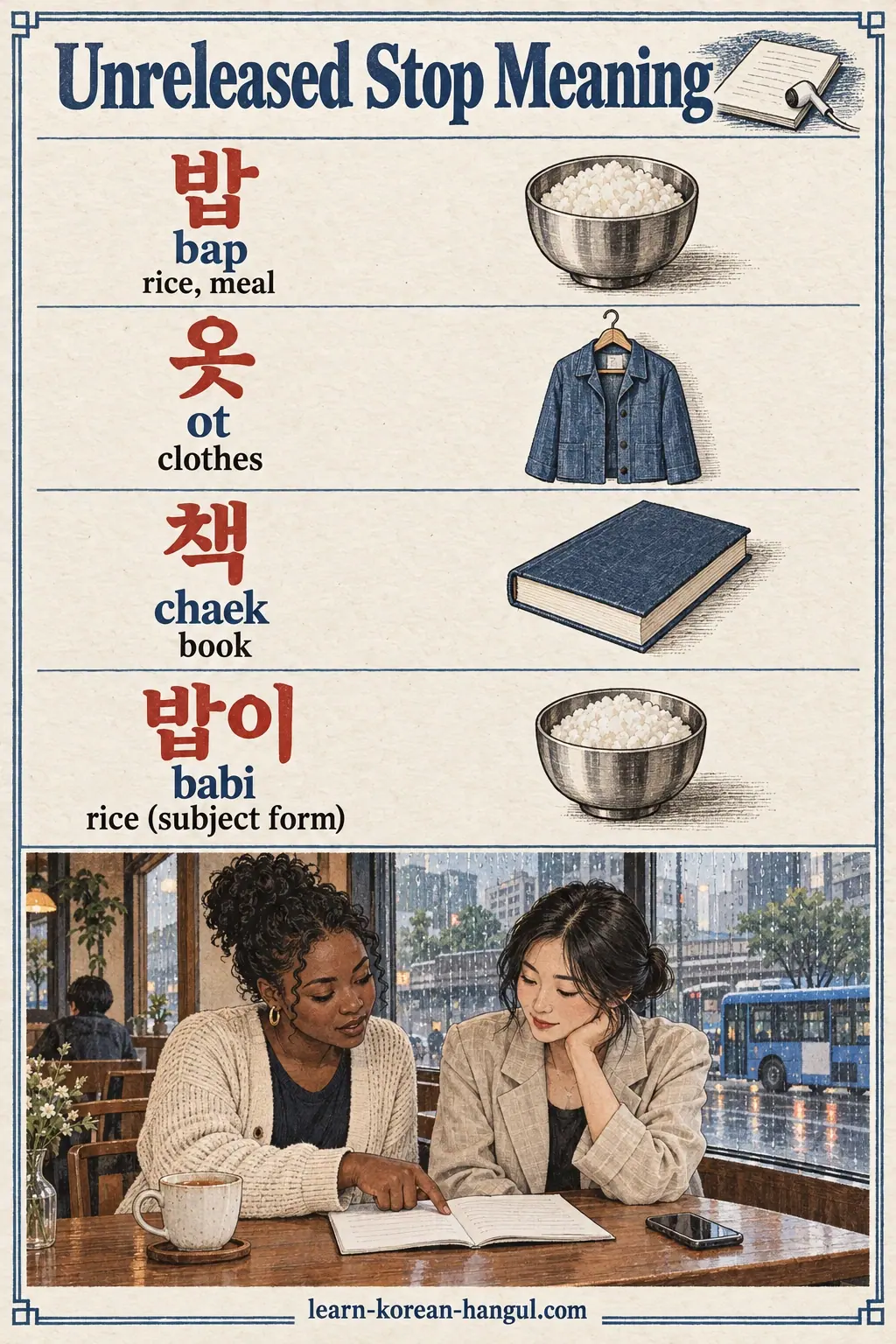
밥
bap
rice, meal
옷
ot
clothes
책
chaek
book
밥이
babi
rice (subject form)
In 옷 the final letter is ㅅ, but the sound is the tongue-tip stop, so the word is pronounced [옫]. In 밥이 the ㅂ is no longer final, so it is released. Practise by saying 밥, then 밥이, and noticing when the lips open. That habit prevents the most common mistake.
What Do Learners Get Wrong about Unreleased Stops?

Learners often assume that a final stop is "silent" and drop it. The closure is made, though, and a Korean listener hears the difference between 밥 and 바 by the shape of the vowel and the abrupt end. Do not leave out the final consonant; close the mouth for it.
Two other errors are common:
- Releasing the stop with a puff. English speakers often add a small puff after final "p", "t" and "k". In Korean, a puff after 밥 can sound like an extra syllable, closer to 바프.
- Thinking English never does this. English often leaves a final stop unreleased, as in the t of "that" in "that car", but speakers can choose to release it. Korean speakers do not choose; the rule is fixed.
Remember that the closure is the sound. The questions below cover the next steps.
Frequently Asked Questions

What is an unreleased stop? An unreleased stop is a stop consonant that you close but do not open with a burst of air. The lips, tongue tip or back of the tongue block the air, and the sound ends there. Korean uses unreleased stops for the final ㄱ, ㄷ and ㅂ in words such as 책, 옷 and 밥.
Which Korean sounds are unreleased? The three final stops are unreleased: the back-of-tongue stop written [k̚], the tongue-tip stop [t̚] and the lip stop [p̚]. Many spellings lead to them, including ㅋ, ㄲ, ㅅ, ㅈ, ㅊ, ㅌ, ㅎ, ㅍ and others, as final consonant neutralization explains. The nasal finals ㄴ ㅁ ㅇ and the liquid ㄹ are not stops.
How do I make an unreleased stop? Say the word 밥 and close your lips for ㅂ, then stop. Do not open your lips or push air out. Your mouth stays closed and the word ends in silence. If a puff escapes when you finish, you have released the stop. Practise with 책, 옷 and 밥 until each ends cleanly.
Is it silent? No, though it can feel silent. The closure itself changes the vowel before it, which is how listeners hear the final stop. The only missing part is the burst of air after the release. The sound of 밥 is shorter and more abrupt than an English "bop", and the vowel is cut off by the closed lips.
Related Terms and Lessons
Unreleased stop meaning belongs with the batchim lessons: unreleased consonants shows the sound in practice and representative sounds lists which spellings lead to each stop. The related glossary term is final consonant neutralization. Find every other sound term in the Korean Pronunciation Glossary.