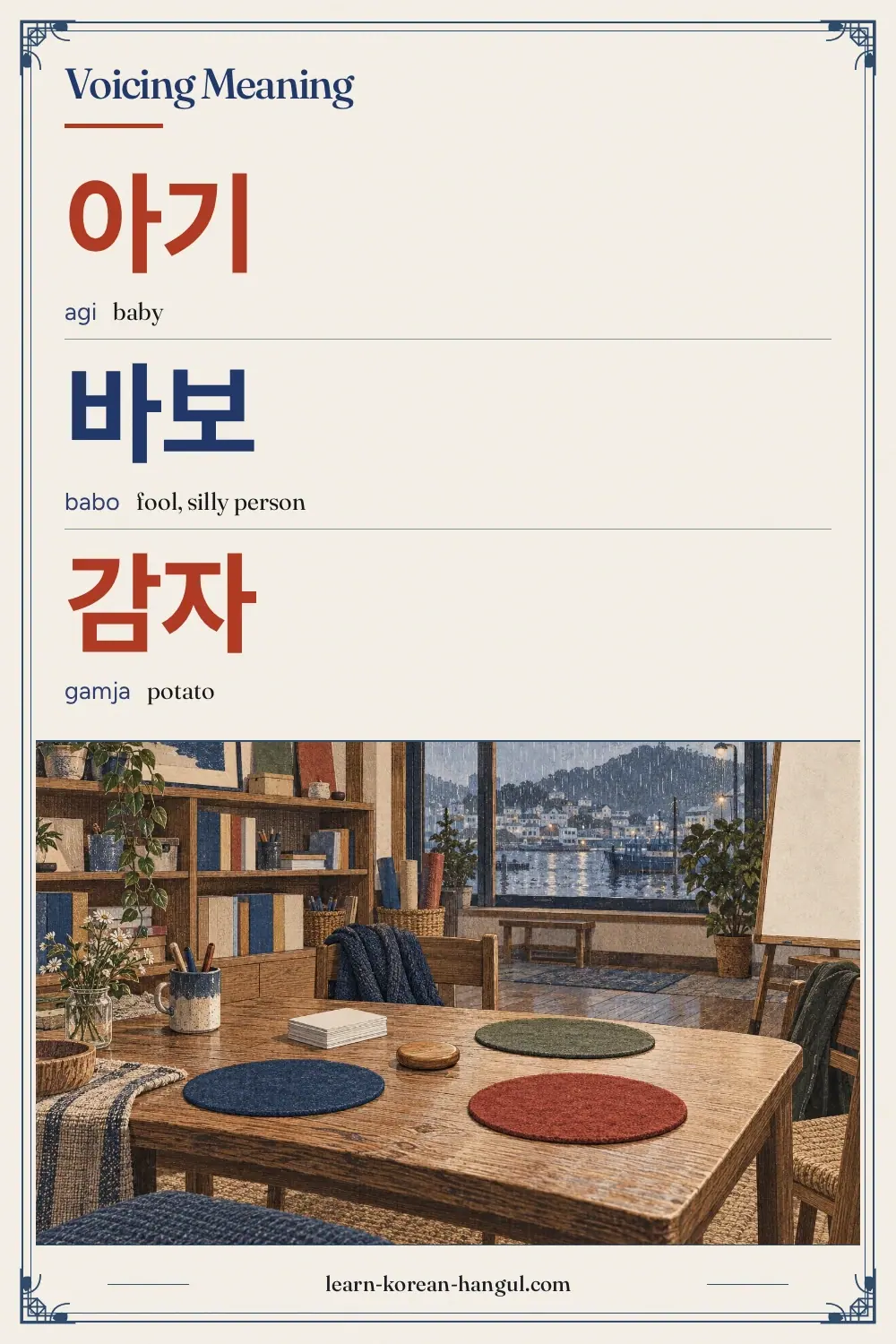
Voicing Meaning in Korean
Voicing happens in the larynx, the box of tissue in the throat that holds the vocal cords. When the cords vibrate, the sound is voiced. When air passes without vibration, the sound is voiceless. English "z" is voiced and "s" is voiceless, and the mouth shape is the same for both.
You can feel the difference. Rest one finger on your throat and say a long "zzz", then a long "sss". The first buzzes under your finger and the second does not.
Korean applies this in a pattern rather than in spelling. Vowels, the nasals ㄴ ㅁ ㅇ and ㄹ are voiced almost all the time. The plain stops ㄱ ㄷ ㅂ and the plain affricate ㅈ are voiceless at the start of a word and usually voiced between voiced sounds. Hear the voiced ㄱ in 아기 (agi, baby).
Voicing for plain stops shows up in four places: between two vowels (아기), after a nasal (감자, gamja, potato), after ㄹ (달걀, dalgyal, egg) and, in general, between any voiced sounds. The tense consonants ㄲ ㄸ ㅃ ㅉ and the aspirated consonants ㅋ ㅌ ㅍ ㅊ stay voiceless in all of these places. Because Korean has one letter for each plain stop, the spelling ㄱ covers both the voiceless and voiced versions. See the lesson on consonant voicing for the full set of positions.
Why Does Voicing Matter for Learners?
Voicing explains why one Korean letter sounds like "g" in one word and like "k" in another. It also explains why Revised Romanization, the official Latin spelling system, writes ㄱ as g before a vowel and as k before a consonant or at the end of a word (아기 agi, 책 chaek, book). The writing follows the position, so learners do not need to memorize two letters.
For English speakers the point is a warning. English uses voicing to separate "bat" from "pat", so listeners expect a buzz to be the key cue. Korean does not work that way. Its three-way contrast of plain, tense and aspirated stops depends on tension and breath, not on a buzz. The next section sets the two ideas side by side.
Voicing Versus Aspiration
Aspiration is a puff of breath after a stop is released. Voicing is vocal-cord vibration. The two are different features, and the timing term that links them is voice onset time.
| Feature | Voicing | Aspiration |
|---|---|---|
| What it is | cord vibration | puff of air after release |
| How to feel it | finger on throat | paper held at the lips moves |
| Role in English | separates b/p, d/t, g/k | marks p, t, k at the start of stressed syllables |
| Role in Korean | background habit between voiced sounds | separates ㅋ from ㄱ and ㄲ |
| Example | 아기 (agi) | 카 (ka) versus 가 (ga) |
Notice that the Korean letter ㅋ is aspirated and voiceless, while the ㄱ in 아기 is voiced and not aspirated. Those two facts do not conflict, because they describe two separate features.
What Are Examples of Voicing?
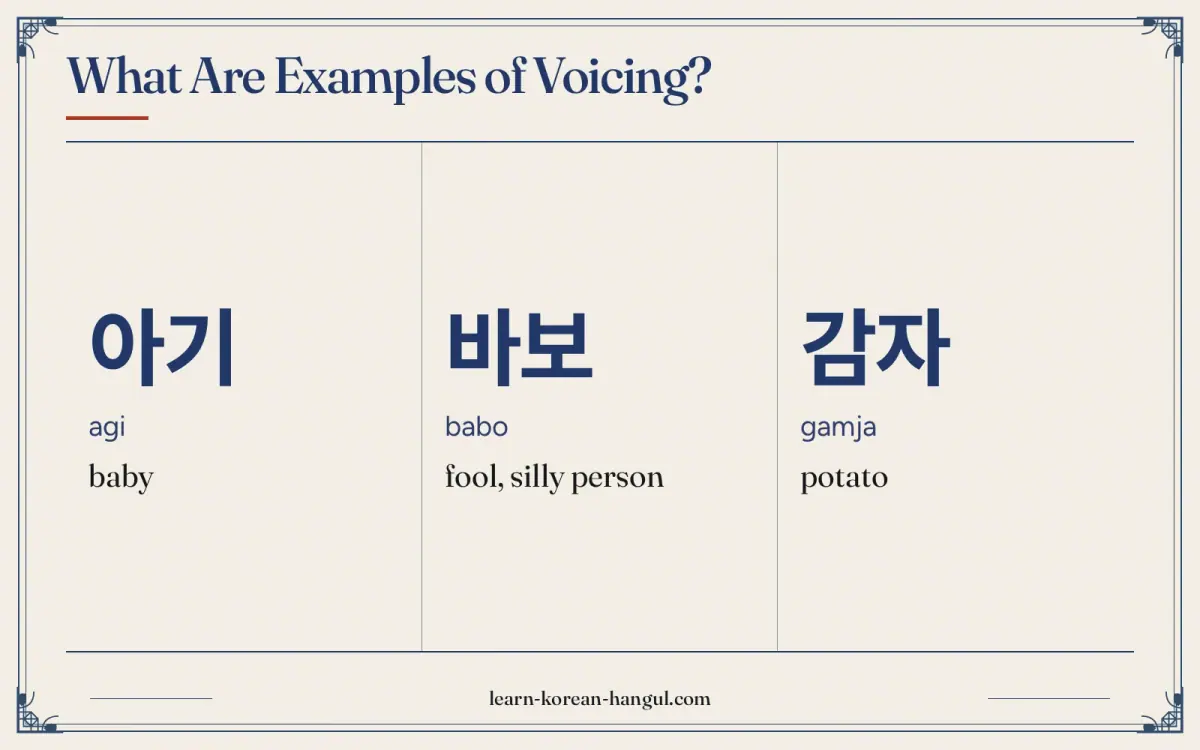
Three words show plain stops voiced inside a word. One word shows the stop at the end, where it is not voiced.
아기
agi
baby
바보
babo
fool, silly person
감자
gamja
potato
밥
bap
cooked rice, meal
In 바보 the same letter ㅂ has two sounds. The first is voiceless and the second buzzes, so the word is spoken roughly as [pabo]. In 밥 the final ㅂ closes the lips and stops, with no buzz and no release.
What Do Learners Get Wrong about Voicing?
Learners often assume that ㄱ is "g" and ㅋ is "k", as in English, then wonder why Korean speakers cannot hear the difference between "g" and "k" in a word like 아기. Korean has no contrast based on voicing alone: [k] and [g] are two forms of the one letter ㄱ, chosen by position, so speakers do not notice the switch.
Other common errors:
- Forcing a buzz at the start. Saying 가 with an English hard "g" adds voicing that a Korean plain stop does not have in that place. It can sound foreign, although it is easy to understand.
- Dropping the buzz in the middle. Saying 아기 with a hard, tight "k" in the middle pushes it toward tense ㄲ, which makes a different syllable.
- Thinking tense means voiced. ㄲ is voiceless and tight. Tension, not voicing, makes it different.
This page covers the sound feature only. Pitch, vowel length and dialect variation lie outside its scope.
Frequently Asked Questions
What is voicing? Voicing is the vibration of the vocal cords during a speech sound. A voiced sound such as "z" or a vowel buzzes in the throat, while a voiceless sound such as "s" does not. In Korean, voicing is a background habit that depends on the sounds around a consonant, not on which letter is written.
Which Korean sounds are voiced? Vowels, the nasals ㄴ ㅁ ㅇ and ㄹ are voiced nearly always. The plain stops ㄱ ㄷ ㅂ and the affricate ㅈ are voiced between voiced sounds, as in 아기. Tense and aspirated stops stay voiceless. Plain stops are also voiceless at the start of a word and at the end of a syllable.
Does Korean have b and p letters? Korean has ㅂ, ㅃ and ㅍ, but none of them is a "b" or "p" in the English sense. Plain ㅂ is voiceless at the start of a word and voiced between vowels, so one letter covers both. Revised Romanization writes it as b before a vowel and p before a consonant or at the end of a word.
How do I feel voicing? Place one finger on the front of the throat and say "zzz". You feel a buzz. Then say "sss" and the buzz stops. Try 아기 and 카 the same way. The ㄱ in the middle of 아기 gives a faint buzz, while the ㅋ in 카 gives a puff of air instead.
Related Terms and Lessons
Voicing meaning connects to three other pages. The timing measure is voice onset time. The base series of stops is explained under plain consonant. The practical lesson is consonant voicing. All sound terms are listed in the Korean Pronunciation Glossary.