
Voice Onset Time Meaning in Korean
Say 달. Your tongue touches the ridge behind the upper teeth, then releases. The release is the moment the air bursts out. The vocal cords start vibrating for the vowel a moment later. The gap between the release and the start of vibration is the voice onset time, or VOT. Phoneticians, the people who study speech sounds, measure it in milliseconds.
VOT works as a ruler for stops. A short gap means the vowel starts almost at once. A long gap means a stretch of breath comes first. Korean uses this ruler to keep three kinds of stop apart.
| Korean stop type | Letters | VOT | What you hear |
|---|---|---|---|
| tense | ㄲ ㄸ ㅃ | shortest | tight, no puff of breath |
| plain | ㄱ ㄷ ㅂ | middle | soft, light breath |
| aspirated | ㅋ ㅌ ㅍ | longest | strong puff of breath |
This page gives no millisecond values on purpose. Published numbers differ by speaker, word position and study, and none of them is an official figure. The order of the three types is stable and is what a learner needs.
Why Does Voice Onset Time Matter for Learners?
English speakers carry a habit that Korean punishes. English separates "bat" from "pat" mostly by VOT too, but listeners call the result voiced or voiceless. A learner who listens only for a buzz will treat Korean ㄱ and ㅋ as one pair, g and k, and miss the third member, ㄲ. Knowing that VOT is the real measure gives you a better cue to listen for: how long the breath lasts before the vowel.
A second reason is that the cue is changing. Research on Seoul Korean reports that for many younger speakers the VOT of plain and aspirated stops has moved closer together at the start of a word. Those speakers lean more on the pitch of the following vowel: higher after an aspirated or tense stop, lower after a plain one. This is a published trend, not a rule, and researchers still debate how far it has gone. The lesson on consonants and pitch covers the pitch cue.
Voice Onset Time Versus Voicing
VOT and voicing are close relatives and learners often mix them up. Voicing asks whether the cords vibrate during a sound. VOT asks when vibration starts after a release.
| Feature | Voicing | Voice onset time |
|---|---|---|
| Question it answers | do the cords buzz? | how long before the buzz starts? |
| Scale | yes or no | a length of time |
| Korean use | explains ㄱ in 아기 | explains ㄱ, ㄲ, ㅋ at word start |
| Example | 아기 (agi) | 달 / 딸 / 탈 |
The related term aspirated consonant names the stops at the long end of the scale.
What Are Examples of Voice Onset Time?
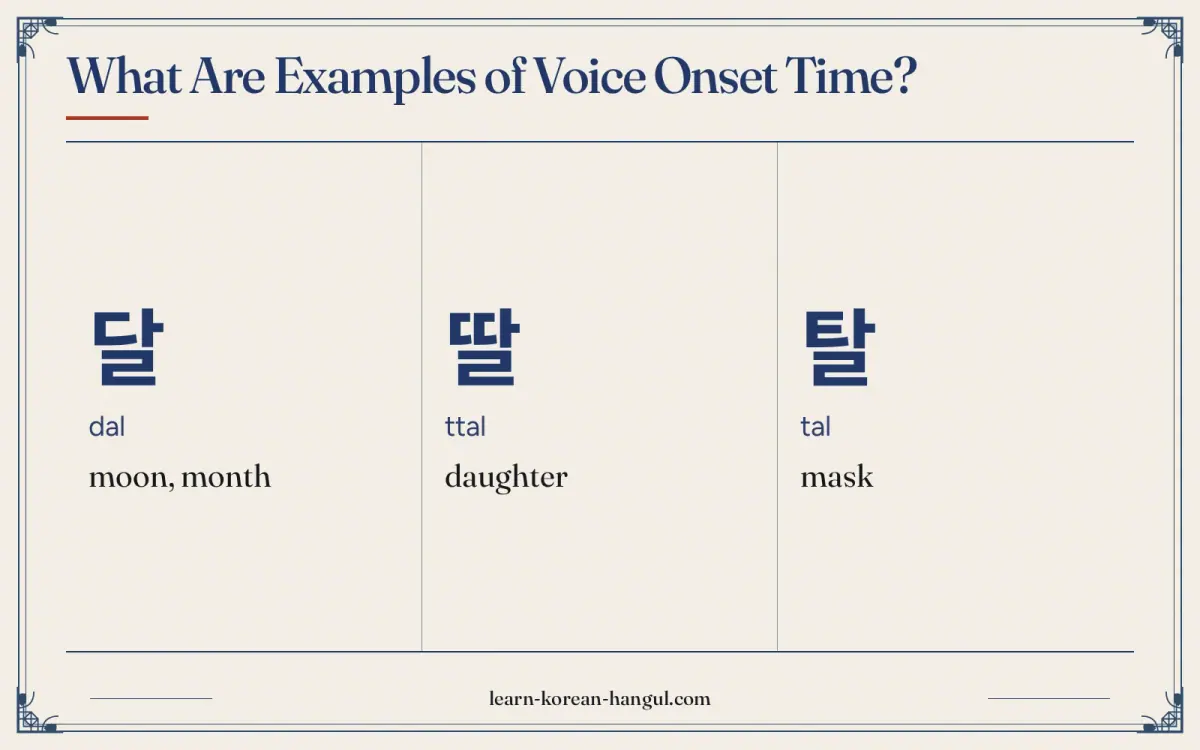
The classic Korean set is three words that differ only in the first stop. They are spoken at the start of a word, which is where VOT shows the contrast most clearly.
달
dal
moon, month
딸
ttal
daughter
탈
tal
mask
Hear the aspirated ㅋ as well, in 카 (ka).
What Do Learners Get Wrong about Voice Onset Time?
Learners usually make one of three mistakes:
- Hearing 달 and 탈 as the same word. The plain ㄷ is not voiced like English "d", so it can sound like "t". Listen for the breath, not the buzz.
- Making ㄸ with a hard push. Tense stops are short in VOT and tight in the throat. A strong puff turns them into aspirated ㅌ.
- Treating VOT as a beginner skill. VOT is a research measure. Beginners do not need to time anything. They need to hear three levels of breath.
This page does not teach how to measure VOT with software. It defines the term so that lesson pages can use it.
Frequently Asked Questions
What is VOT? VOT is voice onset time, the delay between releasing a stop and the start of vocal-cord vibration for the vowel. A short gap means the vowel begins at once. A long gap means breath comes first. It is usually measured in milliseconds.
Why does Korean need VOT? Korean has three stops at each place of articulation: plain, tense and aspirated. English has two. VOT is one of the clearest measures separating the three, so it explains why 달, 딸 and 탈 are different words even though none of them depends on a vocal-cord buzz.
Is VOT a cue for beginners? Not directly. Beginners do not need to time anything. They need to hear three levels of breath: none for tense, light for plain, strong for aspirated. VOT is the research name for that difference, and the audio examples on this page let you hear it without any numbers.
What is the VOT of ㅋ? Aspirated ㅋ has the longest VOT of the Korean stops, with a clear puff of breath before the vowel. This page does not quote a number, because published values vary by speaker, word position and study. The reliable fact is the order: tense is shortest, plain is middle, aspirated is longest.
Related Terms and Lessons
Voice onset time meaning is closest to voicing, which asks the simpler yes-or-no question. The practical side is in the lesson on consonants and pitch. All terms are listed in the Korean Pronunciation Glossary.