
What you will learn
- Choose the correct word in 12 nasal and liquid sets with at least 80 percent accuracy (10 or more correct).
- Tell the final nasals ㄴ, ㅁ and ㅇ apart by mouth position.
- Tell a final ㄴ from a final ㄹ.
- Hear initial ㄴ and ㅁ in pairs such as 눈 and 문.
Before you start: you should know the three nasal batchim lessons, ㄴ batchim, ㅁ batchim and ㅇ batchim. Time: about 25 minutes with audio. Audio plays only when you press a button.
Key Facts
- The list has 12 sets of real words: eight with the contrast at the end of the word and four at the start.
- Core final sets: 간 / 감 / 강, 산 / 삼 / 상 and 날 / 남 / 난.
- Initial pairs: 눈 / 문, 날 / 말, 낮 / 맛 and 난 / 만 (ㄴ against ㅁ).
- Final ㄴ and ㄹ pairs: 문 / 물, 신 / 실 and 전 / 절.
- Each word has audio at normal and slow speed.
- Mouth position is the main cue: lips for ㅁ, tongue tip for ㄴ and ㄹ, tongue back for ㅇ.
Last updated: 2026-10-09.
What Are Korean ㄴ ㅁ ㅇ ㄹ Minimal Pairs?
Korean ㄴ ㅁ ㅇ ㄹ minimal pairs are real-word sets in which only a nasal or liquid sound changes. A nasal is a consonant made with air flowing through the nose: ㄴ, ㅁ and the "ng" sound of a final ㅇ. A liquid is a smooth consonant, and ㄹ is the only liquid in Korean. At the end of a syllable it is an l.
Listen to the core nasal trio. The three words differ only in the last sound, and each sound closes the mouth in a different place.
Now add the liquid. Listen to 날, 남 and 난, which end in ㄹ, ㅁ and ㄴ.
Revised Romanization (RR) is the official Latin-letter system for Korean, and it writes these as gan, gam, gang and nal, nam, nan. RR is a learning aid on this page, and the Hangul and the audio are the reference. The next section explains why these sets cause trouble.
Why Do English Speakers Struggle with Nasals and ㄹ?
English speakers struggle because the whole contrast sits in one short final sound, while the vowel before it is almost the same in every word of a set. A listener who waits for a vowel difference hears nothing, and the three nasals blur into one. English has the same three sounds, as in "sun", "sum" and "sung", so the problem is attention, not ability.
A second problem is ㄹ. At the end of a word, ㄹ is an l, but an English speaker who has learned that ㄹ is "r" says a hard r, and the word no longer matches the audio. A third problem is the pair ㄴ and ㅇ. Both are made with the tongue, and no lip movement helps, so a listener must attend to the tongue.
The fix is to train the mouth position alongside the ear. The list of sets comes next.
Which Sets Are Included?
The 12 sets are split into two blocks: eight with the contrast in final position and four with the contrast at the start of the word. Every word is real, and each is common enough to meet in beginner material.
| Block | Set | Meanings | Sounds that differ |
|---|---|---|---|
| Final | 간 / 감 / 강 | liver / persimmon / river | ㄴ ㅁ ㅇ |
| Final | 산 / 삼 / 상 | mountain / three / prize | ㄴ ㅁ ㅇ |
| Final | 날 / 남 / 난 | day / other person / orchid | ㄹ ㅁ ㄴ |
| Final | 신 / 실 / 심 | god, shoe / thread / core | ㄴ ㄹ ㅁ |
| Final | 문 / 물 | door / water | ㄴ ㄹ |
| Final | 공 / 곰 / 골 | ball / bear / valley | ㅇ ㅁ ㄹ |
| Final | 병 / 별 | bottle / star | ㅇ ㄹ |
| Final | 전 / 절 / 점 | before / temple / dot | ㄴ ㄹ ㅁ |
| Initial | 눈 / 문 | eye, snow / door | ㄴ ㅁ |
| Initial | 날 / 말 | day / horse | ㄴ ㅁ |
| Initial | 낮 [낟] / 맛 [맏] | daytime / taste | ㄴ ㅁ |
| Initial | 난 / 만 | orchid / ten thousand | ㄴ ㅁ |
The pairs 간 / 강, 전 / 절 and 문 / 물 are the ones learners usually mix up most often, since they differ by a small tongue movement. That ranking is a typical pattern, not a measurement. A first look at the mouth positions follows.
How Do You Hear Nasals and ㄹ at the End of a Word?
Nasals and ㄹ are heard by naming the mouth position before you answer. Each sound has a different place of closure, and each has a different feel.
| Final sound | Where the mouth closes | Air goes | Feel |
|---|---|---|---|
| ㅁ | lips together | through the nose | hum at the lips |
| ㄴ | tongue tip on the ridge behind the teeth | through the nose | hum behind the teeth |
| ㅇ | back of the tongue against the soft palate | through the nose | hum at the back |
| ㄹ | tongue tip on the ridge, sides open | around the sides of the tongue | open, flowing l |
Use these steps for each set.
- Say the first word and hold the final sound for one beat. Feel where the closure sits.
- Say the second word and hold it. Notice the new position.
- Play the clip and name the position before you choose a word.
- For ㄹ, check that the air flows around the tongue and does not stop.
You will know it worked when you can name the position of a final sound with your eyes shut. A common mistake is to listen only to the vowel, which is nearly the same in all of the words in a set. The start of the word needs its own attention.
What about Initial ㄴ and ㄹ?
Initial ㄴ and ㅁ form real pairs, but initial ㄴ and ㄹ do not, and the reason is how the Korean vocabulary works. Native Korean words rarely start with ㄹ, and many Sino-Korean words that began with ㄹ in older spelling now start with ㄴ or a vowel in South Korea. So 노인 (old person) is spoken with ㄴ, and 이유 (reason) with a vowel. Words that do start with ㄹ are mostly loanwords such as 라면 (ramyeon, instant noodles) and 라디오 (radio).
For that reason, the initial block uses ㄴ and ㅁ, as in 눈 and 문. The hard ㄴ and ㄹ contrast appears inside words and at the end, where 문 and 물 or 전 and 절 are the practice pairs. A rare real pair inside a word is 고리 (ring) and 고니 (swan), but 고니 is uncommon, so the set list leaves it out.
For ㄴ and ㅁ at the start of a word, the cue is the lips: the lips close for ㅁ and stay open for ㄴ. Next, the score.
How Is the Score Used?
The score tells you which of three actions to take: move on, repeat selected sets, or return to the sound lessons. Count one point for each set where you chose the right word at the first listen.
| Score out of 12 | Meaning | Next action |
|---|---|---|
| 10 to 12 | At or above 80 percent | Move on to Korean homophones |
| 7 to 9 | You hear most sets but not all | Repeat only the missed sets, then retest |
| 0 to 6 | The positions are not yet stable | Review the nasal batchim lessons first |
Scores are a self-check, and the page does not judge your pronunciation. A score of 10 or more on two separate days is a sensible sign that you are ready. The worked example takes one trio through the whole task.
Worked Example: 간, 감 and 강
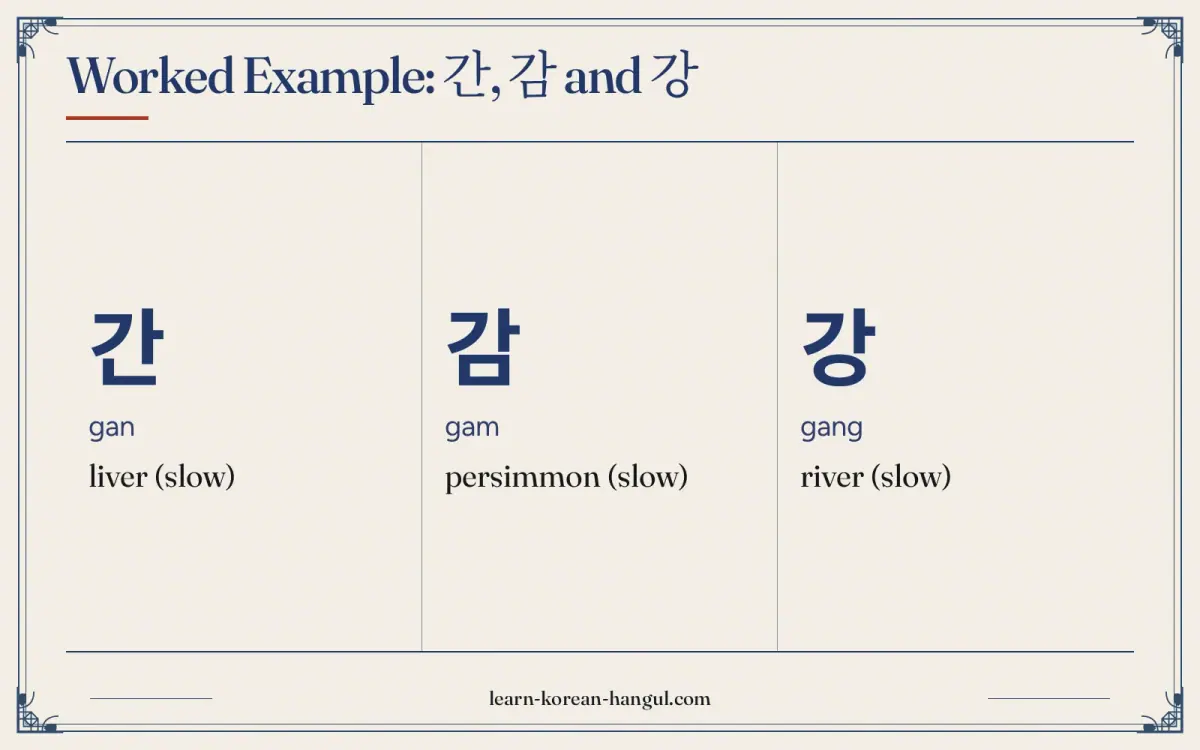
The worked example uses the core nasal trio.
- Listen. Play the three slow clips in order.
간
gan
liver (slow)
감
gam
persimmon (slow)
강
gang
river (slow)
- Name the position. Tongue tip for 간, lips for 감, tongue back for 강.
- Feel it. Say each word and hold the last sound. Your lips should touch for 감 only.
- Choose. A fourth clip plays one of the three. Choose the word you heard.
- Check. If you were wrong, ask which position you missed.
Note that 간 also means "seasoning, saltiness", as in 간이 맞아요 (the seasoning is right), so one spelling carries two meanings. Learners make a set of repeat mistakes with these words.
Common Learner Mistakes
Learners often assume that the vowel changes, as it does in English, so they listen for a vowel difference in 감 and 강. In fact the vowel is the same, and the final nasal is the whole difference. Three more mistakes follow a similar pattern.
- Learners often assume a final ㅇ is silent. Actually the empty ㅇ at the top of a block is silent, but the ㅇ at the bottom is a real "ng" sound, so 강 is not 가.
- Learners often assume the final ㄹ is an r. Actually it is an l with the tongue tip on the ridge, so 물 sounds like "mool".
- Learners often assume 난 is only an uncommon noun. Actually 난 is also the spoken short form of 나는, "I (topic)", and that use is very common.
Test yourself with the full task.
Practice and Answer Key
Use the listening task first, then the reading quiz. The listening task plays one word from a set and asks which word you heard.
Practice · Read
Show answer
간
gan
liver (slow)
Show answer
감
gam
persimmon (slow)
Show answer
강
gang
river (slow)
The reading quiz tests spelling and meaning without audio. Choose the word that matches each meaning.
- Which word means "river": 간, 감 or 강?
- Which word means "water": 문 or 물?
- Which word means "persimmon": 간, 감 or 강?
- Which word means "star": 병 or 별?
- Which word means "door": 눈 or 문?
- Which word means "taste": 낮 or 맛?
- Which word means "bear": 공, 곰 or 골?
- Which word means "temple": 전, 절 or 점?
Answer key: 1. 강. 2. 물. 3. 감. 4. 별. 5. 문. 6. 맛. 7. 곰. 8. 절.
For the speaking task, pick three sets and say each word twice. Hold the last sound and check the mouth position. Common questions follow.
Frequently Asked Questions
How do I tell 감 and 강 apart? Check where the mouth closes. For 감 the lips come together and the hum stays at the lips. For 강 the back of the tongue lifts to the soft palate and the lips stay open. Say both words, hold the last sound for one beat, and feel the difference before you listen again.
Is 난 a common word? As a noun meaning "orchid", 난 is not very common. As a spoken short form of 나는, meaning "I" as a topic, it is extremely common. The list uses the noun because a minimal set needs a single word. Both senses sound the same, and the context shows which one is meant.
How many sets are in the list? The list has 12 sets. Eight put the contrast at the end of the word, such as 간 / 감 / 강, and four put it at the start, such as 눈 / 문. Sets have two or three words each, and every word is a real Korean word with a gloss, audio at two speeds and an answer key.
Is it for beginners? Yes. The words are short, common and written with simple letters, and the level is A1. The task is still demanding, because the ear must learn a new contrast. Beginners should start with 간 / 감 / 강 and 산 / 삼 / 상, then continue to the sets that include ㄹ.
Where to Go Next
The Korean ㄴ ㅁ ㅇ ㄹ minimal pairs above cover nasals and ㄹ only. They do not cover stops, vowels or the initial plain, tense and aspirated contrast, and they do not test pronunciation. For words that sound exactly alike, continue with the last list in the section.
Next in the series: Korean Homophones. To return to the full set of contrasts, see Korean Minimal Pairs.