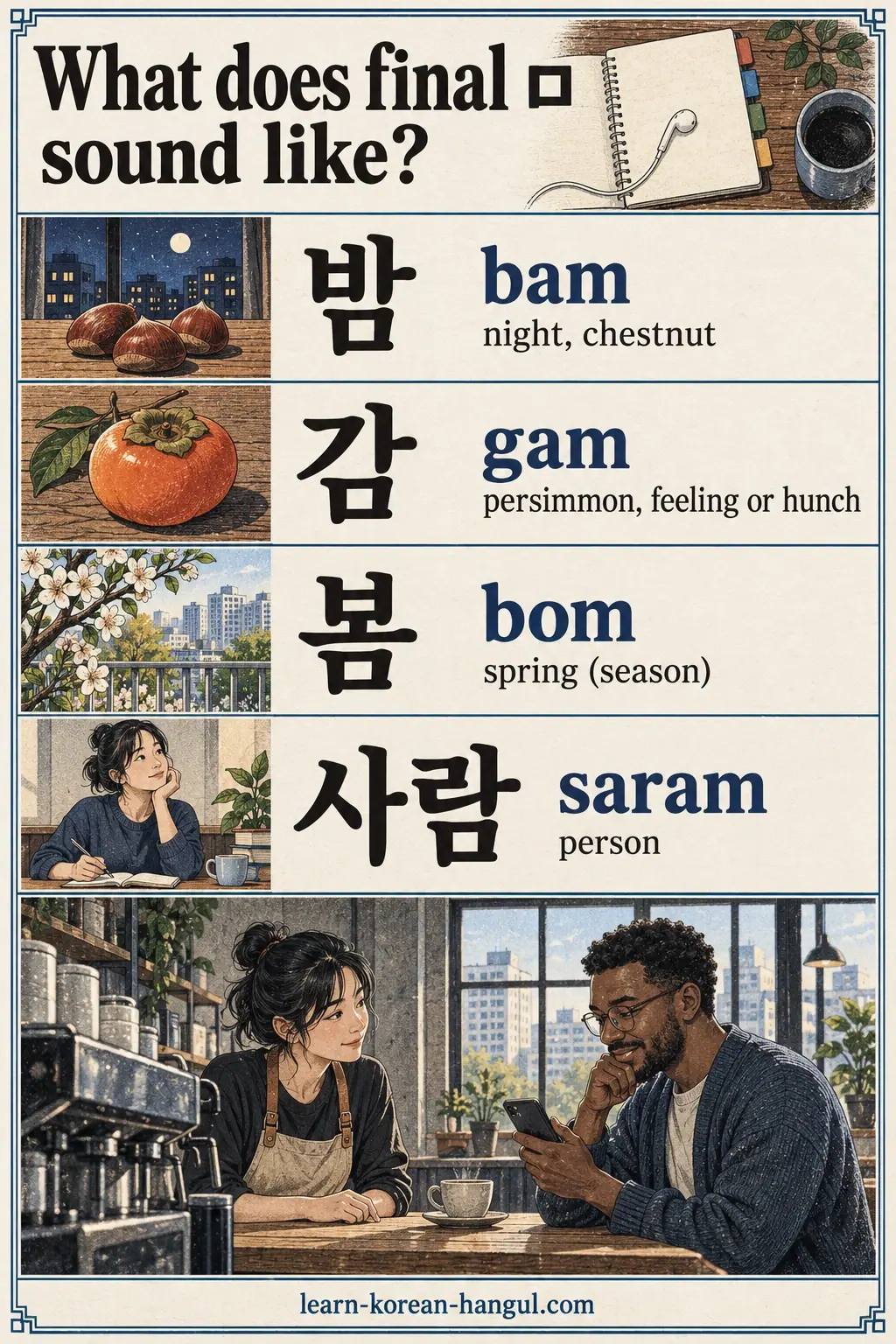
What you'll learn
- Close the lips and hum a clear [m] at the end of 밤, 감, 봄 and 사람.
- Tell final ㅁ apart from final ㄴ and ㅇ in the trio 감, 간, 강.
- Predict the linked forms: 사람이 [사라미], 밤이 [바미], 마음이 [마으미].
- Say 합니다 as [함니다] and explain why ㅂ turns into ㅁ.
Prerequisites: you can read Hangul blocks and know what a batchim is. Time: about 20 minutes.
Listen to five words that end in the closed hum.
English speakers already know this sound. The difficulty is keeping it clean, as the next section shows.
Why English Speakers Struggle with the ㅁ Batchim
English speakers struggle with the ㅁ batchim mainly because of what happens after the lips close. In English, a final "m" is often followed by a faint release, so "room" can end in a tiny "uh". Korean ends the hum and stops.
A second difficulty is distinguishing the three nasal endings. Korean has three: ㅁ (lips), ㄴ (tongue tip) and ㅇ (back of tongue). English has the same three endings, as in "sum", "sun" and "sung". The trouble is that Korean words such as 감, 간 and 강 differ only in the ending, and English-speaking learners often hear ㄴ and ㅇ as the same sound, or let ㅁ and ㄴ blur in fast speech.
A third difficulty is ending on the vowel. Some learners say 밤 as "ba" with a weak lip closure that never fully shuts. The result sounds like 바. The mouth must finish with a visible lip closure.
The fix is a fixed picture: the lips meet, the nose hums, then the mouth stops. The next section describes exactly how it sounds.
What Does Final ㅁ Sound Like?

Final ㅁ sounds like the "m" at the end of English "ham", with the lips closed and air flowing out through the nose. Linguists call this a bilabial nasal (made with both lips, with air through the nose). The hum is steady, so you can sustain it.
| Written | Spoken | RR (aid) | Meaning |
|---|---|---|---|
| 밤 | [밤] | bam | night, chestnut |
| 감 | [감] | gam | persimmon, feeling or hunch |
| 봄 | [봄] | bom | spring (season) |
| 사람 | [사람] | saram | person |
| 마음 | [마음] | maeum | heart, mind |
| 삶 | [삼] | sam | life (double batchim ㄻ) |
Article 8 of the Standard Pronunciation Rules (표준 발음법, 국립국어원) lists ㅁ among the seven representative final sounds. The seven are shown together in The 7 Final Sounds. The double batchim ㄻ reduces to ㅁ as well: 삶 is [삼], and 닮다 (to resemble) is [담따].
The word 감 deserves a note. It has two common meanings, "persimmon" and "feeling or hunch", as in 감이 좋다 (to have a good feeling about something). Both senses sound the same, and context decides.
Here is a quick test for a correct ㅁ batchim. Say 밤 and hold the last sound for a second. Your lips should stay together and you should feel a gentle buzz at the nose. If the sound stops, the nasal was missing. The next section compares ㅁ with the other two nasals.
How Is Final ㅁ Different from ㄴ and ㅇ?

Final ㅁ differs from final ㄴ and ㅇ in where the mouth closes. For ㅁ the lips close. For ㄴ the tongue tip touches the ridge behind the upper teeth. For ㅇ the back of the tongue touches the soft palate. All three send air through the nose.
| Ending | Where it closes | Example trio | Spoken | RR (aid) |
|---|---|---|---|---|
| ㅁ | lips | 감 | [감] | gam |
| ㄴ | tongue tip, behind the upper teeth | 간 | [간] | gan |
| ㅇ | back of the tongue, soft palate | 강 | [강] | gang |
Other useful trios are 밤 / 반 / 방 (night, half, room), 삼 / 산 / 상 (three, mountain, prize), and 점 / 전 / 정 (dot, before, affection). Each word is real and each differs only in the ending.
A mirror makes the difference visible. Say 감 and your lips shut. Say 간 and your lips stay apart, with the tongue tip touching behind the upper teeth. Say 강 and your lips stay apart, and the tongue tip does not move, because the closure is far back.
The trio is a high-value listening drill. Listen to 감, 간, 강 in a random order and name the ending. When you can name ten in a row correctly, move on to longer words. The pair ㄴ Batchim and ㅇ Batchim cover the other two endings in full. For more discrimination work, see nasal and liquid minimal pairs. A rule of thumb helps in fast speech: if the mouth ends closed with a hum, the final sound is ㅁ. If the mouth ends open and the hum sits at the back, it is ㅇ. If the tongue tip is up behind the teeth and the lips are apart, it is ㄴ.
The next section shows what happens when a vowel follows.
What Changes before a Vowel?
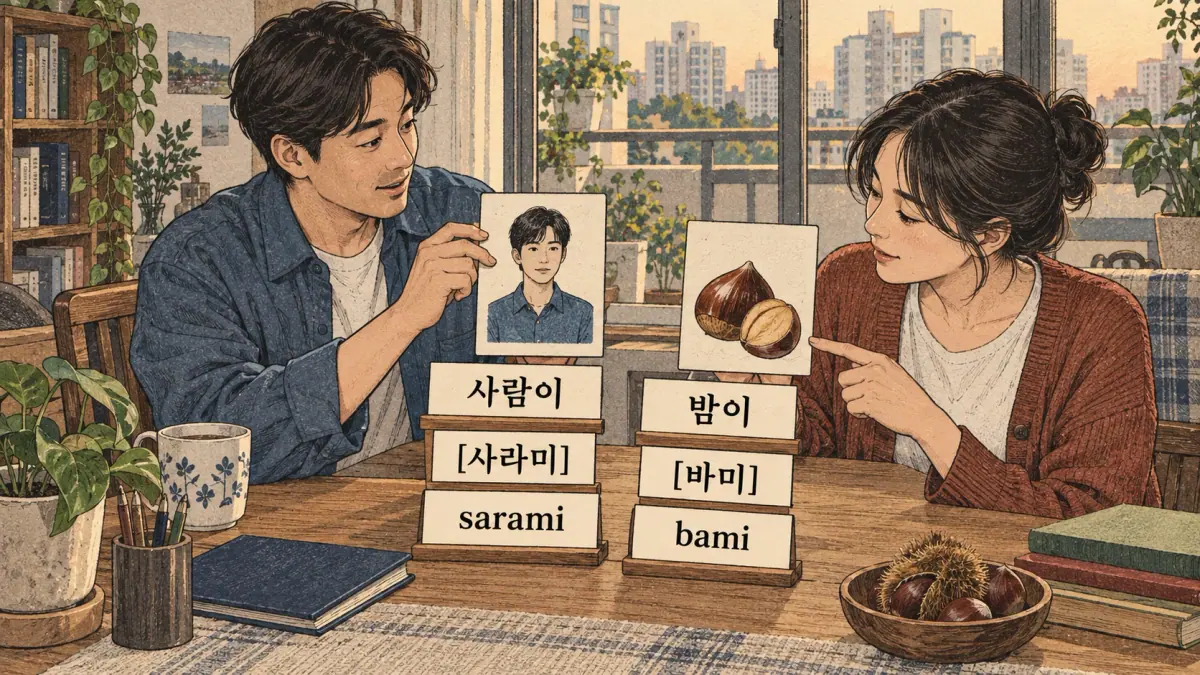
Before a vowel, final ㅁ moves to the start of the next syllable. This is liaison. The lips close and then release into the vowel, so the hum becomes the beginning of the next syllable.
| Written | Spoken | Pattern | RR (aid) |
|---|---|---|---|
| 사람이 | [사라미] | 사람 + 이 becomes 사라 + 미 | sarami |
| 밤이 | [바미] | 밤 + 이 becomes 바 + 미 | bami |
| 봄이 | [보미] | 봄 + 이 becomes 보 + 미 | bomi |
| 마음이 | [마으미] | 마음 + 이 becomes 마으 + 미 | maeumi |
| 감을 | [가믈] | 감 + 을 becomes 가 + 믈 | gameul |
| 삶이 | [살미] | ㄻ splits: ㄹ stays, ㅁ moves | salmi |
마음 is the case that surprises learners. Its first syllable has no batchim, and 음 has the silent ㅇ as a placeholder, so the word is said [마음] with a smooth link between the vowels. With 이, the final ㅁ links to give [마으미]. The spelling suggests "ma-eum-i", but the actual syllable breaks are ma-eu-mi.
The double batchim ㄻ behaves differently. In 삶이, the ㄹ stays in place and the ㅁ moves across: [살미]. This is part of the double batchim lessons.
The linking rule for all nasals is the same one used for stops. See Korean liaison for the full account. The next section covers ㅁ in the common polite ending.
Why Do You Hear ㅁ in 합니다?

In 합니다, ㅁ is not written, but it is heard. The ㅂ in 합 meets the ㄴ in 니다 and becomes ㅁ, so the word is said [함니다]. The change happens because the lips are already closed for ㅂ, and the next sound is a nasal. This is why the ㅁ batchim appears here as a preview.
| Written | Spoken | What happens | RR (aid) |
|---|---|---|---|
| 합니다 | [함니다] | ㅂ + ㄴ becomes ㅁ + ㄴ | hamnida |
| 입니다 | [임니다] | ㅂ + ㄴ becomes ㅁ + ㄴ | imnida |
| 감사합니다 | [감사함니다] | ㅂ + ㄴ becomes ㅁ + ㄴ | gamsahamnida |
| 심리 | [심니] | ㄹ becomes ㄴ after ㅁ | simni |
| 음료 | [음뇨] | ㄹ becomes ㄴ after ㅁ | eumnyo |
The last two rows show a second rule. After ㅁ or ㅇ, a following ㄹ in a Sino-Korean word becomes ㄴ. 심리 (psychology) is [심니], and 음료 (beverage) is [음뇨]. The learner who reads 심리 as "sim-ri" will not be understood easily.
The first rule is explained further in ㅂ nasalization. Before a plain consonant, ㅁ stays ㅁ: 담배 (cigarette) is [담배], and the lips stay closed for the next ㅂ. One exception matters for verbs: when a verb stem ends in ㅁ, a following ㄱ, ㄷ, ㅅ or ㅈ in the ending becomes tense, so 감다 (to wash one's hair) is [감따] and 삼고 is [삼꼬] (Article 24). The next section applies all of this to one word.
Worked Example: 밤

밤 (night, chestnut) is a good worked example because it is simple, it has two meanings that share one sound, and it appears in the pair 밥 and 밤.
Step 1: read the blocks. 밤 has ㅂ as the first consonant, ㅏ as the vowel, and ㅁ as the batchim.
Step 2: say the first part. ㅂ starts the syllable with a soft stop: [바].
Step 3: close the lips. Press the lips together and begin to hum: [밤]. RR writes bam.
Step 4: hold the hum. Keep the lips closed for about one beat, with air going through the nose.
Step 5: add a vowel. With 이, 밤이 becomes [바미].
Step 6: add a consonant. With 도 (also), 밤도 becomes [밤도], with the lips closing and then opening for the next sound.
| Form | Spoken | Which rule |
|---|---|---|
| 밤 | [밤] | final nasal ㅁ |
| 밤이 | [바미] | liaison |
| 밤도 | [밤도] | no change before a plain consonant |
| 밥 | [밥] | contrast: stop without nasal |
Compare 밤 [밤] with 밥 [밥]. Both close the lips. In 밤 the nose hums, and in 밥 no air flows. Pinch your nose to test: only 밤 changes. The reverse pair, 밥 and 밤, is covered from the stop side in ㅂ Batchim.
The next section lists where learners go wrong.
Common Learner Mistakes with the ㅁ Batchim

Learners often assume one of four things about the ㅁ batchim. Each has a reason and a fix.
Learners often assume the lips only touch lightly. Actually the lips must close firmly for the whole nasal. Fix: hold a pencil lightly between the lips for a second, then say 밤. The closure feels firm and stable.
Learners often assume ㅁ can be replaced by ㄴ. Actually 감 and 간 are different words, and the change in meaning can be large. Fix: use the mirror test and watch whether the lips shut.
Learners often assume the spelling and the sound are the same in 합니다. Actually 합니다 is [함니다]. Fix: read the spoken form in brackets before saying the word.
Learners often assume the vowel should follow the nasal. Actually the syllable simply ends. Adding "uh" makes 밤 sound like 바므 ("ba-meu"). Fix: relax the lips silently after the hum.
An honest limit: this lesson describes Seoul Standard Korean. Fast speech can shorten the nasal, and in connected speech the lips may begin to close early. The clean, held [m] is the clearest target for learners.
The next section lets you test yourself.
Practice and Answer Key
Complete the four tasks, then check the key.
Task 1. Write the spoken form: 밤, 봄, 사람, 마음, 삶.
Task 2. Write the spoken form with a particle: 사람이, 밤이, 마음이, 봄을.
Task 3. Write the spoken form: 합니다, 감사합니다, 심리, 담배.
Task 4. Which word has a different ending sound from the other three? 감, 밤, 봄, 간.
Practice · 8
How is final ㅁ made?
Show answer
The lips close and air flows through the nose
Final ㅁ is a bilabial nasal: both lips close and stay closed while air hums through the nose.
How is 사람이 pronounced?
Show answer
[사라미]
Before a vowel, final ㅁ links to the next syllable: 사람이 [사라미].
What happens to the ㅂ in 합니다?
Show answer
It becomes ㅁ, so the word is [함니다]
The ㅂ in 합 meets the ㄴ of 니다 and becomes ㅁ, because the lips are already closed: [함니다].
What happens to the ㄹ in 심리 (psychology)?
Show answer
It becomes ㄴ, so the word is [심니]
After ㅁ, a following ㄹ in a Sino-Korean word becomes ㄴ: 심리 [심니].
Which word has a different ending sound from the other three: 감, 밤, 봄, 간?
Show answer
간
간 ends in the tongue-tip nasal [n]. 감, 밤 and 봄 end in the lip nasal [m].
The double batchim in 삶 (life) reduces to which sound when the word is said alone?
Show answer
ㅁ
The double batchim ㄻ reduces to ㅁ, so 삶 is [삼].
How do the syllables of 마음이 break when it is spoken?
Show answer
ma-eu-mi, as in [마으미]
The final ㅁ of 마음 links to 이, so the spoken syllables are ma-eu-mi: [마으미].
What happens to the ㄷ in the verb 감다 (to wash one's hair)?
Show answer
It becomes tense, so the word is [감따]
When a verb stem ends in ㅁ, a following ㄱ, ㄷ, ㅅ or ㅈ in the ending becomes tense: 감다 [감따].
Listening drill. Play 감, 간 and 강 in a random order, or ask a friend to say them. Write M, N or NG for each ending. Start with three plays, then try nine, and check your answers against the audio labels.
Answer key
- 밤 [밤], 봄 [봄], 사람 [사람], 마음 [마음], 삶 [삼].
- 사람이 [사라미], 밤이 [바미], 마음이 [마으미], 봄을 [보믈].
- 합니다 [함니다], 감사합니다 [감사함니다], 심리 [심니], 담배 [담배].
- 간. It ends in the tongue-tip nasal [n]. The other three end in the lip nasal [m].
If you missed no more than two of the fourteen items, move on. If task 3 was hard, say 합니다 slowly and feel the lips close on the second syllable.
Where to Go Next
After the ㅁ batchim, continue with ㅂ Batchim, where the lips close without a hum. The parent page is The 7 Final Sounds. If you want the nasal change in the polite ending, read ㅂ nasalization.
This lesson does not cover the full double batchim list (11 spellings), Sino-Korean ㄹ changes in depth, or regional variation. Those topics have their own lessons in the Pronunciation hub.
About this page. Last updated 2026-10-09. The Korean text, spoken forms and audio on this page were machine-generated and reviewed and signed off by Min-ji Park on 15 October 2026. Standard Korean follows the National Institute of Korean Language (국립국어원) Standard Pronunciation Rules, and romanization follows the Revised Romanization of Korean (2000).
Frequently Asked Questions
How do I pronounce 사람? 사람 is said [사람]. Say 사 with a soft start, then 람 with the tongue tip touching the ridge for ㄹ, and finish by closing the lips for ㅁ. Revised Romanization writes saram. With the particle 이, 사람이 links to [사라미]. The ㅁ batchim stays a clear hum when the word is alone.
Is final ㅁ silent? Final ㅁ is never silent. It is a full nasal [m], and the lips must close for it. If the lips stay open, 밤 sounds like 바. The sound is voiced and can be held, so you can feel a buzz at the nose. The ㅁ batchim is quiet only in the sense of having no puff.
What is the difference between 감 and 강? 감 ends with the lips closed [m], and 강 ends with the back of the tongue raised [ŋ]. Both send air through the nose. Look in a mirror: your lips shut for 감 and stay open for 강. The pair 감, 간, 강 trains the three nasal endings together.
How is 마음 linked? 마음 is said [마음] alone, and its final ㅁ links to a following vowel: 마음이 is [마으미]. The ㅇ in 음 is silent at the start of a syllable, so the syllable breaks fall as ma-eu-mi. The ㅁ moves across and gets released as the beginning of the last syllable.