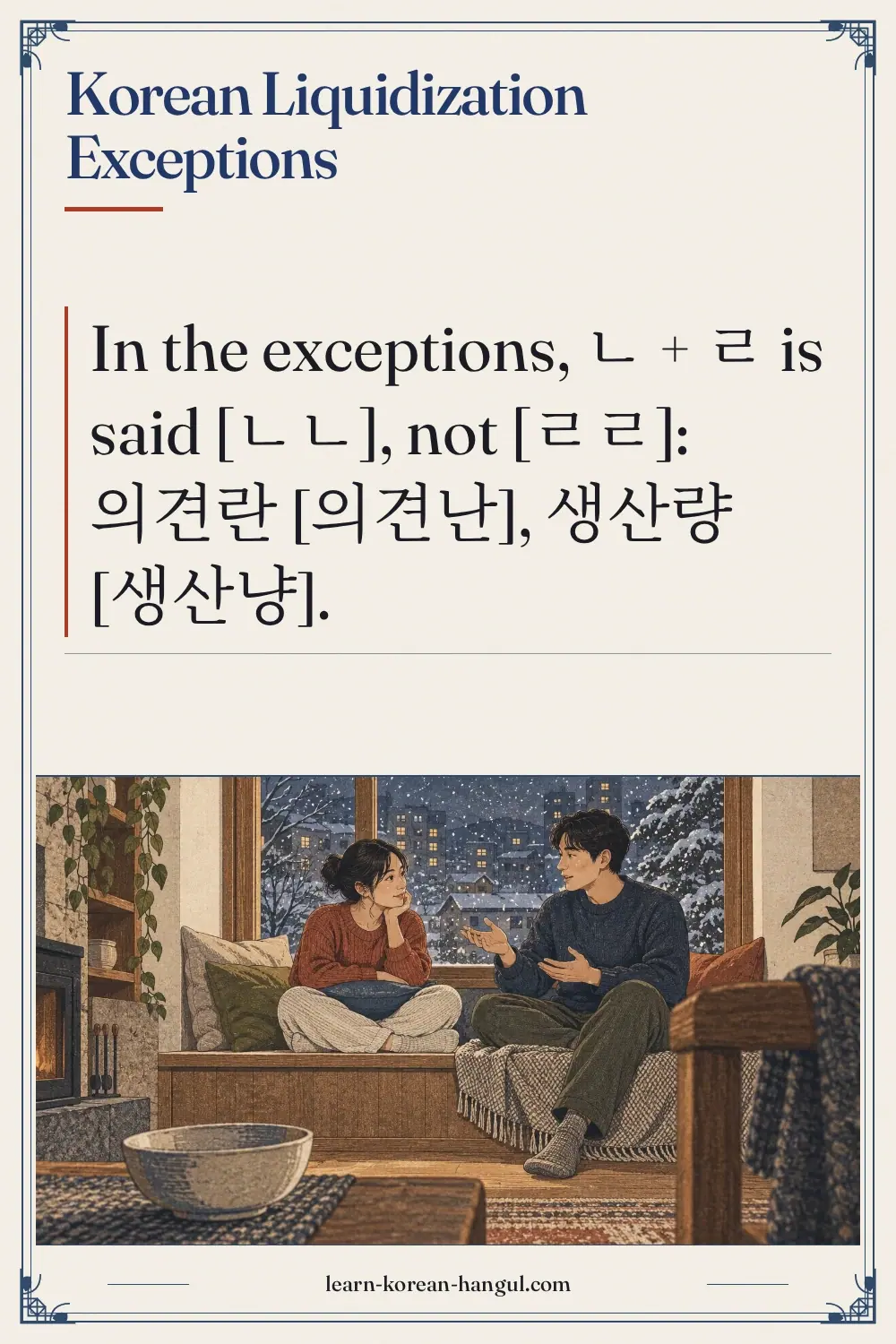
The Korean liquidization exceptions are words in which ㄴ + ㄹ is pronounced [ㄴㄴ] instead of the expected [ㄹㄹ], because the ㄹ starts a separate Sino-Korean element added to a full word. 의견란 (opinion column) is [의견난], not [의결란], and 생산량 (production volume) is [생산냥].
What you'll learn
- Say 의견란, 생산량, 결단력, 공권력 and 상견례 with [ㄴㄴ].
- Explain why 신라 becomes [실라] but 의견란 becomes [의견난].
- Use the seam test to predict the pronunciation of a new ㄴ + ㄹ word.
- Recognize the nine Sino-Korean elements that create most exceptions.
Prerequisite: Korean Lateralization Rules, the main rule in which ㄴ next to ㄹ becomes [ㄹ]. Estimated time: 30 minutes. This lesson is level B2: the words are formal, and most learners meet them in news and exam reading.
What Are Korean Liquidization Exceptions?
Korean liquidization exceptions are the words that go against the liquidization rule. Liquidization (유음화) normally turns ㄴ into [ㄹ] when ㄴ and ㄹ meet: 신라 (Silla, an ancient kingdom) is [실라], and 난로 (stove) is [날로]. In the exceptions, the change runs the other way. The ㄹ becomes [ㄴ], so the pair is said [ㄴㄴ].
| Word | Written pair | Expected by the main rule | Actual | Direction |
|---|---|---|---|---|
| 신라 | ㄴ + ㄹ | [실라] | [실라] | ㄴ → ㄹ |
| 의견란 | ㄴ + ㄹ | [의결란] | [의견난] | ㄹ → ㄴ |
Both words are written with ㄴ followed by ㄹ, so spelling alone cannot tell you which way the sound goes. Article 20 of the Standard Pronunciation Rules (표준 발음법), published by the National Institute of Korean Language (국립국어원), states the main rule and then adds a 다만 (however) clause with the exceptions. The rest of this lesson explains that clause and why English speakers find it hard.
Why English Speakers Struggle Here
English speakers struggle with these words for two reasons. The first is that English allows [nl] freely, as in "only" and "unless". A learner who has worked hard to replace [nl] with Korean [ㄹㄹ] now has to suppress that habit in a small set of words.
The second reason is that both directions sound similar to an untrained ear. [의결란] and [의견난] differ only in whether the tongue holds a lateral [l] or a nasal [n] across the seam. Hum through the middle of [의견난]: air flows through the nose the whole time. In [의결란], the air flows around the sides of the tongue, and the nose is closed. The audio below gives each exception so the ear can learn the nasal version.
Which Words Are Exceptions?
The exceptions are the 11 words listed in the 다만 clause of Article 20, plus other words built the same way. Every listed word joins a word ending in ㄴ to a one-syllable Sino-Korean element that starts with ㄹ. Sino-Korean means built from Chinese-origin morphemes (hanja).
| Written | Parts | Spoken | Meaning |
|---|---|---|---|
| 의견란 | 의견 (opinion) + 란 (column) | [의견난] | opinion column |
| 임진란 | 임진 (the year 1592) + 란 (war, upheaval) | [임진난] | the Imjin War |
| 생산량 | 생산 (production) + 량 (amount) | [생산냥] | production volume |
| 결단력 | 결단 (decision) + 력 (power) | [결딴녁] | decisiveness |
| 공권력 | 공권 (public authority) + 력 (power) | [공꿘녁] | state authority |
| 동원령 | 동원 (mobilization) + 령 (order) | [동원녕] | mobilization order |
| 상견례 | 상견 (meeting each other) + 례 (ceremony) | [상견녜] | formal meeting of two families |
| 횡단로 | 횡단 (crossing) + 로 (road) | [횡단노] | crossing route |
| 이원론 | 이원 (two principles) + 론 (theory) | [이원논] | dualism |
| 입원료 | 입원 (hospital admission) + 료 (fee) | [이붠뇨] | hospital admission fee |
| 구근류 | 구근 (bulb) + 류 (kind) | [구근뉴] | bulb plants |
Two spoken forms contain extra tense sounds: 결단력 [결딴녁] and 공권력 [공꿘녁]. The tense [ㄸ] in 결단 comes from a separate rule, Sino-Korean tensification, which tenses ㄷ after ㄹ in Sino-Korean words. The tense [ㄲ] in 공권 is a fixed fact of that word. Neither affects the ㄴ + ㄹ seam, so set them aside for now. 입원료 also shows ordinary liaison: 입 + 원 → [이붠].
Of the eleven, 상견례 (the formal first meeting between two families before a wedding) is the one you are most likely to hear in conversation. 생산량, 공권력 and 결단력 are common in news. The next section explains the pattern behind all of them.
Why Do They Differ?
The exceptions differ because the first part is a word on its own, so speakers treat the join like a gap between two words. Follow the steps to see the mechanism.
- Find the seam. 의견란 splits into 의견 (opinion), a complete noun, and 란 (column), a one-syllable element added to it.
- Treat the seam as a word boundary. Speakers hear 의견 + 란 much like 의견 plus a short attached word.
- Apply ㄹ nasalization instead of liquidization. At such a boundary, an initial ㄹ after a consonant becomes [ㄴ]. That is the same change as in 종로 [종노] and 심리 [심니], described in ㄹ nasalization.
- Result. ㄹ → [ㄴ], so 의견란 is [의견난], with a long [ㄴㄴ].
A contrast shows that the seam, not the letters, decides the result. 대관령 and 동원령 both end in 령. 대관령 (the Daegwallyeong Pass) is a place name, not 대관 plus 령, so it follows the main rule: [대괄령]. 동원령 is 동원 (mobilization) plus 령 (order), so it is an exception: [동원녕].
The same contrast appears with 료. 원료 (raw material) is one two-syllable word, so it is [월료]. 입원료 is 입원 plus 료 (fee), so it is [이붠뇨].
The pattern is easier to learn once you know which elements trigger it, so the memory aid comes next.
How Do You Remember Them?
Remember the exceptions through their second element. Nine one-syllable Sino-Korean elements create almost all of them. Each is a hanja that attaches to a whole word to add a general meaning, much like English "-wide" or "-proof".
| Element | Meaning | Listed example | Spoken |
|---|---|---|---|
| -란 (欄) | column, space | 의견란 | [의견난] |
| -량 (量) | amount | 생산량 | [생산냥] |
| -력 (力) | power, ability | 결단력 | [결딴녁] |
| -령 (令) | order, decree | 동원령 | [동원녕] |
| -례 (禮) | ceremony | 상견례 | [상견녜] |
| -로 (路) | road, route | 횡단로 | [횡단노] |
| -론 (論) | theory | 이원론 | [이원논] |
| -료 (料) | fee, charge | 입원료 | [이붠뇨] |
| -류 (類) | kind, class | 구근류 | [구근뉴] |
(임진란 uses a tenth element, -란 亂, war or upheaval, which is written and said the same way as -란 欄.)
A quick seam test works for most new words: remove the last syllable. If what is left is a complete word you could use alone, expect [ㄴㄴ]. 판단력 (judgment) leaves 판단 (judgment, decision), so it is [판단녁]. 신라 leaves 신, which is not the word here, so it is [실라]. The -력 family is large, and the hanja word families section shows many more members. The test has limits, which the next section covers.
Are the Eleven Words the Only Exceptions?
No. The eleven words are the examples that Article 20 gives, introduced as words "such as the following". Other words built the same way follow them, for example 판단력 [판단녁]. The list is a model of the pattern, not a closed set.
Two cautions apply. First, the seam test is a strong guide, not a law. Speakers do not always agree on rarer or newer words, and some may use [ㄹㄹ] where the dictionary gives [ㄴㄴ]. Second, the reverse order, ㄹ + ㄴ, has no listed exceptions in Article 20. Words such as 칼날 (blade) [칼랄] and 물난리 (flood) [물랄리] follow the main rule.
When you meet a new ㄴ + ㄹ word, check the bracketed pronunciation in the Standard Korean Language Dictionary (표준국어대사전). The dictionary records each word, which is more reliable than any rule of thumb.
Do You Need Them as a Beginner?
No. A beginner can skip this lesson without harm. The exception words are formal Sino-Korean vocabulary, and A1–A2 courses rarely need them. Learn the liquidization rule first, because it covers everyday words such as 신라, 연락 (contact) [열락] and 설날 (Lunar New Year) [설랄].
The exceptions become useful at intermediate level, when you start reading news, following formal speech or preparing for TOPIK II. 생산량, 공권력, 결단력 and 상견례 appear in news, essays and everyday talk about weddings. The next section shows them in sentences.
Hearing the Exceptions in Sentences
The exceptions keep their [ㄴㄴ] inside full sentences, at any speed. Read these three sentences aloud and mark the seam in each word before you speak.
| Sentence | Key word spoken | Meaning |
|---|---|---|
| 올해 쌀 생산량이 늘었어요. | [생산냥이] | This year's rice production went up. |
| 다음 달에 상견례를 해요. | [상견녜를] | We are holding the families' meeting next month. |
| 결단력이 필요해요. | [결딴녀기] | It takes decisiveness. |
Notice that the particle after each word links normally: 결단력이 is [결딴녀기], because 이 is a particle and the final ㄱ simply moves onto it. The exception changes only the seam inside the word. A worked example now walks through one word from start to finish.
Worked Example: 의견란
Follow these steps to read 의견란 (opinion column) aloud.
- Spot the pair. 견 ends in ㄴ, and 란 starts with ㄹ. A ㄴ + ㄹ pair normally signals liquidization.
- Run the seam test. Remove 란: 의견 (opinion) remains, a complete noun. So 란 is an added element meaning "column".
- Choose the direction. At this seam, the ㄹ of 란 becomes [ㄴ]: 의견 + 난.
- Say it. [의견난], with the tongue tip held on the ridge behind the teeth through both [ㄴ] sounds, and air flowing through the nose.
- Check the first syllable. 의 at the start of a word is said [의], as a full diphthong.
You will know it worked when you can hum through the middle of the word without a break. If the tongue sides open and the sound becomes [l], you have applied the main rule by mistake. Compare it once more with 신라 [실라], where the sides should open.
Common Learner Mistakes
Mistake 1: applying the main rule everywhere. Learners who have just learned liquidization say 생산량 as [생살량]. Actually -량 is an element added to the full word 생산, so ㄹ becomes [ㄴ]: [생산냥].
Mistake 2: keeping the written ㄹ. Learners sometimes say 상견례 as [상견례] with a clear [l]. Actually the standard form is [상견녜], with no [l] at all.
Mistake 3: overusing the exception. Learners who like the seam test sometimes say 원료 as [원뇨]. Actually 원료 is a single word, not 원 plus 료, so it is [월료].
Mistake 4: treating the list as complete. Learners often assume only eleven words behave this way. Actually Article 20 gives examples, and words such as 판단력 [판단녁] follow the same pattern.
Mistake 5: adding the exception to ㄹ + ㄴ words. Learners sometimes say 칼날 as [칼난]. Actually ㄹ + ㄴ inside a word becomes [ㄹㄹ]: [칼랄].
All five mistakes come from reading letters instead of looking for the seam. The practice set trains that habit.
Practice and Answer Key
Exercise 1. Write the spoken form.
- 생산량
- 입원료
- 동원령
- 이원론
Exercise 2. Main rule [ㄹㄹ] or exception [ㄴㄴ]? Give the spoken form.
- 난로 (stove)
- 판단력 (judgment)
- 원료 (raw material)
- 횡단로 (crossing route)
- 광한루 (Gwanghallu Pavilion)
Exercise 3. Which element do 결단력 and 공권력 share, and what does it mean?
Answers.
Exercise 1: 1 [생산냥], 2 [이붠뇨], 3 [동원녕], 4 [이원논].
Exercise 2: 1 main rule, [날로]. 2 exception, [판단녁]. 3 main rule, [월료]. 4 exception, [횡단노]. 5 main rule, [광할루].
Exercise 3: -력 (力), meaning power or ability.
If you missed two or more in Exercise 2, run the seam test aloud on each word: remove the last syllable and ask whether the rest is a word.
Where to Go Next
The next lesson, Tensification, explains the tense sounds you heard in 결단력 [결딴녁]. The opposite pattern, ㄹ becoming [ㄴ] after other consonants, is in ㄹ nasalization. The whole group of lessons is listed on the Liquidization page.
This lesson covers the ㄴ + ㄹ exceptions in standard Seoul speech. It does not cover loanwords such as 온라인 (online), regional pronunciation, or vowel length, which dictionaries mark on some of these words. The audio gives one standard form per word.
In short, the Korean liquidization exceptions are ㄴ + ㄹ words with a seam between a full word and a Sino-Korean element, and at that seam ㄹ becomes [ㄴ], giving [ㄴㄴ].
Frequently Asked Questions
Why is 생산량 pronounced 생산냥? 생산량 (production volume) is 생산 (production) plus -량 (amount). 생산 is a word on its own, so speakers treat the join like a gap between words. Instead of turning ㄴ into ㄹ, they turn the ㄹ of 량 into ㄴ, as happens after other consonants. The result is [생산냥].
Is 공권력 [공꿘녁]? Yes. 공권력 (state authority, public power) is 공권 (public authority) plus -력 (power), so ㄹ becomes [ㄴ]: [공권녁]. The ㄱ of 권 is also said tense in this word, giving [공꿘녁]. That tensing is a separate, word-specific fact. Article 20 lists the full form [공꿘녁].
What is the exception list? Article 20 of the Standard Pronunciation Rules lists 의견란, 임진란, 생산량, 결단력, 공권력, 동원령, 상견례, 횡단로, 이원론, 입원료 and 구근류. In each, the written ㄹ is said [ㄴ], so ㄴ + ㄹ gives [ㄴㄴ]. The rule text introduces them as words "such as the following", so the list is not complete.
Which exceptions appear in everyday news? 생산량 (production volume), 공권력 (state authority) and 결단력 (decisiveness) are the listed words most often met in news reports, and 동원령 (mobilization order) appears in reporting on war. Unlisted words of the same type are common too, such as 판단력 (judgment) [판단녁]. 상견례 [상견녜] belongs to everyday talk about weddings rather than to news.