What you will learn
- Say ten Korean tongue twisters slowly, then at a steady pace.
- Name the sound or sound change that each twister trains.
- Write the spoken form of a twister from its spelling.
- Use a four-step routine to fix the word where you trip.
Before you start: you should read Hangul and know the seven final sounds. Time: about 20 minutes. Audio plays only when you press a button.
Key Facts
- Ten twisters are included, each with its spoken form and meaning.
- Each twister trains a named sound, such as ㅊ, ㄲ, ㅅ/ㅆ, ㄹ or a final consonant.
- The first three twisters have audio at normal and slow speed.
- Fast speed is the goal you build, not a clip you copy.
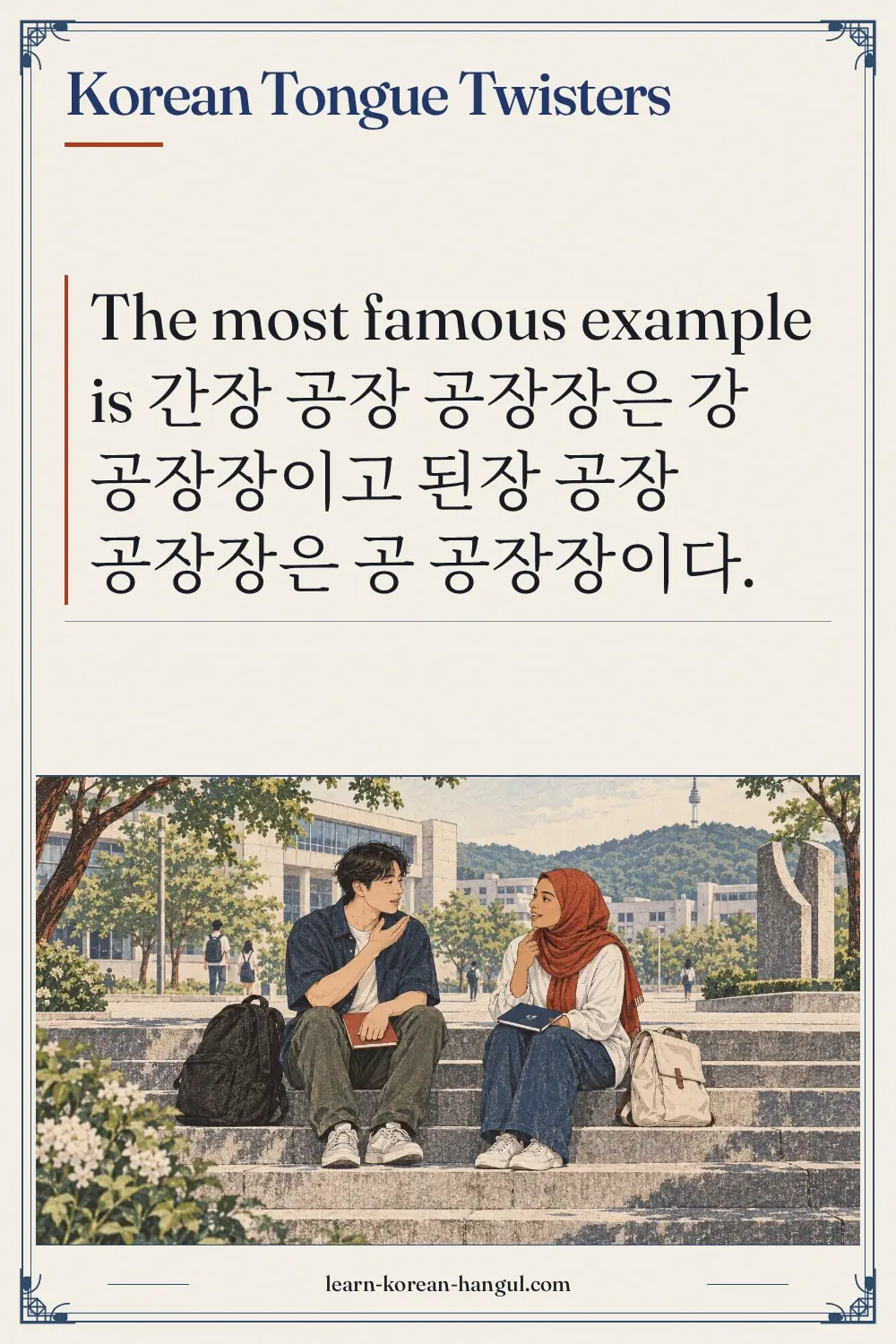
- The most famous example is 간장 공장 공장장은 강 공장장이고 된장 공장 공장장은 공 공장장이다.
- This page is a fun supplement to the pronunciation lessons, not a replacement for them.
Last updated: 2026-10-09.
What Are Korean Tongue Twisters?
Korean tongue twisters are short sentences, called 잰말놀이 (jaenmalnori), that stack the same or similar sounds close together. The word is usually explained as "quick-talk play": 말 means speech and 놀이 means play. Children say them as a game, and adults use them as a speed challenge.
A tongue twister works as a drill because it removes the safety margin. In a normal sentence you can blur one consonant and still be understood. In a twister the same consonant returns every second word, so a blurred sound shows up at once. The result is a quick, honest check of a sound you already know.
Revised Romanization (RR) is the official Latin-letter system for Korean. On this page RR appears only as a learning aid in the first column. The Hangul and the bracketed spoken form are the reference, because the spoken form is where the traps are. The next section explains why English speakers meet them.
Why Do English Speakers Struggle with Korean Tongue Twisters?
English speakers struggle because Korean twisters combine three habits English does not have: a three-way consonant contrast, a strict set of final sounds and automatic sound changes between words. Each habit is easy alone and hard when repeated at speed.
The three-way contrast means that ㅈ (plain), ㅊ (aspirated, with a strong puff of air) and ㅉ (tense, with a tight throat) are three different consonants. English has only two groups, so learners often merge them. The lesson on plain, tense and aspirated sounds explains how to make each one.
Final sounds are the second habit. Only seven sounds can end a syllable, however many letters are written, so 못 is said [몯] and 있고 is said [읻꼬]. Learners who say the spelling letter by letter ("mot", "iss-go") lose the rhythm.
Sound changes are the third habit. When a final consonant meets the next syllable, Korean links, nasalizes or tightens it. A twister gives you this rule many times in one breath. Now see which ten twisters the page uses.
Which Ten Korean Tongue Twisters Are Included?
This page includes ten twisters, ordered roughly from easiest to hardest. Each row gives the Hangul, the spoken form in brackets and the meaning. Folk twisters have no single fixed text, so small variations exist in other sources.
| # | Twister (Hangul) | Spoken form | Meaning |
|---|---|---|---|
| 1 | 간장 공장 공장장은 강 공장장이고 된장 공장 공장장은 공 공장장이다 | [간장 공장 공장장은 강 공장장이고 된장 공장 공장장은 공 공장장이다] | The soy sauce factory manager is Manager Kang, and the soybean paste factory manager is Manager Gong. |
| 2 | 경찰청 철창살은 외철창살이고 검찰청 철창살은 쌍철창살이다 | [경찰청 철창싸른 외철창싸리고 검찰청 철창싸른 쌍철창싸리다] | The iron bars of the police agency are single bars, and the iron bars of the prosecutors' office are double bars. |
| 3 | 내가 그린 기린 그림은 잘 그린 기린 그림이고 네가 그린 기린 그림은 못 그린 기린 그림이다 | [내가 그린 기린 그리믄 잘 그린 기린 그리미고 네가 그린 기린 그리믄 몯 끄린 기린 그리미다] | The giraffe picture I drew is a well-drawn giraffe picture, and the giraffe picture you drew is a badly drawn one. |
| 4 | 저기 있는 말뚝이 말 맬 말뚝이냐 말 못 맬 말뚝이냐 | [저기 인는 말뚜기 말 맬 말뚜기냐 말 몬 맬 말뚜기냐] | Is that post over there a post to tie a horse to, or a post you cannot tie a horse to? |
| 5 | 저기 저 뜀틀이 내가 뛸 뜀틀인가 내가 안 뛸 뜀틀인가 | [저기 저 뜀트리 내가 뛸 뜀트린가 내가 안 뛸 뜀트린가] | Is that vaulting box over there the one I will jump, or the one I will not jump? |
| 6 | 콩깍지는 깐 콩깍지인가 안 깐 콩깍지인가 | [콩깍찌는 깐 콩깍찌인가 안 깐 콩깍찌인가] | Is the bean pod a peeled pod or an unpeeled pod? |
| 7 | 작은 토끼 토끼통 옆에는 큰 토끼 토끼통이 있고 큰 토끼 토끼통 옆에는 작은 토끼 토끼통이 있다 | [자근 토끼 토끼통 여페는 큰 토끼 토끼통이 읻꼬 큰 토끼 토끼통 여페는 자근 토끼 토끼통이 읻따] | Next to the small rabbit's hutch is the big rabbit's hutch, and next to the big rabbit's hutch is the small rabbit's hutch. |
| 8 | 중앙청 창살은 쌍창살이고 시청 창살은 외창살이다 | [중앙청 창싸른 쌍창싸리고 시청 창싸른 외창싸리다] | The window bars of the old Central Government Building are double bars, and the window bars of City Hall are single bars. |
| 9 | 안 촉촉한 초코칩이 촉촉한 초코칩 나라에 갔다 | [안 촉초칸 초코치비 촉초칸 초코침 나라에 갇따] | A non-moist chocolate chip went to the land of moist chocolate chips. |
| 10 | 서울특별시 특허허가과 허가과장 허과장 | [서울특뼐씨 트커허가과 허가과장 허과장] | Manager Heo, head of the patent permit section of the Seoul Metropolitan Government. |
Some meanings are deliberately silly, and the silliness is part of the game. Twister 10 is the hardest because the words are formal and the sounds repeat at every syllable. The table gives the words, and the next section explains what each one trains.
Which Sound Does Each Twister Train?
Each twister trains one main sound plus one or two supporting changes. The table below names them, so you can pick a twister for the sound you want to fix.
| # | Main sound trained | Supporting sound or rule | Where it appears |
|---|---|---|---|
| 1 | Plain ㄱ and ㅈ | Final ㅇ [ŋ] against final ㄴ [n] | 간장 / 공장장 / 강 / 된장 |
| 2 | Aspirated ㅊ against plain ㅈ | Tense [ㅆ] in 창살 [창쌀] against written ㅆ in 쌍; liaison | 경찰청 / 철창살 / 쌍철창살 |
| 3 | ㄱ and ㄹ in a row | ㅐ and ㅔ (내가, 네가); final ㅅ becomes [ㄷ] and tenses the next ㄱ | 그린 기린 그림 / 못 그린 |
| 4 | Tense ㄸ | Nasalization of 못 맬 to [몬 맬] | 말뚝이 / 못 맬 |
| 5 | Tense ㄸ against plain ㄷ | Final ㄹ [l] | 뜀틀 / 뛸 |
| 6 | Tense ㄲ and ㅉ | Tensification after a final ㄱ | 콩깍지 / 깐 |
| 7 | Aspirated ㅌ against tense ㄲ | Liaison; ㅆ final becomes [ㄷ] | 토끼 / 옆에는 / 있고 |
| 8 | ㅊ, ㅅ and ㅆ again | Tense [ㅆ] in 창살 [창쌀] | 창살 / 쌍창살 / 시청 |
| 9 | Aspirated ㅊ and ㅋ | ㄱ + ㅎ joins as [ㅋ]; nasalization of 칩 나 to [침 나] | 촉촉한 / 초코칩 나라 |
| 10 | ㄱ + ㅎ joins as [ㅋ] | Tensification after ㄱ; ㄹ then tense ㅅ | 특허 / 특별시 |
If your problem is the three-way contrast, start with twisters 2, 5, 6 and 8. If your problem is final sounds, start with 1, 3, 4 and 7. For ㄹ, the lesson on difficult sounds gives the tongue position, and twisters 3 and 5 test it. A good routine comes next.
How Do I Practise a Tongue Twister?
Practise a tongue twister in four steps: read it slowly, mark the rules, say it at speed, and record it. The order matters because speed added too early trains mistakes.
- Read it slowly. Say each word clearly, with a pause between phrases. You are not being timed. Check that every syllable has the right vowel.
- Mark the rules. Copy the spoken form from the table and underline each place where it differs from the spelling. For twister 4 you mark 있는 → [인는] and 못 맬 → [몬 맬]. This step turns the twister into a short rule review.
- Say it at speed. Repeat the phrase three times in a row, a little faster each time. Stop when you stumble and go back one speed.
- Record it. Record yourself once and compare it with the clip or the written spoken form. Tick the places where you made the sound you intended.
A fifth habit helps all four: repeat only the part that failed. If you trip on 철창살, drill that one word ten times before you return to the full sentence. The same idea is behind shadowing, where you speak along with a model. Speed is the next question.
How Fast Should I Go?
Go at the slowest speed where every sound is correct, then speed up in small steps. A good target is a pace where you could say the twister three times in a row without a single stumble. Speed is a skill you build in three stages.
| Stage | Speed | What to check |
|---|---|---|
| 1. Slow | One syllable at a time, with clear gaps | Each vowel and each final sound is correct |
| 2. Normal | The pace of an ordinary sentence | The links between blocks, such as [그리믄] |
| 3. Fast | As quick as you can stay accurate | No sound merges with a neighbour |
The page provides audio at normal and slow speed for the first three twisters. There is no fast clip, because fast speech from a model can hide the very errors you want to hear. Fast speed is what you build yourself, and you stop at the speed where a sound starts to blur. The worked example shows the full routine.
Worked Example: 간장 공장 공장장
The worked example takes the most famous twister, number 1, through the four steps. Listen first to the normal clip and then to the slow clip.
간장 공장 공장장은 강 공장장이고 된장 공장 공장장은 공 공장장이다
ganjang gongjang gongjangjang-eun gang gongjangjang-igo doenjang gongjang gongjangjang-eun gong gongjangjang-ida
The soy sauce factory manager is Manager Kang, and the soybean paste factory manager is Manager Gong.
- Read it slowly. Split it into four phrases: 간장 공장 공장장은 / 강 공장장이고 / 된장 공장 공장장은 / 공 공장장이다. Notice that 강 and 공 are surnames, and 간장 and 된장 are the two kinds of sauce.
- Mark the rules. The spoken form is almost the same as the spelling, so there is little to mark. The trap is the repeated nasal ending: 간 ends in ㄴ [n], and 장 and 공 end in ㅇ [ŋ], the sound at the end of English "sing". Keep the tongue tip down for ㅇ and up for ㄴ.
- Say it at speed. Start from the short word first. The clip below isolates 공장장, the word that carries most of the difficulty.
- Record it. Check that the ㅈ in 장 is plain, with only a light breath, and not the strong puff of ㅊ. Check that the three syllables of 공장장 have equal weight.
Twister 1 is the easiest because it has no consonant tightening. For the aspirated ㅊ, move to twister 2 and listen to the key word 철창살, where ㅊ appears twice and the ㅅ of 살 is said tense: [철창쌀].
경찰청 철창살은 외철창살이고 검찰청 철창살은 쌍철창살이다
gyeongchalcheong cheolchangsal-eun oecheolchangsal-igo geomchalcheong cheolchangsal-eun ssangcheolchangsal-ida
The iron bars of the police agency are single bars, and the iron bars of the prosecutors' office are double bars.
내가 그린 기린 그림은 잘 그린 기린 그림이고 네가 그린 기린 그림은 못 그린 기린 그림이다
naega geurin girin geurim-eun jal geurin girin geurim-igo nega geurin girin geurim-eun mot geurin girin geurim-ida
The giraffe picture I drew is a well-drawn giraffe picture, and the giraffe picture you drew is a badly drawn one.
In twister 3 the final consonant of 그림은 links to the next block, so it is said [그리믄], and 그림이고 is said [그리미고]. The word 못 is said [몯] because a final ㅅ is always [ㄷ]. That [ㄷ] then makes the ㄱ of 그린 tense when no pause comes between the words, so the table shows [몯 끄린]. Mistakes are the next topic.
What Mistakes Do Learners Make with Tongue Twisters?
Learners often assume that a twister is read exactly as it is spelled. In fact most of the difficulty is in the spoken form, because Korean links, tightens and nasalizes sounds across word boundaries. Four mistakes follow the same pattern.
- Learners often assume 못 맬 is said [못 맬]. Actually a final ㅅ is said [ㄷ], and ㄷ before ㅁ becomes [ㄴ], so the phrase is [몬 맬]. This is the nasalization rule at work.
- Learners often assume 촉촉한 is said [촉촉한]. Actually ㄱ and ㅎ join into an aspirated ㅋ, so the word is [촉초칸]. The tensification and aspiration rules explain why spelling alone is a poor guide.
- Learners often assume faster means louder. Actually speed comes from a relaxed, small mouth movement. A tense jaw makes tense consonants such as ㅆ and ㄸ too strong.
- Learners often assume the twister must be perfect before they move on. Actually twisters are a game, and a stumble is the point. Use liaison and the other rules to explain the stumble, then move on.
Try the exercise below to check what you have learned.
Practice and Answer Key
Write the spoken form of each item from memory, then check the answer key. Use the table above only after you try.
- 있는
- 못 맬
- 말뚝이
- 콩깍지는
- 촉촉한
- 초코칩 나라에
- 작은
- 철창살은
Answer key: 1. [인는]. 2. [몬 맬]. 3. [말뚜기]. 4. [콩깍찌는]. 5. [촉초칸]. 6. [초코침 나라에]. 7. [자근]. 8. [철창싸른].
For a speaking task, choose one twister, record three attempts at your best pace and tick every sound you meant to make. Name the one sound that failed most often, and review that lesson.
Where Do I Go Next?
Go next to the broader Korean Pronunciation section, which sorts every lesson by the problem it fixes. If a twister kept failing, the graded drills in pronunciation practice give you more controlled repetition of the same sounds. The plain, tense and aspirated sounds lesson teaches the contrast that twisters 2, 5, 6 and 8 test, and the page on improving pronunciation covers a weekly routine.
Word play is also part of Korean culture, and 잰말놀이 is a long-standing children's game.
This page is a fun supplement. It does not teach each sound from the beginning, and it does not score your recording. It covers ten phrases, not the wider set of Korean riddles and rhymes. The spoken forms and meanings were drafted by an AI model and reviewed and signed off by Min-ji Park on 15 October 2026.
Frequently Asked Questions
What is a Korean tongue twister called? A Korean tongue twister is called a 잰말놀이 (jaenmalnori), which is often explained as "quick-talk play". The word combines 말 (speech) and 놀이 (play). Some people also say 발음 연습 문장, meaning pronunciation practice sentence, when they use a twister as a drill instead of a game.
Which is the most famous? The best known is 간장 공장 공장장은 강 공장장이고 된장 공장 공장장은 공 공장장이다, about a soy sauce factory manager named Kang and a soybean paste factory manager named Gong. It is short, has a clear rhythm, and appears first in this set for that reason.
Do tongue twisters help pronunciation? They help with control and speed, but they do not replace lessons. A twister repeats one sound pair many times, so you notice when your mouth drifts to a familiar English sound. Use them after you know the sound, as a fun check, and return to the lesson if one keeps failing.
Where can I hear them? On this page. The first three twisters have audio at normal and slow speed, and some trap words have their own clips. Audio plays only when you press a button, and every twister also has its spoken form written out.
Are there children's twisters? Yes. Several twisters here, such as the soy sauce factory and the giraffe picture, are the kind Korean children say as a game. They use common words, so they are suitable for beginners. The harder ones, such as the Seoul patent office phrase, are mainly used by adults as a challenge.
These ten Korean tongue twisters give you a fun way to test the sounds you have learned.