
What you will learn
- Work through five graded sets of 12 items each, from single words to full phrases.
- Say each item so that it matches the example clips at normal and slow speed.
- Score a recording of your own with a simple 0, 1 or 2 rubric.
- Decide which lesson to review when a set goes badly.
Before you start: you should know the Hangul letters and the seven final sounds. Time: about 10 minutes per set. Audio plays only when you press a button.
Key Facts
- There are five sets of 12 items, 60 items in total.
- Each item shows the Hangul, the spoken form and the meaning.
- Example clips are provided at normal and slow speed.
- Set 4 covers liaison, nasalization and tensification.
- Set 5 uses full phrases from beginner dialogues.
- A 0, 1 or 2 rubric turns a recording into a score out of 8.
Last updated: 2026-10-09.
What Is Korean Pronunciation Practice?
Korean pronunciation practice is repeated speaking of real words, checked against a model, in an order that adds one skill at a time. A drill is a short, repeated exercise on one skill. Each set here targets one skill, so a learner who fails a set knows which lesson to review.
The sets are graded by pronunciation skill, not by vocabulary theme. Set 1 uses plain words with simple sounds. Set 2 adds the plain, tense and aspirated contrast. Set 3 adds final consonants, set 4 adds sound changes, and set 5 puts all four skills into polite phrases.
Listen to one example from three of the sets: the word 바다, the contrast word 딸 and the sound-change word 꽃이.
Revised Romanization (RR) is the official Latin-letter system for Korean. RR is a learning aid on this page, and the Hangul, the bracketed spoken form and the audio are the reference. The first obstacle for most English speakers is how they read the spelling.
Why Do English Speakers Struggle with Korean Pronunciation?
English speakers struggle because they read Hangul with English sound habits. The main habits are using voicing to tell stops apart, releasing final stops, and saying every letter as written. Each habit is wrong for Korean in a specific way.
- Voicing habit. English separates d from t by voicing. Korean separates ㄷ, ㄸ and ㅌ by breath and tension.
- Release habit. English releases a final p, t or k with a small puff. Korean holds it closed, as in 밥 and 앞.
- Spelling habit. English speakers say each written letter, but Korean changes many sounds at block boundaries, as in 꽃이 [꼬치].
Each set below trains one of these habits, and the rubric in the scoring section tells you which one is causing problems. The sets themselves come next.
What Is in Each Set?
Each set has 12 real items. The table shows the skill, the contents and the lesson to review if a set goes badly.
| Set | Skill | Contents | Review lesson |
|---|---|---|---|
| 1 | Basic sounds | 12 common words with simple sounds | Korean sounds |
| 2 | Plain, tense, aspirated | three triples (ㄷ, ㅂ, ㅈ), tense 쌀 and the pair 공 / 콩 | plain, tense and aspirated pairs |
| 3 | Final consonants | 12 words with batchim | seven final sounds |
| 4 | Sound changes | liaison, nasalization and tensification, 4 items each | pronunciation rules |
| 5 | Phrases | 12 phrases from beginner dialogues | Korean shadowing |
Every item shows the Hangul, the spoken form in brackets and the meaning. The spoken form is the same as the spelling when no brackets differ.
Set 1: Basic Sounds
Set 1 trains clean vowels and plain consonants with everyday words. Say each word slowly first, with even syllable length.
| Hangul | Spoken | Meaning |
|---|---|---|
| 바다 | [바다] | sea |
| 아이 | [아이] | child |
| 우유 | [우유] | milk |
| 오리 | [오리] | duck |
| 어머니 | [어머니] | mother |
| 구름 | [구름] | cloud |
| 사과 | [사과] | apple |
| 나무 | [나무] | tree |
| 하늘 | [하늘] | sky |
| 의사 | [의사] | doctor |
| 고양이 | [고양이] | cat |
| 거울 | [거울] | mirror |
Set 2: Plain, Tense and Aspirated
Set 2 trains the three-way consonant contrast. Hold a strip of paper at your lips: it should move most on the aspirated sound and least on the tense one.
| Hangul | Spoken | Meaning | Type |
|---|---|---|---|
| 달 | [달] | moon | plain |
| 딸 | [딸] | daughter | tense |
| 탈 | [탈] | mask | aspirated |
| 불 | [불] | fire | plain |
| 뿔 | [뿔] | horn | tense |
| 풀 | [풀] | grass | aspirated |
| 자다 | [자다] | to sleep | plain |
| 짜다 | [짜다] | to be salty | tense |
| 차다 | [차다] | to be cold | aspirated |
| 쌀 | [쌀] | uncooked rice | tense |
| 공 | [공] | ball | plain |
| 콩 | [콩] | bean | aspirated |
Set 3: Final Consonants
Set 3 trains final consonants, including the reduced stops. Hold each final closure and do not release it.
| Hangul | Spoken | Meaning |
|---|---|---|
| 밥 | [밥] | cooked rice |
| 밭 | [받] | field |
| 부엌 | [부억] | kitchen |
| 앞 | [압] | front |
| 옷 | [옫] | clothes |
| 꽃 | [꼳] | flower |
| 낮 | [낟] | daytime |
| 있다 | [읻따] | to exist |
| 읽다 | [익따] | to read |
| 없다 | [업따] | to not exist |
| 값 | [갑] | price |
| 닭 | [닥] | chicken |
Set 4: Liaison, Nasalization and Tensification
Set 4 trains the three most common sound changes, four items each. Check each item against its spoken form before you say it.
| Hangul | Spoken | Meaning | Change |
|---|---|---|---|
| 책이 | [채기] | the book (subject) | liaison |
| 한국어 | [한구거] | Korean language | liaison |
| 꽃이 | [꼬치] | the flower (subject) | liaison |
| 음악이 | [으마기] | the music (subject) | liaison |
| 합니다 | [함니다] | do (formal) | nasalization |
| 먹는 | [멍는] | eating | nasalization |
| 국물 | [궁물] | broth | nasalization |
| 종로 | [종노] | Jongno (a street in Seoul) | nasalization |
| 학교 | [학꾜] | school | tensification |
| 먹다 | [먹따] | to eat | tensification |
| 입다 | [입따] | to wear | tensification |
| 읽고 | [일꼬] | read and | tensification |
The changes are taught in the liaison, nasalization and tensification sections.
Set 5: Phrases from Beginner Dialogues
Set 5 puts every skill into whole phrases. Say each phrase as one flow, not word by word.
| Hangul | Spoken | Meaning |
|---|---|---|
| 안녕하세요 | [안녕하세요] | hello |
| 감사합니다 | [감사함니다] | thank you |
| 처음 뵙겠습니다 | [처음 뵙껟씀니다] | pleased to meet you (first meeting) |
| 만나서 반갑습니다 | [만나서 반갑씀니다] | nice to meet you |
| 저는 학생이에요 | [저는 학쌩이에요] | I am a student |
| 얼마예요? | [얼마예요] | how much is it? |
| 물 주세요 | [물 주세요] | water, please |
| 괜찮아요 | [괜차나요] | it is okay |
| 좋아요 | [조아요] | it is good |
| 한국어를 공부해요 | [한구거를 공부해요] | I study Korean |
| 맛있어요 | [마시써요] | it is delicious |
| 죄송합니다 | [죄송함니다] | I am sorry |
Set 5 is the one to repeat most often. How to work through a set is next.
How Do I Practise a Set?
Practise a set in four passes, listening before speaking. Use this sequence for each set.
- Listen. Play each item at normal speed and read the spoken form while you listen.
- Echo. Say the item right after the clip, with the same rhythm.
- Record. Record yourself saying four items from the set, one after another.
- Compare. Play the clip, then your recording, and score yourself with the rubric below.
You will know it worked when your recording and the clip are hard to tell apart. A common mistake is to skip step 3 and judge by feel, since your own voice sounds different from outside. A simple scoring method makes the comparison fair.
How Do I Score Myself?
Score each recorded item 0, 1 or 2, then add up the four items for a total out of 8. The score is a self-check, and the page does not judge your pronunciation.
| Score for one item | Meaning |
|---|---|
| 2 | Matches the clip: the same sounds in the same order |
| 1 | Close, but one sound differs, so a listener might mishear it |
| 0 | A different word or a clearly different sound |
| Total out of 8 | What to do |
|---|---|
| 7 to 8 | Move to the next set |
| 4 to 6 | Repeat the items scored 0 or 1, then redo the set |
| 0 to 3 | Review the lesson named in the table, then retry |
A total of 7 or more on two separate days is a sensible sign that the set is stable. After scoring, the next step is easy to forget.
What Should I Do after a Set?
After a set, review the items you scored 0 or 1, and then link them to their lesson. Each type of item has a home lesson in the table above. For example, a slip on 꽃이 belongs to the liaison with tense and aspirated batchim lesson. A slip on 딸 belongs to the minimal pair lists.
Then plan the week. The routine in improving pronunciation suggests a short daily session and a weekly recording. One set per day, with set 5 repeated at the end of the week, is a workable pattern. The printable list is on the way.
Korean Pronunciation Practice Sets (printable list)
Now watch one item go through the full routine.
Worked Example: 바다
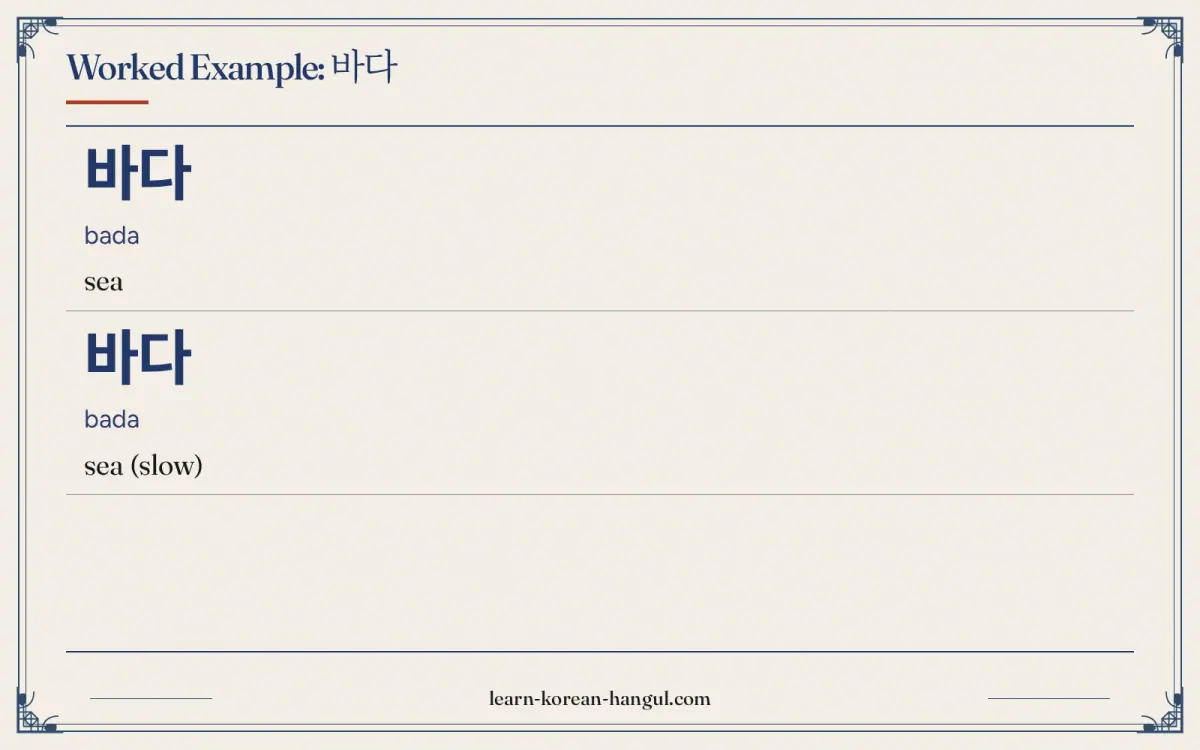
The worked example takes one word from set 1 through the routine.
- Listen at normal speed. The word has two even syllables.
바다
bada
sea
- Listen at slow speed. Notice that the ㄷ between two vowels sounds soft.
바다
bada
sea (slow)
- Echo. Say 바다 right after the clip, with equal weight on both syllables.
- Record and compare. The first ㅂ is a p-like sound with only a light breath, much weaker than the strong puff of 파. The ㄷ between the vowels is a soft, voiced d, not the strong puff of 타.
- Score. Give yourself 2 if neither consonant has a strong puff and the vowels are clear.
Note that plain consonants such as ㅂ and ㄷ often sound softer between vowels than at the start of a word. That is normal, and it is one reason a quick check against the clip matters. The most frequent errors are listed next.
Common Learner Mistakes
Learners often assume that a word should be said exactly as it is spelled, so they say 꽃이 as "kkot-i". In fact Korean links the final consonant to the next block, so the word is [꼬치]. Three more mistakes follow the same pattern.
- Learners often assume tense means loud. Actually a tense consonant is a tight throat, not volume.
- Learners often assume slow speech is more accurate. Actually very slow speech breaks the links between blocks, so use slow speed to hear the sounds and normal speed to say the item.
- Learners often assume one good attempt is enough. Actually the same item should be correct on two separate days before you treat it as learned.
Check yourself with the written drill.
Practice and Answer Key
Write the spoken form of each item from memory, then check it against the sets above.
Practice · 8
How is 꽃이 (the flower, as subject) pronounced?
Show answer
[꼬치]
Korean links the final consonant to the next block, so the ㅊ moves across: [꼬치]. Saying it as spelled is the most common mistake.
How is 읽다 (to read) pronounced?
Show answer
[익따]
Set 3 gives 읽다 as [익따]. [읻따] is the spoken form of 있다, and [일꼬] is 읽고.
Which sound change does 합니다 [함니다] show?
Show answer
Nasalization
합니다 is a set 4 nasalization item: ㅂ before ㄴ becomes ㅁ.
Which sound change does 학교 [학꾜] show?
Show answer
Tensification
학교 is a set 4 tensification item: the ㄱ after a final ㄱ becomes tense ㄲ.
In the set 2 triple 달, 딸, 탈, which word has the aspirated sound?
Show answer
탈 (mask)
탈 is aspirated, 달 is plain and 딸 is tense. A paper strip at the lips moves most on the aspirated sound.
What is a tense consonant, such as the ㄸ in 딸?
Show answer
A consonant made with a tight throat
Tense does not mean loud. A tense consonant is a tight throat, and the strong puff belongs to the aspirated sounds.
You score 5 out of 8 on a set. What should you do next?
Show answer
Repeat the items scored 0 or 1, then redo the set
A total of 4 to 6 means repeat the weak items and redo the set. 7 to 8 moves you on, and 0 to 3 sends you back to the lesson.
How many items does each practice set contain?
Show answer
12
There are five sets of 12 items each, 60 items in total.
- 꽃이
- 읽다
- 밭
- 합니다
- 학교
- 괜찮아요
- 맛있어요
- 한국어를
Answer key: 1. [꼬치]. 2. [익따]. 3. [받]. 4. [함니다]. 5. [학꾜]. 6. [괜차나요]. 7. [마시써요]. 8. [한구거를].
For the speaking task, choose one set, record four items and score them. Common questions follow.
Frequently Asked Questions
How many words are in the practice sets? The page has 60 items in five sets of 12. Sets 1 to 4 are single words, and set 5 is a list of phrases. Every item shows the Hangul, the spoken form in brackets and the meaning, so you can check the sound without leaving the page. All items are real, common Korean.
Is there audio? Yes, for the example items on this page, at normal and slow speed. Audio plays only when you press a button. The clips are machine-generated (text-to-speech), only clips approved in review are published, and clips for the other items will be added as they are approved. Use slow speed to hear the sounds and normal speed to copy the rhythm.
Can I print it? The tables on this page are plain text and print cleanly from any browser, so you can print the lists now. A printable PDF of the same sets is available here in A4 and US Letter. Printing helps with reading and scoring, but it cannot replace the audio.
Which set should I do first? Start with set 1 and work upward, because each set adds one skill to the previous one. If you already know the basic sounds, start with set 2 or set 3, whichever contrast is hardest for you. Do set 5 last and repeat it often, since it combines every skill.
Where to Go Next
The Korean pronunciation practice sets above cover 60 items in five skills. They do not cover intonation or conversation speed, and they do not score your pronunciation automatically. For another way to train rhythm with whole phrases, try the Korean shadowing practice.
Next in the series: Korean Tongue Twisters. To return to the full section, see Korean Pronunciation.