What you'll learn
- Read a 16-sentence folk-tale retelling aloud.
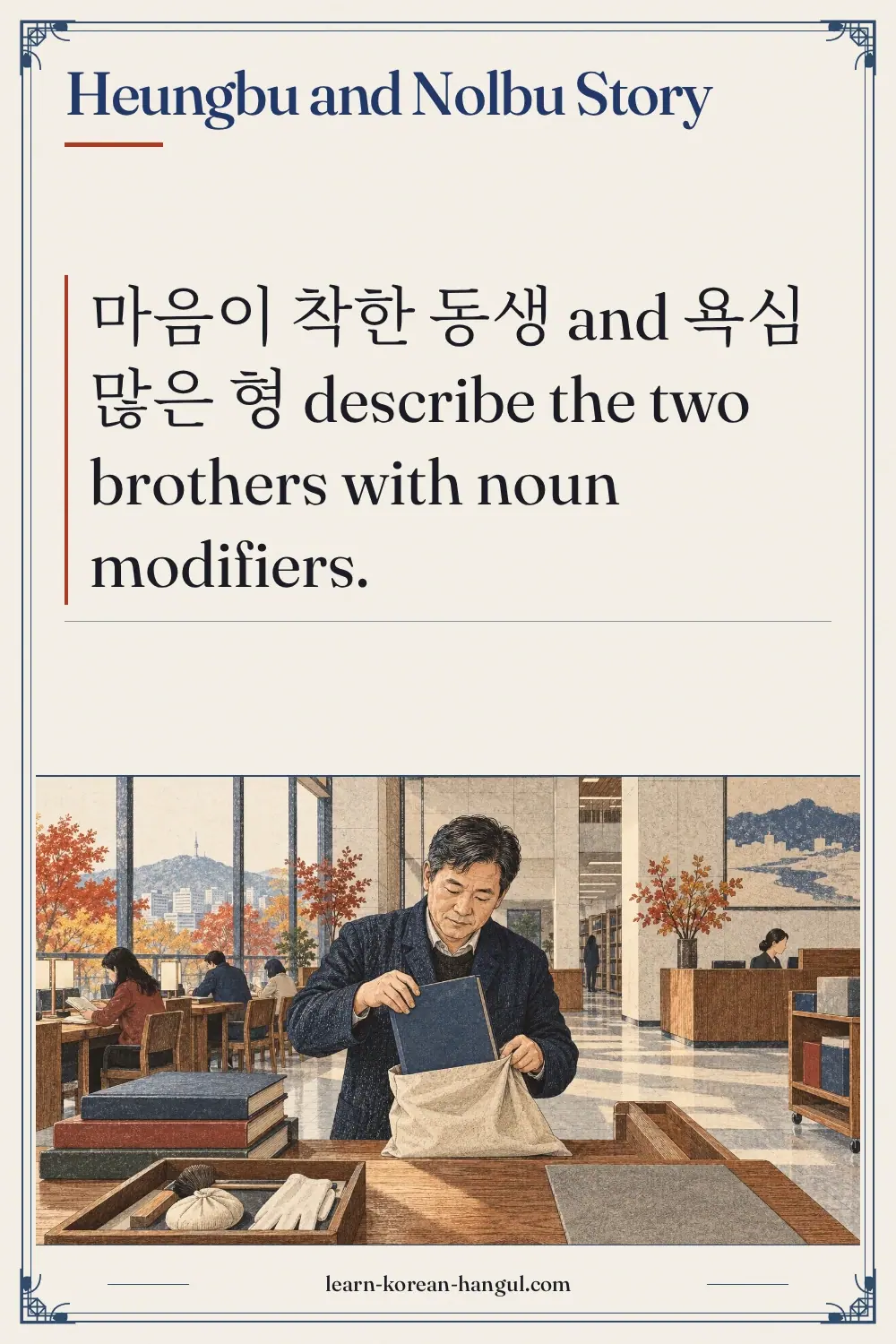
- Describe each brother with a modifier phrase: 마음이 착한 동생, 욕심 많은 형.
- Tell the present modifiers 착한 and 많은 from the past modifier 다친.
- State the moral of the tale in one sentence.
Before you start: You should be comfortable with the past polite style and simple connectors such as 그래서 and 하지만. Modifiers are explained on the Korean noun modifier page, but you can read the tale first. The story takes about 25 minutes. The sound changes are covered in Korean tensification.
What Happens in This Heungbu and Nolbu Story?
In this Heungbu and Nolbu story, two brothers live in a village. The older brother, Nolbu, is greedy and keeps their parents' money. The younger brother, Heungbu, is kind and poor. Heungbu cares for an injured swallow, and the next spring it brings him a gourd seed. The gourd is full of gold and silver. Nolbu copies him, breaks a swallow's leg on purpose, and gets only bad things from his gourd. Play the narration once, then read along with the table.
옛날 옛날에 두 형제가 살았어요. 형은 놀부였고 동생은 흥부였어요. 놀부는 욕심 많은 형이었어요. 흥부는 마음이 착한 동생이었어요. 놀부는 부모님의 집과 돈을 다 가졌어요. 흥부는 가족과 가난하게 살았어요. 어느 날 흥부는 다친 제비를 봤어요. 흥부는 제비를 정성껏 치료해 줬어요. 다음 봄에 제비가 박씨를 가지고 왔어요. 흥부가 박씨를 심었어요. 박이 크게 자랐어요. 박 안에는 금과 은이 가득했어요. 놀부도 부자가 되고 싶었어요. 그래서 놀부는 일부러 제비의 다리를 부러뜨렸어요. 하지만 놀부의 박에서는 나쁜 것이 나왔어요. 착한 사람은 복을 받고, 욕심 많은 사람은 벌을 받아요.
| # | Korean | Meaning |
|---|---|---|
| 1 | 옛날 옛날에 두 형제가 살았어요. | Once upon a time two brothers lived. |
| 2 | 형은 놀부였고 동생은 흥부였어요. | The older brother was Nolbu, and the younger brother was Heungbu. |
| 3 | 놀부는 욕심 많은 형이었어요. | Nolbu was an older brother with great greed. |
| 4 | 흥부는 마음이 착한 동생이었어요. | Heungbu was a younger brother with a kind heart. |
| 5 | 놀부는 부모님의 집과 돈을 다 가졌어요. | Nolbu kept all of his parents' house and money. |
| 6 | 흥부는 가족과 가난하게 살았어요. | Heungbu lived poorly with his family. |
| 7 | 어느 날 흥부는 다친 제비를 봤어요. | One day Heungbu saw an injured swallow. |
| 8 | 흥부는 제비를 정성껏 치료해 줬어요. | Heungbu treated the swallow with care. |
| 9 | 다음 봄에 제비가 박씨를 가지고 왔어요. | The next spring the swallow came with a gourd seed. |
| 10 | 흥부가 박씨를 심었어요. | Heungbu planted the seed. |
| 11 | 박이 크게 자랐어요. | The gourd grew big. |
| 12 | 박 안에는 금과 은이 가득했어요. | Inside the gourd, there was plenty of gold and silver. |
| 13 | 놀부도 부자가 되고 싶었어요. | Nolbu wanted to become rich too. |
| 14 | 그래서 놀부는 일부러 제비의 다리를 부러뜨렸어요. | So Nolbu broke a swallow's leg on purpose. |
| 15 | 하지만 놀부의 박에서는 나쁜 것이 나왔어요. | But bad things came out of Nolbu's gourd. |
| 16 | 착한 사람은 복을 받고, 욕심 많은 사람은 벌을 받아요. | A kind person receives good fortune, and a greedy person receives punishment. |
The tale is known as 흥부전 (Heungbu-jeon) in Korean tradition, and versions differ in details, such as what comes out of Nolbu's gourds. This retelling keeps only the parts every version shares: a kind brother, a greedy brother, an injured swallow, gourds and a moral. The next section shows what is easy and hard.
What Makes This Story Easy or Hard to Read?
The text is easy because the plot is simple and the verbs are mostly the past polite forms you know. It is harder in four places: modifiers placed before nouns, the two-brother vocabulary, several sound changes and the shift to the present in the last line.
| Feature | In the story | Note |
|---|---|---|
| Noun modifiers | 착한 동생, 욕심 많은 형, 다친 제비 | Describe a noun before it, with no "who is" |
| Brother words | 형, 동생, 형제 | 형 is the older brother of a male speaker; 동생 is a younger sibling |
| Connectors | 그래서, 하지만, -고 | So, but, and |
| Sound change | 착한 [차칸], 욕심 [욕씸], 복을 받고 [보글 받꼬] | Aspiration and tensing |
| Tense shift | 받았어요 → 받아요 | The moral is a general truth, so it is in the present |
| Set phrase | 옛날 옛날에 | Once upon a time |
The modifier is the main skill. In English the description follows the noun ("a brother who is kind"). In Korean it comes before the noun and ends in a form like -ㄴ or -은: 착한 동생. Once you can find the modifier, the rest of the sentence is a plain past sentence.
Which New Words Should You Preview?
Preview these words before you read. The first six are the words you need most to follow the plot.
| Word | Revised Romanization | Meaning | Sentence |
|---|---|---|---|
| 형제 | hyeongje | brothers (or siblings) | 1 |
| 형 | hyeong | older brother (said by a man) | 2, 3 |
| 동생 | dongsaeng | younger sibling | 2, 4 |
| 욕심 | yoksim | greed | 3 |
| 착한 | chakan | kind, good-natured | 4, 16 |
| 가난하게 | gananhage | poorly | 6 |
| 제비 | jebi | swallow (the bird) | 7, 8, 14 |
| 정성껏 | jeongseongkkeot | with all one's heart | 8 |
| 박씨 | bakssi | gourd seed | 9, 10 |
| 박 | bak | gourd | 11, 12, 15 |
| 가득했어요 | gadeukaesseoyo | was full of | 12 |
| 부자 | buja | rich person | 13 |
| 일부러 | ilbureo | on purpose | 14 |
| 복 | bok | good fortune | 16 |
| 벌 | beol | punishment | 16 |
Romanization is only a reading aid here. The words 제비 (swallow) and 박 (gourd) are the two key objects of the tale, so learn them first. Hear two of the harder words before you start.
Read the Story in Three Passes
Read the story three times, each pass with one job.
- Pass 1: read silently for the plot. Find the two brothers, the swallow and the gourd. Do not look anything up.
- Pass 2: find the modifiers. Underline the words that describe a noun before it: 욕심 많은, 마음이 착한, 다친, 나쁜. Check the table for each.
- Pass 3: read aloud. Read the tale as if you were telling it to a child, with a flat voice for the narration and a firm voice for the moral.
Try the two brother lines with the audio and then without it.
Use them as a model, then read along. The extensive reading page explains why finishing easy texts and re-reading them works.
Comprehension Questions
Answer from the text. Question 5 asks for the moral.
- Who is the older brother? (a) Heungbu (b) Nolbu (c) the swallow
- How is Heungbu described? (a) greedy (b) kind-hearted (c) lazy
- What did Heungbu do for the swallow? (a) treated it (b) sold it (c) ignored it
- What was inside Heungbu's gourd? (a) gold and silver (b) goblins (c) nothing
- What is the moral? (a) kindness is rewarded and greed is punished (b) birds are lucky (c) older brothers are always right
Answers
- 1 (b). Sentence 2: 형은 놀부였고 means the older brother was Nolbu.
- 2 (b). Sentence 4: 마음이 착한 동생 means a younger brother with a kind heart.
- 3 (a). Sentence 8: 치료해 줬어요 means treated it for the swallow.
- 4 (a). Sentence 12: 금과 은이 가득했어요.
- 5 (a). Sentence 16: a kind person receives good fortune, a greedy person receives punishment.
If you missed question 2, look at the phrase before 동생 in sentence 4. The modifier comes first, and it tells you what kind of brother it is.
What Grammar Appears in the Story?
Seven patterns carry the story.
| Pattern | Example | What it does |
|---|---|---|
| Adjective + ㄴ/은 + noun | 착한 동생, 많은 형 | a present description before the noun |
| Verb + ㄴ/은 + noun (past) | 다친 제비 | a finished state before the noun |
| Noun + 와/과 | 가족과, 금과 은 | with, and |
| Verb + -고 | 놀부였고, 받고 | and; joins two parts |
| -고 싶었어요 | 부자가 되고 싶었어요 | wanted to |
| -아/어 주다 | 치료해 줬어요 | do something for someone |
| Connectors 그래서 / 하지만 | 그래서 놀부는, 하지만 놀부의 | so / but |
The modifier rule has two parts. After a consonant, the present modifier ending is -은 (많은). After a vowel, it is -ㄴ (착한 from 착하다). A past modifier uses -ㄴ after a vowel (다친 from 다치다) and -은 after a consonant. The Korean noun modifier lesson gives the full pattern with a table.
Worked Example: the Two Brothers' Modifiers
Read sentences 3 and 4 as a pair, because they show the two main modifiers side by side.
- 욕심 많은 형: 많다 (to be a lot) + 은 (after a consonant) = 많은. So 욕심 많은 형 means "an older brother with a lot of greed".
- 마음이 착한 동생: 착하다 (to be kind) + ㄴ (after a vowel) = 착한. The phrase 마음이 착한 means "whose heart is kind".
- 다친 제비: 다치다 (to be hurt) + ㄴ = 다친. A past modifier: "the swallow that was hurt".
- 나쁜 것: 나쁘다 (to be bad) + ㄴ = 나쁜. 것 means "thing", so 나쁜 것 is "a bad thing".
- In each case the modifier sits directly before the noun, and the noun carries the particle: 착한 동생은, 다친 제비를.
놀부는 욕심 많은 형이었어요.
nolbuneun yoksim maneun hyeongieosseoyo
Nolbu was an older brother with great greed.
흥부는 마음이 착한 동생이었어요.
heungbuneun maeumi chakan dongsaengieosseoyo
Heungbu was a younger brother with a kind heart.
You can make your own modifier phrase by choosing an adjective and a noun: 마음이 따뜻한 친구 (a warm-hearted friend) or 키가 큰 동생 (a tall younger brother). The structure noun + 이/가 + adjective-modifier + noun is the same.
What Mistakes Do Learners Make Here?
Learners often make four mistakes with this text.
| Learners often assume | Actually | Because |
|---|---|---|
| The modifier follows the noun: 동생 착한 | It comes first: 착한 동생 | Korean puts the description before the noun |
| 착한 is said [착한] | It is said [차칸] | ㄱ + ㅎ joins into one ㅋ sound |
| 박씨 is said [박시] | It is said [박씨] | The 씨 already has a tense ㅆ |
| 형 means any older brother for anyone | Men say 형; women say 오빠 | The word depends on the speaker |
The second error comes from reading letter by letter. The same aspiration happens in the other order, ㅎ before ㄷ, in 좋다 [조타]. For sounds like 욕심 [욕씸], where a tense sound appears without a tense letter, see Korean tensification.
Practice and Answer Key
Part A: make the modifier. Write the modifier form for each adjective.
- 착하다 → ___ 사람
- 많다 → ___ 사람
- 나쁘다 → ___ 사람
Part B: speak. Describe both brothers in Korean in one sentence each, using 착한 and 욕심 많은.
Part C: moral. Say the moral of the tale in your own words, in English or in Korean.
Answers
- Part A: 1 착한, 2 많은, 3 나쁜.
- Part B: for example 흥부는 마음이 착한 동생이에요. 놀부는 욕심 많은 형이에요.
- Part C: kindness is rewarded, and greed is punished.
Where to Go Next
Continue with the other tales in Graded Korean Stories, or return to the Korean short stories for beginners overview. For the grammar behind this tale, read Korean noun modifier. The Korean culture section has more on stories and traditions.
This Heungbu and Nolbu story is a short retelling for reading practice, not a full translation of the classic text, and it leaves out many incidents. It covers present and past modifiers and a few connectors, but not every modifier form. A reread a week later should be easier.
Frequently Asked Questions
Who Are Heungbu and Nolbu?
They are two brothers in a classic Korean folk tale. Heungbu is the kind younger brother, and Nolbu is the greedy older brother. Heungbu cares for an injured swallow and is rewarded with a gourd full of treasure. Nolbu tries to copy him, but his greed brings him bad luck. The tale is known as 흥부전.
What Is a Noun Modifier?
A noun modifier is a word or phrase that describes a noun and comes before it. In 착한 동생, the word 착한 describes 동생. It is formed from the adjective stem plus -ㄴ or -은. Korean has no word for "who is", so the description simply sits before the noun.
Why Is 착한 Said [차칸]?
The ㄱ at the end of 착 meets the ㅎ of 한. Together they sound like one aspirated ㅋ, so 착한 sounds like 차칸. Romanization shows this as chakan. The same aspiration happens in 좋다 [조타], where ㅎ and ㄷ join into ㅌ. Reading aloud and checking the brackets is the quickest way to learn it.
What Is the Difference between 형 and 오빠?
Both mean older brother. A male speaker says 형, and a female speaker says 오빠. For an older sister, a female speaker says 언니, and a male speaker says 누나. The tale uses 형 as the plain word for an older brother. 동생 means a younger sibling of either sex.
Why Is the Last Sentence in the Present Tense?
The moral is a general truth, not an event in the story, so Korean puts it in the present: 받아요. The earlier sentences tell what happened, so they are in the past. The ending -고 in 받고 joins two ideas, and the tense of the whole sentence is shown on the last verb.