Before you start
- Time: 4 weeks, 15 to 30 minutes a day, 5 days a week.
- Difficulty: low. The method works because the texts are easy.
- Materials: the graded texts linked below, a notebook or spreadsheet for the log, and a timer.
- Prerequisites: you can read Hangul syllable blocks with final consonants and have finished a few single sentences. If not, start with how to read Hangul.
- Cost: free. Every text recommended first is on this site.
What Is Extensive Reading in Korean?
Extensive reading in Korean is reading a large amount of easy text for the story or the content, not to study the language. You read quickly, guess unknown words from context, and look up very little. The aim is volume and fluency. The opposite is intensive reading, where you study a short, difficult text sentence by sentence.
| Feature | Extensive reading | Intensive reading |
|---|---|---|
| Text difficulty | Easy: few unknown words | Hard: many unknown words |
| Amount | Many pages | A few lines or a page |
| Dictionary use | Almost none | Constant |
| Goal | Fluency and enjoyment | Accuracy and new grammar |
| Typical session | 15 to 30 minutes | 20 to 60 minutes |
Both methods are useful, and neither replaces the other. This guide covers the first. Why extensive reading is worth the time comes next.
Why Extensive Reading Works for Korean
Extensive reading works for Korean because Korean grammar is carried by short, repeated endings and particles, and many easy pages show them again and again. Each page repeats 은/는, 이/가, 을/를, 에, 에서 and the polite 요 ending dozens of times. After several hundred repetitions you stop decoding them and start seeing them as part of a chunk.
Researchers in second-language reading, including Paul Nation and Richard Day with Julian Bamford, have long argued for large amounts of easy reading, and many teachers use it. This site does not report its own study results. The method is a well-known teaching practice, not a guaranteed outcome, and the speed of progress depends on how often you read.
There is also a practical reason. Intensive reading of hard texts burns motivation fast. A learner who finishes ten easy pages a week keeps going longer than one who stalls on a single difficult page.
How Do You Choose a Text at the Right Level?
Choose a text with the 100-word test. Count 100 running words from the middle of the text, mark the words you do not know, and use the count to decide. The test takes two minutes and prevents the main failure of this method: reading texts that are too hard.
- Pick 100 words. Use a stretch from the middle of the text, not the first page, which is often easier.
- Mark unknown words. Count every occurrence of an unknown word. Do not look anything up yet.
- Read the count. Use the table below.
- Check by feel. Could you follow the story without stopping?
| Unknown words in 100 | Verdict | What to do |
|---|---|---|
| 0 to 5 | Comfortable (about 1 in 20 or better) | Read it straight through |
| 6 to 10 | Borderline | Read with the five-lookup limit, or choose an easier text |
| More than 10 | Too hard for this method | Switch to an easier text now |
The first row follows a common teaching rule of thumb: when about 95 percent of the words are known, a text can be read for meaning. Some researchers suggest even higher figures, up to 98 percent, for unaided reading. Treat these as heuristics, not laws.
Site Texts by Level
The texts on this site run in a clear ladder. Start at the lowest row where the test gives 5 or fewer unknown words.
| Level | Text | Length |
|---|---|---|
| A1 | Easy Korean Story About Morning Routine | 12 sentences |
| A1 | Easy Korean Story at the Cafe | 10 sentences |
| A1 | Easy Korean Story About Family | 12 sentences |
| A1 | Easy Korean Story About a School Day | 12 sentences |
| A1 | Korean Paragraph Reading for Beginners | 4 paragraphs |
| A2 | Korean Reading Passages with Questions | 3 passages |
If you outgrow these, look at the graded readers reviewed in Korean textbooks. With any outside book, run the 100-word test first.
Worked Example: Counting a 100-Word Sample
A short worked count shows the method on a 20-word text. The learner reads the text, marks unknown words and scales the result.
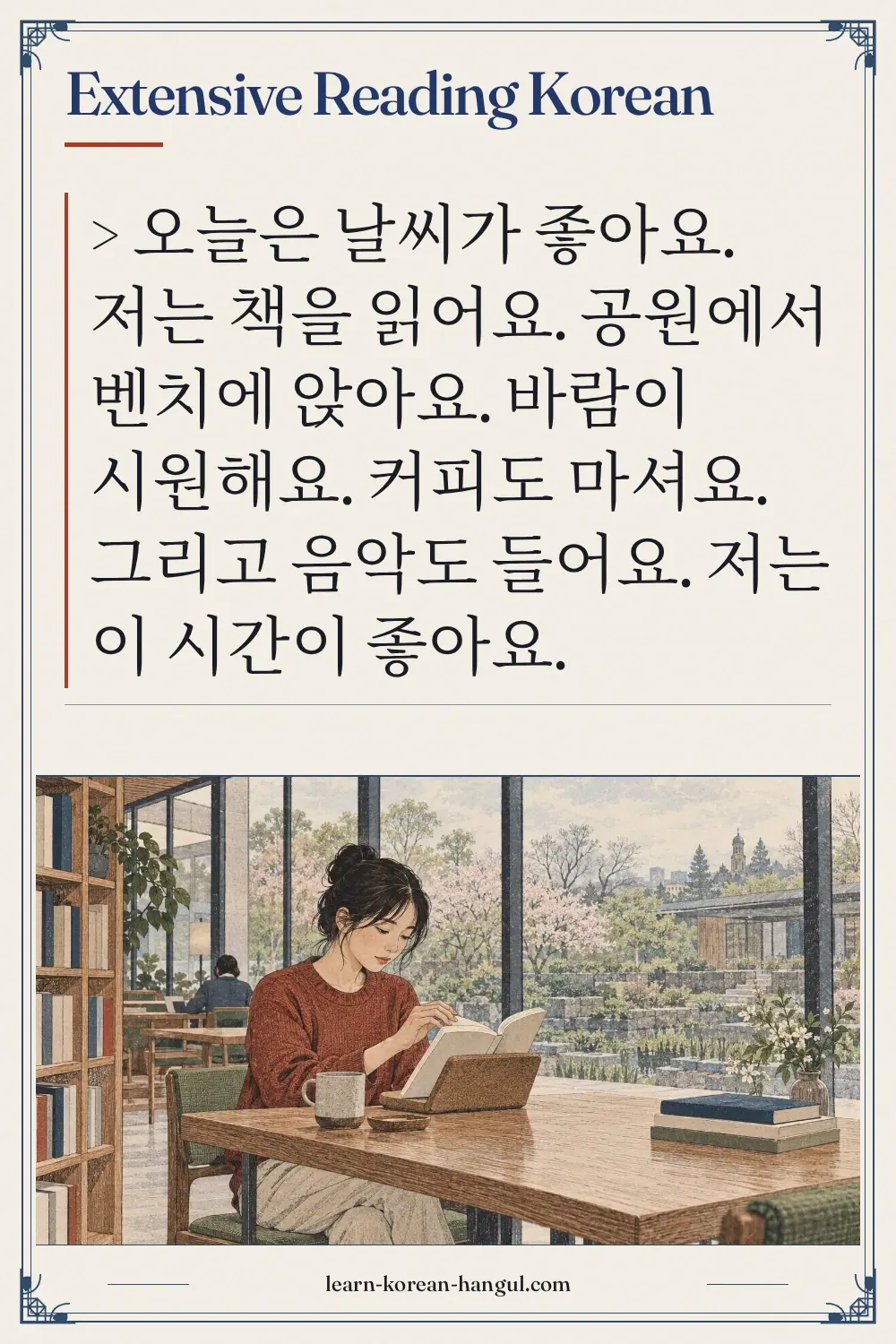
오늘은 날씨가 좋아요. 저는 책을 읽어요. 공원에서 벤치에 앉아요. 바람이 시원해요. 커피도 마셔요. 그리고 음악도 들어요. 저는 이 시간이 좋아요.
(The weather is nice today. I read a book. I sit on a bench in the park. The breeze is cool. I drink coffee too. And I listen to music too. I like this time.)
오늘은 날씨가 좋아요. 저는 책을 읽어요. 공원에서 벤치에 앉아요. 바람이 시원해요. 커피도 마셔요. 그리고 음악도 들어요. 저는 이 시간이 좋아요.
The text has 20 words: 오늘은, 날씨가, 좋아요, 저는, 책을, 읽어요, 공원에서, 벤치에, 앉아요, 바람이, 시원해요, 커피도, 마셔요, 그리고, 음악도, 들어요, 저는, 이, 시간이, 좋아요. A learner marks 벤치 (bench) and 시원해요 (is cool) as unknown. That is 2 in 20, or 10 in 100.
The result is at the switch limit. One unknown in twenty would be comfortable, and two in twenty is borderline. The learner can either read this text with a lookup limit of five, or choose an easier one.
Use it to check how a line sounds, then read the line silently again. Next comes the routine itself.
Extensive Reading Korean: a Four-Week Routine
Follow this routine for four weeks. Each week adds a little time and a slightly harder text. The page targets are illustrative, so adjust them to your pace. One site story or one passage counts as one page-equivalent.
| Week | Daily time | Text level | Target (page-equivalents) | Rule |
|---|---|---|---|---|
| 1 | 15 minutes | A1 stories you can read with 0 to 5 unknown words | 6 | Read each story twice |
| 2 | 20 minutes | A1 stories and paragraphs | 8 | Use no more than five lookups per text |
| 3 | 25 minutes | First A2 passages, without the questions | 10 | Switch texts if you lose the thread in 10 sentences |
| 4 | 30 minutes | Free choice from any level that passes the test | 12 | Finish what you start, or drop it at once |
Step 1: Set the Lookup Limit
Allow five lookups per text. Write each looked-up word in a list, then keep reading. You will know it worked when you finish a text with at least half of the unknown words guessed from context. The common mistake here is to look up a word as soon as it appears, which stops the story. Look up only after the sentence ends.
Step 2: Keep Translation Apps out of the Session
Do not run a translation app in the middle of reading. Apps give an English sentence that replaces the Korean one, so you read the English instead. Use a glossary or dictionary for single words only. You will know it worked when you can retell the story in a sentence or two without checking the text.
Step 3: Apply the Switching Rule
Switch texts in two cases: you lose the thread in the first 10 sentences, or the 100-word test turns out wrong and the text is above 10 unknown words in 100. The common mistake is to push on out of pride. Finishing a text that is too hard teaches the habit of skimming.
Step 4: Re-Read Once
Re-read one story each week at the end of the session. Re-reading shows you how much easier the same text has become, and it is the cheapest sign of progress. For more on speed, see the reading strategies hub.
Keeping a Reading Log
Keep a log with five columns and update it after every session. The log records volume, not performance. Count what you read, not what you learned.
| Date | Text | Minutes | Pages | Unknown words (of 100) |
|---|---|---|---|---|
| Mon | Morning Routine story, read 1 | 12 | 1 | 4 |
| Tue | Morning Routine story, read 2 | 8 | 1 | 1 |
| Wed | Cafe story, read 1 | 14 | 1 | 5 |
| Thu | Paragraph reading, paragraph 1 | 10 | 1 | 6 |
This is an example of the format, not real data. Two measures matter. Pages per week shows volume. Minutes per page shows speed: the Morning Routine story drops from 12 to 8 minutes on the second read, which is what you want to see.
New words from the log can go to flashcards or the Korean vocabulary hub, but keep review short. Five words after a session is enough. Counting new words as the main goal pushes you toward harder texts, and that is the opposite of this method.
What Are the Most Common Mistakes and How Do You Fix Them?
Most learners make the same six mistakes with extensive reading. Each has a clear fix.
| Mistake | Why it hurts | Fix |
|---|---|---|
| Choosing texts that are too hard | Reading becomes study and stalls | Run the 100-word test and switch above 10 |
| Looking up every word | Breaks the flow and the fluency | Limit lookups to five per text |
| Using a translation app mid-text | You read English, not Korean | Use a glossary for single words only |
| Reading once and moving on | No sign of progress | Re-read one text each week |
| Skipping the log | No evidence you are improving | Log pages and minutes after each session |
| Counting new words as the goal | Pushes you to harder texts | Count pages read instead |
An honest warning for the second row: some learners feel anxious without a dictionary. Start with the limit of five lookups, and reduce it only when you feel ready.
When Extensive Reading Is the Wrong Tool
Extensive reading is the wrong tool in four situations.
- You cannot yet read Hangul quickly. Practise how to read Hangul and single sentences first.
- You need a new grammar pattern. Easy texts rarely teach new rules. Use a lesson or a textbook for that.
- You are preparing for an exam in a few weeks. Exam preparation needs timed practice with exam-style texts, which is different.
- You want a large vocabulary quickly. Easy texts repeat the same words. A word list or deck builds vocabulary faster.
There is also a limit to this site: it has a limited number of graded texts, so a learner reading daily will run out within a few weeks and need outside material. Plan for that in week three.
What to Expect after Four Weeks
After four weeks, expect smaller and steadier changes than a headline promise would suggest. The measurable signs are in your own log, not in a test score.
- Minutes per page fall. The same kind of text takes fewer minutes by week four, as in the Morning Routine example above.
- Unknown words per 100 fall on new texts of the same level. A text that gave 6 in week one may give 3 in week four.
- Lookups drop below five. You guess more words and check fewer.
- Particles stop slowing you down. Chunks like 학교에서 or 친구와 are read as one unit.
What you should not expect is a jump in speaking ability or a large vocabulary. Reading builds recognition, and speaking needs its own practice. If none of the signs appear after four weeks, the usual cause is a text level that is still too high, so repeat the 100-word test.
Variations for Busy Weeks and for Listening
Two variations keep the routine going when life changes.
A busy week. Cut each session to 10 minutes and read one story once, not twice. Ten minutes five times a week still adds up to 50 minutes and keeps the habit. Resume the full time the following week. The one rule that does not change is the lookup limit.
Read-along with audio. The stories on this site have narration. Play a sentence, read it with your eyes, then read the next one before the audio plays it. This trains your eyes to lead your ears, and it helps with tense consonants and sound changes such as 읽어요 [일거요] that the spelling hides. Switch the audio off for the second read. Use Korean short stories for beginners to pick the stories that have audio.
Finishing the Routine and Moving Up
Finish the four weeks by looking at your log. Compare minutes per page in week one and week four. If the times drop and you stay at five lookups or fewer, increase the level by one step and repeat the routine with new texts. If the times do not drop, stay at the same level for another four weeks. Extensive reading Korean works best when the texts stay easy, the habit stays regular and the log stays honest.
Start with the Korean short stories for beginners, then add the Easy Korean Story at the Cafe and the next stories in the same section. The Reading Strategies hub covers speed, guessing and reading aloud.
Frequently Asked Questions
How Much Should I Read Each Day?
Fifteen to thirty minutes on five days a week is a realistic routine. Regular short sessions beat one long weekend session, because the benefit comes from many easy texts and repeated particles and endings. Start at fifteen minutes and add five minutes each week, but stop when you lose focus or enjoyment.
What Are Graded Readers?
Graded readers are books or texts written within a controlled vocabulary and grammar level, so a learner can read them with few lookups. The graded stories on this site at A1 and A2 work this way. Publishers also sell graded Korean readers by level. Check any book with the 100-word test before you commit to it.
Do I Need to Look up Every Word?
No. Looking up every word turns extensive reading into slow study. Set a limit of five lookups per text and guess the rest from context. If you need more than five to follow the story, the text is too hard for this method, so choose an easier one and return to it later.
Where Can I Find Easy Korean Texts?
Start with the graded stories and reading sets on this site, which run from A1 sentences to A2 passages. Beyond them, look for publisher graded readers and short texts written for learners. Children's picture books look easy but can use rare words, so test a sample with the 100-word count first.