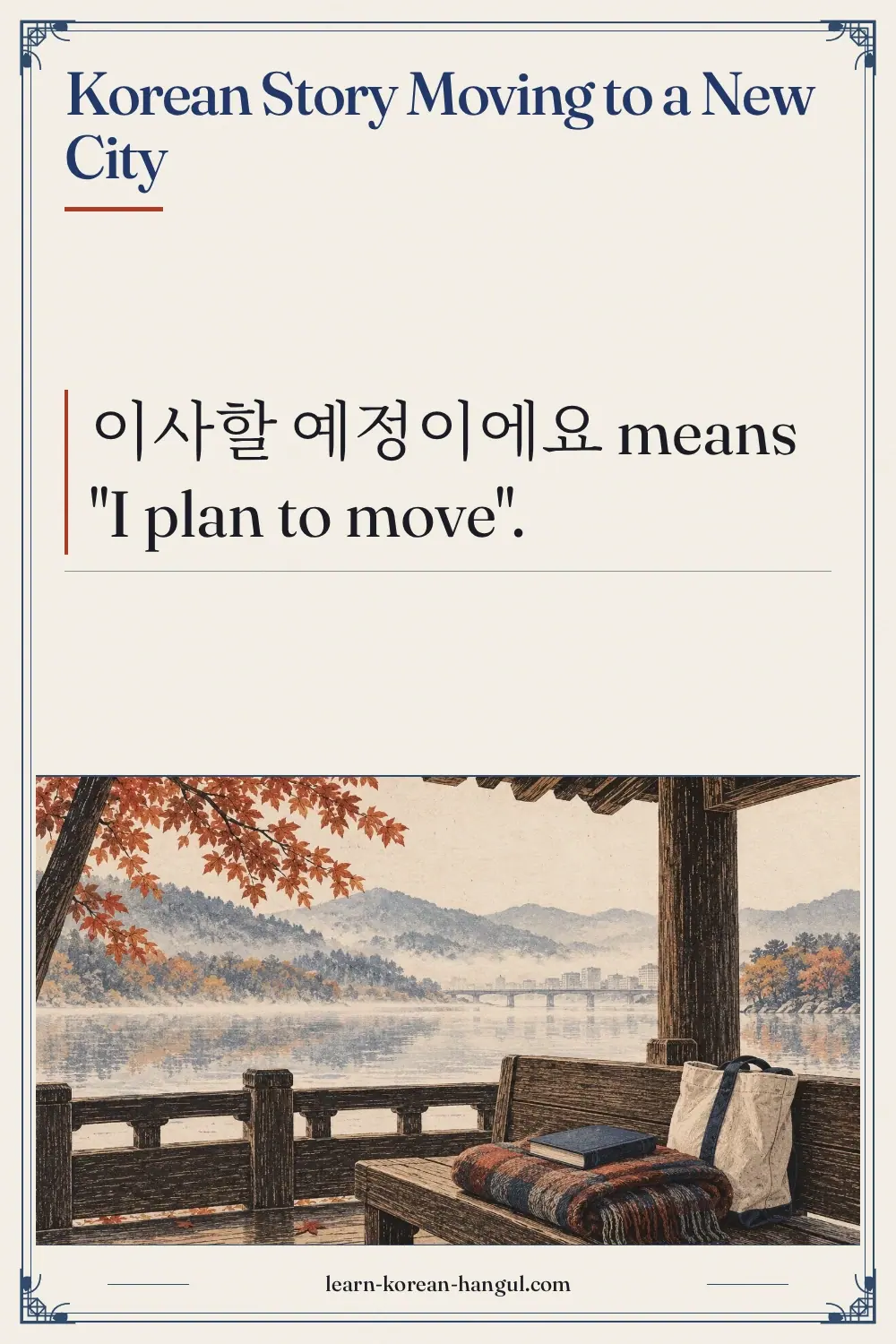
What you'll learn
- Read a 16-sentence story about a move, in the polite 해요 style.
- Say a plan with -(으)ㄹ 예정이에요 and a small intention with -ㄹ 거예요.
- Change 가깝다 to 가까워서 with the ㅂ-irregular rule.
- Say a wish with -고 싶어요 and "get used to" with 익숙해지다.
Before you start: you should know the past and future forms of polite verbs and the endings -아/어서 and -지만. The lesson takes about 25 minutes. If the grammar feels new, the Korean future tense page is a good warm-up.
What Happens in This Korean Story about Moving to a New City?
In this Korean story about moving to a new city, the narrator plans to move from Seoul to Busan next month because of a new job. They have already found a house near the office, they are still packing, and friends have given them a small gift. They are excited about the sea but a little worried about not knowing anyone. They end the story with a wish: that the new place will soon feel like home. Play the narration once, then read along with the table.
저는 다음 달에 부산으로 이사할 예정이에요. 지금은 서울에 살지만 새 회사는 부산에 있어요. 그래서 지난주에 새집을 구했어요. 새집은 회사에서 가까워서 좋아요. 방은 작지만 창문이 커서 밝아요. 아직 짐을 다 싸지 않았어요. 책과 옷, 그릇, 이불을 먼저 챙겨야 해요. 친구들이 작은 선물을 줬어요. 하지만 아는 사람이 없어서 조금 걱정돼요. 부산은 바다가 있는 도시라서 기대돼요. 새로운 동네에 빨리 익숙해지고 싶어요. 도착하면 먼저 근처 시장에 가 볼 거예요. 주말에는 바다도 보러 갈 거예요. 이사가 끝나면 친구들을 집에 초대할 거예요. 새집이 곧 제 집처럼 편해지면 좋겠어요. 오늘 밤에는 상자를 하나 더 싸야겠어요.
| # | Korean | Meaning |
|---|---|---|
| 1 | 저는 다음 달에 부산으로 이사할 예정이에요. | I plan to move to Busan next month. |
| 2 | 지금은 서울에 살지만 새 회사는 부산에 있어요. | I live in Seoul now, but my new company is in Busan. |
| 3 | 그래서 지난주에 새집을 구했어요. | So last week I found a new home. |
| 4 | 새집은 회사에서 가까워서 좋아요. | The new home is close to the office, so it is nice. |
| 5 | 방은 작지만 창문이 커서 밝아요. | The room is small, but the window is big, so it is bright. |
| 6 | 아직 짐을 다 싸지 않았어요. | I have not packed all my things yet. |
| 7 | 책과 옷, 그릇, 이불을 먼저 챙겨야 해요. | I have to get the books, clothes, dishes and blankets ready first. |
| 8 | 친구들이 작은 선물을 줬어요. | My friends gave me a small gift. |
| 9 | 하지만 아는 사람이 없어서 조금 걱정돼요. | But I know no one there, so I am a little worried. |
| 10 | 부산은 바다가 있는 도시라서 기대돼요. | Busan is a city with the sea, so I am looking forward to it. |
| 11 | 새로운 동네에 빨리 익숙해지고 싶어요. | I want to get used to the new neighbourhood quickly. |
| 12 | 도착하면 먼저 근처 시장에 가 볼 거예요. | When I arrive, I will first go and see the nearby market. |
| 13 | 주말에는 바다도 보러 갈 거예요. | On the weekend I will go to see the sea too. |
| 14 | 이사가 끝나면 친구들을 집에 초대할 거예요. | When the move is over, I will invite my friends to my home. |
| 15 | 새집이 곧 제 집처럼 편해지면 좋겠어요. | I hope the new home soon becomes comfortable like my own home. |
| 16 | 오늘 밤에는 상자를 하나 더 싸야겠어요. | Tonight I should pack one more box. |
The story moves from the plan (1–2), through the practical steps (3–8), to the feelings (9–11), and ends with the future (12–16).
What Makes This Story Easy or Hard to Read?
The story is easy because every sentence has one clear job and the vocabulary is about daily life. It is harder in three places: the future endings look alike, one adjective is irregular, and several sentences join two ideas with -아/어서 or -지만.
| Feature | In the story | Note |
|---|---|---|
| Plan | 이사할 예정이에요 | Verb stem + -(으)ㄹ 예정이에요 |
| Future intention | 갈 거예요, 초대할 거예요 | Verb stem + -(으)ㄹ 거예요 |
| ㅂ-irregular | 가까워서 | 가깝다 + -아서 |
| Wish | 익숙해지고 싶어요 | -고 싶어요 for verbs |
| Reason | 가까워서, 없어서, 도시라서 | -아/어서 or 이라서 |
| Contrast | 살지만, 작지만 | -지만, "but" |
| Condition | 도착하면, 끝나면, 편해지면 | -(으)면, "when, if" |
The pattern to notice: each long sentence has two halves. The first half gives a fact (방은 작지만) and the second half gives a result (창문이 커서 밝아요). Find the join word first, then read each half on its own. See Korean want to grammar for the wish ending.
Which New Words Should You Preview?
Preview these words before you read. They carry most of the story.
| Word | Revised Romanization | Meaning | Sentence |
|---|---|---|---|
| 이사하다 | isahada | move house | 1, 14 |
| 예정 | yejeong | plan, schedule | 1 |
| 구하다 | guhada | find, look for and get | 3 |
| 가깝다 | gakkapda | be close, near | 4 |
| 창문 | changmun | window | 5 |
| 밝다 | bakda | be bright | 5 |
| 짐 | jim | luggage, things to carry | 6 |
| 싸다 | ssada | pack, wrap | 6, 16 |
| 챙기다 | chaenggida | get ready, take care to bring | 7 |
| 걱정되다 | geokjeongdoeda | be worried | 9 |
| 기대되다 | gidaedoeda | look forward to | 10 |
| 동네 | dongne | neighbourhood | 11 |
| 익숙해지다 | iksukaejida | get used to | 11 |
| 근처 | geuncheo | nearby area | 12 |
| 초대하다 | chodaehada | invite | 14 |
| 편하다 | pyeonhada | be comfortable | 15 |
Romanization here is only a reading aid. In 익숙해지다, the h joins the final ㄱ, so the word is said [익쑤캐지다] and written iksukaejida. The nouns keep their h, as in 근처 geuncheo.
Packing-list nouns. Sentence 7 lists four things to pack: 책 (chaek, book), 옷 (ot, clothes), 그릇 (geureut, dish) and 이불 (ibul, blanket). Add these to your list for review: 상자 (sangja, box), 수건 (sugeon, towel), 컵 (keop, cup), 신발 (sinbal, shoes). Read them aloud, then cover the English and say each one in a short sentence such as 상자가 하나 있어요.
Read the Story in Three Passes
Read the story three times, each pass with one job.
- Pass 1: read silently. Find three things in the order they happen: where the narrator moves, what they pack and what they hope for. Do not look anything up.
- Pass 2: read with the table. Check only the words you could not guess. Then re-read each Korean sentence before checking the English.
- Pass 3: read aloud with the narration. Play a sentence, pause and repeat it, then read the story aloud without audio.
Use it as a model for rhythm. The extensive reading page shows how to read stories like this one on a weekly schedule.
Comprehension Questions
Answer these in English or in short Korean. The answers are in the practice section.
- When will the narrator move, and to which city?
- Why does the narrator like the new home?
- Why is the narrator a little worried?
- What will the narrator do first after arriving?
- What does the narrator hope for at the end?
If you can answer all five, you have followed the story. If one answer escapes you, find the sentence in the table and read it again.
What Grammar Appears in the Story?
Five patterns carry the story.
1. -(으)ㄹ 예정이에요 for a plan. In 이사할 예정이에요, 이사하다 takes the modifier ending -ㄹ and then 예정이에요, which means "it is a plan". Use it for events that are set: a move, a trip, a meeting. -(으)ㄹ 거예요 is the general future. Sentences 12–14 use it for small intentions: 갈 거예요, 초대할 거예요. After -ㄹ, the next sound is tense and is said attached: 갈 거예요 is said [갈꺼예요], and 볼 거예요 is [볼꺼예요]. For more, see Korean future tense.
2. The ㅂ-irregular. 가깝다 loses its ㅂ before a vowel and adds 우: 가까워요, 가까워서, 가까운. Before a consonant, nothing changes: 가깝지만.
| Dictionary form | Before a vowel | Meaning |
|---|---|---|
| 가깝다 | 가까워서 | be close |
| 춥다 | 추워서 | be cold |
| 어렵다 | 어려워서 | be difficult |
3. -고 싶어요 and -아/어지다. -고 싶어요 attaches to a verb stem and means "I want to". 익숙해지다 is 익숙하다 (be familiar) plus 지다, so it means "become familiar". Together, 익숙해지고 싶어요 means "I want to become used to it".
4. 새 and 새로운. Both mean "new". 새 is a word that goes right before a noun (새 회사, a new company). 새로운 is the modifier form of the adjective 새롭다, and it also goes before a noun (새로운 동네, a new neighbourhood). 새로운 also fits abstract things such as 새로운 생각, a new idea.
5. -(으)면. 도착하면, 끝나면 and 편해지면 each mean "when or if". The first two are real plans in the future. The last one is a hope, and it ends with 좋겠어요, "it would be good".
Worked Example: Reading Sentence 4
Take sentence 4 and read it slowly: 새집은 회사에서 가까워서 좋아요.
- Find the topic. 새집은 means "as for the new home". The 은 marks the topic.
- Find the place word. 회사에서 means "from the office". With 가깝다, the point you measure the distance from takes 에서.
- Find the reason. 가까워서 is the ㅂ-irregular 가깝다 + -아서. It means "because it is close".
- Find the result. 좋아요 means "is good, I like it".
Put it together: "Because the new home is close to the office, it is good." Now do the same with sentence 1, which has a plan, a time (다음 달에, "next month"), and a place (부산으로, "to Busan").
다음 달에 부산으로 이사할 예정이에요.
daeum dare busaneuro isahal yejeongieyo
I plan to move to Busan next month.
새집은 회사에서 가까워서 좋아요.
saejibeun hoesaeseo gakkawoseo joayo
The new home is close to the office, so it is nice.
새로운 동네에 빨리 익숙해지고 싶어요.
saeroun dongnee ppalli iksukaejigo sipeoyo
I want to get used to the new neighbourhood quickly.
도착하면 먼저 근처 시장에 가 볼 거예요.
dochakamyeon meonjeo geuncheo sijange ga bol geoyeyo
When I arrive, I will first go and see the nearby market.
What Mistakes Do Learners Make Here?
Learners often make four mistakes.
| Learners often assume | Actually | Because |
|---|---|---|
| 가깝아서 is the right form | Say 가까워서 | ㅂ-irregular stems drop ㅂ and add 워 |
| 예정이에요 and 거예요 are always the same | 예정이에요 sounds more planned and formal | It points to a schedule |
| 익숙하고 싶어요 is correct | Say 익숙해지고 싶어요 | You need "become" (지다) to express the change |
| 새 and 새로운 always swap freely | Both go before a noun, but 새로운 also fits ideas such as 새로운 생각 | 새로운 comes from the adjective 새롭다, while 새 is a fixed word that only goes before a noun |
Another trap is the negative in sentence 6. 싸지 않았어요 means "I have not packed", a simple fact. It does not say "I could not pack", which would use 못.
Practice and Answer Key
Part A: true or false.
- The narrator will move to Busan next month.
- The new home is far from the office.
- The narrator has finished packing.
- The narrator knows many people in Busan.
- The narrator wants the new home to feel like home.
Part B: ㅂ-irregular. Write the -아/어서 form of 춥다, 어렵다 and 가깝다.
Part C: write three sentences. Say something you plan to do next month with 예정이에요, one small intention with 거예요, and one wish with 고 싶어요.
Practice · 3
Which is the correct -아/어서 form of 가깝다?
Show answer
가까워서
ㅂ-irregular stems drop the ㅂ and add 워: 가까워서.
Which ending says that an event is planned or scheduled?
Show answer
-(으)ㄹ 예정이에요
-(으)ㄹ 예정이에요 marks a plan or schedule.
What does 익숙해지고 싶어요 mean?
Show answer
I want to get used to it
익숙해지다 means become familiar, and -고 싶어요 means want to.
Answers
- Comprehension: 1 next month, to Busan; 2 it is close to the office; 3 they know no one there; 4 go to the nearby market; 5 that the new home soon feels as comfortable as their own home.
- Part A: 1 true, 2 false (close), 3 false (not yet), 4 false (no one), 5 true.
- Part B: 추워서, 어려워서, 가까워서.
- Part C: for example, 다음 달에 여행할 예정이에요. 내일 친구를 만날 거예요. 한국어를 잘하고 싶어요. Check that each sentence uses the ending it was asked for.
If Part B went wrong, go back to the table in the grammar section and say each pair aloud.
Where to Go Next
Read the next story, Korean Folktale Sun and Moon Siblings, a shorter retelling in the past tense. For more reading at your level, see the full set of Korean short stories for beginners. For the sound change in 익숙해지고, read the Korean aspiration rule.
This Korean story about moving to a new city covers one narrator's plan and feelings. It does not teach housing contracts, address forms or moving-day phrases. A good next step is to write your own five-sentence story about a plan, using 예정이에요 once.
Frequently Asked Questions
What Is the ㅂ-Irregular Change in 가깝다?
Some stems that end in ㅂ lose the ㅂ before a vowel and add 우, which joins the vowel ending as 워. So 가깝다 (be close) becomes 가까워요, 가까워서 and 가까운. Before a consonant, nothing changes: 가깝지만. The same pattern gives 춥다 → 추워요 and 어렵다 → 어려워요.
What Is the Difference between -ㄹ 예정이다 and -ㄹ 거예요?
Both talk about the future. -(으)ㄹ 예정이에요 says an event is planned or scheduled, such as a move, a trip or a wedding, and it sounds a little more formal. -(으)ㄹ 거예요 is the general future form and also covers guesses and personal decisions. In this story, 이사할 예정이에요 is the main plan, and the later sentences use -ㄹ 거예요 for small intentions.
What Does 익숙해지다 Mean?
익숙해지다 means "get used to" or "become familiar". It is 익숙하다 (be familiar) plus the ending -아/어지다, which means "become". 익숙해지고 싶어요 therefore means "I want to get used to it". Say it with a place or situation marked by 에, as in 새 동네에 익숙해지다.
Why Is It 새집 and Not 새 집?
Both are correct. 새집 written as one word is a dictionary noun for a newly built house or a home you have just moved into, which is the meaning in this story. 새 집 with a space is the ordinary phrase "a new house", where 새 is a word that means "new" and only comes before a noun. A different 새집, meaning a bird's nest, has the same spelling, but the context makes the meaning clear.