What you will learn
- Sort an unseen word into one of four types: loanword, Sino-Korean compound, noun plus 하다, or context-only word.
- Use the repeating syllables 학 and 전 to guess the meaning of six words each.
- Apply the order loanword, root, 하다 pattern, context to ten unseen words, name the method that worked, and confirm in a dictionary.
Before you start: you should be able to read Hangul blocks, as covered in how to read Hangul. Time: about 25 minutes. Audio plays only when you press a button.
Key Facts
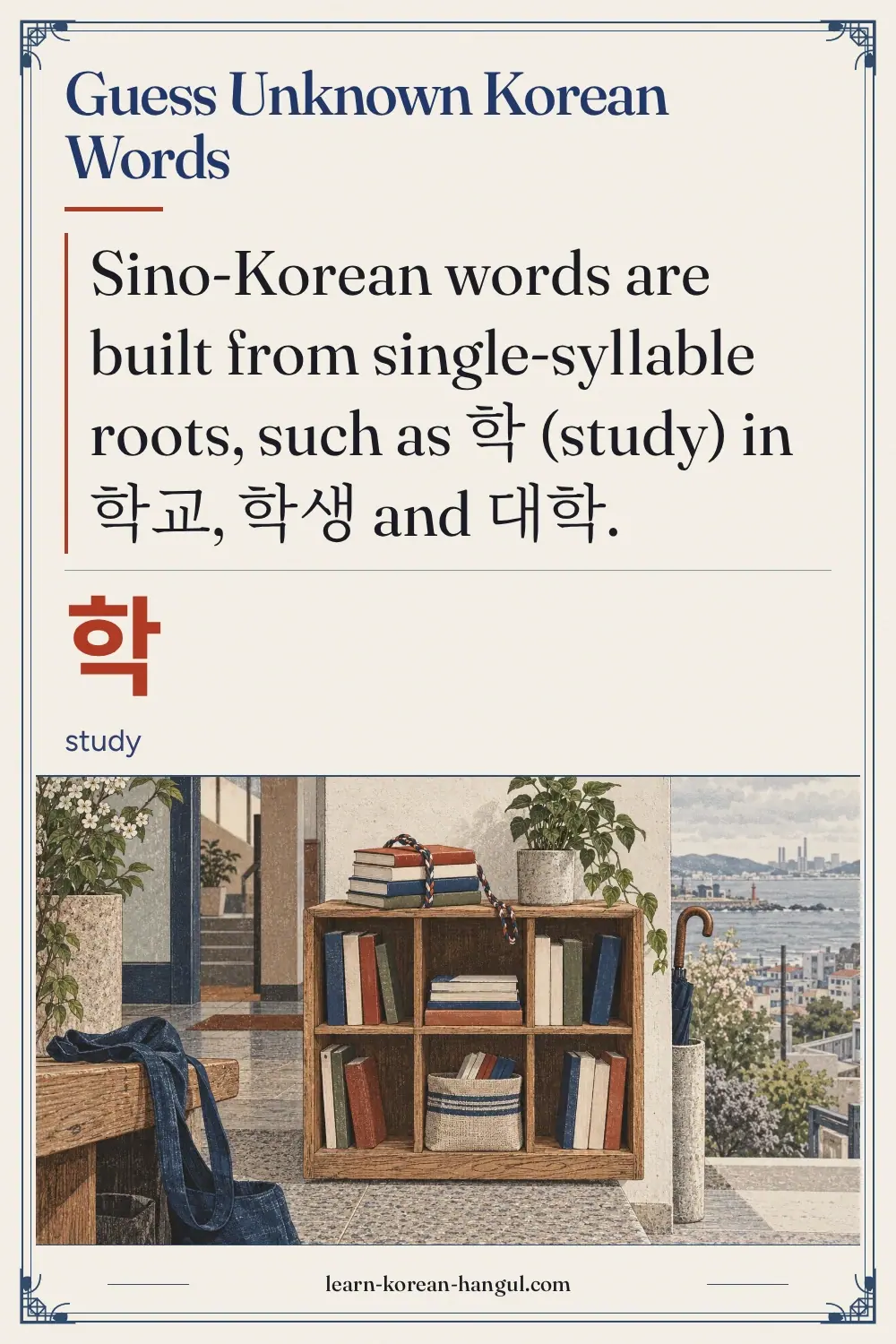
- Sino-Korean words are built from single-syllable roots, such as 학 (study) in 학교, 학생 and 대학.
- Loanwords can often be guessed by reading the Hangul aloud and listening for the English word.
- Context clues are the most reliable method at A2 and above, and they check the other methods.
- Verbs often use a noun plus 하다, so removing 하다 shows the noun to look up or guess.
- Every guess should be checked in a dictionary later, because homophone roots and shifted loanwords cause errors.
*Last updated: 2026-10-09. The Korean text, romanization and audio on this page are AI-assisted drafts.
How Do You Guess Unknown Korean Words?
Readers guess unknown Korean words by asking four questions in order, and stopping at the first one that gives a sensible answer. First: does the word sound like English? Second: does it contain a syllable you have already met in other words? Third: does it end in 하다 or a form of it? Fourth: does the sentence around it show what kind of word it must be?
A short example shows the order. Suppose you meet 컴퓨터 in a sentence. Sounding it out gives "keom-pyu-teo", which is "computer" (question one). Now suppose you meet 학생. It does not sound like English, but you may know 학교 (school), so the shared syllable 학 points to something about study (question two).
A guess is a hypothesis, not a fact. Three of the four sources can mislead you, and the sections below mark where. A dictionary entry in the Korean dictionary tools section settles the question, and the habit of checking is what turns guesses into vocabulary. The next section explains why English speakers find this skill unusually hard in Korean.
Why Do English Speakers Struggle to Guess Korean Words?
English speakers struggle because the clues they rely on in English do not exist in Korean. In English, a reader meets "telephone" and spots "tele" (far) from "television", or spots "phone" in "microphone". Spelling carries history, and many roots look the same across words. Korean has a different system. It is written in Hangul, which records sound, and it has no letters that look like English letters. A learner cannot lean on shape.
Korean does have a root system, but it works through syllables rather than spelling. A large share of Korean vocabulary is Sino-Korean, meaning words built from Chinese-origin syllables. Many dictionary-based estimates put Sino-Korean words at more than half of all entries, although the exact figure depends on how entries are counted. Each syllable is a root that carries a meaning, and the same syllable appears in many words. The difficulty is that the learner sees only the sound, and the same sound can stand for several roots.
Loanwords bring a second problem. Korean borrows English words and respells them in Hangul, so 커피 is "coffee". A reader who expects the borrowed word to be spelled like English will miss it. The fix is to say the Hangul aloud and listen for English.
| Clue in English | Korean equivalent | Reliability for a learner |
|---|---|---|
| Latin or Greek root in the spelling | Repeating Sino-Korean syllable | Good, but one sound may hide several roots |
| English word inside a longer word | Loanword written in Hangul | Good when said aloud, risky when the meaning has shifted |
| Suffix such as "-ize" | 하다 after a noun | Very good for verbs |
| Sentence context | Sentence context | Best at A2 and above |
The table shows why the order matters. Start with the sources that are quick and usually right, then fall back on context. Sino-Korean roots come first because they open up the most words.
How Do Sino-Korean Roots Help?
Sino-Korean roots help because one syllable repeats across dozens of words and keeps a stable core meaning. A root is a single syllable with a meaning, written as one Hangul block. When you know that 학 relates to study or learning, then 학교, 학생, 대학, 학년, 학원 and 방학 all become partly readable. Pairing the root with a second syllable you know gives the rest.
Here is the 학 family. The meanings are given in plain English, and the second syllable is explained in the last column.
| Word | Spoken form | Meaning | How the parts combine |
|---|---|---|---|
| 학교 | [학꾜] | school | 학 (learning) + 교 (school) |
| 학생 | [학쌩] | student | 학 (learning) + 생 (student, life) |
| 대학 | [대학] | university | 대 (big) + 학 (learning) |
| 학년 | [항년] | school year, grade | 학 (learning) + 년 (year) |
| 학원 | [하권] | private academy | 학 (learning) + 원 (institute) |
| 방학 | [방학] | school holiday | 방 (release) + 학 (learning) |
The spoken forms change because of sound rules in the 표준 발음법 (standard pronunciation rules), for example 학교 [학꾜] and 학년 [항년]. Those rules are taught in the sound change rules section, and a reader who meets them for the first time here only needs to know that the spelling and the sound can differ.
Play two of these words and listen for the shared 학.
The second family is 전, which here means electricity.
| Word | Meaning | How the parts combine |
|---|---|---|
| 전화 | telephone, phone call | 전 (electric) + 화 (talk) |
| 전기 | electricity | 전 (electric) + 기 (energy) |
| 전철 | metro, electric train | 전 (electric) + 철 (iron, rail) |
| 전자 | electronics | 전 (electric) + 자 (small particle) |
| 전등 | electric light | 전 (electric) + 등 (lamp) |
| 정전 | power cut | 정 (stop) + 전 (electric) |
The glosses for the second syllables are teaching aids, not full dictionary entries. The point is the pattern: when you see 전, test the idea of electricity first. The next section marks where this test fails. Words that look like roots can also be traps, so the risks come before the sound-based method.
When Does a Root Guess Go Wrong?
A root guess goes wrong when one sound belongs to several roots. Korean has many homophones among Sino-Korean syllables because Hangul writes sound, not the original Chinese character. The syllable 전 also appears in 전날 (the day before), 전국 (the whole country) and 전쟁 (war), where it does not mean electricity. The syllable 수 stands for water in 수영 (swimming), for number in 수학 (mathematics) and for giving or teaching in 수업 (class).
A single word can even have two unrelated meanings. 수도 is the usual word for a capital city, and it is also the word for a water supply. A reader who knows only one meaning will guess wrongly in a sentence about the other.
The rule of thumb is simple: treat a root as a first guess, then ask whether the whole word fits the setting. If the sentence is about electricity, 전 means electricity. If the sentence is about a trip, 전 more probably means "before". The context section returns to this check.
The original Chinese characters behind these roots are explained in the hanja section. You do not need hanja to use roots. You need only the repeating syllable and its approximate meaning.
Which Words Can Be Guessed from Sound?
Loanwords can be guessed from sound, because Korean writes borrowed words as they are pronounced. The method is to read the Hangul aloud, slowly at first, and listen for an English word. Applied to 샌드위치, the sounds are "saen-deu-wi-chi", and the English word "sandwich" appears.
Common loanwords follow regular patterns of respelling. English "k" and hard "c" become ㅋ, English "p" becomes ㅍ, "t" becomes ㅌ, and a consonant with no vowel gets a short ㅡ or ㅣ attached, so "ice cream" becomes 아이스크림. One habit helps with the extra vowels: the added ㅡ or ㅣ is only there to make a lone consonant pronounceable, so 스 in 아이스크림 stands for the English "s".
| Hangul | Said aloud | English word |
|---|---|---|
| 컴퓨터 | keom-pyu-teo | computer |
| 택시 | taek-si | taxi |
| 호텔 | ho-tel | hotel |
| 아이스크림 | a-i-seu-keu-rim | ice cream |
| 주스 | ju-seu | juice |
| 인터넷 | in-teo-net | internet |
The method has limits, because meaning sometimes shifts away from English. These loanwords look like English but mean something different or narrower.
| Hangul | Meaning in Korean | Trap |
|---|---|---|
| 핸드폰 | mobile phone | English has no phrase "hand phone", so the word must be learned |
| 아파트 | apartment complex, block of flats | Names the whole building, not one rented room |
| 에어컨 | air conditioner | Clipped from "air conditioner" |
| 아르바이트 | part-time job | Comes from German Arbeit, not English |
| 서비스 | a free extra | In a restaurant, a free side dish or a gift item |
A reader who guesses 서비스 as "customer service" is partly right but will misread a menu line that says 서비스 (free). The fix is to treat a loanword guess as the likely meaning and keep the dictionary check. Beyond loanwords, Korean has a pattern that turns nouns into verbs, which gives a third source of clues.
How Does the Noun Plus 하다 Pattern Help?
The noun plus 하다 pattern helps because a very large group of Korean verbs is built as a noun followed by 하다 ("to do"). When a verb is unknown, remove the 하다 part and read the noun. If you know the noun, the verb means "do the noun".
| Noun | Meaning | Verb | Meaning |
|---|---|---|---|
| 공부 | study | 공부하다 | to study |
| 운동 | exercise | 운동하다 | to exercise |
| 요리 | cooking | 요리하다 | to cook |
| 전화 | telephone | 전화하다 | to phone |
| 청소 | cleaning | 청소하다 | to clean |
In real text you rarely see the dictionary form 하다. You see conjugated forms such as 공부해요 or 운동했어요. The stem 하 changes to 해 in these forms, so the recognisable part is the noun in front. Spot the noun first, and the ending can wait. The conjugation itself is taught in the grammar section.
The pattern has an exception worth noticing. Verbs of the native layer, such as 먹다 (to eat) or 가다 (to go), are not built this way, so no noun hides inside them. Rule of thumb: if the word ends in 하다 and the front part is Sino-Korean or a loanword, the guess works. If the verb is short and native, look it up. Last of all, context has to settle every case the first three methods leave open.
How Does Context Help?
Context helps because the words around an unknown word limit what it can be. A sentence has a grammar slot for the word: a noun after 을/를, a place after 에, a verb at the end. Reading that slot and the meaning of the other words often narrows the choices to one or two.
Take this sentence, and treat 도서관 as unknown.
저는 도서관에서 책을 빌렸어요. (jeoneun doseogwaneseo chaegeul billyeosseoyo) I borrowed a book at the library.
The ending 에서 marks 도서관 as a place where an action happens. The object is 책 (book), and the verb is 빌렸어요 (borrowed). A place where one borrows books is a library. The root 관 (building, hall) confirms the idea, since the same syllable appears in 영화관 (cinema) and 박물관 (museum).
저는 도서관에서 책을 빌렸어요.
jeoneun doseogwaneseo chaegeul billyeosseoyo
I borrowed a book at the library.
Context works best when you have two or more clues. One clue gives a guess. Two clues that agree give a confident guess. Use these three checks in order:
- Which grammar slot does the word fill: subject, object, place, time or verb?
- Which known words sit next to it, and what idea do they share?
- Does your guess still make the whole sentence sensible?
The third check catches most mistakes. If your guess turns the sentence into nonsense, the guess is wrong, and you should either change it or look the word up. Knowing when to stop guessing is as important as guessing.
When Should You Stop Guessing and Look up the Word?
Stop guessing and look up the word when the word matters to the meaning and your guess has not survived two checks. Three situations call for the dictionary at once: the word appears three or more times in one text, the sentence cannot be understood without it, or the word is in a warning or an instruction. Safety text is not a place for guessing.
A guess that survived the sound check and the context check is good enough to keep reading. Write it in the margin with a question mark and look it up when the page ends. A word that has been seen three times is worth saving as a flashcard, and the Korean vocabulary hub explains how to organise those cards.
Never look up every unknown word. A text with one new word per sentence is too hard, and the problem is the text, not your guessing. Choose an easier text, as the next lesson, extensive reading in Korean, explains. The worked example now shows the whole routine on one word.
Worked Example: 학교
The worked example takes the unseen word 학교 through all four questions, step by step.
- Read the blocks. 학 is ㅎ + ㅏ + ㄱ, and 교 is ㄱ + ㅛ. Spelled out, the word is "hak-gyo", spoken [학꾜].
학교에 가요.
hakgyoe gayo
I go to school.
- Ask question one: does it sound like English? "Hak-gyo" does not sound like an English word, so it is not a loanword.
- Ask question two: do I know a syllable in it? Suppose 학생 is familiar. The shared 학 suggests learning or study.
- Ask question three: does it end in 하다? No, so the verb pattern does not apply.
- Ask question four: what does the sentence show? The particle 에 and the verb 가요 (go) show that 학교 is a place you travel to. A place linked to learning is a school.
- Check. The dictionary gives 학교 as "school". The method worked at step three and was confirmed by step five.
You will know the routine worked when you can name the step that gave the answer. For 학교 it was step three. For 컴퓨터 it would have been step two. Practising this naming is what makes later guesses faster. Next come the errors that most often spoil the routine.
What Mistakes Do Learners Make When Guessing Korean Words?
The most common mistakes are trusting sound over meaning, treating loanwords as exact English, and guessing without checking.
- Learners often assume a shared sound means a shared root. Actually many roots sound the same, so 수업 (class) and 수영 (swimming) share 수 without sharing a meaning. Check the whole word against the sentence.
- Learners often assume a loanword means what the English word means. Actually 핸드폰 and 아파트 show how meanings shift, and Korean may also shorten or combine English words. Say the word aloud, then confirm it in a dictionary.
- Learners often assume every long word is Sino-Korean. Actually many everyday words are native Korean, such as 하늘 (sky) and 사람 (person), and they carry no repeating roots. If a short word does not fit any pattern, look it up.
- Learners often assume a confident guess needs no check. Actually a wrong guess that is never corrected becomes a wrong word in memory. Mark each guess and check it later.
Practice now brings the four sources together.
Practice and Answer Key
Use this ten-word test. For each word, write your guess and the method (loanword, root, 하다 pattern or context) before you open the key. Items 1 to 9 are words, and item 10 is a word in a sentence.
- 샌드위치
- 노트북
- 학생증
- 전화번호
- 청소하다
- 영화관
- 대학생
- 주차장
- 에어컨
- 배가 고파서 편의점에서 삼각김밥을 샀어요. (guess 삼각김밥, using the sentence)
Answer key:
| Item | Meaning | Best method | Note |
|---|---|---|---|
| 1 | sandwich | loanword | Say it aloud: saen-deu-wi-chi |
| 2 | laptop computer | loanword | Korean uses "notebook" for a laptop |
| 3 | student ID card | root | 학생 (student) + 증 (certificate) |
| 4 | phone number | root | 전화 (telephone) + 번호 (number) |
| 5 | to clean | 하다 pattern | Noun 청소 (cleaning) plus 하다 |
| 6 | cinema | root | 영화 (film) + 관 (hall) |
| 7 | university student | root | 대학 (university) + 생 (student) |
| 8 | parking lot | root | 주차 (parking) + 장 (place) |
| 9 | air conditioner | loanword | Clipped form of the English phrase |
| 10 | triangular rice-and-seaweed snack | context | 삼각 (triangle) + 김밥; the store and the hunger clue point to food |
Score one point for each correct meaning and one more if you named the right method. A total of 14 out of 20 means the routine is working. Items 3, 4, 6, 7 and 8 are all compounds, which shows how far a few roots can travel. Guesses can be wrong on a new word, so keep checking.
Say each word aloud once to lock the sound and meaning together.
Where to Go Next
The method above covers how to guess unknown Korean words from sound, roots, the 하다 pattern and context. It does not teach hanja characters, it does not list every Sino-Korean root, and it does not replace a dictionary. Native Korean words, which carry no roots, need to be learned directly.
Next: Extensive Reading Korean, which shows how to choose easy texts so that each page contains only a few new words. Keep returning to the Reading Strategies section for the other methods, such as reading in chunks, and look up guesses in a Korean dictionary the same day.
Frequently Asked Questions
How much of Korean is Sino-Korean? Many dictionary-based estimates put Sino-Korean words at more than half of all entries in Korean dictionaries, though the exact figure depends on how entries are counted. Everyday verbs and basic words are often native Korean, so the share is lower in simple speech than in books, news and academic writing.
How can I guess what a Korean word means? Say the Hangul aloud and listen for an English word. Next, look for a syllable you know from other words, such as 학 in 학생. Then check whether the word is a noun plus 하다, and finally test your guess against the sentence. Confirm it in a dictionary afterwards.
Should I look up every unknown word? No. A text with a new word in every sentence is too hard, and constant lookups break the flow of reading. Look up a word when it appears three times, when the sentence makes no sense without it, or when it is part of a warning or instruction. Guess the rest.
Do I need to learn hanja to guess words? No. You need only the repeating Hangul syllable and its rough meaning, such as 학 for study or 전 for electricity. Hanja, the Chinese characters behind these syllables, can explain why two words are related, but beginners can guess well without learning a single character.