
Kdramas to Learn Korean: the Essentials

The right drama for learning is one whose Korean you can almost follow and whose story you enjoy enough to rewatch. Teachers call this kind of material authentic, because it was made for Korean viewers, not learners, and comprehensible input when you understand most of it. Five criteria decide how comprehensible a show will be.
| Criterion | Easier for learners | Harder for learners |
|---|---|---|
| Speech speed | Calm conversations, one speaker at a time | Fast arguments, overlapping speech, shouting |
| Setting | Contemporary daily life: home, office, café, school | Historical dramas (사극, sageuk), hospitals, courts, politics |
| Dialect | Seoul standard speech | Heavy regional dialect (사투리, saturi), such as Gyeongsang or Jeolla speech |
| Slang | Everyday polite and casual speech | Teen slang, internet slang, gangster or military jargon |
| Availability | Licensed where you live, with Korean subtitles | Not licensed in your country, or English subtitles only |
Historical dramas are worth a special warning. 사극 use old-fashioned verb endings and court titles that sound strange in modern conversation, so a beginner who copies them sounds like a character from the past. Save them for later.
A Level Ladder from Easy to Complex
Move up the ladder when you can follow the main story of a show at your level with Korean subtitles.
| Your level | Good genres | Why they work |
|---|---|---|
| Beginner (A1-A2) | Short slice-of-life series, family dramas, children's shows, variety shows with on-screen captions | Repeated daily phrases, slow speech, visual context |
| Lower intermediate (B1) | Romantic comedies and office or campus dramas set in Seoul | Everyday topics, clear speech, polite and casual styles side by side |
| Upper intermediate (B2) | Crime, family saga and workplace dramas with longer dialogues | More vocabulary, faster speech, social topics |
| Advanced (C1+) | Legal, medical and political thrillers, historical dramas, regional dramas | Specialist terms, formal speech, dialect and old-fashioned speech |
Variety shows are a useful extra rung at the bottom. Korean variety programmes often print key lines on screen, which gives you free Korean text to read along. The Korean movie and TV vocabulary page covers words for genres and episodes.
An Active Viewing Method in Five Steps
Passive watching, with English subtitles and no pauses, mostly trains your English reading. Active viewing turns a five-minute scene into a lesson.
- Watch for the story. Watch one scene with English subtitles so you know what happens.
- Rewatch with Korean subtitles. Pause at lines you half understand and read them aloud.
- Collect three to five lines. Write down short, useful sentences, with who said them to whom.
- Shadow the lines. Repeat each line right after the actor, copying the rhythm. The shadow Korean with K-dramas page shows how.
- Rewatch with no subtitles. Check how much you now hear without help.
Twenty minutes on one scene teaches more than an evening of passive episodes. If you want shorter or more learner-friendly listening, Korean YouTube channels for learners and Korean podcasts for learners grade their Korean by level. For listening exercises built on this idea, see Korean drama listening practice, and for the theory behind it, comprehensible input.
Watch Legally
Use licensed streaming services, broadcasters' own sites and official channels. Unlicensed sites often carry malware, poor subtitles and no Korean subtitle track, and they do not pay the people who make the shows. The catalogue on each service differs by country and changes over time, so check what is offered where you live before you choose a show.
What Pages Are in This Subhub?
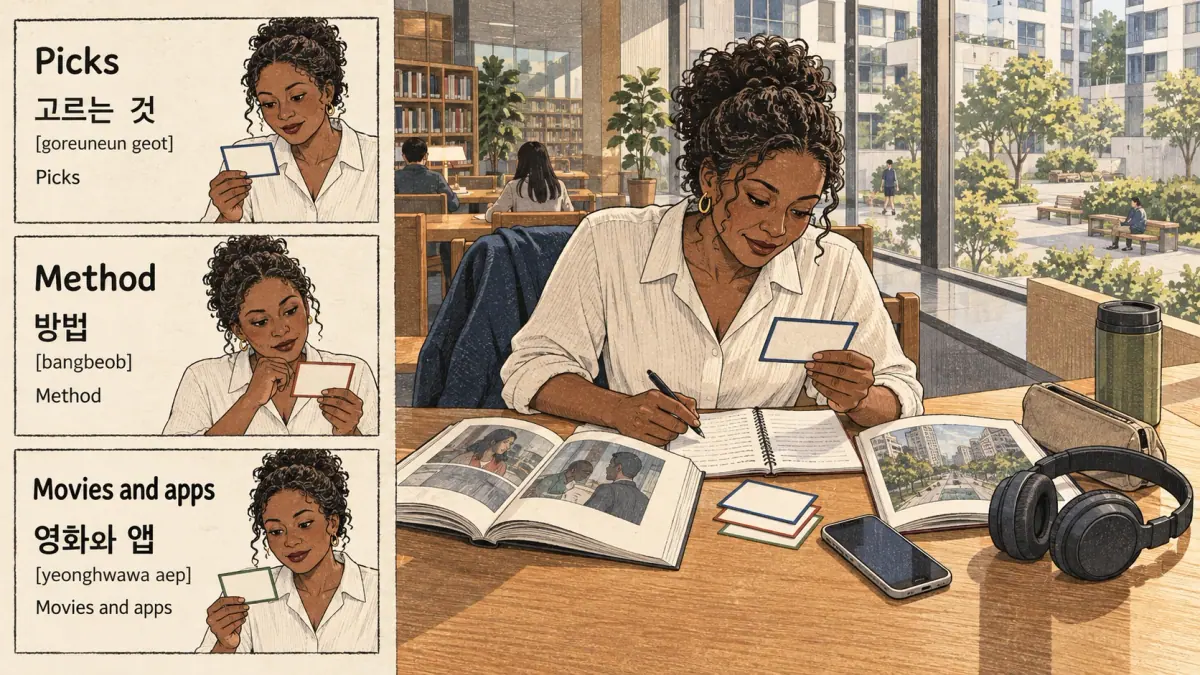
Four guides cover dramas, films and apps for learners, grouped below by what they help you do.
Picks
- Best Korean drama for beginners. Contemporary, standard-accent dramas with clear everyday speech, chosen on six criteria, with a subtitle ladder and ten-minute study segments of five new words each.
For the words and lines you will hear in almost every drama, start with K-drama phrases and K-drama words, or review them with the K-drama phrases flashcards.
Method
- How to learn Korean by watching K-dramas. The five-step method in full: choose a two- to three-minute scene, climb the subtitle ladder, extract words, shadow the lines and review, about 30 minutes per scene.
For a structured course built around drama language, see Korean for K-drama fans. For a wider routine that mixes shows with other Korean input, see Korean immersion at home.
Movies and Apps
- Korean movies with English subtitles for learning. Choosing films by speech clarity, setting, subtitle quality and genre, studying three-minute scenes instead of whole films, and six example titles to check for availability.
- Best Korean app to watch K-dramas. Streaming options compared by feature, not brand: Korean subtitles, speed control, dual subtitles, offline download, cost and legal availability in your country.
When you compare apps, check the subtitle options first. The word for subtitles is 자막 (jamak), and the subtitles in Korean page shows how it is used in menus.



Does K-Drama Korean Sound Natural?
Mostly yes, with three limits. Contemporary dramas use real everyday phrases, natural rhythm and current vocabulary, which is why they are good listening material. But scripts are written to be dramatic, so emotion, shouting and rudeness are far more common than in real life.
The biggest trap is speech level. Characters who are close friends, siblings or couples speak casual 반말 (banmal) to each other, and a learner who copies those lines with a shop assistant or a teacher sounds rude. Polite 존댓말 (jondaenmal, said [존댄말]) is the safe default with people you do not know. Before you reuse a line, ask who is speaking to whom, and whether you would speak to your listener the same way.
Frequently Asked Questions

Can I learn Korean from dramas alone?
Not efficiently. Dramas give you listening practice, natural phrases and motivation, but they do not teach Hangul, grammar or how to build your own sentences. Use them alongside a course or textbook. Once you know basic grammar, active viewing of a few scenes a week helps your listening grow much faster than passive watching.
Which drama is best for beginners?
A contemporary slice-of-life or romantic comedy set in one city, with short episodes, clear everyday speech and little dialect or specialist language. Avoid historical dramas and legal, medical or political thrillers at first. Pick a show you enjoy enough to rewatch scenes, because rewatching is where most of the learning happens.
Do dramas teach natural Korean?
Mostly, with limits. Contemporary dramas use real everyday phrases and natural rhythm, but scripts exaggerate emotion, and characters often use casual speech (반말) or rude language you should not copy with strangers. Historical dramas use old-fashioned speech. Notice who is speaking to whom before you reuse a line.
Should I use Korean subtitles?
Yes, once you can read Hangul at a comfortable speed. Use English subtitles first to understand the story, then Korean subtitles to connect sounds with words, then no subtitles to test your listening. Korean subtitles are not offered for every title or in every country, so check the platform's subtitle options.