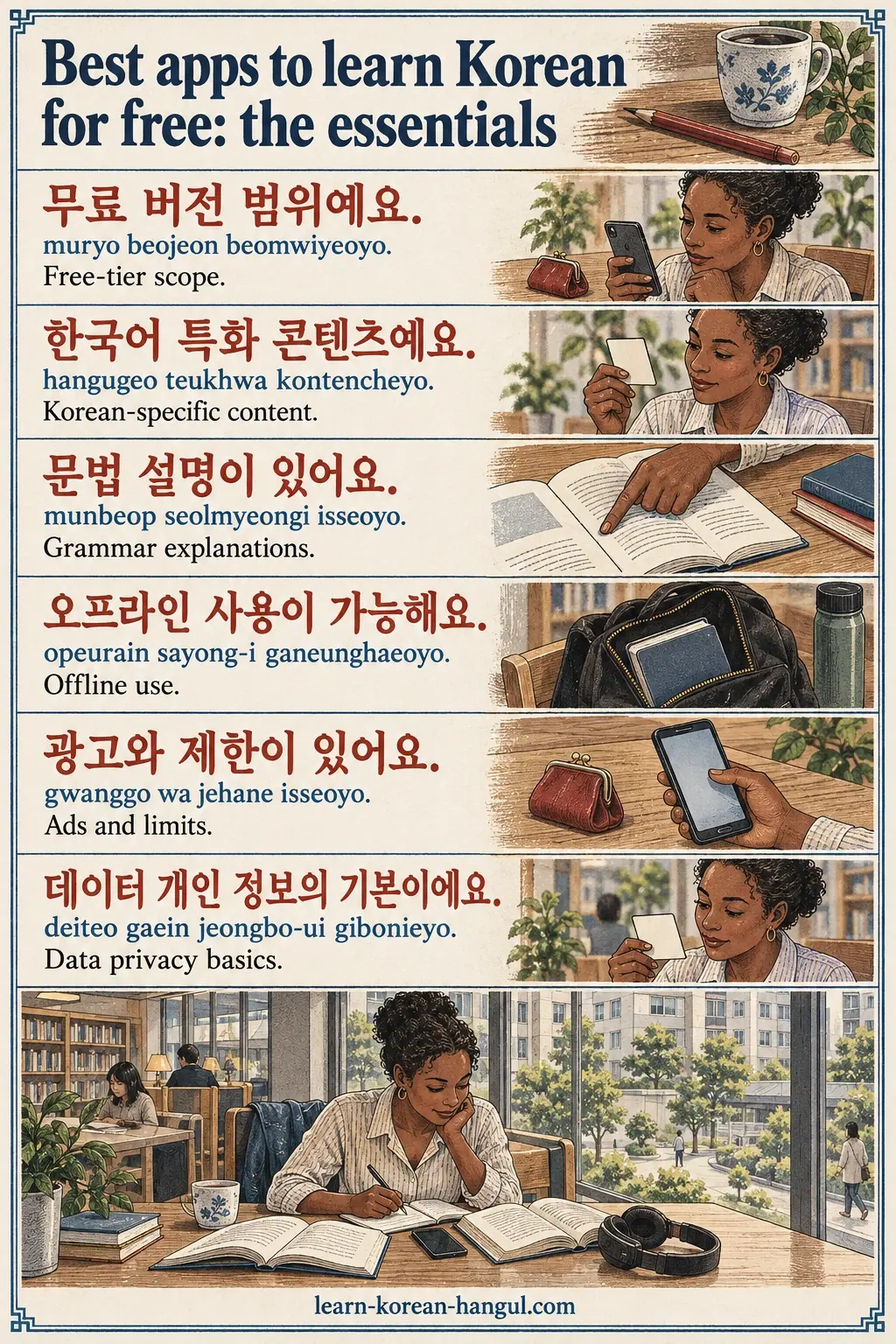
The best apps to learn Korean for free are the ones whose free tier covers your next step, since most apps give Hangul and early vocabulary free and put grammar, speaking and offline use behind a paywall. This page compares seven well-known options, a course app, a flashcard app and a free translator, by what each free tier includes and where it stops. It gives no ratings and no affiliate links, and every app comes with a drawback.
Key facts
- Hangul and early vocabulary are usually free; grammar notes, offline use and unlimited practice are usually the paid parts.
- This page compares seven options and gives each one an honest drawback.
- It uses no star ratings, scores or affiliate links.
Last updated: 2026-10-09.
Best Apps to Learn Korean for Free: the Essentials

Start with the job, not the brand. A free course app can teach you the alphabet and your first 200 or so words, a free flashcard app can keep them in memory, and a free translator can help you check a sentence. No single free app does all three well, and none replaces speaking with a person. The box below shows our editorial picks for three situations. They are judgements based on what each app's free tier offers, not scores.
Our top picks
| Situation | Pick | Why |
|---|---|---|
| Best free start for a complete beginner | Duolingo | The free course includes Hangul and short daily lessons |
| Best free review of the words you meet | Anki | Free on computers and Android, with spaced repetition |
| Best free helper for checking text | Papago | A free translator and dictionary-style tool, not a course |
How to read these picks: a complete beginner who wants one app should start with the first row, then add the second row after about two weeks, when there are words worth reviewing. The third row is a tool and not a course. The sections below explain each pick and add four more options.
A word on "free". Three kinds of free exist: free forever (Anki on a computer), free with limits (a daily time, a cap on mistakes, ads) and a free trial that ends. The difference matters, because a trial is not a free app. This page names which kind each app is, as far as its public description shows.
How Did We Choose?

We compared each app on six criteria, listed from the one that matters most to the one that matters least for a learner on a budget. The page does not run hands-on tests and gives no scores. It compares what each publisher says in its public description and what is widely known about the app, and it asks you to check the store listing for the current details.
- Free-tier scope. What can you do without paying: how many lessons, how much practice each day, and which features are locked.
- Korean-specific content. Was the course built for Korean? It should teach Hangul, include audio for every word and explain that Korean puts the verb last and uses particles.
- Grammar explanations. Does the app explain why a form is used, or only mark an answer right or wrong?
- Offline use. Can you use it without a connection, which matters on a train or a flight?
- Ads and limits. How often do ads interrupt you, and does a limit stop you from practising?
- Data privacy basics. Does the app need an account, and what does it ask to access on your phone? Read the privacy notice before you sign up.
Every item below ends with a drawback and a "choose it if / skip it if" line. If you cannot name what an app does not do, you have not read enough about it.
1. Duolingo: Best for a Free Daily Habit
Duolingo is the best free way to start a daily habit, because the whole course is built around short lessons and reminders. Specs: course app; free with ads and limits; paid plan available.
Its Korean course starts with the alphabet and moves to simple words and sentences, with audio and tap-the-answer exercises. The free tier is enough to learn Hangul and your first words. A free user usually sees ads and meets limits on how many mistakes or how much practice the app allows in a session, and the exact rules change, so check them in the app.
The drawback is depth. Duolingo gives short tips instead of full grammar explanations, and exercises such as tile-matching can be completed without understanding why a particle is used. A streak can also reward showing up more than learning.
Choose it if you need a low-friction daily habit and have never studied Korean. Skip it if you want clear grammar explanations, because you will need a second source.
2. Anki: Best for Free Spaced-Repetition Review
Anki is the best free tool for remembering vocabulary, because it schedules each card just before you would forget it. Specs: flashcard app; free on Windows, Mac, Linux and Android; the iPhone and iPad app is paid.
Anki is free and open source on computers, and AnkiDroid is the free version for Android. AnkiMobile, the iPhone and iPad version, is a paid app, so an iPhone user who wants a fully free route should use the free web or computer version, or choose another tool. Anki does not teach anything by itself. You make your own cards or download shared decks, and you decide what the cards contain.
The drawback is setup. A new user must learn how to add cards and set daily limits, and shared decks vary in accuracy, so a deck with wrong spelling will teach wrong spelling.
Choose it if you want a free, powerful review system and do not mind a short learning curve. Skip it if you want a ready-made course with lessons.
3. LingoDeer: Best for Grammar Notes in a Structured Course
LingoDeer is the best free taster for a course that explains grammar in each lesson. Specs: course app; free first lessons; a subscription unlocks the rest.
LingoDeer was built for Asian languages, and its Korean course pairs short lessons with grammar notes that explain, for example, why a particle follows a noun. According to its store listing, a free user can try the alphabet lesson and the first unit, and the rest of the course is part of the paid plan. For a learner who wants to know whether this style suits them before paying, the free part is a useful test.
The drawback is the paywall: the free tier is a sample, not a full course, and you will meet the limit sooner than with Duolingo.
Choose it if you want grammar explained in plain steps and plan to pay later if you like it. Skip it if you need a course that is free from start to finish.
4. Memrise: Best for Hearing Real People Say the Words
Memrise is the best option here for hearing short clips of real speakers, because its courses use video of people saying the words. Specs: course and vocabulary app; part of the content is free; a paid plan unlocks more.
Hearing different voices helps your ear, and seeing a mouth helps with sounds such as the plain ㅅ and the tense ㅆ. Some of the vocabulary content and a limited number of videos are free, and most of the video library is part of the paid plan. Check the current free content before you commit.
The drawback is that Memrise focuses on words and short phrases, so it explains little grammar and gives little speaking feedback. Content also changes over time.
Choose it if you learn well by listening to voices. Skip it if your main need is grammar.
5. Drops: Best for Five-Minute Visual Vocabulary
Drops is the best free app for a short burst of vocabulary, because each session is a few minutes of picture-based matching. Specs: vocabulary game; a limited free session each day; a paid plan removes the limit.
The design is simple: you see a picture, hear the word and tap to match. A free user gets a short daily session (five minutes, according to its store listing), so it fits in a coffee break and cannot swallow an evening. Its Korean listing says it covers Hangul, but content changes over time, so check in the app.
The drawback is that it teaches words in isolation. There are no full sentences or grammar, and a word learned from a picture is not tied to a particle or an ending.
Choose it if you want a short, light vocabulary habit. Skip it if you want sentences and grammar.
6. Quizlet: Best for Ready-Made Shared Sets
Quizlet is the best free choice if you want flashcard sets that other learners or teachers have already made. Specs: flashcard app; free with limits; a paid plan unlocks more study modes.
You can search for a set, such as the vocabulary of a textbook chapter, and start studying in a minute. That saves time compared with making your own cards. Which study modes are free changes, so check what is included.
The drawback is accuracy. Anyone can publish a set, so Korean spelling, spacing and translations can be wrong, and a set with a wrong card will teach the wrong card. Check new words in a dictionary.
Choose it if you want quick sets for a class or textbook. Skip it if you want a guarantee that every card is correct.
7. Papago: Best Free Helper for Checking Text
Papago is the best free helper for checking a word or a sentence, though it is a tool and not a course. Specs: translation app; free; supports Korean and many other languages.
Papago is a translation app from the Korean company Naver. You can type text, speak or point your camera at a sign. It is useful for reading a menu or checking what a sentence roughly means. Treat the result as a lead and not as a ruling, particularly for politeness levels and honorifics, where a translation may choose a style that does not fit your situation.
The drawback is that it teaches nothing in order. If you lean on it, you will translate and not learn, and a machine translation can be wrong without warning.
Choose it if you need to check meaning quickly while you read. Skip it if you are looking for a lesson plan.
Which Free App Is Best for Hangul?
For Hangul, a course app with audio and a reading drill is the best free choice. Duolingo's course starts with the alphabet, and LingoDeer and Memrise offer early lessons with audio. Check any app against a short test: does it play audio for each letter, does it show how a syllable is built (가 is ㄱ plus ㅏ) and does it include final consonants (batchim)? If an app skips the last two, the free lessons on this site fill the gap. For a comparison built around the alphabet, see the best app to learn the Korean alphabet.
Which Free App Is Best for Vocabulary?
For vocabulary, Anki is the strongest free choice for long-term memory, because the spaced schedule is what keeps words. Quizlet is faster to start with ready-made sets. Drops is the lightest, and it suits a short daily habit. A combination works well: learn words in a course app, then review the ones you keep forgetting in Anki. A good card shows the word, its sound and one short sentence, such as 학교 (school) with 학교에 가요 (I go to school). The sentence shows the particle that single words hide. For more, see the best Korean vocabulary app.
What Do Free Tiers Withhold?

Free tiers usually withhold the same four things. The table shows what to check for each app. A "check" means the answer changes, so look in the app.
| App | Hangul | Vocabulary | Grammar notes | Offline use | Main limit |
|---|---|---|---|---|---|
| Duolingo | Yes, in the course | Yes | Short tips | Usually paid, check | Ads and limits on practice |
| Anki | No lessons, your own cards | Yes, your own cards | None | Yes, after you download | iPhone and iPad app is paid |
| LingoDeer | Yes, early lessons | Yes | Yes | Usually paid, check | Free part is a sample |
| Memrise | Check | Yes, part free | Little | Usually paid, check | Most videos are paid |
| Drops | Check | Yes, words only | None | Check | Short daily free session |
| Quizlet | Sets made by others | Yes | None | Usually paid, check | Some study modes are paid |
| Papago | No | A dictionary-style lookup | None | Check | A tool, not a course |
The pattern is clear. Free tiers give you practice, and they hold back explanation and convenience. That is a reasonable trade for a beginner, and it is the reason a free-first plan works best when one source supplies the grammar.
A 15-Minute Test for Any Free App

Before you spend weeks in an app, give it a 15-minute test in three blocks of five minutes. The test works for every app on this page and for any app you find later.
- Minutes 1 to 5: sound. Open the first lesson and listen. Does every Korean word have audio? Can you replay it or slow it down? Say three words aloud, such as 안녕하세요 (hello), and compare. If audio is missing or sounds wrong, stop here.
- Minutes 6 to 10: explanation. Make one mistake on purpose. Does the app tell you why it is wrong, or does it only mark it red? A good app explains, for example, that 는 follows a vowel-ending word and 은 follows a consonant-ending word, as in 저는 and 학생은.
- Minutes 11 to 15: limits. Keep going until you meet a limit, an ad or a locked lesson. Note what it is. If you reach it in five minutes, the free tier is a trial and not a free app.
저는 학생이에요.
jeoneun haksaengieyo
I am a student.
Use this sentence as a check. The topic particle 는 follows 저, the copula 이에요 follows the final consonant of 학생, and the spoken form is [저는 학쌩이에요]. An app that teaches the sentence with audio and explains why the ending is 이에요 and not 예요 has Korean-specific content. An app that only asks you to tap the tiles does not.
The Combination That Works: One Structured App Plus Anki

The best free setup for most learners is two tools with different jobs. A structured app gives you the order of lessons: the alphabet, then the first 200 or so words, then simple sentences. Anki gives you the memory: it shows each card again at the right time. You do not need a third app in the first month.
Here is how to run the pair. Do your lesson in the course app. Then, once a day, add up to 10 new cards to Anki from the words you found hard, which makes 70 new cards in a week. Each card needs the Korean word with spelling checked against a dictionary, the meaning, and one short sentence. Do your reviews first and add new cards second, so the pile of due cards never grows out of control. If you stop for a few days, reduce the number of new cards and clear the reviews before you add more.
The pair has one gap: speaking. Neither tool listens to you. Plan a weekly session with a person, or read your sentences aloud and record yourself. The self-study Korean guide shows how to set that up for free.
Do Streaks Hide Weak Grammar?
They can. A streak counts days, not understanding. A learner can keep a 100-day streak on short, easy lessons and still not be able to say why 가 follows 학교 in one sentence and 이 follows 책 in another. That is the main risk of a gamified free app, and it is why this page asks for a grammar check in the 15-minute test.
The fix is small. Once a week, close the app and write three sentences from memory using the week's words. Say each aloud. If you cannot, repeat the week's lessons before you move on, whatever your streak says. A free app is a way to practise often, and it works best when a real source of grammar sits beside it.
Which Should You Pick?
Match your situation to a pick.
- You are a complete beginner and have never studied Korean. Start with Duolingo for the daily habit, and read the free Hangul lessons on this site for the full alphabet. Add Anki after two weeks.
- You want grammar explained. Try the free lessons of LingoDeer, and pair them with the free grammar pages on this site.
- You have only five minutes at a time. Use Drops for words, and keep a short list of phrases to say aloud.
- You have an iPhone and want everything free. Use Duolingo and the free web lessons, and check the price of Anki on iPhone before you decide.
- You want to reach fluency. No free app will do it alone. Add a speaking partner or a tutor, as described in the self-study Korean guide.
A weekly plan with free tools costs only time. If you spend 30 minutes a day, split as 10 minutes in a course app, 10 minutes of Anki review and 10 minutes saying sentences aloud, you spend 3.5 hours a week (30 minutes × 7 days). The third block is the one that most app users skip.
Frequently Asked Questions
Is there a fully free app for Korean? Anki is free forever on computers and Android, but it is a flashcard tool and not a course. For a course, several apps offer a free tier with limits, and none teaches everything free. A fully free route combines a free course app, Anki and free lessons online, with a free speaking partner for practice.
Does Duolingo cover Hangul? Yes. Its Korean course teaches the alphabet at the start, with audio, and then moves on to words and sentences. Check whether it covers final consonants (batchim) in enough depth for you. If it does not, use a dedicated Hangul lesson, such as the alphabet lessons on this site.
Do I need to pay for grammar? Not always. Free apps give short tips, but free lessons online and on this site explain grammar in full. Pay for a grammar-rich course or a tutor only after a month of steady use shows that a free source is not enough.
Is Anki free? Anki is free on Windows, Mac, Linux and Android, and an AnkiWeb account lets you sync. The iPhone and iPad app, AnkiMobile, is a paid app, so check the current price. Shared decks are free to download, but their accuracy varies.
Which free app works offline? It varies, and it can change. Anki works offline once your cards are on your device. Course apps often keep offline lessons for paid plans, so check the app before a flight, and download what you need while you have a connection.