
The best Korean dictionary for learners is a bilingual online dictionary with example sentences and audio for daily use, backed by a monolingual dictionary for nuance. Six options were compared on seven criteria, with no scores: Naver Dictionary, the Korean Learners' Dictionary, the Standard Korean Language Dictionary, 우리말샘, Daum Dictionary and print learner dictionaries. The top pick for most learners is Naver Dictionary for lookups plus the free Korean Learners' Dictionary for simple definitions.
Our top picks
- Best overall for daily use: Naver Dictionary (Korean–English), because it combines glosses, examples and audio in one search.
- Best free learner dictionary: the Korean Learners' Dictionary (한국어기초사전), for simple definitions at A1 to B1.
- Best for standard spelling and spacing: the Standard Korean Language Dictionary (표준국어대사전).
- Best for newer words: 우리말샘, the open dictionary from the same institute.
- Best offline and focused study: a print learner dictionary.
Key facts
- Use a bilingual dictionary for speed and a monolingual one for precision.
- The three official dictionaries of the National Institute of Korean Language (국립국어원) are free online.
- A translator is not a dictionary; see the Papago Korean page.
- Verbs and adjectives are listed in the base form ending in -다, so search 사다, not 샀어요.
- No scores, ratings or affiliate links are used. Features and prices change, so confirm them in the app or shop.
Last updated: 2026-10-09.
Best Korean Dictionary: the Essentials

Most learners need two dictionaries, not one. A bilingual dictionary answers "what does this mean?" in seconds. A monolingual or learner dictionary answers "is this the right word, spelled and spaced correctly?" in Korean, with examples written for the purpose. The sections below compare six options and then say which to pick by level.
| Option | Type | Definitions in | Cost | Best at |
|---|---|---|---|---|
| Naver Dictionary | Portal, bilingual | English and Korean | Free with ads | Daily lookups |
| Korean Learners' Dictionary (한국어기초사전) | Learner, official | Simple Korean with translations | Free | A1 to B1 meanings |
| Standard Korean Language Dictionary (표준국어대사전) | Monolingual, official | Korean | Free | Standard spelling and spacing |
| 우리말샘 | Open monolingual, official | Korean | Free | New words and regional forms |
| Daum Dictionary | Portal, bilingual | English and Korean | Free with ads | A second opinion |
| Print learner dictionary | Book | Mostly English | Paid | Offline, focused study |
Reading across: five of the six options are free (two of them with ads), and the paid one buys offline use and an editor's selection. The dictionary hub on this site explains the four dictionary types in more detail.
How Did We Choose?
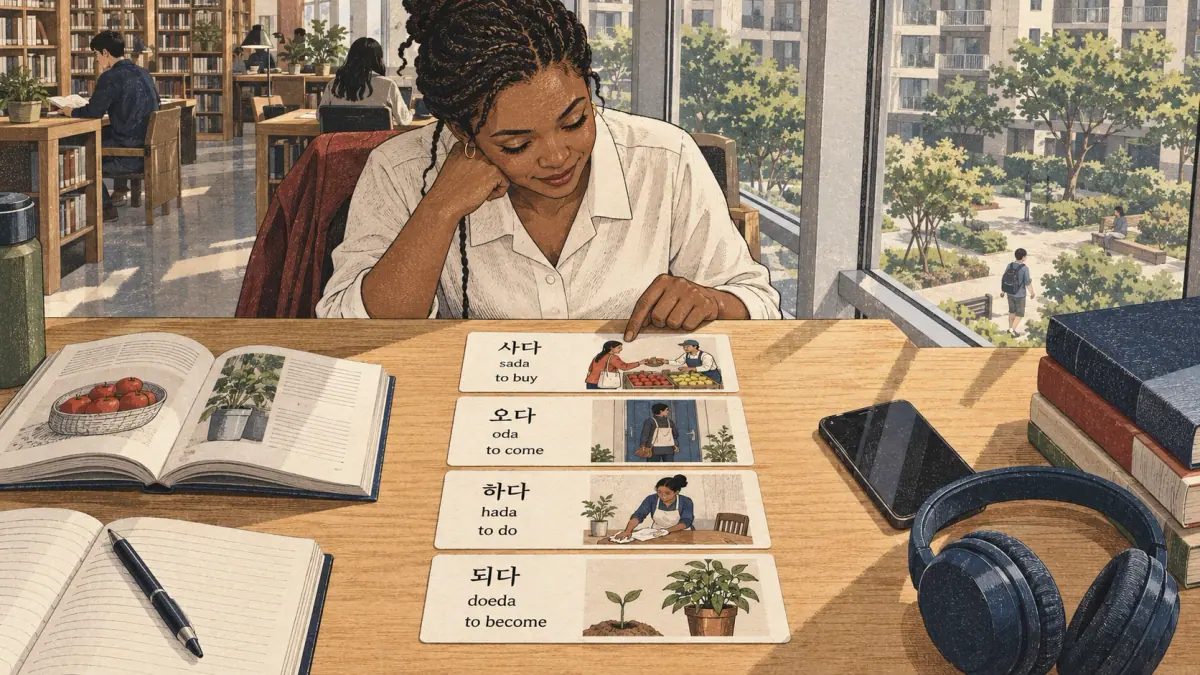
We judged each option on seven criteria that a learner can check in five minutes, and we use no scores. Each criterion has a question and a test.
- Headword coverage. Does it include everyday words, loanwords and set phrases? Test: search 발이 넓다.
- English glosses. Are the meanings precise, and are senses separated? Test: search 되다.
- Example sentences. Are there natural examples, and is their source clear? Test: read the examples for 사다.
- Audio. Is there audio for headwords and examples? Test: play 오다.
- Search tolerance. Does it find a word from an inflected form, such as 샀어요? Test: search 샀어요.
- Offline use. Does it work without a connection?
- Cost. Is it free, free with ads or paid? Prices are labelled typical and change.
The test words. Run these five in every dictionary you consider:
| Test word | Why it tests the dictionary |
|---|---|
| 사다 (sada), to buy | A simple verb: do the examples and audio appear at once? |
| 오다 (oda), to come | A short, common verb with many set phrases |
| 하다 (hada), to do | A huge entry: does it organise the senses so you can read them? |
| 되다 (doeda), to become | Many senses (become, be okay, work); does it separate them? |
| 발이 넓다 (bari neolda) | An idiom: does it list the expression, not only the word? |
Our judgments describe what each dictionary documents about itself and what a learner can check by running these tests. Test results vary with the app version, so run them yourself before you commit.
1. Naver Dictionary — Best for Daily Lookups
Naver Dictionary is the best everyday dictionary for most learners because it searches a Korean–English dictionary, a Korean-language dictionary and a hanja dictionary from one box.
Specs: free with ads; web and app; English glosses, examples and audio; some inflected-form matching.
It reads Korean input well and shows several senses with examples. Audio is available on many entries. The main strengths are speed and coverage: you can look up almost anything you meet. Same-spelled entries are numbered, so 사과 "apple" and 사과 "apology" appear separately. The page on how to use the Naver dictionary explains each part of an entry.
Drawback: the first gloss can mislead, and the page includes ads and portal links that distract from the entry. Examples differ in quality.
Choose this if you want one fast tool for everyday reading. Skip it if you need the official spelling and spacing rule, where the standard dictionary decides.
2. Korean Learners' Dictionary (한국어기초사전) — Best for A1 to B1 Meanings
The Korean Learners' Dictionary is the best free dictionary for simple definitions because the National Institute of Korean Language wrote it for people learning Korean.
Specs: free; web (an app edition may also be available, so check your app store); definitions in simple Korean with translations into several languages; graded example sentences; a limited headword list.
Entries use simple Korean in their definitions and examples, so reading them is practice in itself. Translations into English and other languages help while your Korean is limited. Headwords focus on common vocabulary, which is what a learner needs most. It is a good second dictionary beside Naver for checking a meaning in Korean.
Drawback: it has fewer headwords than a large portal, so rare words and new slang may be missing.
Choose this if you are between A1 and B1 and want to read Korean definitions. Skip it if you mainly need fast coverage of unusual words.
3. Standard Korean Language Dictionary (표준국어대사전) — Best for Spelling and Spacing
The Standard Korean Language Dictionary is the reference for standard spelling, spacing and word meanings because it is the official dictionary of the National Institute of Korean Language.
Specs: free; web; definitions in Korean; pronunciation in brackets; hanja origins; very large headword list.
When two sources disagree about whether a compound is written together or apart, this is the one that settles it. Entries show the part of speech, the senses in order, example phrases and the hanja where relevant. It is the source behind the rulings on the Korean spacing rules and Korean spelling rules pages on this site.
Drawback: definitions are in Korean at native-reader level, and the interface is not designed for learners.
Choose this if you are at B1 or above and need to settle a spelling or spacing question. Skip it if you cannot yet read simple Korean definitions.
4. 우리말샘 — Best for Newer Words and Regional Forms
우리말샘 (urimalsaem) is the best place to look when a word is missing from the standard dictionary, because it is an open dictionary from the same institute that records newer words and regional forms.
Specs: free; web; definitions in Korean; users can suggest entries; wide headword list.
New words, slang that has settled into use, technical terms and dialect forms appear here before or instead of the standard dictionary. This makes it valuable for reading modern text and for dialect in dramas.
Drawback: because it is open to contributions, entries vary in quality, and not every entry carries the authority of the standard dictionary.
Choose this if you are reading modern text and meet a word that the standard dictionary lacks. Skip it if you need a ruling on standard spelling.
5. Daum Dictionary — Best as a Second Opinion
Daum Dictionary is a second portal dictionary that is useful for cross-checking a gloss against Naver. It comes from another Korean portal company, so its entries and examples are chosen separately.
Specs: free with ads; web; English and Korean entries.
When Naver's first gloss feels odd, Daum often gives a different set of examples. Two glosses that agree give you more confidence. Two that disagree send you to the learner or standard dictionary.
Drawback: it adds little for a beginner who is already using Naver, and the service layout and availability can change.
Choose this if you like to confirm important words in a second source. Skip it if you want a single tool and do not want to compare.
6. Print Learner Dictionaries — Best for Offline and Focused Study
A print learner dictionary is the best option when you want to study without a screen because it works with no battery, no signal and no notifications.
Specs: paid (typical prices vary by size); Korean–English; no audio; fixed content until a new edition.
Browsing a book teaches you things a search box does not, such as neighbouring words and word families. A compact dictionary can sit on the desk during a textbook lesson. The choice among titles is a matter of size and edition, so look at a few pages in a shop before buying.
Drawback: a print dictionary lacks audio, is slow to search and cannot find an inflected form for you, since you must work out the base form first.
Choose this if you study at a desk and enjoy browsing, or you travel without a data connection. Skip it if you want audio, fast search or new vocabulary.
What Do the Five Test Words Show?
Each test word exposes a different weakness, so a dictionary that handles all five well is a safe daily tool. Work through them in order and write down what you see.
- 사다. A good entry gives the main sense, "to buy", first. It lists at least one example with an object, such as 빵을 사요 (ppangeul sayo), "I buy bread". It should also tell you the verb is regular, so that 샀어요 (sasseoyo) [사써요] is easy to build.
- 오다. Look for set phrases such as 비가 오다 (biga oda), "it rains", where 오다 does not mean "come" in the plain sense. A dictionary that lists them saves you from translating word by word.
- 하다. The entry should be long and organised, with the main sense and the verb-forming use (공부하다, 운동하다) kept apart. If the entry is a wall of text, the layout is the weakness.
- 되다. The entry should separate "become", "be done", "be okay" and "work (function)". If you see a single gloss such as "to become", you will misread 안 돼요 (an dwaeyo), "it does not work, it is not allowed".
- 발이 넓다. A dictionary that lists idioms under the key word, with the meaning "to know many people", passes. One that only shows 발 "foot" and 넓다 "wide" leaves you with a literal reading.
If a dictionary passes four of the five, it is good enough for daily use at beginner level. If it fails the idiom test, you can still use it, but pair it with a second source for phrases.
What Search Tips Save Time?

Four habits make every dictionary faster to use.
- Search the base form first. For 샀어요, search 사다. If you do not know the base form, search the whole word and look at what the dictionary suggests.
- Type the whole syllables. Search with complete Hangul, such as 사다. Some portals also accept romanization or English words, but accuracy is better with Hangul.
- Search the phrase for idioms. Type 발이 넓다 as written, with the particle, not 발 alone.
- Use the other language side. If you know the English word, search it in the English–Korean direction to find the Korean headword, then search the Korean headword to read its entry and examples.
For typing on a computer or phone, the typing in Korean page explains the keyboard layout.
What Mistakes Do Learners Make When Choosing?
Four choices cause most regret.
- Buying a large dictionary too early. A beginner can use only a fraction of a large dictionary, and a free online one does the same job.
- Using only a translator. It hides the senses you need to learn. See the Papago Korean page for the safe-use loop.
- Trusting the first gloss. Check an example before you accept it.
- Never moving up. At around B1, start reading Korean definitions in the learner or standard dictionary, because English glosses cannot carry every nuance.
Bilingual or Monolingual: When Should You Switch?

Start bilingual, add a learner dictionary at A2, and add a monolingual dictionary at about B1. The switch is not a single day. It is a gradual change in which dictionary you open first.
A bilingual entry for 사과 gives "apple" and "apology". A learner-dictionary entry gives a short Korean definition and an example sentence, such as 사과를 먹어요 (sagwareul meogeoyo) [사과를 머거요], "I eat an apple". A monolingual entry gives a full definition in Korean, with the hanja for the second sense and usage notes. Each step adds precision and costs reading effort.
| Level | Open first | Check second | Why |
|---|---|---|---|
| A1 | Bilingual | None | Reading Korean definitions is too slow |
| A2 | Bilingual | Learner dictionary | Simple Korean definitions are now readable |
| B1 | Bilingual or learner | Standard dictionary | You need spelling, spacing and finer meanings |
| B2 and above | Learner or standard | 우리말샘 for new words | English glosses hide nuance |
A good rule is to read the Korean definition whenever the English gloss leaves you unsure, even at A2. You may not understand every word, but the example sentence will usually carry you.
What Does a Dictionary Cost?
Most useful dictionaries for learners are free. The three official dictionaries are free online, and the main portal dictionaries are free with ads. The cost sits in print books and in some apps that sell offline data or remove ads. Prices vary by shop, edition and country, so check the current price in the shop or app store before you buy. A free dictionary used every day is worth more than an expensive one left on a shelf.
Which Has the Best Examples?
For examples, the Korean Learners' Dictionary is the clearest for beginners and Naver has the most volume. Learner-dictionary examples are short and graded. Naver examples come from several sources and vary: some are written by editors, some collected from texts. Always read the example next to the sense you chose, as the Naver dictionary page explains.
Which Has the Best Audio?
Naver Dictionary is the most convenient for audio because many entries have an audio button for the headword and sometimes for examples. Check the audio on your test words, because coverage varies by entry. The official dictionaries show pronunciation in brackets, and you may need to read the bracket rather than listen.
Which Is Best Offline?

A print dictionary is the surest offline option, and some dictionary apps allow data downloads. The official online dictionaries need a connection. If you study on flights or commutes, check an app's offline setting before you rely on it, and download the data at home. The best Korean dictionary app page tests this feature in detail.
How Do the Options Compare?
The comparison table gives each option's value on every criterion. Values describe the kind of feature, since versions change.
| Criterion | Naver | Learners' Dictionary | Standard Dictionary | 우리말샘 | Daum | |
|---|---|---|---|---|---|---|
| Headword coverage | Very wide | Common words | Very wide | Widest, incl. new words | Wide | Limited to the book |
| English glosses | Yes | Translations in several languages | No | No | Yes | Yes |
| Examples | Many, mixed sources | Graded, short | Some | Some; quality varies by entry | Some | A few per entry |
| Audio | Many entries | Check headwords | Brackets; check for audio | Brackets; check for audio | Some | None |
| Search tolerance | Often finds inflected forms | Check | Base form best | Base form best | Check | None; find the base form |
| Offline | App features vary | Check the app | Needs connection | Needs connection | Needs connection | Always |
| Cost | Free with ads | Free | Free | Free | Free with ads | Paid |
The pattern is clear. The free online options cover the widest range, and print wins only on offline use.
Which Should You Pick?
Pick by level and by what you are doing.
| Situation | Primary | Backup |
|---|---|---|
| Absolute beginner (A1) | Naver Dictionary | Korean Learners' Dictionary |
| Elementary to intermediate (A2 to B1) | Naver Dictionary | Korean Learners' Dictionary, then the standard dictionary |
| Intermediate and above (B1 and up) | Naver Dictionary | Standard Korean Language Dictionary and 우리말샘 |
| Reading modern text or drama | Naver Dictionary | 우리말샘 |
| Desk study without a screen | Print learner dictionary | Naver Dictionary for audio |
| Writing and checking spelling | Standard Korean Language Dictionary | The Naver Hangul spell checker |
The honest limitation of this list is that no dictionary replaces a teacher for nuance, and no free tool gives perfect glosses. When two dictionaries disagree, read the example sentences and choose the sense that fits yours.
When Is a Dictionary the Wrong Tool?
A dictionary is the wrong tool for translating whole sentences and for learning grammar. Use a translator for the gist of a sentence, and use a lesson for why a pattern works. For word origins, the hanja part of a portal dictionary helps, and the Korean hanja lookup page shows how to find a character by its radical or sound.
Frequently Asked Questions
Which dictionary do Koreans use? Native speakers commonly use portal dictionaries such as Naver for quick checks and the official dictionaries from the National Institute of Korean Language for standard spelling and meanings. Learners can use the same tools, but should start with a bilingual one that gives English meanings.
Do I need a print dictionary? No. Online dictionaries are free, faster to search and have audio. A print dictionary is useful if you study best on paper, want to avoid screens or travel without data. If you buy one, look at a few pages first.
Is Naver better than Google? They do different jobs. Naver Dictionary is a dictionary that shows several senses with examples, while Google Translate is a translator that gives one translation of a sentence. For single words, use the dictionary. Use a translator for the gist of a text, then verify.
What is 우리말샘? 우리말샘 is an open online dictionary from the National Institute of Korean Language. Users can suggest entries, and it records newer words, slang that has become common and regional forms. Use it when a word is missing from the standard dictionary, and check its entries against a second source.
Can I use a dictionary app on my phone? Yes, and many learners do. Look for fast search, examples, audio and an offline mode. The comparison of apps is on the best Korean dictionary app page.
The Bottom Line
The best Korean dictionary for learners is not one dictionary but a pair: a bilingual dictionary such as Naver Dictionary for daily lookups, and a learner or monolingual dictionary for precise meaning, spelling and spacing. Run the five test words on any dictionary you consider, read the examples before accepting a gloss, and add the free official dictionaries as you advance. A print dictionary is a choice for offline and desk study, not a necessity.