Korean Hanja Lookup: the Essential Checks
Verify four things before learning a result: the Korean reading, the selected word meaning, the exact character form and the source. A matching sound is useful evidence for finding candidates, but it does not prove that a particular character belongs to the word you have in mind. A character's general meaning also does not automatically translate a compound. The explorer separates character reference records from dictionary word senses so you can see what each source establishes.
| Your clue | Start here | Check before accepting |
|---|---|---|
| A complete Hanja character | Character search | Code point, Korean readings and variants |
| A Korean word | Dictionary sense search | Recorded origin and intended meaning |
| One Korean syllable | Reading search | Same sound can represent different roots |
| A visible component | Radical and strokes | Filing key, residual strokes and glyph tradition |
| A drawing | Local candidate matching | Shape candidate followed by dictionary confirmation |
How Do You Use This Korean Hanja Dictionary?
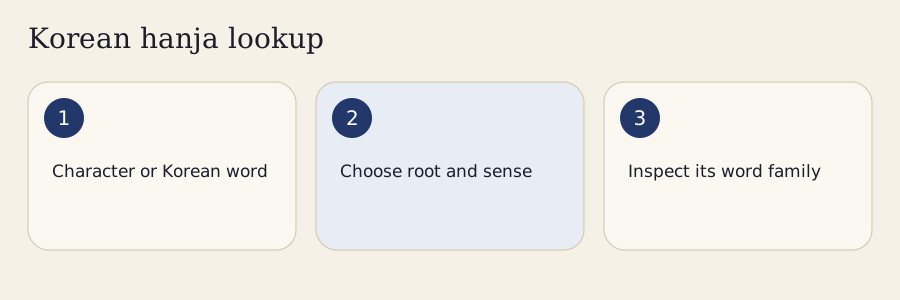
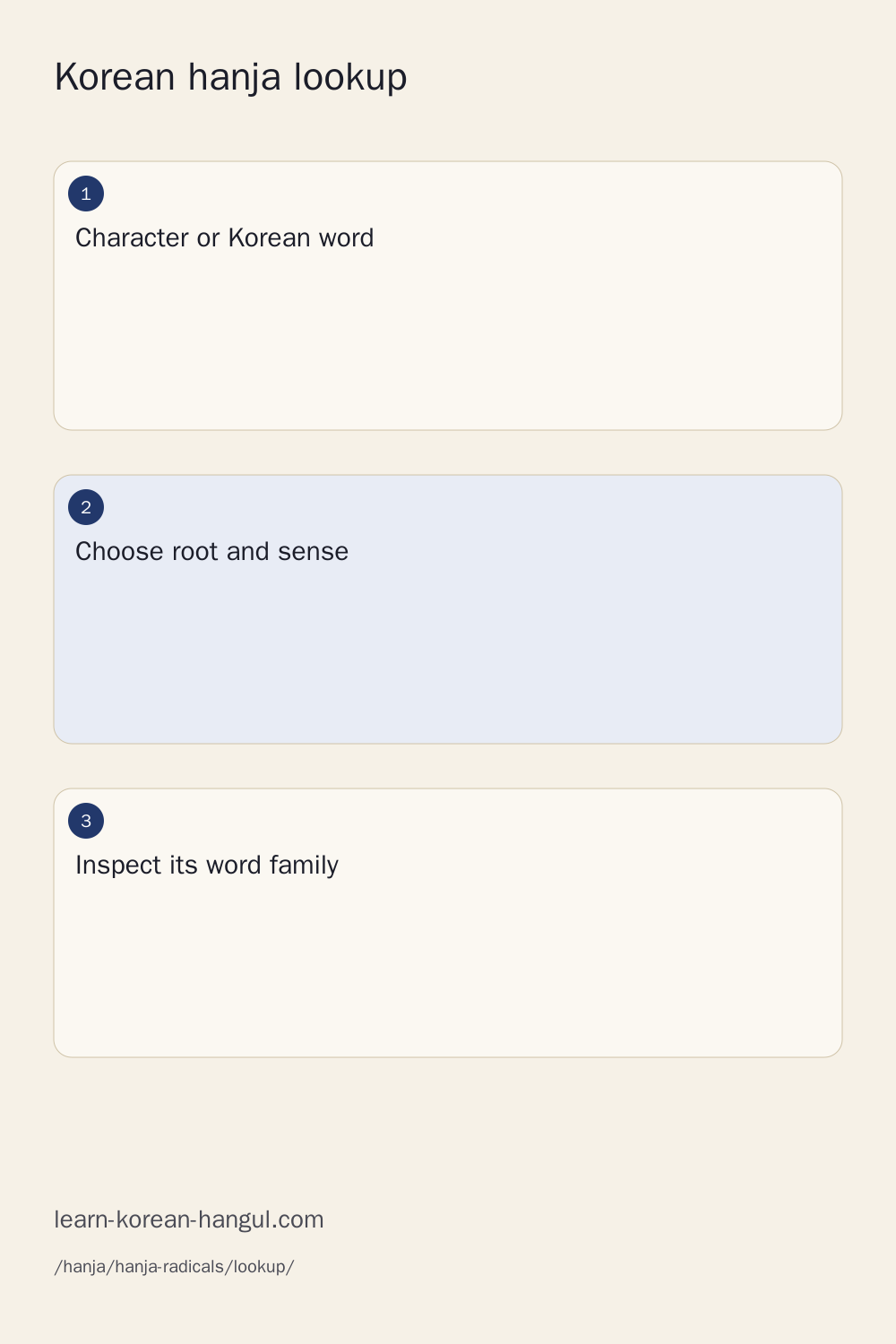
Use four steps to move from a clue to an identified word:
- Choose character search for a complete glyph, word search for Hangul or reading search for one known syllable.
- Enter your clue, then press Look Up.
- Compare the returned candidates with the original shape or sentence meaning.
- Open Sources and confirm the dictionary sense before saving or copying.
The default school example shows 학교 and its recorded Hanja origin 學校. Meaning, Family, Form and Sources answer different questions without sending you through a long reference table.
Choose a Clue and Search
A word search should begin with the complete headword. Searching 학 is a reading search; searching 학교 asks for a lexical word. Those queries may share a character, but they have different goals. Use More and Filters to narrow character results by radical, total strokes or residual strokes. Exact, contains, prefix and suffix matching help when you know only part of a word or meaning. Clear Filters removes those conditions without changing your input.
Confirm the Word Sense
When several senses share a headword, move through the candidate senses and read the meaning before copying. The spelling 사과 can refer to an apple or an apology, with different recorded Hanja origins. The source link identifies the dictionary entry being used. A useful checkpoint is to explain why the meaning fits your sentence. If you cannot do that, keep the result as a candidate and consult the surrounding text rather than accepting the first spelling automatically.
What Is the Difference between a Reading and a Root?
A reading is the Korean sound associated with a character in a particular reference or lexical context. A root family groups words that contain the exact same recorded character. The two groupings overlap, but they are not identical. 학 can lead to both 學 and 鶴. Only words whose recorded origin contains 學 belong in the study-related 學 family; the shared Hangul syllable does not make the crane character 鶴 a variant of 學.
Shared Sounds and Different Characters
Character records may also list more than one Korean reading. 金 has 금 and 김 in the Unicode reference, while 見 has 견 and 현 with different source flags. These alternatives should remain visible. A surname context or a particular compound can select a reading, but an isolated character does not supply all that context. Do not replace the reading of a whole word by joining whichever character readings happen to appear first in a reference list.
Why Does 학 Not Always Mean Study?
The English word study is a helpful gloss for 學 in appropriate learning contexts. It is not a universal translation of the sound 학. Korean contains homophones, and a character gloss may be a mnemonic rather than the complete meaning of a compound. Consult the 學 word family for connected vocabulary, and keep the dictionary's definition beside your own mnemonic. A memorable explanation should support the recorded meaning rather than replace it.
Search by Radical, Total Strokes or Visible Parts
A radical organizes an index. It is not automatically the part that explains a character's meaning or historical origin. The Kangxi convention has 214 radical numbers; a source can give multiple radical-and-residual entries for a character. The index may distinguish regional forms of a radical. Use the number and the actual glyph form together, especially when a component's side form looks different from its independent character.
Can You Search without Knowing the Radical?
Yes. Try a known Korean reading, a complete copied glyph or a drawing candidate. If you count strokes, allow a small tolerance where the regional form is uncertain. In the filter view, choose exact, one-stroke or two-stroke tolerance for total strokes. This broadens the candidate list without asserting that every count is equally authoritative. Compare the returned form with the printed example and the source record. The common radicals and side forms guide provides a useful visual starting point.
What Do Residual Strokes Count?
Residual strokes are the strokes indexed outside the chosen radical form. In the recorded 學 example, radical 39 has residual count 13 and the total is 16. 校 has radical 75, residual count 6 and total count 10. The residual number is not a second total. Do not force every source entry into an arithmetic formula based on the full independent radical glyph, because side forms and regional indexing can differ. The Form tab retains the actual source values.
Draw, Photograph or Speak a Lookup Clue
Drawing, optical character recognition and voice transcription solve different input problems. A drawing matcher compares pen paths with reference shapes. OCR attempts to read a photographed glyph. Voice transcription tries to recover the spoken Korean clue. None of those operations decides the dictionary meaning on its own. Recognition should produce an editable candidate that you confirm before lexical lookup, especially when a personal name or an uncommon character is involved.
Verify Recognition before Choosing a Meaning
The drawing view keeps your strokes local and offers candidate shapes only after you request matching. Undo and Redo restore pen paths; Clear starts again. Relax Stroke Order can broaden matching, but its distance is not a probability that a character is correct. The keyboard-accessible radical filters provide an alternative to the canvas. For photographs, the tool offers a local imported-image preview, rotation and confirmed manual text. Automatic traditional-character OCR and local voice-model recognition depend on their separate shared model packs.
Why Can Handwriting Recognition Miss a Character?
Stroke count, direction, spacing, cursive joins and regional glyph differences all affect comparison. A Chinese or Taiwanese reference may not reflect every Korean writing convention. A plausible-looking candidate should therefore be checked against the printed form, readings and dictionary origin. If no candidate fits, try a more careful drawing, relax ordering, search a visible radical or copy the glyph from another source. A recognition failure does not establish that the character is absent from Korean or absent from Unicode.
Four Worked Hanja Lookup Examples
學 and the School Word Family
Enter 학교 to obtain its school dictionary sense and recorded origin 學校. The result supplies the dictionary pronunciation 학꾜 separately from spelling. Select Family with the root 學 to find recorded word senses containing that exact character. 학교, 학생 and 대학 are useful examples of the relationship. Each word still needs its own meaning: school, student and university are not interchangeable translations. The teaching mnemonic “study plus school” helps you remember the characters; the dictionary sense supplies the actual word meaning.
Check Form to compare the character data. 學 has the recorded 16-stroke total and radical-residual entry 39.13; 校 has total 10 and 75.6. Those character records explain indexing, while the official 학교 dictionary entry establishes the lexical school origin. Keeping those sources distinct prevents a common mistake: using a conversion list to decide a compound meaning without examining a dictionary sense.
사과: Apple and Apology
Enter 사과 and inspect each lexical candidate. The apple origin 沙果 and apology origin 謝過 identify different words despite the shared Hangul spelling. Choosing the apology sense changes the roots you should investigate and the family words that make sense in context. A family graph that merged every 사 reading or every 과 reading would obscure that difference. Confirm the meaning before saving a card so your collection preserves the intended sense.
The related predicate 사과하다 also illustrates mixed origin handling. Its Sino-Korean part may be represented as 謝過 while the Korean 하다 remains Hangul. The explorer should not convert every syllable to a Hanja merely because the first part has a recorded origin. Preserve the lexical construction, spelling and part of speech. For more complete definitions and examples, follow the source into the broad dictionary rather than treating a short character gloss as a complete usage lesson.
女 in 여자 and 남녀
The character 女 retains the reference readings 녀 and 여. The word 여자 uses 여 at the beginning, while 남녀 retains 녀 in its compound context. These are useful contrasts because they show that a reading belongs within lexical spelling rules. A character record supplies alternatives; a word record and Korean orthography explain which spelling applies. Keep 女 as the same root when comparing these words rather than treating the different initial sound as a different character.
This example also warns against global replacement. Changing every 녀 to 여 in a string would produce inappropriate results in contexts that retain 녀. Conversely, insisting that every 女 be read 녀 would miss the word-initial behavior of 여자. The Hanja learning guide provides the broader vocabulary context, while the explorer lets you compare the recorded alternatives without changing your original input.
学, 學 and Regional Forms
Enter 学 and inspect its typed relationship to 學 rather than silently rewriting the text. The simpler glyph has simplified and Japanese-form relationships in relevant source records. Selecting 學 is a deliberate lookup action that can reveal a Korean word family. It does not establish that every simplified compound has a one-to-one Korean counterpart or the same meaning. Keep the original form in your notes when comparing languages.
The same principle applies to 国 and 國, and to 龙, 竜 and 龍. These are separate code points and regional forms with their own source relationships. A Japanese reading or Mandarin pronunciation belongs under its own language label. It must not be presented as a Korean pronunciation merely because the shape resembles a Korean dictionary character. The Hangul and Hanja comparison explains why script identity and language identity are separate questions.
Why Does a Hanja Reading Change inside a Word?
Initial-sound rules concern lexical spelling and context rather than a universal operation on the first Unicode character. The reference alternatives for 年 include 년 and 연, and 力 includes 력 and 역. A word such as 연세 uses the word-initial pattern, while 능력 retains 력 in a different position. 역사 and 경력 provide another useful contrast. The word's recorded spelling is stronger evidence than a tool that simply concatenates isolated readings.
Initial-Sound Rules and Lexical Boundaries
Boundaries matter. A dependent noun in 몇 년 retains 년; the spelling is not 몇 연. A compound such as 신여성 can use 여 even though the character is not the first character of the complete written string. Those examples show why replacing initials based only on string position cannot reproduce all Korean rules. Use the 力 reading guide alongside a dictionary entry and ask where the lexical boundary falls.
Spelling and pronunciation also need separate treatment. 학교 is spelled with 교 but its dictionary pronunciation is 학꾜. That sound change does not alter its Hanja origin 學校. Copying a pronunciation reference into an origin field would mix up two different kinds of evidence. When making cards, reserve separate fields for spelling, pronunciation, characters and meaning. This gives you a clear place to record initial-sound explanations without changing the lexical source.
Are Name Readings the Same as Dictionary Readings?
A person's name requires the actual supplied characters and their chosen readings. Hangul 민수 alone does not identify one particular Hanja name or personal meaning. A lookup may provide possible characters, but assigning a name meaning from those possibilities would invent information about the person. Ask for the written characters first. The Hanja names guide explains the distinction between reading candidates and a person's documented name.
Current legal registration rules require the appropriate court reference and the exact character-reading combination. Unicode's historical name flags are not a current legal eligibility decision. An absent flag does not establish that a character is forbidden, and an educational-list flag is not a name-use permission. Use the deliberate court link when checking a registration question. This tool does not silently submit a name or claim to provide legal advice.
Traditional, Simplified and Japanese Forms
Typed variant relationships make comparison useful without pretending that all forms are interchangeable. The Variants view retains the current code point and displays its relationships as candidates. Each relationship has a type. A simplified variant is not the same assertion as a semantic variant, a Japanese-new form or a Unicode compatibility alias. Following one edge should not silently collapse every related character into a single universal identity.
| Recorded form | Comparison candidates | Verification question |
|---|---|---|
| 學 | 学 | Which language and word sense are you looking up? |
| 國 | 国 | Does the Korean dictionary origin use this exact form? |
| 龍 | 龙, 竜 | Which regional relationship is recorded? |
| 金 | Compatibility glyph 金 | Must the original name code point be retained? |
Can a Chinese or Japanese Character Explain Korean Usage?
A general Han definition can help you understand a character, but it does not establish every Korean word meaning. Unihan includes cross-language reference properties; their presence is not an endorsement of one language's reading for another. Use Korean dictionary origins and senses for Korean vocabulary, and label general character glosses as reference data. A regional stroke template is likewise a regional writing reference until Korean convention has been checked by a specialist.
Compatibility glyphs deserve special care in copied names and historical documents. Some have Unicode decomposition relationships, yet blindly normalizing the complete Hanja string can erase the original code point. The explorer normalizes Hangul for matching while retaining Hanja identity. A separate alias can assist lookup without replacing the original text. If a font fails to display a rare supplementary character, use its code-point label to preserve the identification rather than guessing a visually similar substitute.
Build Word Families and a Useful Practice Deck
A family should explain a specific recorded root, not collect every similar-looking component or homophone. Start with a word whose meaning you know, choose the exact root, then inspect related dictionary senses. The list and small graph express the same relationship. Each edge should lead to a word origin containing the selected character. Changing to another family is a deliberate navigation step, and returning to the word sense helps keep the connection interpretable.
Save a small selection in a local collection. Add your own private note if a mnemonic helps, while retaining the dictionary sense and source separately. For recall practice, try reading and explaining the displayed origin before revealing the meaning. Looking up a word does not establish mastery or award a practice streak. Export a backup when the collection is useful; browser storage can be cleared or unavailable. Transfer your local collection with explicit file export and import. Accounts and classroom synchronization are not provided.
The Export view downloads CSV, TSV or JSON with source and license fields. Select the complete loaded family rather than only the two visible rows. Print creates an attributed table that can be saved as PDF through the browser. Keep pronunciation recordings separate unless their particular rights allow export. A dictionary's free access does not automatically mean its audio can be redistributed in flashcards. Synthetic device speech supplies listening convenience but is not a downloadable owned recording.
Sources, Licensing and Trustworthy Corrections
The character reference uses the pinned Unicode 18 Unihan data with Unicode License V3. Korean word senses use the Korean Basic Dictionary source through the site's shared dictionary package, with its CC BY-SA 2.0 Republic of Korea text attribution. Legacy conversion candidates originate in the separately licensed BSD libhangul data file. The data's BSD notice does not license the libhangul program under different terms, and no competitor's algorithm is imported as if it were public domain.
Legacy conversion evidence can disagree with the teaching default. For 학교, a conversion source records both 學校 and 學敎. The school dictionary sense establishes 學校; the extra source candidate should not silently become the preferred school spelling. More and Sources lets you inspect those legacy records rather than hiding them or treating them as equal semantic authorities. A correction should identify the source, entry or sense and exact origin field being questioned.
Stroke paths come from a pinned Hanzi Writer Data source derived from ARPHIC fonts. The ARPHIC notice accompanies the separately served paths and normalized matcher templates. These Chinese/Taiwanese reference paths do not certify Korean order. The drawing code is an original deterministic matcher; its relative distances have not been calibrated as recognition probabilities. For regional writing conventions, compare a Korean writing reference; recognition paths alone cannot establish the appropriate stroke order.
Frequently Asked Questions
Can I paste a whole passage and count repeated Hanja? Yes. Open Passage, paste up to ten thousand Unicode characters and count them. The result retains each matching character's occurrence count and scalar positions; export includes all spans. This operation does not translate a Chinese or Japanese passage into Korean or determine the dictionary sense of every repeated character.
Does saving a word require an account? No. Collections are local to this browser and saving a selected item needs no sign-in. Export a JSON backup before moving devices or clearing browser data. If storage is blocked, the collection remains in the current session and you can export it. Use file export and import to move collections between devices.
Why does the same radical search return several stroke counts? A source may record multiple radical-residual indexes or total counts for regional glyph traditions. Side forms can also differ from the independent radical glyph. The explorer preserves the recorded entries instead of forcing one arithmetic interpretation. Compare the printed shape, the index form and the source before deciding which count applies.
Can I download pronunciation audio with my flashcards? Only a specific recording whose rights permit that export can be included. Dictionary text licenses do not automatically cover every audio asset. Device speech is synthetic playback and supplies no downloadable recording through this tool. Keep the pronunciation text in your export, and check an audio asset's own permission before redistribution.
Will my last lookup work without an internet connection? Loaded generator and reference data can remain usable in the current session. Reloading an uncached page or requesting an uncached dictionary, drawing or media pack requires connectivity. Coverage is limited to the packs actually installed or loaded. Current court freshness cannot be checked offline, even if historical character flags are available.
Korean Hanja Lookup Limits and Next Learning Steps
A missing result can mean a missing local shard, an absent Korean reading in a source or a word outside that dictionary snapshot. Those are different states. Do not conclude that a character has no Korean use merely because one source lacks a reading. Do not invent Hanja for a native word such as 하늘 or 사람. A semantic relationship to a character like 人 is different from a recorded etymological origin.
When Do You Need a Specialist?
Seek specialist help with cursive or historical text, regional writing differences, name registration and uncertain lexical origins. A clean Unicode match cannot settle those questions alone. Keep a photograph or source context privately if it will help a knowledgeable reader, but share it deliberately rather than allowing a tool to upload it automatically. The tool does not automatically upload photographs, handwriting, names or pasted passages.
Choose the Next Lesson or Tool
Use Korean Hanja lookup to answer one concrete question and then return to real vocabulary. Study Hanja radicals if filing methods are unfamiliar; follow a useful root family when meaning connections help you remember words. Use the Korean romanization converter for a longer reading guide, and the broad dictionary for sentence examples. A successful lookup ends with a verified word sense, not merely a plausible character that shares a sound.