This page is one of our other Korean learning questions, which cover difficulty, methods and cost. It gives ranges, shows the arithmetic and explains why the ranges are wide. Every figure below is a typical estimate for English speakers who study on their own and include listening, not a measurement or a promise.
How Long Does It Take to Learn Korean? the Short Answer
Learning Korean takes about 5 to 15 hours to read Hangul, 120 to 200 hours to reach CEFR A1, 500 to 800 hours to reach B1 and 900 to 1,400 hours to reach B2. Study 1 hour a day and A1 arrives in about 4 to 7 months, B1 in about 1.5 to 2 years.
The levels come from the CEFR, the Council of Europe's six-level scale from A1 (beginner) to C2 (near-native). A1 means you can use familiar phrases and ask simple questions. B1 means you can handle everyday topics and describe experiences. The ranges are wide because people differ in method, prior languages and listening time. The sections below show where each number comes from.
Korean Learning Time by Milestone

Korean learning time is easiest to plan by milestone. The table gives a typical hour range (an editorial estimate, not an official figure), the same range converted to calendar time at three daily study levels, and the assumption behind it. The assumption for every row is the same: an English speaker, studying alone or with a light course, including listening and some speaking.
| Milestone | What you can do | Typical hours | At 30 min/day | At 1 h/day | At 2 h/day |
|---|---|---|---|---|---|
| Read Hangul | Sound out any written word | 5 to 15 | Under 1 month | Under 1 month | Under 1 month |
| Survival Korean | Greetings, numbers, order food, read signs | 30 to 60 | 2 to 4 months | 1 to 2 months | 2 to 4 weeks |
| A1 | Introduce yourself, simple questions and answers | 120 to 200 | 8 to 13 months | 4 to 7 months | 2 to 3 months |
| A2 | Short everyday exchanges in past and present | 250 to 400 | 17 to 27 months | 8 to 13 months | 4 to 7 months |
| B1 | Everyday topics, describe plans and experiences | 500 to 800 | 33 to 53 months | 17 to 27 months | 8 to 13 months |
| B2 | Follow most media, discuss opinions | 900 to 1,400 | 5 to 8 years | 2.5 to 4 years | 15 to 23 months |
Months in the table use a 30-day month, so 30 minutes a day is 15 hours a month, 1 hour is 30 hours and 2 hours is 60 hours. The three bands below describe what each stage feels like.
How Long Does It Take to Learn Hangul?
Learning Hangul takes 5 to 15 hours, usually 1 to 2 weeks of 30 to 60 minutes a day. After that you can sound out any word, even words you do not understand. The 24 basic letters follow regular rules, and most learners read a word such as 사랑해요 ("I love you") slowly but correctly by the end of the first week.
Reading speed grows after that with practice. Hangul is the one milestone worth finishing before anything else, which is why the 7-day Hangul course comes first. Read how long Hangul takes for the detailed breakdown.
Survival Korean and A1
Survival Korean takes 30 to 60 hours, and A1 takes 120 to 200. At survival level you know 50 to 100 fixed phrases, numbers and the polite ending. At A1 you can form simple sentences of your own. A1 sentences look like 저는 학생이에요 ("I am a student"):
At this stage progress feels fast, because every new word and pattern is visible in daily life. The A1 range is larger than the 60 to 90 lesson hours in the Korean for Beginners course path. The course hours cover lessons and exercises. The extra hours in the A1 range cover listening, review and speaking that make the material usable. This lines up with the Korean proficiency levels.
Conversation (A2 to B1)
Conversation takes 250 to 400 hours at A2 and 500 to 800 at B1. At A2 you handle short past-tense exchanges. At B1 you connect clauses with because, if and although. Compare an A2 question, 주말에 뭐 했어요? ("What did you do at the weekend?"), with a B1 sentence, 비가 와서 집에 있었어요. ("It rained, so I stayed home."):
The second sentence links two clauses with -아서/어서 ("because"). Many learners find this stage slower, because listening to real speech now matters more than new rules. The FSI figure sits far beyond these levels, which is why it needs its own explanation.
What Does the FSI 2,200-Hour Figure Really Mean?

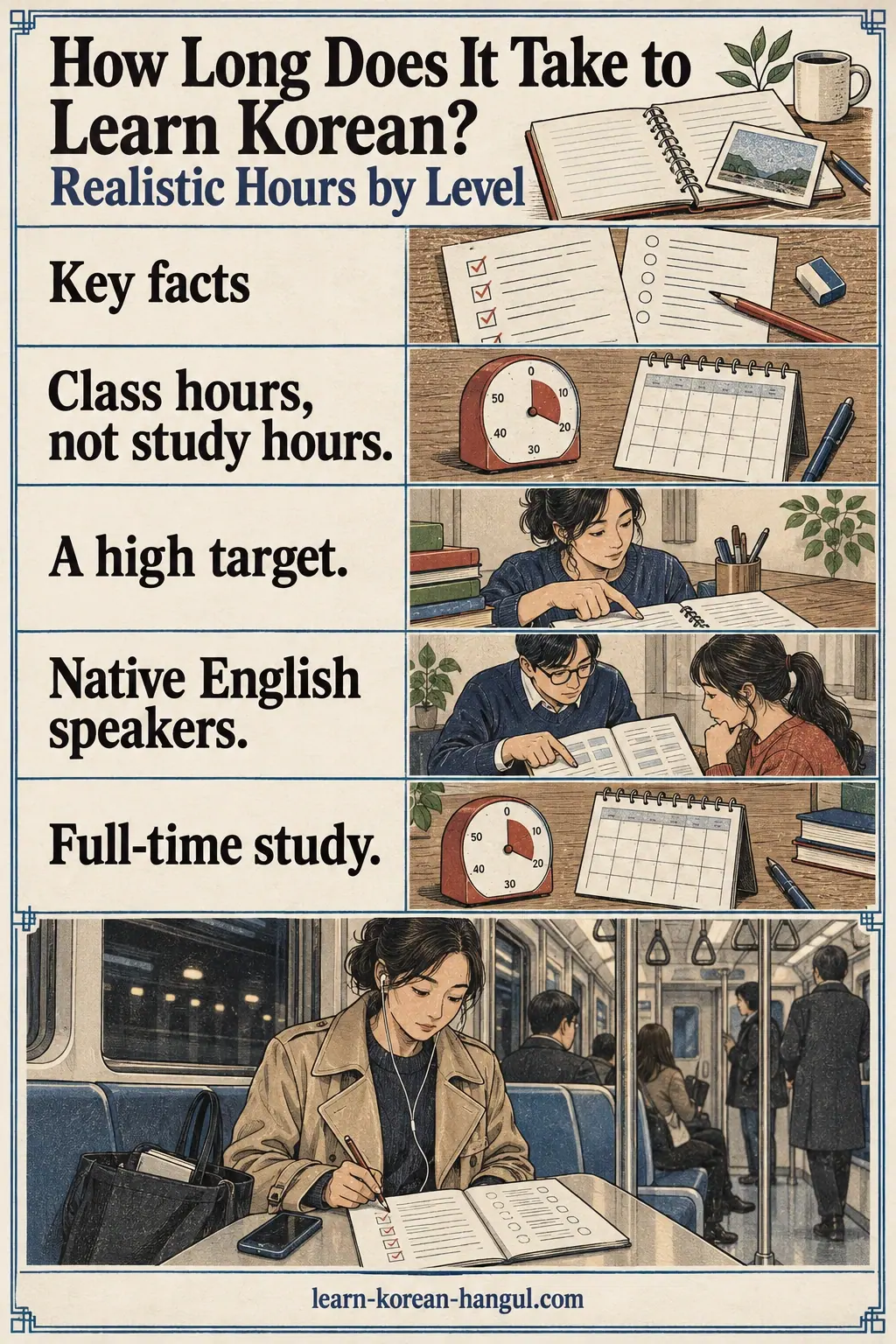
The FSI 2,200-hour figure is time in full-time, teacher-led classes for diplomats, not self-study time. The U.S. Foreign Service Institute (FSI) places Korean in Category IV, its hardest group for native English speakers, at about 88 weeks (2,200 class hours) of full-time training to reach professional working proficiency. Category IV also contains Japanese, Mandarin, Cantonese and Arabic.
Four conditions make the figure a poor personal forecast:
- Class hours, not study hours. The 2,200 hours are time in small, intensive classes, about 25 hours a week, and students also do homework.
- A high target. Professional working proficiency is above B1 and above TOPIK 3. Most learners do not need it.
- Native English speakers. The figure is set for that group and for the FSI's own program.
- Full-time study. Students are paid to study, with no other job during the course.
An independent learner who studies one hour a day would need about six years to reach 2,200 hours (2,200 divided by 365), but that comparison is not like-for-like. Check the current figures on the FSI's published language-difficulty page before quoting them. The practical question is how much you should study each day.
How Many Hours a Day Should You Study Korean?

Most learners study 30 to 60 minutes a day, and 1 to 2 hours a day is a heavy, sustainable load. Daily consistency matters more than session length. Two 30-minute sessions on separate days produce more reviews of each word than one 60-minute session.
A day that works for many people combines three parts: new material (15 to 30 minutes), review (10 minutes) and listening (15 to 30 minutes). A fourth part, speaking, can sit on one or two days a week. Longer sessions have diminishing returns, because attention drops after 45 to 60 minutes of focused study.
Expert insight: listening lags. Listening to native-speed speech is usually the slowest Korean skill, because Korean links final consonants to the next vowel and softens sounds between vowels. The written 한국어 is spoken [한구거], so a learner who matches sound to spelling letter by letter misses the word. Reserve at least a quarter of your weekly time for listening, a rule of thumb rather than a measured figure.
Worked Examples: 30 Minutes, 1 Hour, 2 Hours a Day
Use this formula to turn hours into calendar time:
Months to a milestone = target hours ÷ (hours per day × 30)
Example 1: you study 30 minutes a day and want A1 (150 hours, the midpoint). Hours a month: 0.5 × 30 = 15. Months: 150 ÷ 15 = 10 months.
Example 2: you study 1 hour a day and want A2 (325 hours, the midpoint). Hours a month: 30. Months: 325 ÷ 30 ≈ 11 months.
Example 3: you study 2 hours a day and want B1 (650 hours, the midpoint). Hours a month: 60. Months: 650 ÷ 60 ≈ 11 months.
Example 4: you study 45 minutes on weekdays only. Weekly hours: 0.75 × 5 = 3.75. Monthly hours: about 16. A2 at 325 hours: 325 ÷ 16 ≈ 20 months.
Treat midpoints as starting guesses and update them after each four-week block by measuring what you actually completed. The arithmetic assumes steady weeks, and real months include illness, travel and plateaus. Before the bigger targets, the first 100 hours deserve their own plan.
What the First 100 Hours Should Include

The first 100 hours should cover Hangul, sounds, fixed phrases, numbers, the first grammar patterns and a steady listening habit. A split such as the one below keeps every skill moving. The hours are a suggested allocation, not a measured optimum.
| Block | Hours | What it produces |
|---|---|---|
| Hangul and reading practice | 10 | Reading any word aloud |
| Pronunciation and final sounds | 10 | Saying 한국어 as [한구거], not letter by letter |
| Greetings, phrases and numbers | 20 | A set of fixed phrases and counting for time and prices |
| First grammar: particles, 이다, polite present | 30 | Simple sentences such as 저는 학생이에요 |
| Listening | 20 | Following slow, scripted audio |
| Review and speaking | 10 | Flashcards and a few conversations |
The proportions show where time goes: grammar and listening take half of the total. After 100 hours you are just below the low end of the A1 range in the milestone table, which is why weekly hours matter more than a single "fast" tool. The first 100 hours also expose the speed question, which the learn Korean fast page treats in detail. Before the first 100 hours are over, put the plan into numbers.
Calculate Your Own Timeline in Four Steps

Calculating your own timeline takes four steps and about ten minutes. Each step produces a number you can check later.
- Choose one target. Pick a level from the table, for example A2 (250 to 400 hours).
- Count your real weekly hours. Use the minutes you actually studied last week, not the minutes you planned. Say you studied 4 times, 35 minutes each: 140 minutes, or 2.3 hours.
- Divide. Target hours ÷ weekly hours gives weeks. For A2 at the midpoint of 325 hours: 325 ÷ 2.3 ≈ 141 weeks, about 2.7 years.
- Test a change. Raise weekly hours by one 30-minute session and divide again: 325 ÷ 2.8 ≈ 116 weeks, about 2.2 years.
The fourth step shows how little extra time moves the date: one more half-hour a week saves about 25 weeks over the whole climb in this example. Re-run the calculation every four weeks with your measured hours, because plans drift. The next question is what the hours buy at the top end: fluency.
How Long Does It Take to Be Fluent in Korean?

Being fluent in Korean takes years of regular practice, from about 500 to 1,400 hours for comfortable conversation to 2,000 hours or more for professional work. Fluency has no standard definition, so the answer depends on which of three targets you mean.
| Target | CEFR level (rough) | Typical hours | What it means |
|---|---|---|---|
| Hold an everyday conversation | B1 | 500 to 800 | Talk about daily life with pauses and mistakes |
| Follow media and discuss opinions | B2 | 900 to 1,400 | Understand most shows and articles with some gaps |
| Work in Korean | C1 | 2,000 or more | Use Korean flexibly for professional tasks |
Adults can reach advanced levels, and nothing in language-learning research rules adults out. Accent is the area where adults usually find it harder to sound fully native, but a clear, understood accent is a realistic goal. The next section treats two targets that people often equate with fluency.
How Long until You Understand K-Dramas or Pass TOPIK 3?
Understanding K-dramas without subtitles usually needs B2 or above, meaning 900 hours or more, while TOPIK level 3 sits closer to B1. These are different skills with different times. Dramas use fast speech, slang and contractions, and they rarely repeat words slowly.
TOPIK II level 3 needs 120 points out of 300 on the exam, and TOPIK does not publish an official CEFR mapping, so comparing it with B1 is an approximation. A learner at A2 to B1 with timed practice can approach level 3 in about 500 to 800 hours of total study plus exam practice. Check the current thresholds on the TOPIK official site.
Three targets, three timelines:
- Conversation: 500 to 800 hours, with the most speaking.
- TOPIK 3: 500 to 800 hours, with timed reading and listening.
- Dramas without subtitles: 900 hours or more, with the most listening.
The best choice is the target you will use first. Timelines also move, depending on what speeds you up or slows you down.
Can You Learn Korean in 6 Months or a Year?

At 1 hour a day, the typical ranges put A1 at about 6 months and A2 at about a year. Six months of daily study is about 180 hours, and a year is about 365 hours. The result depends on the daily amount, as the table shows.
| Time | At 30 min/day | At 1 h/day | At 2 h/day |
|---|---|---|---|
| 3 months (about 90 days) | About 45 h: survival phrases | About 90 h: late survival, early A1 | About 180 h: A1 material |
| 6 months (about 180 days) | About 90 h: survival to early A1 | About 180 h: A1 | About 360 h: A2 |
| 12 months (about 365 days) | About 180 h: A1 | About 365 h: A2 | About 730 h: B1 range |
The stated levels are the typical ranges from the milestone table, so a learner near the low end of a range arrives earlier and one near the high end arrives later. The label "A1" here means the material is covered, not that every skill is comfortable. Listening usually trails reading by a level, so a 6-month learner at 1 hour a day who has done little listening may read at A1 and hear at pre-A1.
Is Korean Faster to Learn than Japanese?
Korean and Japanese sit in the same FSI category, so both take a long time. Korean gives a faster start in reading, because Hangul takes days while Japanese needs two kana sets and many kanji. Japanese pronunciation is simpler. Neither language wins on every skill, so total hours are close. For the skill-by-skill split, read whether Korean is harder than Japanese.
What Speeds up or Slows down Learning Korean?
Weekly hours, listening share, prior languages and method decide most of the spread in the ranges. Two learners with the same hours can differ by months.
Factors That Shorten the Timeline
- Prior Japanese. Grammar order, particles and many Chinese-origin words overlap, which can shorten early grammar. See whether Korean is harder than Japanese.
- Daily listening. Twenty to thirty minutes of Korean you mostly understand builds the skill that lags.
- Speaking with correction. A weekly tutor or exchange session shows errors early.
- Reading Hangul from day one. It avoids later re-learning of romanized words.
- Spaced review. Words come back just before you forget them.
Factors That Lengthen It
Typical costs of common time sinks are editorial estimates:
| Time sink | Typical added delay | Why |
|---|---|---|
| Relying on romanization | 2 to 6 weeks | You must re-learn the same words in Hangul |
| No listening practice | Listening stays at A1 while reading reaches A2 | Reading and listening grow separately |
| Collecting many apps and books | 2 to 4 weeks per switch | Each switch resets your place |
| Study in rare long sessions | Slower recall | Fewer reviews per word |
Time sinks matter more for self-study, where nobody notices them.
How Long Does It Take to Learn Korean by Yourself?
Learning Korean by yourself takes about the same hours as the table above when your hours include structure, listening and some speaking, and longer when they do not. Self-study works without a teacher if you have three things: an ordered course, a review habit and a way to get corrected.
Without correction, errors in speech levels and pronunciation can harden into habits. Add one speaking session per week as early as A1. Also, count only active hours. Reading a passage with notes counts; passively hearing a drama while cooking does not. For the methods themselves, compare what speeds Korean up and choose a method with the best way to learn Korean comparison.
Why Am I Not Improving after a Year of Korean?
You are probably on a plateau, which means your input and output no longer match your level. After a year of study the early gains stop, because beginner material is now easy and the next level needs more listening and speaking, not more of the same.
Check these causes in order:
- Only review, no new input. Add 20 minutes a day of material at a slightly higher level.
- No speaking. Add one conversation a week and ask for corrections.
- Passive listening. Switch to active listening with transcripts and replays.
- Unclear goal. Choose one target (conversation, TOPIK or media) and measure it.
A plateau is a signal to change the mix, not to study less. Measure it with a four-week task such as dictating five short sentences.
Study Plans That Fit Your Timeline
Match the plan to the horizon you calculated. If your calculation lands near 90 days, follow a 3-month Korean plan. For one year, use the 12-month Korean plan with a six-month checkpoint. If you need to choose, study plans lists every horizon. Plans work only when they fit your weekly hours.
The Bottom Line
How long does it take to learn Korean? Hangul takes days, A1 about 120 to 200 hours and B1 about 500 to 800 hours, with FSI's 2,200 class hours describing a much higher target. Two nuances matter most. Hours are only comparable when they include the same mix of listening, speaking and review. And consistent daily study beats long, rare sessions at every level.
Frequently Asked Questions
Can I learn Korean in 3 months?
Three months at one hour a day is about 90 hours, which typically covers Hangul, a few hundred words and basic polite sentences. That is below the typical range for full A1 use. Three months is enough for a firm foundation, not for conversation at a stable level.
Does watching K-dramas count as study time?
Only active watching counts. Rewatching short scenes with Korean subtitles, pausing to look up words and repeating lines is study. Watching with subtitles in your own language mainly trains you to read subtitles. A useful rule is to count a viewing hour as half an hour of study, or less.
How long does TOPIK I preparation take?
TOPIK I covers levels 1 and 2 and tests reading and listening. Many learners prepare in 150 to 400 hours of total study, which matches the A1 to A2 range above (an editorial estimate). The last few weeks are best spent on timed practice with exam-style questions.
Is it too late to learn Korean as an adult?
No. Adults learn grammar and vocabulary faster than children in early stages because they use study strategies and reading skills. Accent is harder to perfect after childhood, but a clear, understandable accent is a realistic goal. Your hours and method matter more than your age.
How long until I can read Korean webtoons?
Reading Hangul takes days, but understanding webtoons needs vocabulary and casual grammar. Short, picture-supported webtoons are possible at around A2, roughly 250 to 400 hours. Slang, dialect and informal contractions slow you down, so start with genres that use simple everyday speech.