- 01
How to Learn Korean in 3 Months: Is A1 Realistic?
- 02
Before You Start
- 03
How Does the 90-Day Plan Differ from the 30-Day Plan?
- 04
Step 1: Read and Pronounce (month 1)
- 05
Step 2: Build Present-Tense Sentences (month 2)
- 06
Step 3: Talk about the past and Speak Weekly (month 3)
Compare the plan with all Korean study plans if you need a different time horizon. Everything below assumes an adult learner starting from nothing.
How to Learn Korean in 3 Months: Is A1 Realistic?
Reaching approximately A1 in 3 months is a reasonable planning target at about an hour a day, but conversational fluency is not. A1 is the first level of the Council of Europe's CEFR scale (2020 Companion Volume): a learner can use familiar everyday phrases and simple sentences about themselves and their surroundings.
Ninety hours is the key number. The U.S. Foreign Service Institute (FSI) places Korean in Category IV, its hardest group for native English speakers, at about 88 weeks (2,200 class hours) of full-time training to reach professional working proficiency. Ninety hours is a small part of that figure, and it fits the beginning of the scale. It covers the A1 material in this plan, while comfortable A1 use, with extra listening and review, typically takes 120 to 200 hours (see how long it takes to learn Korean), so expect listening to lag behind reading at day 90. The plan therefore aims at A1 and not at "speaking Korean".
| Question | Short answer |
|---|---|
| Is A1 realistic in 90 days at 1 hour a day? | It is a reasonable target, not a certainty |
| Is conversational fluency realistic? | No, for English speakers |
| What can you do at the end? | Introduce yourself, describe a day, tell a short past story |
| What can you not do? | Follow native-speed talk or discuss complex topics |
Results vary with study method, the amount of listening and speaking, and the learner's other languages. The plan gives you a structure; the pace remains yours. First, the setup.
Before You Start
The 90-day plan needs about one hour a day, a device with audio and a flashcard tool, and no earlier Korean. Check these items on day zero.
| Item | Detail |
|---|---|
| Time | About 60 minutes a day, 6 days a week, for 13 weeks (about 78 hours, or about 90 if you study every day) |
| Difficulty | Beginner (A0 to about A1) |
| Cost | Free: all linked lessons, audio and decks cost nothing; tutors cost extra |
| Prerequisites | None |
| Tools | Headphones; flashcard decks; a notebook; a speaking partner from month 2 |
| Speech level | Polite 해요체 only |
If you want a faster start with less commitment, try the 30-day plan first, then continue here. The 90-day plan repeats that month at a more relaxed pace. Before choosing a pace, compare this plan with the shorter one.
How Does the 90-Day Plan Differ from the 30-Day Plan?
The 90-day plan differs from the 30-day plan in scope, pace and grammar: it teaches sentence-building, while the 30-day plan teaches reading and fixed phrases. The comparison below helps you pick one.
| Feature | 30-day plan | 90-day plan |
|---|---|---|
| Daily time | 45-60 minutes | About 60 minutes |
| Total hours | About 22-30 | About 80-90 |
| Words | About 150 | About 400 |
| Grammar | Two patterns | Six grammar steps |
| Speaking | Role-play alone | Weekly tutor or partner from month 2 |
| Result target | Hangul and survival phrases | Approximately A1 |
Pick the 30-day plan for a trip and the 90-day plan for steady progress. Month 1 of this plan reuses the same Hangul route, so a learner who finishes the 30-day plan can enter this one at the start of month 2. The deciding factor is time: if you can give an hour a day for three months, the longer plan builds grammar that the shorter one leaves out. Month 1 comes first either way.
Step 1: Read and Pronounce (month 1)
Action: in days 1-30, learn all 40 Hangul letters, the main pronunciation rules and about 150 words.
How: split the month into three parts.
- Days 1-7: learn all letters through the Hangul in a week route. Read 20 syllables a day aloud.
- Days 8-21: study the pronunciation rules that change spoken sound: the seven final sounds of batchim (final consonants) and liaison (linking a final consonant to a following vowel). For example, 한국어 is spelled with a final ㄱ but said [한구거], and 읽어요 is said [일거요].
- Days 22-30: learn about 150 common words and about 25 survival phrases, each with audio.
Pronunciation follows the standard rules of the National Institute of Korean Language (국립국어원 표준 발음법). Use a flashcard deck for the words, with 15 new cards a day at most.
You'll know it worked when: you can read 20 unseen syllables in 60 seconds and recognise about 150 words, with audio, in your deck.
Common mistake: studying romanization instead of Hangul. Romanization is a temporary aid. Set a rule: from day 8, no Latin letters on flashcards.
With reading and sound in place, sentences can begin.
Step 2: Build Present-Tense Sentences (month 2)
Action: in days 31-60, learn 이다 and 있다, the main particles and the polite present ending -아요/어요, and add about 130 words.
How: follow this order, one new idea per week.
- Week 5: 이다 and 있다. 이다 means "to be" (identity), and 있다 means "to exist" or "to have". Examples: 저는 학생이에요 (I am a student) and 책이 있어요 (There is a book).
- Week 6: particles. A particle is a short tag attached to a noun that shows its job. 은/는 marks the topic, 이/가 marks the subject, 을/를 marks the object, 에 marks time and place. Example: 저는 커피를 마셔요 (I drink coffee). See the lesson on topic and subject particles.
- Week 7: the polite present, -아요/어요. Take the verb stem and add 아요 after the vowels ㅏ or ㅗ, and 어요 after other vowels. 가다 becomes 가요, 먹다 becomes 먹어요, 하다 becomes 해요. The lesson on polite present conjugation lists the exceptions.
- Week 8: a daily routine. Combine everything into five sentences about your day.
Speaking begins now. Book one 30-minute session a week with a tutor or an exchange partner, and prepare five sentences for it.
Expert tip: vowel harmony decides between 아요 and 어요. The last vowel of the stem sets the choice: 가다 (stem 가) takes 아요, but 먹다 (stem 먹) takes 어요. A short rule of thumb is that bright vowels ㅏ and ㅗ take 아요 and everything else takes 어요. Irregular verbs, such as 듣다 (to listen), change their stem, and they are better left to the one-year plan. Do not let them slow month 2; the regular verbs cover most of the early word list.
You'll know it worked when: you can describe your daily routine in five present-tense sentences, such as 저는 아침 일곱 시에 일어나요, without notes.
Common mistake: memorising each verb form separately. Learn the rule, then apply it to 20 common verbs until it is automatic.
Month 3 adds time, wishes and refusals.
Step 3: Talk about the past and Speak Weekly (month 3)
Action: in days 61-90, add the past tense, negation and "want to", reaching about 400 words.
How: work through these items.
- Weeks 9-10: the past tense -았어요/었어요. The pattern follows -아요/어요. 가다 becomes 갔어요, 먹다 becomes 먹었어요, 마시다 becomes 마셨어요, 하다 becomes 했어요, 보다 becomes 봤어요. Example: 어제 친구를 만났어요 (I met a friend yesterday). See the lesson on past tense.
- Week 11: negation. Put 안 before a verb to say "do not", such as 안 가요. Use 못 to say "cannot", such as 못 가요. A full sentence looks like 오늘은 안 가요 (I am not going today). With noun + 하다 verbs, 안 goes between the noun and 하다: 공부 안 해요.
- Week 12: wishes with -고 싶어요. Attach it to the verb stem to say "I want to": 가고 싶어요 (I want to go), 먹고 싶어요 (I want to eat), 한국에 가고 싶어요 (I want to go to Korea).
- Week 13: review and test. Re-run every flashcard deck, then take the month-3 test.
For weekly speaking, compare online tutors or exchange partners, and decide which suits your budget and schedule. A tutor corrects mistakes you cannot hear yourself.
You'll know it worked when: you can tell a six-sentence story about yesterday and hold a five-minute chat with a tutor using simple sentences.
Common mistake: only reading about grammar and never speaking it. By month 3, spoken practice is not optional.
The grammar order across the three months deserves its own explanation.
Which Grammar Comes First?
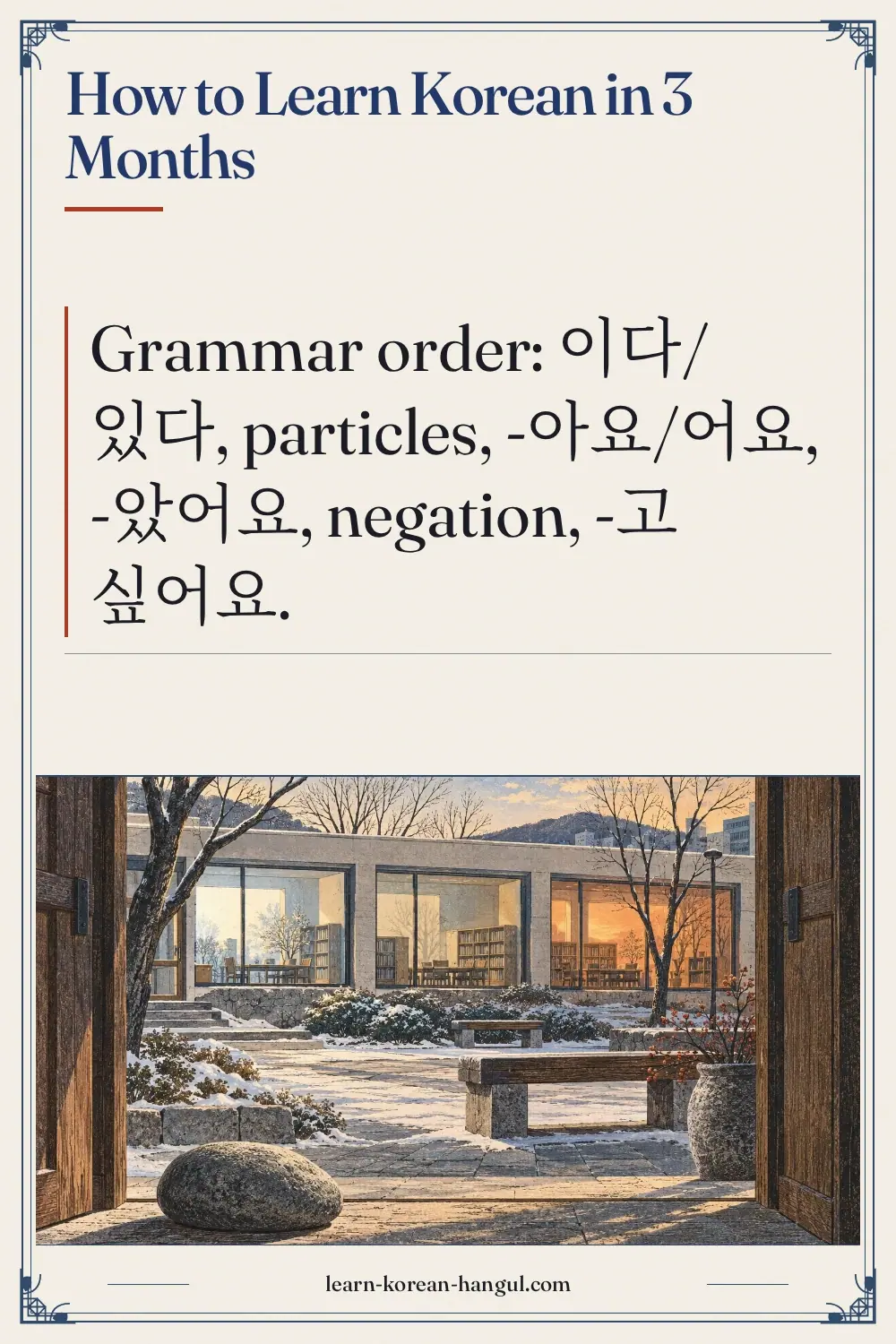
The grammar order is 이다/있다, particles, -아요/어요, -았어요, 안/못 negation and -고 싶어요, and it is ordered by how much each step enables. The table shows what each item enables.
| Order | Grammar | Why here | Example |
|---|---|---|---|
| 1 | 이다 / 있다 | Gives identity and existence sentences with few rules | 저는 학생이에요 |
| 2 | Particles 은/는, 이/가, 을/를, 에 | Every later sentence needs them | 저는 책을 읽어요 |
| 3 | Polite present -아요/어요 | Opens all verbs | 먹어요, 가요 |
| 4 | Past -았어요/었어요 | Needs the present stem rules first | 먹었어요 |
| 5 | Negation 안 / 못 | Short, adds meaning cheaply | 안 가요, 못 가요 |
| 6 | Wish -고 싶어요 | Attaches to a stem, needs no vowel harmony | 가고 싶어요 |
The reason for this order is dependency. Past tense reuses the present stem rules, and negation sits before verbs the learner can already conjugate. A spiral approach also helps: each month revisits earlier items in new sentences. Tests keep the order honest, so they come next.
How Do the Monthly Tests Work?
Each monthly test checks one concrete task and takes under 20 minutes. Pass it before the next month, or repeat the last two weeks.
| Month | Test | Pass condition |
|---|---|---|
| 1 | Read 20 unseen syllables and 20 words from the deck | 20 syllables in 60 seconds; 15 of 20 words |
| 2 | Describe your day in five present-tense sentences | Correct particles and endings in at least four |
| 3 | Tell a six-sentence story about yesterday and chat for five minutes | Past tense in all six; the chat continues without switching to English |
Record each test on your phone, then compare it with audio. A missed test means two weeks of repeat work on that month's topic, not a restart. The tests do not replace a standard exam; for that, see the TOPIK pages. The weekly targets show where each test falls in the calendar.
Weekly Targets at a Glance
The 13 weekly targets below turn the three steps into a calendar. Each row has one main goal and a running word count (typical).
| Week | Main goal | Words (running, typical) |
|---|---|---|
| 1 | All 40 letters; read syllables | 0 |
| 2 | Batchim and seven final sounds | 30 |
| 3 | Liaison and basic sound changes | 60 |
| 4 | Survival phrases; month-1 test | 150 |
| 5 | 이다 and 있다 | 190 |
| 6 | Particles 은/는, 이/가, 을/를, 에 | 230 |
| 7 | Polite present -아요/어요 | 270 |
| 8 | Daily routine; month-2 test | 280 |
| 9 | Past tense, regular verbs | 320 |
| 10 | Past tense, 하다 verbs and contracted forms (봤어요, 마셨어요) | 350 |
| 11 | Negation 안 and 못 | 375 |
| 12 | Wishes with -고 싶어요 | 395 |
| 13 | Review; month-3 test | 400 |
Lesson Review
Weeks can slide by a few days. What cannot slide is the order: a particle lesson before the polite present, and the present before the past. A tutor makes the order work in speech, so speaking is next.
What Should a Weekly Speaking Session Cover?
A weekly 30-minute speaking session should repeat the week's pattern, correct pronunciation and add one new question. Start from month 2, when you have enough sentences to say.
A simple session plan:
- Minutes 0-5: greet, then say three sentences prepared at home.
- Minutes 5-20: answer questions that use the week's grammar, such as 뭐 먹어요? (What do you eat?) or 어제 뭐 했어요? (What did you do yesterday?).
- Minutes 20-27: ask your partner the same questions in Korean.
- Minutes 27-30: ask for corrections and note two of them for tomorrow's review.
Tell your partner to speak slowly and to repeat when you ask 다시 말해 주세요. Record the session if both of you agree. The same flashcard system picks up the corrections. If no partner is available, shadow a short audio line aloud three times and record one version. The plan can fail for reasons other than its design, so the next section is about when it is the wrong fit.
When Is the 90-Day Plan the Wrong Choice?
The 90-day plan is the wrong choice if you need Korean for work or study within the same 90 days, or if you cannot study at least five days a week. In those cases, a longer plan or a tutor-led course is a better base.
The plan also assumes the learner can read the instructions in English and use audio. Learners who prefer to learn through a classroom or a textbook can still follow the order of grammar above and use their textbook for exercises. The core lessons stay the same; only the delivery changes. The plan is a structure, so its value depends on use, not on the calendar. It also carries a cost: Hangul and pronunciation take the first three weeks, and skipping them to reach grammar sooner leaves a gap that grows later. If the plan fits, the daily hour needs a shape.
What Does a 60-Minute Day Look Like?
A 60-minute day has four blocks in a fixed order: 10 minutes of review, 25 minutes of new material, 15 minutes of listening and shadowing, and 10 minutes of output. Review comes first because retrieving yesterday's words strengthens memory more than rereading them.
- Review (10 minutes). Run your due flashcards.
- New material (25 minutes). One lesson from the current step.
- Listening (15 minutes). Shadow short audio clips: play a line, then repeat it immediately.
- Output (10 minutes). Say or write three sentences using the lesson's pattern.
If you have only 20 minutes, do the 10-minute review and the 10-minute output, and skip the rest. A fuller account of this order is in the Korean study routine. Words also need a plan, so the next section covers them.
The 400-Word Vocabulary Split
A typical 400-word target splits into about 180 nouns, 120 verbs, 50 adjectives and 50 other words such as numbers, question words and time words. The numbers are labelled typical and will shift with your interests.
| Category | Count (typical) | Examples |
|---|---|---|
| Nouns | 180 | 물, 책, 학교, 친구, 커피 |
| Verbs | 120 | 가다, 먹다, 마시다, 보다, 하다 |
| Adjectives | 50 | 좋다, 크다, 재미있다, 맛있다 |
| Other | 50 | 일, 이, 어디, 오늘, 어제 |
Build the list in three waves: about 150 words by day 30, 280 by day 60 and 400 by day 90. Use the 500 most common words as the pool, and learn verbs in the dictionary form (가다, 먹다), so you can find the stem and apply the -아요/어요 rule at once. Mistakes follow patterns, which the next section lists.
Common 90-Day Mistakes and Fixes
The most common 90-day mistake is skipping review when time is short. Five mistakes appear most often:
- Skipping review. New words disappear within days. Fix it with a 10-minute review block every day.
- Delaying speaking. Learners who wait until month 3 to speak often freeze. Fix it with one weekly session from month 2.
- Learning formal and casual speech together. Mixing 합니다체 and 반말 with 해요체 confuses endings. Fix it by using only 해요체 for building sentences.
- Stacking too many words. Over 20 new words a day backs up reviews. Fix it with a cap of 15.
- Ignoring pronunciation after month 1. Spelling-based reading returns. Fix it by checking new words against audio.
Expert tip: keep a single list of "words I keep forgetting" and review it on Sundays. Not every learner has an hour a day, so variations come next.
Variations for 30 Minutes or 2 Hours a Day
The plan scales with daily time. Keep the order of steps and the review-first rule in every version.
| Daily time | Total length | What changes |
|---|---|---|
| 30 minutes | About 6 months | Keep review and one new item; weekly speaking stays |
| 1 hour | 3 months | The plan as written |
| 2 hours | About 6-7 weeks | Add listening and speaking, not new items per day |
If you can study only on weekdays, spread the plan over about 18 weeks and keep one review session on the weekend. For shorter slots, the 15-minute plan for busy people fits into a commute. With the pace set, the last question is what the finish line means.
What Does A1 Mean, and What Does It Not Mean?
A1 means you can handle simple, familiar situations with simple language, and it does not mean you can hold a general conversation. The labels here are approximate. Check what A1 Korean means before your month-3 test.
At the end of 90 days, the plan aims at this profile:
- You can read Hangul and apply the main pronunciation rules.
- You can introduce yourself and describe a daily routine.
- You can tell a short story about yesterday in polite past tense.
- You know about 400 words and basic sentence patterns.
It will not cover native-speed listening, speech levels beyond 해요체, complex grammar or most TOPIK material. TOPIK is the official exam, and TOPIK I level 1 needs 80 of 200 points according to topik.go.kr; any match between this plan and TOPIK is unofficial. After 90 days, continue with the one-year plan, which extends these habits toward A2. This is how to learn Korean in 3 months with an honest scope: a structured start that makes the next stages easier.
Frequently Asked Questions
Can I pass TOPIK I level 1 after 3 months?
TOPIK I level 1 needs 80 of 200 points, according to the official site. This plan is not designed around the exam, so a pass is not guaranteed or predicted. Take an official practice test around day 80 to see where you stand, and use the result to decide whether to study further.
Is a tutor necessary?
No, but weekly speaking practice from month 2 helps. A tutor or exchange partner catches pronunciation and ending mistakes that you cannot hear yourself, and gives you real conversation time. If you cannot afford one, record yourself and compare with audio, which is a weaker but free substitute.
Should I learn formal speech in 3 months?
Learn to recognise formal 합니다체 endings, but build and speak sentences in polite 해요체. Formal endings appear in announcements and news, so you will hear them. Spend production time on 해요체, which works in nearly every situation you will meet as a beginner, from shops to meeting new people.
What if I can only study on weekdays?
Stretch the plan to about 18 weeks, studying five days a week for an hour. Keep one short review session on the weekend, 10 to 15 minutes, because long gaps cost more in forgetting than the session costs in time. Do not combine two weekdays of material into one day.