
This page belongs to our Korean learning questions. It explains why Hangul should come first, the few situations where you can postpone it, and the order to learn the letters in.
Should I Learn Hangul First? the Answer
Learn Hangul first if you plan to study Korean for more than a few weeks. That covers almost every learner: people heading for TOPIK, drama and K-pop fans, heritage learners, students and anyone who wants to hold a conversation.
The verdict rests on three conditions:
- Your goal goes beyond a few phrases. If you want to read menus, use a textbook or follow subtitles, you need Hangul.
- You have one to two weeks. At 20 to 40 minutes a day, that is enough to read simple words.
- You want accurate pronunciation. Hangul tells you which sound to make; romanization often does not.
If all three apply, start with Hangul and add words from day three onward, when you can already read them. If none apply, the exceptions section below explains when to wait. First, here is why the alphabet earns its place at the front of the line.
Why Should Hangul Come before Words?
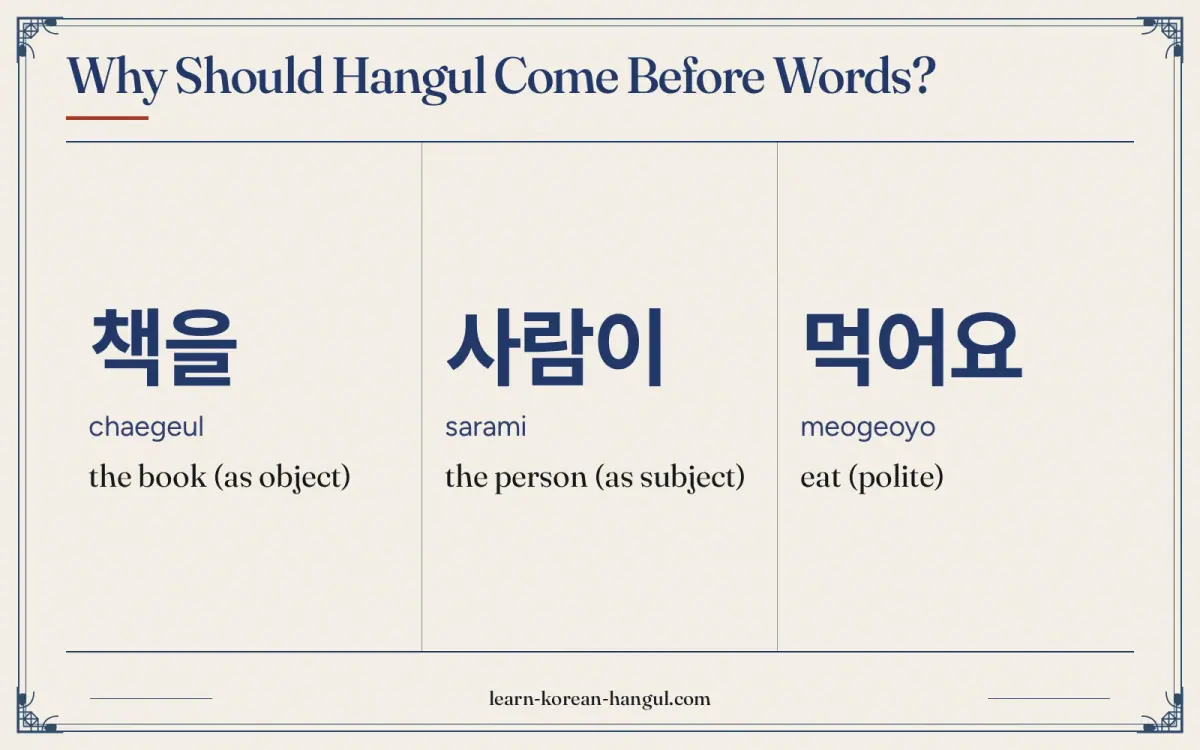
Hangul should come before words because every word you learn in romanization must later be relearned in Hangul, and romanization teaches some wrong sounds along the way. Four reasons make the case.
Romanization Hides Korean Sounds
Romanization means writing Korean in Latin letters. South Korea's official system is Revised Romanization (국어의 로마자 표기법), introduced by the Ministry of Culture and Tourism in 2000. It is useful for signs and passports, but it was not designed to teach pronunciation to English speakers. Three examples show the problem:
| Hangul | Romanization | What English readers often say | What Korean actually has |
|---|---|---|---|
| 서울 | Seoul | "soul", one syllable | Two syllables: 서 + 울 |
| ㅓ | eo | "e-oh", two vowels | One open vowel, between "uh" and "aw" |
| ㅡ | eu | "ew" or "you" | One vowel with flat, spread lips |
Romanization also makes the consonant contrast easy to overlook. 달 (moon), 탈 (mask) and 딸 (daughter) are romanized "dal", "tal" and "ttal". An English reader sees "d" and "t" and assumes the English sounds, which do not match the Korean plain, aspirated and tense consonants. In Hangul, the letters ㄷ, ㅌ and ㄸ make the three-way difference visible at a glance.
To see the limits in detail, read how Korean romanization works.
One Word, Several Spellings
Romanized Korean is not consistent across sources. The same word can appear in several spellings:
- 부산 is "Busan" in Revised Romanization but "Pusan" in the older McCune-Reischauer system, which South Korea used before 2000.
- 강남 is "Gangnam" today and "Kangnam" in older maps and books.
- The surname 이 is "I" in Revised Romanization, but most people write it "Lee", "Yi" or "Rhee".
Revised Romanization also follows pronunciation, not spelling, in many words. 종로, a Seoul district, is romanized "Jongno" because it is pronounced [종노]. If you learned "Jongno", you would not know the second syllable is spelled 로.
Hangul has one standard spelling for each word, set by the National Institute of Korean Language (국립국어원) in its orthography rules (한글 맞춤법). Learning that one spelling is simpler than juggling several romanized ones.
Resources Assume You Can Read
Almost every serious Korean resource assumes you can read Hangul. Popular textbook series, grammar references such as Korean Grammar in Use and Korean dictionaries present Korean in Hangul, and many stop showing romanization after the first chapters. Subtitles, menus, signs, song lyrics and websites are in Hangul.
If you skip Hangul, you lock yourself into the small set of resources that romanize everything. That set runs out at the beginner level, usually within a few weeks.
Hangul Shows How Grammar Attaches
Hangul makes Korean grammar visible, and romanization hides it. Korean attaches particles and endings directly to words, and Hangul spelling keeps the word and the ending recognisable. Romanization follows the sound, so the boundary disappears.
| Hangul | Parts | Romanization | Meaning |
|---|---|---|---|
| 책을 | 책 (book) + 을 (object particle) | chaegeul | the book (as object) |
| 사람이 | 사람 (person) + 이 (subject particle) | sarami | the person (as subject) |
| 먹어요 | 먹 (eat) + 어요 (polite ending) | meogeoyo | eat (polite) |
In "chaegeul", a learner cannot see that the word is 책 plus 을. In Hangul, the block 책 stays intact, and the particle 을 sits beside it. This matters from your first grammar lesson, because particles are taught by showing which ending follows which kind of word.
Hangul Takes Days, Not Months
Hangul is fast, so putting it first costs very little time. It has 24 basic letters (14 consonants and 10 vowels), and the shapes follow a logical design. Most learners recognise every basic letter after a few hours and read simple words after one to two weeks. Plan your week with how long Hangul takes, which breaks the timeline into stages.
Put these four reasons together and the trade is clear: one or two weeks of alphabet work saves months of relearning. But can you skip that week entirely?
Can You Learn Korean without Hangul?
You can learn a few spoken phrases without Hangul, but you cannot learn Korean beyond a basic level without it. Audio-only courses and phrasebooks can teach greetings, numbers and polite requests by ear. That works for a short trip.
The limits show up quickly:
- You cannot check spelling. A word you heard as "kamsahamnida" is written 감사합니다. Without Hangul you cannot look it up in a Korean dictionary.
- You cannot read the environment. Menus, station signs and product labels in Korea are mostly in Hangul.
- You cannot follow grammar explanations. Particles and endings are taught in Hangul, because the spelling shows how they attach.
- You cannot use subtitles. Korean subtitles, a major learning tool for drama fans, are in Hangul.
In short, skipping Hangul caps your level. Starting with romanization and switching later has a cost of its own.
What Does a Romanization-First Start Cost Later?
A romanization-first start costs you relearning time and a set of pronunciation habits that are hard to break. Consider a typical case: a learner spends a month learning 200 words from a romanized list, then decides to learn Hangul.
That learner now has three extra jobs:
- Relearn every spelling. Each of the 200 words must be matched to its Hangul form. Words like "sarang" (사랑, love) are easy; words with sound changes, such as "hangugeo" for 한국어, do not show where one block ends and the next begins.
- Unlearn sounds. Words learned as "eo" or "u" or "d" were practised with English sounds. Fixing a sound you have repeated a hundred times takes longer than learning it correctly once.
- Change study tools. Romanized flashcards must be rebuilt, and the learner must switch to Hangul textbooks anyway.
A learner who spent the first week on Hangul and then learned the same 200 words would likely finish with correct spellings and fewer sound errors, in about the same total time. That is the practical case for putting the alphabet first. The next question is how to time letters against your first words.
Is It Better to Learn Hangul or Vocabulary First?
Learn Hangul first and vocabulary second, but overlap them from the third day. Once you know the six simple vowels and ten basic consonants, you can read real words, so vocabulary practice turns into reading practice too.
Here is how the overlap works in practice:
- Days 1 to 2: letters only. Learn vowels, then basic consonants.
- Days 3 to 7: letters plus words. Learn new letters and read 5 to 10 words that use them, such as 나비 (butterfly) or 바다 (sea).
- Week 2 onward: words in Hangul only. Add greetings such as 안녕하세요 (hello) and loanwords such as 커피 (coffee).
Expert tip: the first words you learn should use only letters you already know. A word list that jumps ahead of your alphabet sends you back to romanization. There are a few cases where postponing Hangul is reasonable, though, and they are worth knowing.
When Can You Skip Hangul for Now?
You can postpone Hangul in three situations: a very short trip, a speaking-first heritage learner, and very young children. In each case Hangul still comes later; it is postponed, not dropped.
A Short Trip with Survival Phrases
If you are visiting Korea for a few days and only want 10 to 20 survival phrases, learning by ear is fine. Phrases like 안녕하세요 (hello) and 감사합니다 (thank you) can be memorised from audio. Even so, learning to read just the vowels and basic consonants (one or two evenings) helps you read station names and signs.
Speaking-First Heritage Learners
Heritage learners who grew up hearing Korean may already understand a lot and want to talk with family first. Starting with conversation is reasonable for them. They should add Hangul within the first months, because spelling, formal speech and reading are usually the skills heritage learners lack.
Very Young Children
Young children who cannot yet read in their first language learn Korean best through songs, games and speech. Hangul can follow when they begin reading at school age, typically with a few letters a week.
If none of these describe you, Hangul comes first. The next step is choosing the order of the letters.
In What Order Should You Learn the Letters?
Learn the letters in this order: simple vowels, basic consonants, syllable blocks, aspirated consonants, tense (double) consonants, y-vowels and compound vowels, and finally batchim (final consonants). Each step builds on shapes and sounds you already know.
| Step | Letters | Why this position |
|---|---|---|
| 1. Simple vowels | ㅏ ㅓ ㅗ ㅜ ㅡ ㅣ | Every syllable needs a vowel; start here |
| 2. Basic consonants | ㄱ ㄴ ㄷ ㄹ ㅁ ㅂ ㅅ ㅇ ㅈ ㅎ | Combined with step 1, you can read real words |
| 3. Syllable blocks | Vertical and horizontal layouts | Teaches the reading order inside a block |
| 4. Aspirated consonants | ㅋ ㅌ ㅍ ㅊ | Built by adding a stroke to known letters |
| 5. Tense consonants | ㄲ ㄸ ㅃ ㅆ ㅉ | Built by doubling known letters |
| 6. Y-vowels and compound vowels | ㅑ ㅕ ㅛ ㅠ, ㅐ ㅔ, ㅘ ㅝ ㅢ and others | Built from simple vowels |
| 7. Batchim | Final consonants | Needs every earlier step |
The usual first lesson is the vowel ㅏ, a vertical line with a short stroke to the right. The most common mistake is starting with the full consonant chart: 19 consonants in one sitting is too many to retain. Once you have an order for the letters, the next decision is how to divide your time among reading, writing and typing.
Reading, Writing and Typing: Which First?
Learn to read first, then write, then type. Reading is the skill every lesson depends on. Writing and typing reinforce reading but are not required to start.
| Skill | When to start | Why |
|---|---|---|
| Reading | Day 1 | Needed for every lesson, dictionary and subtitle |
| Handwriting | Week 1 or 2 (optional) | Helps some learners remember shapes; teaches stroke order |
| Typing | Week 2 or later | Needs letter recognition first; used for messaging and dictionaries |
Handwriting can follow later with our lessons on writing Hangul, which cover stroke order and block proportions. Typing comes after reading; see typing in Korean when you are ready to set up a keyboard. If you want instant feedback while you learn the letters, practise with the interactive Hangul alphabet tool. Many learners finish the alphabet but keep leaning on romanization, which is the next problem to solve.
Moving off Romanization after You Learn Hangul
Moving off romanization takes deliberate steps, because the habit is comfortable. If you learned Hangul but still read the romanized line first, try this sequence over two weeks:
- Hide the romanization. Turn off romanization in apps and cover it in books.
- Rewrite your flashcards. Put only Hangul on the front, with audio. Keep romanization off the card.
- Read before you listen. Read a word aloud, then play the audio to check.
- Accept slow reading. Slow Hangul reading is still faster progress than quick romanized reading.
You will know it worked when you read a new word in Hangul and the romanization never comes to mind. A few other mistakes are common at this stage.
Common Mistakes When Starting with Hangul
The most common mistakes when starting with Hangul are learning all the letters in one sitting, skipping audio, and treating romanization as the pronunciation. Here is each mistake with its fix:
- Learning all 40 letters in one go. You recognise them on the day and forget half by the weekend. Fix: learn a few letters a day with review.
- Learning letters without audio. You guess the sounds from English. Fix: play each letter and word, every time.
- Learning letter names instead of sounds. Names such as 기역 are useful later but slow you down now. Fix: learn the sound first.
- Postponing words. Letters without words feel abstract. Fix: read real words from day three.
- Copying romanization habits into Hangul. For example, reading 서울 as one syllable. Fix: say each block as one syllable.
Each mistake costs days, not months, but they add up. Avoiding them keeps the Hangul-first route as short as it should be.
What This Advice Does Not Cover
This page gives a sequencing recommendation for adult learners whose goal goes beyond a few phrases. It is based on how Korean resources are written and how Revised Romanization works, not on a study comparing learners who did and did not start with Hangul. The one-to-two-week estimate is typical for self-learners who practise 20 to 40 minutes a day with audio; learners who are new to any alphabet, or who study less often, may need longer. Pronunciation still has to be learned by listening, whichever script you read.
The Bottom Line
Should I learn Hangul first? Yes. For almost every learner, one to two weeks on Hangul replaces romanization, which is inconsistent and hides key sounds, and makes every textbook and dictionary usable. Two nuances matter: short-trip travellers and very young children can postpone it, and you should start reading real words from day three rather than finishing the whole alphabet first. Ready? Start the Korean alphabet now, or follow the 7-day Hangul course if you prefer a schedule.
Frequently Asked Questions
Should I learn the Korean letter names?
Not in the first week. Reading needs only the sound of each letter. The names, such as 기역 for ㄱ and 시옷 for ㅅ, become useful when a teacher spells a word aloud or a grammar book explains a rule by letter name. Most learners pick them up in weeks two to four without special effort.
Does learning Hangul help my pronunciation?
Yes. Hangul shows differences that romanization blurs, such as plain ㄷ, aspirated ㅌ and tense ㄸ, or the vowels ㅓ and ㅗ. Seeing the right letter reminds you which sound to make. Hangul does not replace listening, though; pair every new word with audio so your ear learns what your eyes see.
Do Koreans use romanization themselves?
Only in limited places. Koreans use romanization on road signs, station names, passports and brand names for foreign visitors. Korean speakers almost never read or write Korean in romanization among themselves. Texts, menus, subtitles and websites for Korean readers use Hangul, so romanization will not help you read everyday Korean.
How many Hangul letters do I need to start reading words?
About 16. With the six simple vowels (ㅏ ㅓ ㅗ ㅜ ㅡ ㅣ) and ten basic consonants, you can read many real words, such as 나비 (butterfly), 바다 (sea) and 고기 (meat). The remaining letters build on these shapes, so each new letter immediately opens more words you can read.