
Use the Interactive Hangul Alphabet

What Goes in and What Comes Out?
The interactive alphabet takes one letter choice plus two settings and returns a detail panel for that letter.
| Input | Type | Allowed values | Default | Validation |
|---|---|---|---|---|
| Letter | grid of 40 buttons | any of the 40 letters | none selected | not needed; every button is valid |
| Filter | chip group | all, consonants, vowels, tense, aspirated, compound | all | one filter at a time |
| Show romanization | switch | on / off | on | none |
| Output | Content | Display |
|---|---|---|
| Glyph | the letter in large type | lang="ko" |
| Name | traditional name, e.g. 기역 | Hangul, with RR when the switch is on |
| Romanization | RR at the start and end of a block, e.g. g / k | small line, hidden when the switch is off |
| Sound hint | plain-English description, no IPA | one or two sentences |
| Position notes | how the letter behaves at the start or end of a block | short list |
| Example words | three words with audio buttons | Hangul, RR, English meaning |
| Links | lesson page and stroke-order demo | text links |
The filters show these sets: consonants (19), vowels (21), tense consonants (ㄲ ㄸ ㅃ ㅆ ㅉ), aspirated consonants (ㅋ ㅌ ㅍ ㅊ) and compound vowels (11, from ㅐ to ㅢ).
What Happens with Empty, Wrong or Unusual Input?
Wrong input is impossible, because you can only pick from the 40 letters. These states are handled on purpose:
| Situation | What the tool does |
|---|---|
| Nothing selected yet | The panel says "Choose a letter" |
| A word has no approved recording | Its play button is hidden and "no recording yet" appears |
| Audio fails to load | "Audio unavailable; try again" appears; the text stays |
| JavaScript is off | The static letter chart with names and romanization renders instead |
| You open ㅐ or ㅔ | A note says the two "sound the same for many speakers" |
| A filter leaves the grid short | Only matching letters show; the count is announced |
What Stays Private, and How Accessible Is It?
Everything happens in your browser, and nothing you tap is sent to a server. The only thing saved is the romanization setting, in your browser's local storage. The grid is a set of real buttons inside a labelled table: Tab enters it, the arrow keys move between letters, and Enter or Space opens the detail panel. The panel updates in a polite live region, so a screen reader announces "ㄱ, giyeok, sounds like g at the start and k at the end." Audio never plays by itself, and there are no timers.
The steps below turn these inputs into a short study routine.
How Do I Use the Interactive Hangul Alphabet?
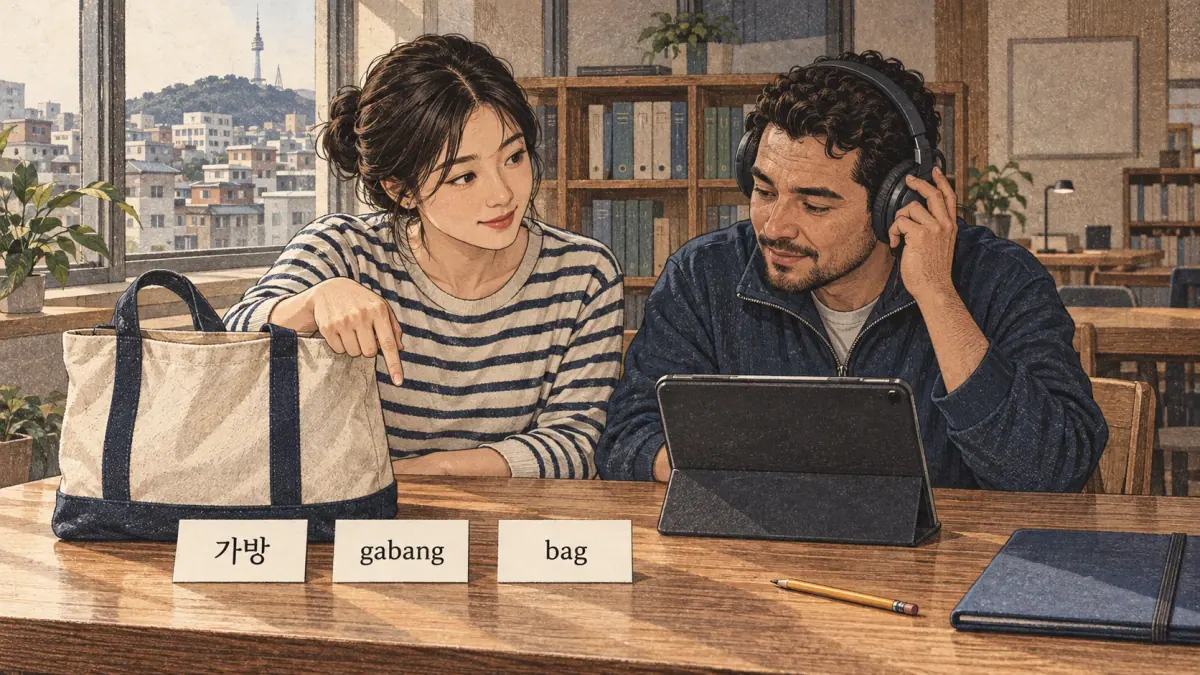
Use the tool in five steps. Each step has a result you can check.
- Choose a filter. Start with "consonants". Expected result: the grid shows 19 letters and hides the vowels.
- Tap a letter. Try ㄱ. Expected result: the panel shows 기역, giyeok, the sounds g and k, and three words.
- Play the example words. Press each speaker. Expected result: you hear 가방, 고기 and 학교, one at a time.
- Read the position notes. Expected result: you learn that ㄱ sounds like g at the start of a block and like k at the end.
- Turn off romanization. Expected result: only Hangul remains. Repeat steps 2–4 and try to say the name before you look.
A common mistake is to learn only the letter names. The name 기역 is how you spell ㄱ aloud; the sound in words is g or k. Learn both, as the panel shows them side by side.
The next section explains where each result in the panel comes from.
How Does the Tool Get Its Results?

The interactive alphabet reads from one fixed letter dataset, not from a calculation. Four rules shape what the panel says.
- The dataset. It holds 19 consonants and 21 vowels, 40 letters in total, each with its traditional South Korean name as given in the Hangul Orthography (한글 맞춤법, article 4) of the National Institute of Korean Language (NIKL). Vowel names are the vowel written with a silent ㅇ, such as 오 for ㅗ.
- The ㅇ rule. ㅇ is silent in the first slot of a block and sounds like ng in the final slot, so 아 is just "a" and 강 ends in ng.
- The seven final sounds. The Standard Pronunciation rules (표준 발음법, article 8) allow only ㄱ ㄴ ㄷ ㄹ ㅁ ㅂ ㅇ as final sounds. This merging is called neutralization (평파열음화 for the stop sounds). For example, ㅅ, ㅈ, ㅊ, ㅌ and ㅎ all end as a t-like sound, so the panel lists "end: t" for each of them.
- Plain-English hints. Sound descriptions use English comparisons, not the International Phonetic Alphabet (IPA), and romanization follows the Revised Romanization of Korean (Ministry of Culture and Tourism, 2000).
Three worked examples show how these rules appear in the panel.
Worked Example: ㄱ
Tapping ㄱ shows the name 기역 (giyeok). The romanization reads g / k: g at the start of a block, k at the end. The example words are 가방 (gabang, bag), 고기 (gogi, meat) and 학교 (hakgyo, school). Read the panel this way: the first ㄱ in 학교 is a final, so it is a short, unreleased k; the second starts a block and is said tense, so the word sounds like [학꾜].
Worked Example: ㅇ
Tapping ㅇ shows the name 이응 (ieung). The romanization reads "silent / ng". The example words are 아이 (ai, child), 강 (gang, river) and 사랑 (sarang, love). In 아이 both ㅇ letters are silent; in 강 the final ㅇ is the ng sound. One shape, two jobs.
Worked Example: ㅐ
Tapping ㅐ shows the name 애 (ae) and the hint "like the e in bed". The example words are 개 (gae, dog), 배 (bae, stomach or pear) and 새 (sae, bird). The panel adds that ㅐ and ㅔ sound the same for most speakers today, so 개 and 게 (crab) are told apart by context and spelling, not by sound.
With the rules clear, it helps to place the tool among the other ways to learn letters.
What Is the Interactive Hangul Alphabet Used For?

The interactive hangul alphabet is a letter explorer: one letter at a time, with every attribute a beginner needs on one screen. The table compares it with the site's other letter resources.
| Resource | What it shows | Best for |
|---|---|---|
| Interactive alphabet (this tool) | one letter in depth: name, RR, hint, positions, 3 words, audio | first contact with each letter |
| Hangul chart | all 40 letters at once in a printable table | overview and quick review |
| Hangul flashcards | one prompt per card, with saved review progress | memorising over days |
| Korean alphabet lessons | how the letters were designed and combine | understanding the system |
The tool groups letters the way the lessons do. The Korean consonants lessons cover plain, aspirated and tense sets; the Korean vowels lessons cover basic and compound vowels.
Each resource has limits, and the tool's own limits come next.
When Should I Use This Tool, and When Not?

Use the interactive alphabet when you meet a letter for the first time or want to check one quickly. It fits these jobs:
- learning the 40 names and their start and end sounds;
- hearing three real words for each letter;
- comparing similar letters, such as ㄱ, ㅋ and ㄲ, with the filters.
Do not rely on it for these jobs:
- Exact sounds. English hints are approximate. ㅓ, ㅡ and the tense consonants have no English match, so the audio, not the hint, is the guide.
- Checking your own voice. The tool has no microphone input and gives no pronunciation score.
- Sound changes between blocks. Liaison, the moving of a final consonant to the next block, is not shown: 한국어 is said [한구거], but the alphabet only shows letters alone. The Korean syllable blocks lesson and the pronunciation lessons cover this.
- Reviewed audio. The example recordings are generated and await review by a Korean specialist.
Expert tip: learners often treat ㅐ and ㅔ as a listening problem and spend hours on it. Learn the spelling of each word instead; many native speakers also tell 개 and 게 apart by spelling, not by ear.
The reference table below holds the same data the tool uses, for reading without JavaScript.
Reference Table
This table mirrors the tool's dataset. "Start / end" shows the Revised Romanization at the start and end of a block.
| Korean | Name | Romanization | Family | Sound |
|---|---|---|---|---|
| ㄱ | 기역 (giyeok) | g / k | plain | g in "go", softer at the start of a word |
| ㄴ | 니은 (nieun) | n / n | other | n in "no" |
| ㄷ | 디귿 (digeut) | d / t | plain | d in "do" |
| ㄹ | 리을 (rieul) | r / l | other | quick tap between r and d |
| ㅁ | 미음 (mieum) | m / m | other | m in "me" |
| ㅂ | 비읍 (bieup) | b / p | plain | b in "boy" |
| ㅅ | 시옷 (siot) | s / t | plain | s in "sun" |
| ㅇ | 이응 (ieung) | none / ng | other | silent |
| ㅈ | 지읒 (jieut) | j / t | plain | j in "jam" |
| ㅊ | 치읓 (chieut) | ch / t | aspirated | ch in "cheese" with a puff |
| ㅋ | 키읔 (kieuk) | k / k | aspirated | k in "kite" with a puff |
| ㅌ | 티읕 (tieut) | t / t | aspirated | t in "top" with a puff |
| ㅍ | 피읖 (pieup) | p / p | aspirated | p in "pin" with a puff |
| ㅎ | 히읗 (hieut) | h / t | other | h in "hat" |
| ㄲ | 쌍기역 (ssanggiyeok) | kk / k | tense | k with a tight throat |
| ㄸ | 쌍디귿 (ssangdigeut) | tt / none | tense | t with a tight throat |
| ㅃ | 쌍비읍 (ssangbieup) | pp / none | tense | p with a tight throat |
| ㅆ | 쌍시옷 (ssangsiot) | ss / t | tense | s said with tension |
| ㅉ | 쌍지읒 (ssangjieut) | jj / none | tense | j with a tight throat |
| ㅏ | 아 | a | basic | a in "father" |
| ㅑ | 야 | ya | basic | ya in "yacht" |
| ㅓ | 어 | eo | basic | between u in "cup" and aw in "law" |
| ㅕ | 여 | yeo | basic | y + ㅓ |
| ㅗ | 오 | o | basic | o in "go", shorter and pure |
| ㅛ | 요 | yo | basic | yo in "yoga" |
| ㅜ | 우 | u | basic | oo in "moon" |
| ㅠ | 유 | yu | basic | "you" |
| ㅡ | 으 | eu | basic | oo in "moon" with lips spread |
| ㅣ | 이 | i | basic | ee in "see" |
| ㅐ | 애 | ae | compound | e in "bed" |
| ㅒ | 얘 | yae | compound | ye in "yes" |
| ㅔ | 에 | e | compound | e in "bed" |
| ㅖ | 예 | ye | compound | ye in "yes" |
| ㅘ | 와 | wa | compound | "wah" |
| ㅙ | 왜 | wae | compound | we in "wet" |
| ㅚ | 외 | oe | compound | we in "wet" |
| ㅝ | 워 | wo | compound | "wuh" |
| ㅞ | 웨 | we | compound | we in "wet" |
| ㅟ | 위 | wi | compound | "wee" |
| ㅢ | 의 | ui | compound | ㅡ gliding into ㅣ |
| Letter | Name | Start / end | Sound hint | Example word |
|---|---|---|---|---|
| ㄱ | 기역 | g / k | g in "go"; k at the end | 가방 (bag) |
| ㄲ | 쌍기역 | kk / k | tight k, no puff | 꽃 (flower) |
| ㄴ | 니은 | n / n | n in "no" | 나무 (tree) |
| ㄷ | 디귿 | d / t | d in "do"; t at the end | 다리 (leg) |
| ㄸ | 쌍디귿 | tt / – | tight t, no puff | 딸 (daughter) |
| ㄹ | 리을 | r / l | between r and l; l at the end | 라면 (instant noodles) |
| ㅁ | 미음 | m / m | m in "me" | 물 (water) |
| ㅂ | 비읍 | b / p | b in "boy"; p at the end | 바다 (sea) |
| ㅃ | 쌍비읍 | pp / – | tight p, no puff | 빵 (bread) |
| ㅅ | 시옷 | s / t | s in "sun"; t at the end | 사람 (person) |
| ㅆ | 쌍시옷 | ss / t | tense s | 쌀 (rice) |
| ㅇ | 이응 | silent / ng | silent; ng in "sing" | 아이 (child) |
| ㅈ | 지읒 | j / t | j in "jam"; t at the end | 집 (house) |
| ㅉ | 쌍지읒 | jj / – | tight j, no puff | 짜다 (salty) |
| ㅊ | 치읓 | ch / t | ch with a strong puff | 차 (car, tea) |
| ㅋ | 키읔 | k / k | k with a strong puff | 코 (nose) |
| ㅌ | 티읕 | t / t | t with a strong puff | 토끼 (rabbit) |
| ㅍ | 피읖 | p / p | p with a strong puff | 포도 (grapes) |
| ㅎ | 히읗 | h / t | h in "hat" | 하나 (one) |
| ㅏ | 아 | a | a in "father" | 아기 (baby) |
| ㅐ | 애 | ae | e in "bed" | 개 (dog) |
| ㅑ | 야 | ya | ya in "yard" | 야구 (baseball) |
| ㅒ | 얘 | yae | ye in "yes" | 얘기 (talk) |
| ㅓ | 어 | eo | u in "cup", mouth open | 어머니 (mother) |
| ㅔ | 에 | e | e in "bed" | 네 (yes) |
| ㅕ | 여 | yeo | yu in "yum", mouth open | 여자 (woman) |
| ㅖ | 예 | ye | ye in "yes" | 예 (yes, formal) |
| ㅗ | 오 | o | o in "go", lips round | 오이 (cucumber) |
| ㅘ | 와 | wa | wa in "wand" | 사과 (apple) |
| ㅙ | 왜 | wae | we in "wet" | 왜 (why) |
| ㅚ | 외 | oe | we in "wet" for most speakers | 회사 (company) |
| ㅛ | 요 | yo | yo in "yoga" | 요리 (cooking) |
| ㅜ | 우 | u | oo in "moon" | 우유 (milk) |
| ㅝ | 워 | wo | wo in "won" | 뭐 (what) |
| ㅞ | 웨 | we | we in "wet" | 웨이터 (waiter) |
| ㅟ | 위 | wi | wee in "week" | 귀 (ear) |
| ㅠ | 유 | yu | you | 유리 (glass) |
| ㅡ | 으 | eu | no English match; lips flat | 그 (that) |
| ㅢ | 의 | ui | ㅡ gliding to ㅣ | 의사 (doctor) |
| ㅣ | 이 | i | ee in "see" | 이 (tooth) |
ㄸ, ㅃ and ㅉ never end a block, so their end column shows a dash.
Frequently Asked Questions
Does the alphabet tool play audio for every letter?
Each letter has three example words, and each word plays audio when an approved recording exists. Where a recording is missing, the button is hidden and "no recording yet" appears, so you never press a dead button. All recordings are generated by text-to-speech and await review by a Korean specialist before they count as reviewed.
Can I use the tool without romanization?
Yes. Turn off the "Show romanization" switch and the panel shows only Hangul: the letter, its name and the example words. Your choice is saved in your browser for the next visit. Learning without romanization early helps, because Revised Romanization cannot show sounds such as ㅓ or the tense consonants exactly.
How is it different from the Hangul charts?
The Hangul chart shows all 40 letters at once in one printable table, which suits overview and review. The interactive alphabet shows one letter in depth: its name, start and end sounds, position notes, three example words with audio and links to its lesson. Use the chart to scan and the tool to study.
Does it show stroke order?
The detail panel links each letter to its stroke-order demo, which shows the strokes one by one with numbered steps written as text. The stroke order matches the site's stroke-order lessons, and the demo needs no audio. For full handwriting practice, including whole blocks, use the Hangul stroke order lessons in the writing section.
Is the interactive hangul alphabet free?
Yes. The interactive hangul alphabet is free, needs no sign-up and has no account. It runs in your browser, so the letters you tap are never sent to a server. The only thing it saves is your romanization setting, in your own browser, and clearing your browser data removes it.
Related Tools and Guides
The interactive hangul alphabet is the first stop; these pages take you further. Learn the system behind the letters in the Korean alphabet guide, then turn letters into blocks with the Hangul syllable builder. For handwriting, follow the Hangul stroke order lessons. Print the Hangul chart for daily review, and keep what you learned with Hangul flashcards. This tool sits with the other korean practice tools, and every tool on the site is listed on the korean learning tools hub.