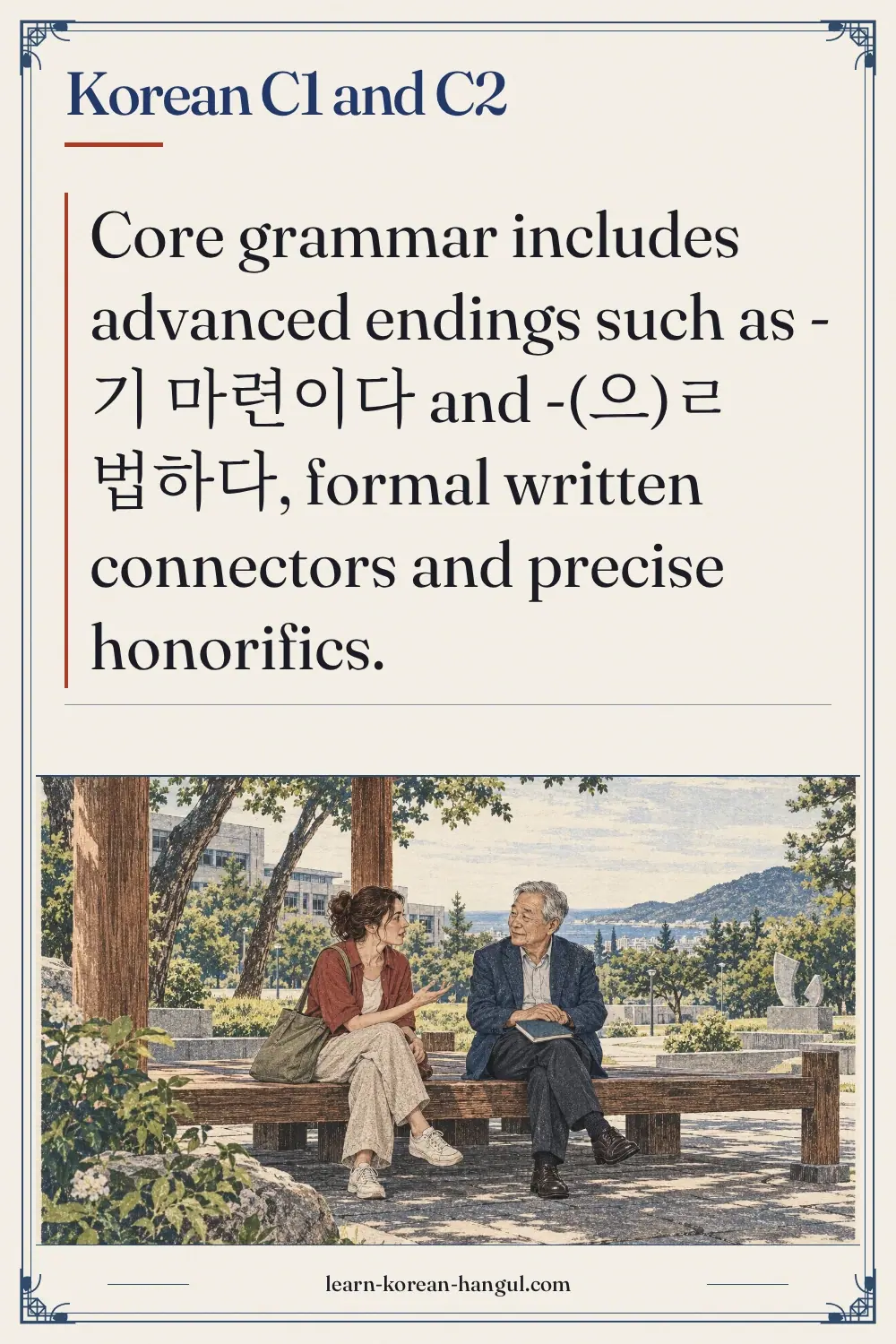
This page covers C1 and C2 together. For how they fit among all six bands, see the Korean language levels overview.
What Is Korean C1/C2?
Korean C1 and C2 are levels of ability, not tests or certificates. The CEFR is a scale published by the Council of Europe that describes language ability in six bands. C1 and C2 are the "proficient user" group: C1 is effective, flexible use of the language, and C2 is mastery close to an educated native speaker.
A C1 learner can understand a wide range of demanding, longer texts and recognise implicit meaning. The speaker can express ideas fluently and spontaneously, use the language flexibly for social, academic and professional purposes, and produce clear, well-structured text on complex subjects. In Korean, this means the learner moves between 해요체 (haeyoche, polite), 합니다체 (hamnidache, formal) and 반말 (banmal, casual) according to the relationship, uses honorific and humble verbs correctly, and understands idioms and word play.
C2 goes beyond C1 in subtlety. A C2 learner understands virtually everything heard or read, and expresses fine shades of meaning even in complex situations. Few learners need C2, and no standard Korean test certifies it.
One caution applies to every claim on this page. No official body issues a "Korean C1" or "Korean C2" certificate. Korea's own systems use different labels, such as the TOPIK levels and the numbered levels of the International Standard Curriculum for Korean from the National Institute of Korean Language (국립국어원). Mappings between them are approximate.
What Can You Do in Korean at C1/C2?
At C1, you can use Korean as a working language in study or at a job. The checklist uses "I can" statements. If you can do most of them without notes, you are working at C1. If several are missing, review the previous level (B2).
Speaking and interaction
- I can follow a debate or a lecture and note its main arguments.
- I can adjust speech level and honorifics to the person and the setting without hesitation.
- I can explain an idiom or a four-character expression (사자성어) in Korean.
- I can speak at length on an abstract topic with a clear structure.
Listening, reading and writing
- I can follow fast drama dialogue, news and lectures without subtitles.
- I can read editorials and longer essays and recognise the writer's attitude.
- I can write formal reports, emails and essays in the right register.
Example: a four-character expression packs a whole idea into four syllables. 일석이조 means getting two benefits from one action, literally "one stone, two birds".
How Does C1/C2 Compare with TOPIK?
TOPIK II levels 5 and 6 are the closest TOPIK range to C1, and the mapping is unofficial. TOPIK (Test of Proficiency in Korean) has two papers: TOPIK I covers levels 1 and 2, and TOPIK II covers levels 3 to 6. TOPIK II has a maximum of 300 points over listening, writing and reading, and the published cut scores are 190 points for level 5 and 230 points for level 6. Confirm current cut scores on the official TOPIK site (topik.go.kr) before relying on them.
| Scale | Label | Rough match to C1/C2 |
|---|---|---|
| CEFR | C1 (advanced) | The reference point on this page |
| CEFR | C2 (mastery) | Above the top TOPIK level |
| TOPIK | TOPIK II, levels 5-6 (about 190+ of 300) | Closest range for C1, unofficial |
| NIKL standard curriculum | Advanced levels | Roughly aligned, check the curriculum |
A high TOPIK score confirms advanced reading, listening and writing, but it says nothing about spoken ability or pragmatics, that is, using the right tone for the right person. The standard TOPIK II has no speaking section (a separate speaking test exists). A C1 learner should therefore check speaking and register by other means, as the sample tasks below show. Read how TOPIK scores levels before treating the scales as equal.
With the level defined, the next question is what grammar it requires.
Grammar You Need for Korean C1/C2
Korean C1 grammar is less about new endings and more about nuance: tendencies, plausibility, results of excess, degree and a firm control of register. The inventory below is a working list of the patterns that matter most at this stage.
| Pattern | Meaning | Example |
|---|---|---|
| -기 마련이다 | Be bound to, naturally tends to | 사람은 누구나 실수하기 마련이다. (Everyone is bound to make mistakes.) |
| -(으)ㄹ 법하다 | It would be natural, it is plausible | 화가 날 법도 한데 그는 웃기만 했다. (He had reason to be angry, but he only smiled.) |
| -(으)ㄴ 나머지 | As a result of too much | 너무 긴장한 나머지 말이 나오지 않았다. (He was so nervous that no words came out.) |
| -(으)ㄹ수록 | The more, the more | 읽을수록 이해가 깊어진다. (The more you read, the deeper the understanding grows.) |
| Honorific and humble verbs | Respect the other person | 할아버지께서 방에 계십니다. 사장님께 여쭤보겠습니다. |
| Formal written connectors | Link ideas in reports | 반면에 (whereas), 따라서 (therefore), 오히려 (rather) |
Listen for the sound changes. After the -(으)ㄹ ending, the next consonant is tense, so 날 법도 is spoken [날뻡또]. The word 일석이조 is spoken [일써기조]: in Sino-Korean words, ㄹ makes only a following ㄷ, ㅅ or ㅈ tense, and the final ㄱ of 석 moves across to 이. The spelling does not always show the sound, so the audio is part of the lesson.
Honorifics and Humble Forms
At C1, the honorific system must work without thought. Honorific verbs raise the person you talk about: 있다 becomes 계시다 (할아버지께서 계십니다), 먹다 becomes 드시다 or 잡수시다, and 자다 becomes 주무시다. Humble verbs lower yourself: 주다 becomes 드리다 and 묻다 (to ask) becomes 여쭙다. A C1 speaker also knows that these forms are tied to the relationship, not to age alone. A common slip is using the humble 드리다 for a gift to a friend, where 주다 is natural.
Nuance Among near-Synonyms
Korean often has a native word and a Sino-Korean word with nearly the same meaning but a different register. Native words feel plain and warm, and Sino-Korean words feel formal and written. Choosing between them is a C1 skill.
| Native word | Sino-Korean word | Where the Sino-Korean word fits |
|---|---|---|
| 나이 (age) | 연령 | Forms, statistics, official documents |
| 이름 (name) | 성명 | Applications and legal papers |
| 나라 (country) | 국가 | News, essays, law |
| 밥 (meal) | 식사 | Formal invitations, menus |
Grammar needs words, so the next section turns to vocabulary.
Vocabulary at the C1/C2 Stage
A typical C1 learner knows about 8,000 words or more, and this is a typical estimate, not a measured standard. At this level the count matters less than the kind of word, because news, law and academic text use many words that daily speech rarely meets. For a wider discussion, see how many Korean words you need.
Four groups carry most of the new learning:
- Four-character expressions (사자성어): 일석이조 (two gains at once), 고진감래 (joy after hardship), 이심전심 (understanding without words).
- Idioms and proverbs: expressions whose meaning cannot be guessed from the words, such as 발이 넓다 (literally "feet are wide", meaning to know many people).
- Formal and written vocabulary: the Sino-Korean words used in editorials, reports and speeches.
- Word play and register jokes: puns and slang that depend on sound, which also need cultural context.
Hanja (Chinese characters) are not required for reading Korean, but knowing the roots makes formal vocabulary easier. Learning hanja for vocabulary building speeds up advanced reading, because one root such as 학 (study) appears in many words.
Words and grammar come together in the four skills, covered next.
Listening, Reading, Speaking and Writing Targets
At C1, each skill has a specific target. The table sets a target for each, so you can aim practice at the weakest one.
| Skill | C1 target | Practice that helps |
|---|---|---|
| Listening | Follow lectures, news and fast drama dialogue without subtitles | Podcasts, debate shows, lectures with transcripts afterwards |
| Reading | Read editorials, essays and long articles; recognise tone and implication | Daily editorial, one longer essay a week |
| Speaking | Speak at length, adjust register, explain idioms | Weekly tutor session on abstract topics; record and review |
| Writing | Write formal reports and essays in the right register | Weekly formal text with correction by a teacher |
At this stage, the skills that lag are usually productive ones. Reading and listening can reach C1 while speech stays at B2, because speech needs real-time choices of register and word. Work on the lowest skill first.
Sample Tasks You Should Manage
Four tasks test whether your C1 skills work together. Try each one without notes.
- Explain a four-character expression in your own Korean: 일석이조는 한 가지 일로 두 가지 이익을 얻는다는 뜻이다.
- Follow a TV debate and summarise each side in two sentences, for example 한쪽은 규제가 필요하다고 주장했고, 다른 쪽은 반대했다.
- Rewrite a casual message as a formal email. Casual: 내일 회의 못 갈 것 같아. 미안! Formal: 내일 회의에 참석하기 어려울 것 같습니다. 죄송합니다. 자료는 오늘 중으로 보내 드리겠습니다.
- Choose the right verb for the right person. Say that your grandfather is at home (계십니다) and that you will ask your boss (여쭤보겠습니다).
If you can do all four with only a few errors, you are working at C1. If one task fails, that task shows what to practise next.
How Long Does It Take to Reach C1/C2?
Reaching Korean C1 typically takes 2,000 or more cumulative study hours, counted from zero, and the range is rough and depends on method and time. The number is a floor, not a target: C2 has no typical figure, and few learners attempt to measure it.
The assumptions matter:
- Classes versus self-study. Advanced learning needs corrected output. A learner who only listens and reads may sit far above 2,000 hours before speech and writing catch up.
- Prior experience. Knowing Chinese or Japanese helps with Sino-Korean vocabulary and formal registers, though it does not replace Korean grammar.
- Living and working in Korean. Real tasks in Korean supply hours of input and feedback, but only when the learner also studies.
The U.S. Foreign Service Institute (FSI) places Korean in Category IV, its hardest group for native English speakers, at about 88 weeks (2,200 class hours) of full-time training to reach professional working proficiency. That target is close in spirit to C1, though FSI measures it on its own scale. At one hour a day, 2,000 hours is about 66 months (5.5 years). At two hours a day, it is about 33 months. These are arithmetic examples of the stated figure, not predictions for any one learner.
Common Gaps at C1/C2
Four gaps appear even in strong learners, and each has a fix.
| Gap | What it looks like | Fix |
|---|---|---|
| Near-synonym choice | Correct words in the wrong register | Keep pairs lists such as 이름 / 성명 and write one sentence for each |
| Pragmatics | Correct grammar but the wrong tone for the person | Role-play with a tutor: same request to a friend, a boss and a stranger |
| Idioms and humour | Words understood, point missed | Learn expressions from context, with a short story for each |
| Fast, overlapping speech | Dramas and variety shows lose you | Transcribe one minute of a variety show each week |
The register gap is the hardest to see alone, because the learner's own sentence sounds fine. A native speaker or teacher notices that a request is too blunt, or that a humble verb is used for a friend. Record an unscripted five-minute talk and ask a Korean teacher to mark register, not grammar.
Limits of Level Labels
Level labels are rough guides, and they cannot measure a person exactly. C1 describes a pattern of abilities, and a learner can sit at C1 in reading and B2 in speaking at once.
Three limits apply. First, the CEFR is a reference scale, and it does not come from a Korean standard, so Korean-specific features such as speech levels and honorific precision are not directly described. Second, tests like TOPIK measure test performance, and the standard TOPIK II has no speaking section, so a TOPIK 6 score does not show spoken C1. Third, C2 has no standard test, so claims of "C2 Korean" depend on who judges. To check yourself, take the Korean level test and compare the result with the checklist on this page.
What Should You Study after C1/C2?
After C1, the goal shifts from levels to a field: choose a domain such as law, journalism, literature or business and read and write in it every week. Further general study returns less than depth in one area.
When you pass most items on the checklist above, continue with the Korean learning roadmap to plan the next stage. Focus on four things:
- Read one editorial and one longer essay a week in your chosen field.
- Write one formal text a week and have a Korean reader correct it.
- Keep a list of near-synonym pairs with the setting for each.
- Learn hanja roots for the vocabulary of your field.
In short, Korean C1/C2 means you can follow lectures, news and fast dialogue, write formal reports and essays, and choose the right register for every listener, and your next job is depth in the field that matters to you.
Frequently Asked Questions
Can I get an official Korean C1/C2 certificate?
No official certificate carries the label "Korean C1" or "Korean C2". The CEFR is a reference scale, and Korean certificates use their own levels. The nearest official proof for C1 is TOPIK II level 5 or 6. C2 has no standard test, so any C2 claim depends on who judges it.
Is C1/C2 enough for a job in Korea?
C1 supports professional work in Korean, including meetings, reports and client contact, though specialist fields still need their own vocabulary. Requirements differ by employer and visa type, so check the specific job or visa rule. Few roles ask for C2, which has no standard test.
Which textbooks match Korean C1/C2?
Advanced university-institute textbooks cover news, essays and formal writing, but at this level real material matters more: editorials, essays, novels, lectures and debate shows. Publisher labels vary, so use the checklist and grammar table on this page to judge a book rather than its level label.
Is C2 Korean realistic for English speakers?
It is possible but rare. Korean is in the hardest FSI group for English speakers, and C2 needs years of daily use for work or study, plus constant correction of register and nuance. Most learners get more value from a strong C1 in a chosen field than from chasing a C2 label.
How do I test my Korean speaking at C1/C2?
Record an unscripted five-minute talk on an abstract topic and ask a Korean teacher to mark register, word choice and honorifics, not only grammar. TOPIK II does not test speaking on the standard paper, though a separate speaking test exists, so check topik.go.kr for details.