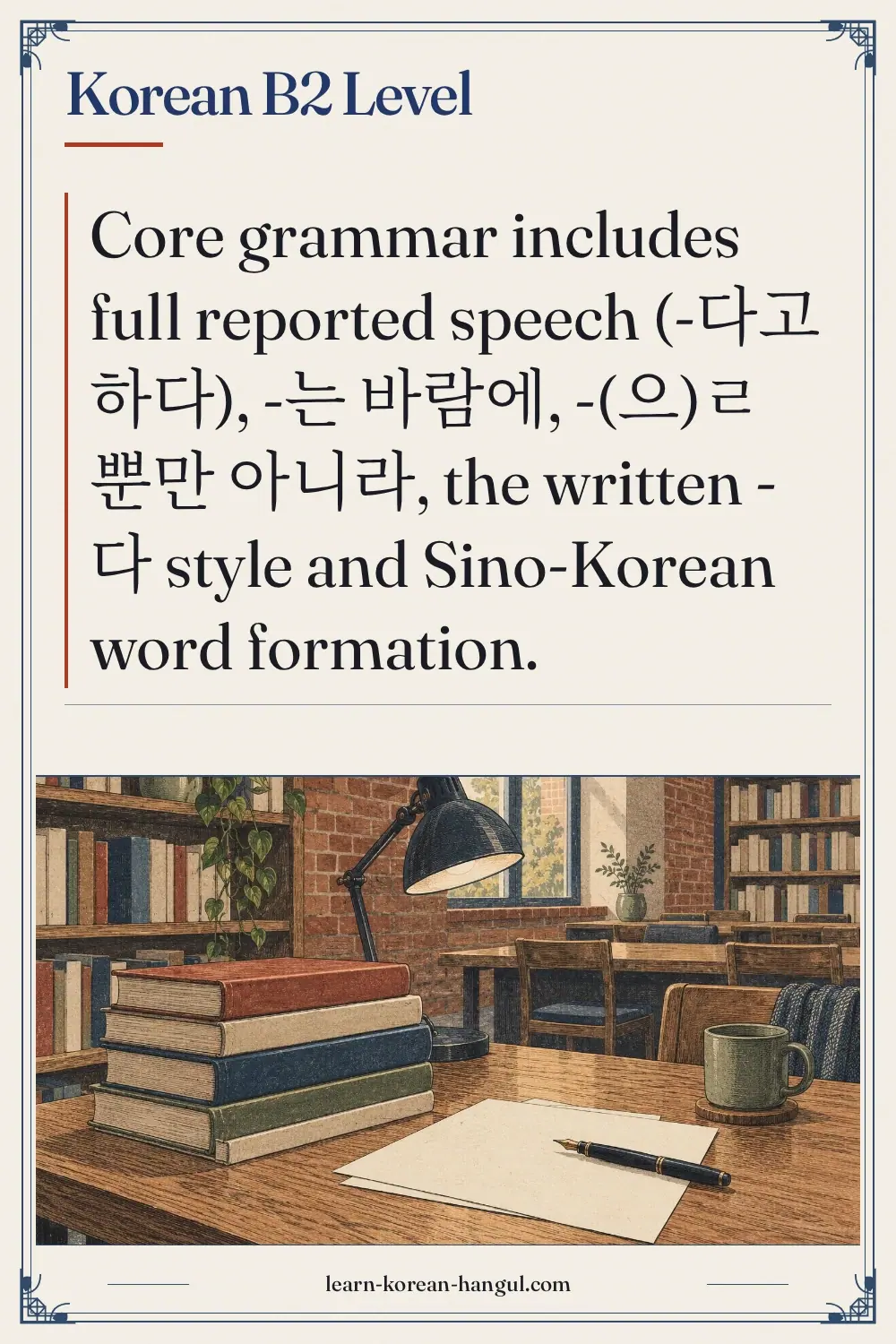
This page covers B2 only. For how B2 fits among all six bands, see the Korean language levels overview.
What Is Korean B2?
Korean B2 is a level of ability, not a test or a certificate. The CEFR is a scale published by the Council of Europe that describes language ability in six bands. B2 sits above B1 (intermediate) and below C1 (advanced), and it is the upper half of the "independent user" group.
A B2 learner can interact with a degree of fluency that makes regular conversation with native speakers possible without strain for either side. The speaker can understand the main ideas of complex text, produce clear detailed text on a wide range of subjects and explain a point of view with the advantages and disadvantages of different options. In Korean, this means 해요체 (haeyoche, the polite -요 style) and 합니다체 (hamnidache, the formal -ㅂ니다/-습니다 style) both work in the right setting, and the written plain style (-다) is readable and writable.
One caution applies to every claim on this page. No official body issues a "Korean B2" certificate. Korea's own systems use different labels, such as the TOPIK levels and the numbered levels of the International Standard Curriculum for Korean from the National Institute of Korean Language (국립국어원). Mappings between them are approximate.
What Can You Do in Korean at B2?
At B2, you can take part in work and study tasks in Korean, not only in daily errands. The checklist uses "I can" statements. If you can do most of them without notes, you are working at B2. If several are missing, review the previous level (B1).
Speaking and interaction
- I can state an opinion in a meeting or class and give two reasons for it.
- I can politely disagree using the formal 합니다체 style.
- I can report what a third person said, including questions and requests.
- I can explain a problem at work or school in clear, connected speech.
Listening, reading and writing
- I can understand most TV news and talk shows on familiar topics without subtitles.
- I can read a news article and give its main points in my own words.
- I can write a structured opinion text of about 600 characters in the written -다 style.
Example: reporting a message uses the reported-speech pattern. 민수 씨가 내일 시간이 없다고 했어요 means "Minsu said he has no time tomorrow."
How Does B2 Compare with TOPIK?
TOPIK II level 4 is the closest TOPIK range to B2, and the mapping is unofficial. TOPIK (Test of Proficiency in Korean) has two papers: TOPIK I covers levels 1 and 2, and TOPIK II covers levels 3 to 6. TOPIK II has a maximum of 300 points over listening, writing and reading, and the published cut score for level 4 is 150 points, with level 5 starting at 190. Confirm current cut scores on the official TOPIK site (topik.go.kr) before relying on them.
| Scale | Label | Rough match to B2 |
|---|---|---|
| CEFR | B2 (upper intermediate) | The reference point on this page |
| TOPIK | TOPIK II, level 4 (about 150-189 of 300) | Closest range, unofficial |
| NIKL standard curriculum | Upper-intermediate levels | Roughly aligned, check the curriculum |
Some Korean universities and employers ask for TOPIK level 4, but the requirement differs by institution, programme and year, so check each admissions or hiring page. The standard TOPIK II has no speaking section (a separate speaking test exists), so level 4 does not prove B2 interaction. A learner who needs to show spoken ability must show it separately, for example in an interview. Read how TOPIK scores levels before treating the two scales as equal.
With the level defined, the next question is what grammar it requires.
Grammar You Need for Korean B2
Korean B2 grammar is about precision and register: reporting what others said, explaining unwanted causes, adding a second point and writing in the plain written style. The inventory below is a working list, and the intermediate grammar list groups the patterns by function.
| Pattern | Meaning | Example |
|---|---|---|
| -다고 하다 (statement) | Report what someone said | 민수 씨가 내일 시간이 없다고 했어요. (Minsu said he has no time tomorrow.) |
| -자고 하다 (suggestion) | Report a suggestion | 친구가 같이 가자고 했어요. (A friend suggested going together.) |
| -(으)라고 하다 (command) | Report a request or order | 의사가 쉬라고 했어요. (The doctor told me to rest.) |
| -는 바람에 | Because of (an unwanted result) | 갑자기 비가 오는 바람에 약속에 늦었어요. (I was late for the appointment because it suddenly rained.) |
| -(으)ㄹ 뿐만 아니라 | Not only, but also | 이 책은 재미있을 뿐만 아니라 값도 싸요. (This book is not only fun but also cheap.) |
| Written -다 style | Plain written register | 환경 문제는 우리 모두의 책임이다. (Environmental problems are everyone's responsibility.) |
| Sino-Korean suffixes -적, -화, -성 | Build abstract words | 가능 (possible) to 가능성 (possibility) |
Listen for the sound changes. In 같이 the written ㅌ is spoken [가치], in 재미있을 뿐만 the first word is spoken [재미이쓸], and 값도 is spoken [갑또]. In 책임이다 the final ㄱ moves across and the word is spoken [채기미다]. The spelling does not always show the sound, so the audio is part of the lesson.
The Four Kinds of Reported Speech
Full reported speech has one ending for each sentence type, and B2 is the stage where all four become active. A statement ends in -다고 (내일 온다고 했어요), a question in -냐고 (어디 가냐고 물었어요, "asked where I was going"), a suggestion in -자고 and a command in -(으)라고. In everyday speech these contract. Statements shorten to -대요 (온대요), questions to -냬요, suggestions to -재요 and commands to -래요. Learners who recognise only the full forms miss these contractions in conversation.
The Written -다 Style
The plain written style drops the polite -요 and ends sentences with -다. Action verbs take -ㄴ다/-는다 in the present (읽는다, "reads"), descriptive verbs stay in dictionary form (좋다), and past tense uses -았다/-었다. Nouns take -이다. This is the register of essays, news and textbooks, and learners who write 해요체 in an essay sound like they are talking.
The same content in the two registers looks like this.
| Spoken (해요체) | Written (-다 style) |
|---|---|
| 요즘 많은 사람들이 온라인으로 공부해요. | 요즘 많은 사람이 온라인으로 공부한다. |
| 시간을 아낄 수 있고 비용도 적게 들어요. | 시간을 아낄 수 있고 비용도 적게 든다. |
| 하지만 혼자 하면 집중하기 어려워요. | 그러나 혼자 하면 집중하기 어렵다. |
Notice that 하지만 becomes 그러나 and 사람들이 becomes 사람이 in the written line. Written Korean prefers formal connectors and often leaves out the plural marker -들 when the context already shows plurality.
Grammar needs words, so the next section turns to vocabulary.
Vocabulary at the B2 Stage
A typical B2 learner knows about 5,000 to 6,000 words, and this is a typical estimate, not a measured standard. Vocabulary sizes vary with the method, the learner and how words are counted. For a wider discussion, see how many Korean words you need.
At this stage, the share of Sino-Korean vocabulary grows, because news, work and academic Korean lean on it. Three suffixes build many words:
- -적 (的): turns a noun into a modifier. 문화 (culture) becomes 문화적 (cultural), as in 문화적 차이 (cultural difference).
- -화 (化): means "becoming" or "making". 세계 (world) becomes 세계화 (globalisation).
- -성 (性): turns a root into an abstract noun of quality. 가능 (possible) becomes 가능성 (possibility).
Learn these as families. One root such as 문화 gives 문화재, 문화적 and 대중문화, and each new member costs a fraction of the effort of a new word. Also add workplace and study words (회의, 발표, 보고서) and the connectors of argument: 따라서 (therefore), 반면에 (on the other hand), 오히려 (rather), 결국 (in the end).
Words and grammar come together in the four skills, covered next.
Listening, Reading, Speaking and Writing Targets
At B2, each skill has a specific target. The table sets a target for each, so you can aim practice at the weakest one.
| Skill | B2 target | Practice that helps |
|---|---|---|
| Listening | Understand most TV news and talk shows on familiar topics | Daily 10-minute clips without subtitles, then with transcripts |
| Reading | Read news articles and understand the line of argument | One article a day, summarised in two sentences |
| Speaking | Argue a point, agree and disagree politely, report what others said | Tutor sessions on current topics, recorded and reviewed |
| Writing | Write a structured opinion text of about 600 characters | Weekly essay in -다 style with feedback |
Even at B2, the skills develop at different speeds. Learners who study mainly through reading often have strong written Korean and slow speech, and learners who live in Korea often have the reverse. Report each skill on its own when you assess yourself.
Sample Tasks You Should Manage
Four tasks test whether your B2 skills work together. Try each one without notes.
- Write an opinion text of about 600 characters in -다 style. A model opening: 나는 대중교통을 더 많이 이용해야 한다고 생각한다. 첫째, 환경에 도움이 된다. 둘째, 비용이 적게 든다.
- Summarise a news report in three sentences with -다고 한다, for example 기사에 따르면 내일부터 날씨가 추워진다고 한다.
- Politely disagree in a meeting with 합니다체: 말씀은 알겠습니다만, 저는 조금 다르게 생각합니다. ("I understand what you are saying, but I think a little differently.")
- Watch a ten-minute clip on a familiar topic without subtitles and write five lines about what happened.
In the last sentence, 생각합니다 is spoken [생가캄니다] because ㄱ and ㅎ merge into ㅋ and the final ㅂ becomes ㅁ before ㄴ. If you can do all four tasks with only a few errors, you are working at B2.
How Long Does It Take to Reach B2?
Reaching Korean B2 typically takes 900 to 1,400 cumulative study hours, counted from zero. The range is an editorial estimate, not an official figure, and it depends on method and time. The range assumes regular study across grammar, listening, reading and speaking, not one skill alone.
The assumptions matter:
- Classes versus self-study. A learner with a teacher and regular writing feedback may sit toward the lower end, and a self-learner with little output practice may sit toward the upper end.
- Prior experience. Knowing Chinese helps with Sino-Korean vocabulary at B2 more than at any earlier level, but it does not replace grammar study.
- Living in Korea. Daily use adds hours of real input, though only if the learner also studies; many residents stall around B1.
The U.S. Foreign Service Institute (FSI) places Korean in Category IV, its hardest group for native English speakers, at about 88 weeks (2,200 class hours) of full-time training to reach professional working proficiency. B2 sits below that point, but it is a large share of it. At one hour a day, 900 to 1,400 hours is about 30 to 47 months. At two hours a day, it is about 15 to 23 months. These are arithmetic examples of the stated range, not predictions for any one learner.
Common Gaps at B2
Four gaps appear again and again at B2, and each has a fix.
| Gap | What it looks like | Fix |
|---|---|---|
| Spoken style in writing | 해요체 in essays, where -다 is expected | Rewrite each spoken paragraph in -다 style |
| Spoken style in formal settings | Casual connectors in a meeting | Learn 합니다체 set phrases for opening, agreeing and disagreeing |
| Near-synonyms | Two words seem the same but fit different settings | Keep a contrast list with one sentence per word |
| Reading speed | Articles take far longer than the clip you can follow | Read one short article daily and track the time |
The register gap is the most common one. A learner who learned Korean mostly through conversation writes 해요체 without noticing, and the essay reads like a text message. A learner who learned from textbooks may do the opposite, using stiff written words in speech. The fix is to practise both directions on purpose: take a spoken paragraph and make it written, then take a news line and say it aloud in 해요체. If progress feels flat after B2 starts, read how to break an intermediate plateau.
Limits of Level Labels
Level labels are rough guides, and they cannot measure a person exactly. B2 describes a pattern of abilities, and a learner can sit at B2 in reading and B1 in speaking at once.
Three limits apply. First, the CEFR is a reference scale, and it does not come from a Korean standard, so Korean-specific features such as speech levels, honorifics and hanja-based vocabulary are not directly described. Second, tests like TOPIK measure test performance, and the standard TOPIK II has no speaking section, so a high score does not show spoken B2. Third, self-assessment tends to be rough: learners often rate themselves too high on reading and too low on speaking. To check yourself, take the Korean level test and compare the result with the checklist on this page.
What Should You Study after B2?
After B2, the next goal is C1, and the main change is moving from clear and correct Korean to flexible, precise and idiomatic Korean. B2 lets you argue a point. C1 lets you choose among near-synonyms, follow fast dialogue and write formal reports.
When you pass most items on the checklist above, continue to the next level, C1. Focus on four things:
- Learn four-character expressions (사자성어) and common idioms.
- Read editorials and longer essays, not only news summaries.
- Study hanja roots to read formal vocabulary faster.
- Write one formal text a week and have it corrected.
In short, Korean B2 means you can argue a point, report what others said, understand most TV on familiar topics and write in the plain written style, and your next job is to widen register and precision.
Frequently Asked Questions
Can I get an official Korean B2 certificate?
No official certificate carries the label "Korean B2". The CEFR is a reference scale, and Korean certificates use their own levels. The nearest official proof is TOPIK II level 4, issued by the test's administrators. Some schools and language centres issue their own B2 statements, but those depend on the school.
Is B2 enough for a job in Korea?
B2 is often enough for many office, service and study settings, because you can follow meetings and write clear emails. Specialist, legal and writing-heavy roles may ask for more. Requirements differ by employer and visa type, so check the specific job or visa rule before you plan.
Which textbooks match Korean B2?
Look for the second intermediate or first advanced level of a university-institute series, with news readings, essays and the grammar listed above. Publisher labels vary, so check the contents page for reported speech, -는 바람에 and written -다 style, and use the grammar table on this page as your reference.
Which TOPIK level do Korean universities ask for?
It differs by university and programme. Degree entry commonly asks for TOPIK II level 3 or 4, and some competitive or graduate programmes ask for more, while some set no TOPIK requirement. Check the admissions page of each university you apply to, because rules change and the standard TOPIK II has no speaking section.
How do I test my Korean speaking at B2?
Record yourself doing the four sample tasks, then listen back and mark errors in grammar and register. A tutor or exchange partner can react and correct you. Ask them to play a manager or a classmate and push back, because disagreeing politely is the best B2 stress test.