What you will be able to do after this lesson
- Conjugate 살다, 알다, 만들다, 팔다, 놀다, 길다 and 멀다 into the polite present, the formal present, the modifier and the -(으)니까 form.
- State the three triggers, ㄴ, ㅂ and ㅅ, and say why 살면 has no 으.
- Choose -는 for verbs (사는 집) and -ㄴ for adjectives (먼 곳) in modifiers.
- Spot stems such as 넓다 and 읽다 that look like ㄹ stems but never drop anything.
Before you start: this page assumes you have read how to recognize irregular verbs first. Time: about 30 minutes. Level: A1.
What Is the Korean ㄹ Irregular?
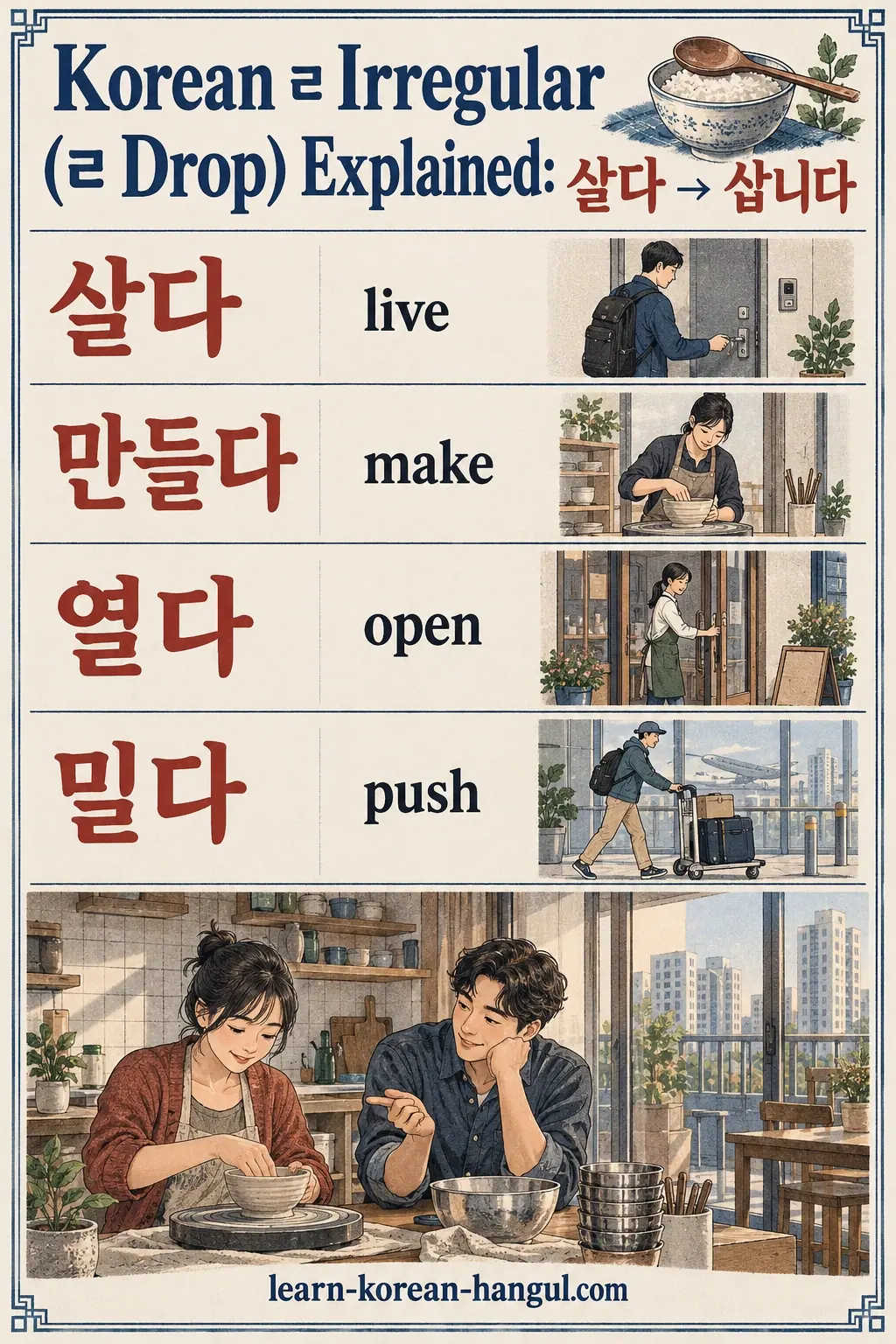
The Korean ㄹ irregular is the class of verbs and adjectives whose stem ends in ㄹ and loses that ㄹ before certain endings. The stem is the dictionary form minus 다: 살다 (to live) has the stem 살. Add the formal ending -ㅂ니다 and the ㄹ disappears: 사 + ㅂ니다 = 삽니다.
Every stem that ends in a single ㄹ behaves this way, without exception. That makes the class easy once you know the trigger letters. The common members include everyday words such as 알다 (to know), 만들다 (to make), 팔다 (to sell), 놀다 (to play, hang out) and 열다 (to open), and adjectives such as 길다 (to be long) and 멀다 (to be far).
The class has two halves, and learners need both:
- ㄹ drop. The ㄹ disappears before an ending that starts with ㄴ, ㅂ or ㅅ.
- 으 skip. The linking vowel 으 is never added after the stem, so 살 + (으)면 is 살면.
Revised Romanization, the official Latin-letter system, writes 살다 as salda and 삽니다 as samnida. Romanization is only a reading aid here; the Hangul spelling is the form to learn. The first half, the drop itself, comes next.
When Does ㄹ Drop?
ㄹ drops when the ending begins with ㄴ, ㅂ or ㅅ. A handy memory line is "ㄴ, ㅂ, ㅅ: the ㄹ goes". Each trigger matches a set of very common endings, so the drop appears in formal speech, in honorific speech and in modifiers every day.
| Trigger | Ending | 살다 (live) | 만들다 (make) | 알다 (know) |
|---|---|---|---|---|
| ㄴ | -는 (present modifier) | 사는 | 만드는 | 아는 |
| ㄴ | -(으)니까 (because) | 사니까 | 만드니까 | 아니까 |
| ㄴ | -네요 (I see that…) | 사네요 | 만드네요 | 아네요 |
| ㄴ | -는데 (background) | 사는데 | 만드는데 | 아는데 |
| ㅂ | -ㅂ니다 (formal) | 삽니다 | 만듭니다 | 압니다 |
| ㅂ | -ㅂ시다 (let's, formal) | 삽시다 | 만듭시다 | (rare) |
| ㅅ | -세요 (honorific polite) | 사세요 | 만드세요 | 아세요 |
| ㅅ | -십니다 (honorific formal) | 사십니다 | 만드십니다 | 아십니다 |
The formal ending deserves a note. Korean has two formal endings: -ㅂ니다 after a vowel and -습니다 after a consonant. An ㄹ stem takes -ㅂ니다, as if it ended in a vowel, and then the ㄹ falls away. That is why the form is 삽니다 [삼니다], never 살습니다. The full rule for both endings is in formal conjugation.
Older grammars add a fourth trigger, 오, which appears only in old-fashioned -오 endings such as 어디 사오? ("Where do you live?"). You will meet it in historical dramas, not in daily speech.
Worked Example: 살다 through Five Endings
Take 살다 (to live) and follow it through five endings, one step at a time.
- Find the stem: remove 다 from 살다. The stem is 살.
- Polite present -아요: the ending starts with 아, which is not a trigger. 살 + 아요 = 살아요 [사라요].
- Formal -ㅂ니다: the ending starts with ㅂ, a trigger. Drop ㄹ: 사 + ㅂ니다 = 삽니다.
- Honorific -세요: the ending starts with ㅅ, a trigger. Drop ㄹ: 사 + 세요 = 사세요.
- Condition -(으)면: skip 으, because the stem ends in ㄹ. 살 + 면 = 살면. The ending starts with ㅁ, so the ㄹ stays.
- Reason -(으)니까: skip 으, then the ending starts with ㄴ. Drop ㄹ: 사 + 니까 = 사니까.
살다
| Form | Korean | Romanization | Rule |
|---|---|---|---|
| Polite present | 살아요 | sarayo | 살 + 아요, ㄹ stays before 아 |
| Formal present | 삽니다 | samnida | 사 + ㅂ니다, ㄹ drops before ㅂ |
| Honorific polite | 사세요 | saseyo | 사 + 세요, ㄹ drops before ㅅ |
| If (-(으)면) | 살면 | salmyeon | 살 + 면, no 으 and ㄹ stays |
| Because (-(으)니까) | 사니까 | sanikka | 사 + 니까, ㄹ drops before ㄴ |
| Polite past | 살았어요 | sarasseoyo | 살 + 았어요, ㄹ stays |
Two example sentences use these forms:
- 어디에 사세요? = Where do you live? (polite, respectful)
- 저는 서울에 삽니다. = I live in Seoul. (formal)
An expert tip: 사세요 is also the honorific of 사다 (to buy). 어디에 사세요? means "Where do you live?", while 이거 사세요 means "Please buy this." The sentence, not the verb form, tells you which verb it is. The drop explains half the class; the endings that leave ㄹ alone are the other half.
When Does ㄹ Stay?

ㄹ stays before every ending that does not start with ㄴ, ㅂ or ㅅ. In practice, that means the 아/어 endings and the endings that start with ㄱ, ㅈ, ㄷ or ㄹ. All of the polite present, the past tense and most connectors keep the full stem.
| Ending starts with | Ending | 살다 | 놀다 (play) | 멀다 (far) |
|---|---|---|---|---|
| 아/어 | -아요/어요 | 살아요 | 놀아요 | 멀어요 |
| 아/어 | -았어요/었어요 (past) | 살았어요 | 놀았어요 | 멀었어요 |
| ㄱ | -고 (and) | 살고 | 놀고 | 멀고 |
| ㄱ | -겠어요 (will, guess) | 살겠어요 | 놀겠어요 | 멀겠어요 |
| ㅈ | -지만 (but) | 살지만 | 놀지만 | 멀지만 |
| ㄷ | -다가 (while, then) | 살다가 | 놀다가 | (rare) |
Compare the past tense across the two groups. Every ㄹ word keeps its ㄹ in the past, because the past marker starts with 았 or 었: 살았어요, 만들었어요, 알았어요. The polite present 알아요 [아라요] and the formal 압니다 therefore look like two different words, though both mean "I know".
- 주말에 친구하고 놀아요. = I hang out with friends on the weekend.
- 집이 회사에서 멀어요. = My home is far from the office.
The endings that start with (으) look like they belong in this "stays" table, yet they behave differently, which the next section explains.
Why Do ㄹ Stems Skip 으?
ㄹ stems skip 으 because Korean treats ㄹ as a sound that can join an ending directly, the way a vowel does. Many endings come in two shapes. After a vowel, the bare ending is used: 가면. After a consonant, the linking vowel 으 (매개모음, maegaemoeum) is added: 먹으면. An ㄹ stem takes the vowel shape.
| Ending | After a vowel (가다) | After a consonant (먹다) | After ㄹ (살다) | Wrong form |
|---|---|---|---|---|
| -(으)면 (if) | 가면 | 먹으면 | 살면 | 살으면 |
| -(으)러 (in order to) | 가러 | 먹으러 | 살러 | 살으러 |
| -(으)ㄹ 거예요 (will) | 갈 거예요 | 먹을 거예요 | 살 거예요 | 살을 거예요 |
| -(으)ㄹ게요 (I'll do it) | 갈게요 | 먹을게요 | 살게요 | 살을게요 |
| -(으)니까 (because) | 가니까 | 먹으니까 | 사니까 | 살으니까 |
| -(으)세요 (honorific) | 가세요 | 드세요* | 사세요 | 살으세요 |
*먹다 uses the special honorific verb 드시다, so 드세요 is the form people say; 먹으세요 also exists.
After the 으 is skipped, the ordinary drop rule still applies. -(으)니까 becomes -니까, which starts with ㄴ, so the ㄹ goes: 사니까. -(으)면 becomes -면, which starts with ㅁ, so the ㄹ stays: 살면. With -(으)ㄹ 거예요, the ending's own ㄹ merges with the stem's ㄹ, so only one is written: 살 거예요 [살꺼예요].
- 주말에 친구 집에 놀러 가요. = I'm going to a friend's place to hang out this weekend.
- 제가 김밥을 만들게요. = I'll make the gimbap.
Learners often assume 살으면 is the safe, "regular" choice because 살 ends in a consonant letter. In fact 살으면 is wrong in standard Korean, because ㄹ stems always take the vowel shape of the ending. With both halves of the rule in hand, the 20 most useful members of the class are next.
20 Common ㄹ Verbs and Adjectives

The 20 words below cover most of the ㄹ stems a beginner meets. The table gives the polite present (ㄹ stays), the formal present and the honorific -세요 (ㄹ drops) and the present modifier (ㄹ drops). Verbs take -는 in the modifier, and adjectives take -ㄴ.
| # | Word | Meaning | Polite present | Formal | -세요 | Modifier |
|---|---|---|---|---|---|---|
| 1 | 살다 | live | 살아요 | 삽니다 | 사세요 | 사는 |
| 2 | 알다 | know | 알아요 | 압니다 | 아세요 | 아는 |
| 3 | 만들다 | make | 만들어요 | 만듭니다 | 만드세요 | 만드는 |
| 4 | 팔다 | sell | 팔아요 | 팝니다 | 파세요 | 파는 |
| 5 | 놀다 | play, hang out | 놀아요 | 놉니다 | 노세요 | 노는 |
| 6 | 열다 | open | 열어요 | 엽니다 | 여세요 | 여는 |
| 7 | 울다 | cry | 울어요 | 웁니다 | 우세요 | 우는 |
| 8 | 들다 | lift, hold | 들어요 | 듭니다 | 드세요 | 드는 |
| 9 | 걸다 | hang; make (a call) | 걸어요 | 겁니다 | 거세요 | 거는 |
| 10 | 밀다 | push | 밀어요 | 밉니다 | 미세요 | 미는 |
| 11 | 풀다 | untie, solve | 풀어요 | 풉니다 | 푸세요 | 푸는 |
| 12 | 벌다 | earn | 벌어요 | 법니다 | 버세요 | 버는 |
| 13 | 날다 | fly | 날아요 | 납니다 | 나세요 | 나는 |
| 14 | 불다 | blow | 불어요 | 붑니다 | 부세요 | 부는 |
| 15 | 돌다 | turn | 돌아요 | 돕니다 | 도세요 | 도는 |
| 16 | 흔들다 | shake, wave | 흔들어요 | 흔듭니다 | 흔드세요 | 흔드는 |
| 17 | 길다 | be long | 길어요 | 깁니다 | 기세요 | 긴 |
| 18 | 멀다 | be far | 멀어요 | 멉니다 | 머세요 | 먼 |
| 19 | 달다 | be sweet | 달아요 | 답니다 | 다세요 | 단 |
| 20 | 힘들다 | be hard, tiring | 힘들어요 | 힘듭니다 | 힘드세요 | 힘든 |
The adjective -세요 forms (기세요, 머세요, 다세요) are grammatical but rare, because they show respect to the subject of a description. They are listed so the pattern is complete. In real speech you will hear 길어요, 멀어요 and 달아요 far more often.
Several drop forms collide with other words. 납니다 (flies) is spelled like 납니다 from 나다 (to come out), 겁니다 (hangs) like the 겁니다 of 갈 겁니다 ("will go"), and 드세요 (please lift) like 드세요 (please eat, from 드시다). Context decides. The modifier column is where verbs and adjectives part ways, so it gets its own section.
ㄹ Words as Modifiers: 사는, 먼, 긴

ㄹ words lose their ㄹ in every modifier that starts with ㄴ, and verbs and adjectives use different modifier endings. A modifier is the form of a verb or adjective that describes a noun, like "long" in "long hair". The table shows both groups with a noun.
| Group | Word | Present modifier | Example | Meaning |
|---|---|---|---|---|
| Verb | 살다 | 사는 | 서울에 사는 친구 | a friend who lives in Seoul |
| Verb | 알다 | 아는 | 아는 사람 | someone I know |
| Verb | 팔다 | 파는 | 과일을 파는 가게 | a shop that sells fruit |
| Verb | 만들다 | 만드는 | 빵을 만드는 사람 | a person who makes bread |
| Adjective | 멀다 | 먼 | 먼 곳 | a far place |
| Adjective | 길다 | 긴 | 긴 머리 | long hair |
| Adjective | 달다 | 단 | 단 음식 | sweet food |
| Adjective | 힘들다 | 힘든 | 힘든 일 | hard work |
Verbs also have a past modifier with -(으)ㄴ and a future one with -(으)ㄹ. Both skip 으, and the past one drops ㄹ: 만든 케이크 (a cake someone made), 살 집 (a house to live in). Example sentences:
- 제가 사는 곳은 부산이에요. = The place where I live is Busan.
- 이 케이크는 제가 만든 거예요. = I made this cake.
- 머리가 긴 사람이 제 동생이에요. = The person with long hair is my younger sibling.
A counterintuitive point: some modifiers become one-syllable words that already exist. 산 is the past modifier of 살다 and also the noun "mountain". 안 is the past modifier of 알다 and also the negation word. 가는 is the modifier of 가늘다 (thin) and also of 가다 (go). Learners who know the rule can read these correctly from context. The full system of modifiers is taught in noun-modifying forms. Not every stem with an ㄹ in it belongs to this class, which leads to the look-alikes.
Which Stems Only Look Like ㄹ Stems?

Stems that have ㄹ inside a double final consonant, such as 넓다, 짧다 and 읽다, are not ㄹ stems and never drop the ㄹ. A double final consonant (겹받침, gyeopbatchim) is a pair of consonant letters at the bottom of one block, like ㄼ in 넓 or ㄺ in 읽. The stem ends in that pair, not in ㄹ alone, so it conjugates like any regular consonant stem: it takes 으 and -습니다.
| Word | Meaning | Polite present | Formal | Modifier | If (-(으)면) |
|---|---|---|---|---|---|
| 넓다 [널따] | be wide | 넓어요 | 넓습니다 | 넓은 | 넓으면 |
| 짧다 [짤따] | be short | 짧아요 | 짧습니다 | 짧은 | 짧으면 |
| 얇다 [얄따] | be thin | 얇아요 | 얇습니다 | 얇은 | 얇으면 |
| 젊다 [점따] | be young | 젊어요 | 젊습니다 | 젊은 | 젊으면 |
| 읽다 [익따] | read | 읽어요 | 읽습니다 | 읽는 [잉는] | 읽으면 |
| 삶다 [삼따] | boil | 삶아요 | 삶습니다 | 삶는 [삼는] | 삶으면 |
Set 길다 beside 짧다, a natural opposite pair. 길다 gives 긴 머리, while 짧다 gives 짧은 머리. The test is visual: if the final block ends in ㄹ alone (길), apply the ㄹ rule; if it ends in two letters (짧), treat it as regular. More pairs of this kind are collected in regular verbs that look irregular. The table of mistakes below shows where learners mix the two groups.
Common Mistakes with ㄹ Stems
Most ㄹ errors come from treating the stem as a regular consonant stem: adding 으, using -습니다 or keeping the ㄹ before a trigger.
| Wrong form | Correct form | What went wrong |
|---|---|---|
| 살습니다 | 삽니다 | used -습니다; ㄹ stems take -ㅂ니다 and drop ㄹ |
| 만들은 | 만든 | added 으 and kept ㄹ before ㄴ |
| 살으면 | 살면 | added 으 after an ㄹ stem |
| 알으세요? | 아세요? | added 으 and kept ㄹ before ㅅ |
| 멀은 곳 | 먼 곳 | added 으 and kept ㄹ before ㄴ |
| 놀으러 가요 | 놀러 가요 | added 으 after an ㄹ stem |
| 사아요 (for "live") | 살아요 | dropped ㄹ before 아, where it stays |
| 넓는, 널은 | 넓은 | applied the ㄹ rule to a double final consonant |
The 사아요 error is the reverse mistake: over-applying the drop. If you remember only one check, use this one: drop ㄹ only when the next letter is ㄴ, ㅂ or ㅅ.
How School Grammar Labels ㄹ Drop
Korean school grammar (학교문법) treats ㄹ drop as a regular rule (규칙 활용), not as an irregular. The reason is that every stem ending in ㄹ follows it automatically, so nothing needs to be memorised word by word. Most English-language textbooks still list it among the irregulars, and this site's ㄹ irregular section follows that learner convention because the forms differ from the regular pattern a learner first studies.
The label does not change any form. 삽니다 is correct under both views. If a Korean teacher tells you "ㄹ 탈락 is regular", both of you are describing the same rule with different labels.
Practice
Write the form asked for. Answers follow the quiz.
Practice · 8
What is the formal present of 살다 (to live)?
Show answer
삽니다
An ㄹ stem takes -ㅂ니다, and the ㄹ drops before ㅂ: 사 + ㅂ니다 = 삽니다.
What is the honorific polite (-세요) form of 알다 (to know)?
Show answer
아세요
ㄹ stems skip 으, and the ㄹ drops before ㅅ.
What is the polite present of 팔다 (to sell)?
Show answer
팔아요
아 is not a trigger, so the ㄹ stays. Dropping it here is the reverse mistake.
What is the -(으)면 form of 만들다 (to make)?
Show answer
만들면
ㄹ stems never take the linking 으, and ㅁ is not a trigger, so the ㄹ stays.
How do you say "a far place" with 멀다 before 곳?
Show answer
먼 곳
An adjective takes -(으)ㄴ before a noun; the ㄹ stem skips 으 and then drops ㄹ before ㄴ.
How do you say "I'm going to hang out" with 놀다 + -(으)러 가요?
Show answer
놀러 가요
ㄹ stems skip 으, and ㄹ is not a trigger, so the ㄹ stays: 놀러.
What are the three letters that make a stem-final ㄹ drop?
Show answer
ㄴ, ㅂ and ㅅ
"ㄴ, ㅂ, ㅅ: the ㄹ goes." Before every other ending the ㄹ stays.
How do you say "a wide room" with 넓다 before 방?
Show answer
넓은 방
넓다 ends in the double final consonant ㄼ, not ㄹ alone, so it is regular: it adds 으 and keeps ㄹ.
- 살다, formal present
- 알다, honorific polite (-세요)
- 만들다, present modifier + 사람
- 팔다, polite present
- 멀다, adjective modifier + 곳
- 길다, -(으)니까 form
- 놀다 + -(으)러 가요
- 열다, formal present
- 넓다, modifier + 방 (room)
- Fix the error: 만들으면
Answers to the Practice
- 삽니다. ㄹ drops before ㅂ.
- 아세요. ㄹ drops before ㅅ.
- 만드는 사람. ㄹ drops before ㄴ.
- 팔아요. ㄹ stays before 아.
- 먼 곳. Adjective modifier -ㄴ, no 으, ㄹ drops.
- 기니까. No 으, then ㄹ drops before ㄴ.
- 놀러 가요. No 으, and ㄹ stays before ㄹ.
- 엽니다. ㄹ drops before ㅂ.
- 넓은 방. 넓다 is regular, so it adds 으 and keeps ㄹ.
- 만들면. ㄹ stems skip 으, and ㅁ is not a trigger.
If you missed items 6, 7 or 10, reread the section on skipping 으: those items test the second half of the class.
What to Learn Next
The Korean ㄹ irregular (ㄹ drop) comes down to one check: drop ㄹ before ㄴ, ㅂ and ㅅ, keep it everywhere else, and never add 으. Next, compare all seven classes side by side in the irregular verbs chart, which lists the trigger, an example verb and its polite present, past, formal and -(으)면 forms. For more ㄹ words, see the word list in the ㄹ irregular section linked above.
This lesson covers ㄹ stems in the main beginner endings. It does not list every rare ending, and it does not cover 르 stems such as 모르다, which follow a separate rule. The bracketed pronunciations are standard Seoul approximations.
Frequently Asked Questions
Why is 살다 삽니다 and not 살습니다? The formal ending is -ㅂ니다 after a vowel or ㄹ and -습니다 after other consonants. 살다 counts as an ㄹ stem, so it takes -ㅂ니다, and the ㄹ drops before ㅂ. 사 + ㅂ니다 gives 삽니다 [삼니다]. 살습니다 is a common learner error, never the standard form.
What is the formal form of 알다? The formal present of 알다 (to know) is 압니다 [암니다], and the formal question is 압니까? The ㄹ drops before ㅂ, exactly as in 삽니다. The honorific forms also drop it, because the honorific marker starts with ㅅ, so 아세요? and 아십니까? mean "Do you know?"
What is the polite form of 만들다? The polite present of 만들다 (to make) is 만들어요, and the ㄹ stays because the ending starts with 어. The formal form is 만듭니다, the honorific is 만드세요, and the past is 만들었어요. Only the forms whose ending starts with ㄴ, ㅂ or ㅅ lose the ㄹ.
How do I say "the place where I live" in Korean? Say 제가 사는 곳, literally "the place I live". 사는 is the present modifier of 살다: the ending -는 starts with ㄴ, so the ㄹ drops. A full sentence is 제가 사는 곳은 부산이에요, "The place where I live is Busan." For a house, say 제가 사는 집.
Why is 길다 긴 and not 길은? 길다 (to be long) is an adjective, and adjectives take -(으)ㄴ in the present modifier. An ㄹ stem skips 으 and then loses its ㄹ before ㄴ, so 길 + ㄴ gives 긴, as in 긴 머리 "long hair". 길은 is wrong for the same reason that 살으면 is wrong.