
What you will be able to do after this lesson
- Apply the one-step test to decide whether a ㅂ, ㄷ, ㅅ or ㅎ word is regular.
- Classify 20 look-alike verbs and adjectives as regular or irregular.
- Explain why 좁다 is regular while 춥다 is irregular.
- Tell apart homographs such as 굽다 (grill) and 굽다 (be bent).
Before you start: the test is part of how to recognize irregular verbs, and this page assumes you have read that lesson first. Time: about 35 minutes. Level: A2.
Which Korean Verbs Look Irregular but Are Regular?

Korean verbs that look irregular but are regular are the many words whose stem ends in ㅂ, ㄷ, ㅅ or ㅎ and still conjugates with no change, such as 입다, 받다, 웃다 and 좋다. A regular word (규칙 활용) adds every ending to an unchanged stem. An irregular word (불규칙 활용) changes its stem before some endings. The final letter alone never tells you which group a word is in.
| Final consonant | Irregular example | Its 아요/어요 form | Regular look-alike | Its 아요/어요 form |
|---|---|---|---|---|
| ㅂ | 돕다 (help) | 도와요 | 입다 (wear) | 입어요 |
| ㄷ | 듣다 (listen) | 들어요 | 받다 (receive) | 받아요 |
| ㅅ | 낫다 (get better) | 나아요 | 웃다 (laugh) | 웃어요 |
| ㅎ | 그렇다 (be so) | 그래요 | 좋다 (be good) | 좋아요 |
| 르 | 모르다 (not know) | 몰라요 | 따르다 (follow) | 따라요 |
Regular words are not rare exceptions. For ㄷ and ㅅ, the irregular words form a short list and many everyday words outside it are regular, and for ㅎ, every verb is regular. For ㄷ and ㅅ verbs and all ㅎ verbs, the safe default is therefore "regular until proven otherwise". ㅂ adjectives are the reverse: most are irregular. Either way, the proof takes one step.
What Is the One Test?
The test is one question: is the stem's final consonant still there in the 아요/어요 form? If yes, the word is regular for that class. If the consonant has changed or disappeared, the word is irregular. You can run the test on any form you hear or read, then work back to the class.
Decision box: run the test in three steps
- Find the stem and its final consonant: 입다 → 입, final ㅂ.
- Look up or listen for the polite present: 입어요.
- Check the final consonant in that form. ㅂ is still under 입, so 입다 is regular.
Now run it on an irregular word. 돕다 → 돕, final ㅂ. Its polite present is 도와요. The ㅂ has gone and 와 has appeared, so 돕다 is ㅂ irregular.
Compare 입어요 and 더워요 above. In 입어요 you hear the ㅂ link into the next syllable [이버요]. In 더워요 there is no ㅂ sound at all; a [w] glide replaces it.
The test has one honest limit. It works for ㅂ, ㄷ, ㅅ and ㅎ, where the irregular change happens in the 아요/어요 form. It does not work for ㄹ stems, which keep ㄹ in 살아요 and lose it elsewhere. For ㄹ and 르, use the checks in the last pair section below. The ㅂ class has the most look-alikes, so it comes first.
ㅂ Look-Alikes: 입다, 잡다, 좁다
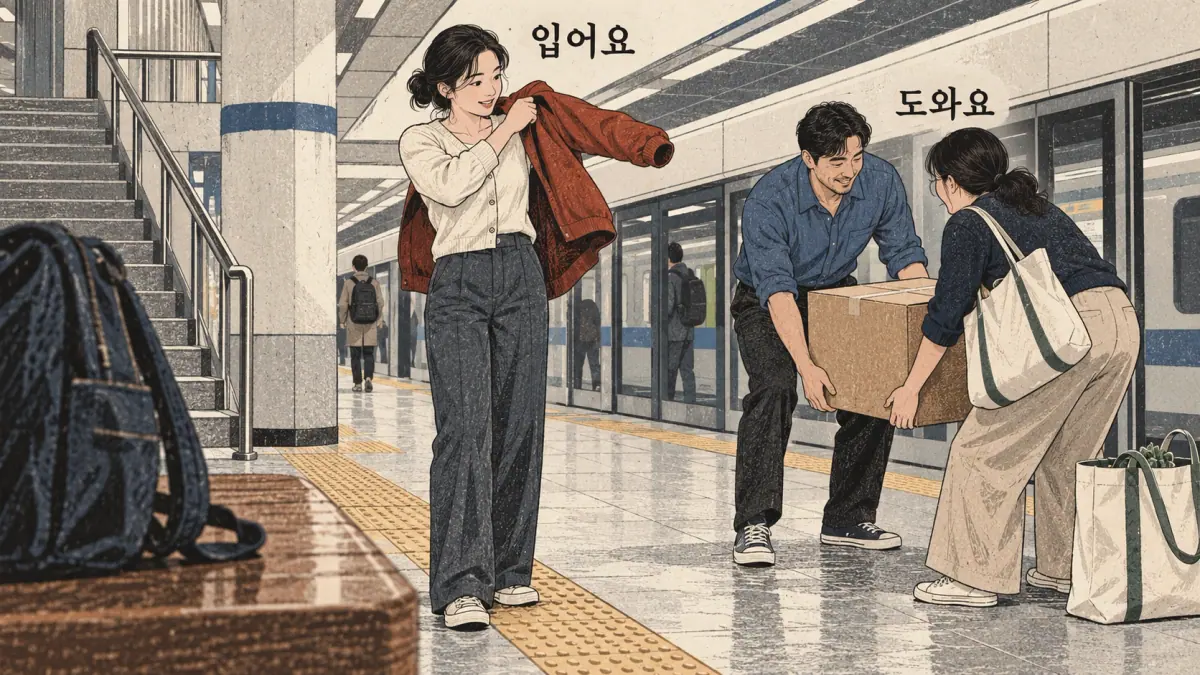
Regular ㅂ words keep ㅂ and add 아요/어요 directly: 입어요, 잡아요, 좁아요. Irregular ㅂ words turn ㅂ into 우 before a vowel, which merges into 워 or 와: 추워요, 도와요. The irregular side of these pairs is taught in ㅂ irregular.
| # | Irregular | Polite present | Regular twin | Polite present | Past (regular) |
|---|---|---|---|---|---|
| 1 | 돕다 (help) | 도와요 | 입다 (wear) | 입어요 | 입었어요 |
| 2 | 춥다 (be cold) | 추워요 | 좁다 (be narrow) | 좁아요 | 좁았어요 |
| 3 | 덥다 (be hot) | 더워요 | 접다 (fold) | 접어요 | 접었어요 |
| 4 | 눕다 (lie down) | 누워요 | 뽑다 (pull out) | 뽑아요 | 뽑았어요 |
| 5 | 쉽다 (be easy) | 쉬워요 | 씹다 (chew) | 씹어요 | 씹었어요 |
| 6 | 어렵다 (be difficult) | 어려워요 | 업다 (carry on the back) | 업어요 | 업었어요 |
| 7 | 줍다 (pick up) | 주워요 | 집다 (pick up with fingers) | 집어요 | 집었어요 |
| 8 | 즐겁다 (be fun) | 즐거워요 | 잡다 (catch, hold) | 잡아요 | 잡았어요 |
| 9 | 아름답다 (be beautiful) | 아름다워요 | 꼽다 (count on fingers) | 꼽아요 | 꼽았어요 |
| 10 | 부드럽다 (be soft) | 부드러워요 | 수줍다 (be shy) | 수줍어요 | 수줍었어요 |
The class pattern gives a rule of thumb for memory. Most ㅂ-final adjectives are irregular, including every adjective ending in -롭다, -럽다, -답다 or -겁다 (자유롭다, 부드럽다, 아름답다, 무겁다). 좁다 and 수줍다 are the common regular exceptions. Most ㅂ-final action verbs done with the hands or body are regular (입다, 잡다, 접다, 씹다, 뽑다, 업다, 집다), and only a few such as 돕다, 눕다, 줍다 and 굽다 (grill) are irregular.
Pair 7 is worth learning as a set: 줍다 and 집다 both mean "pick up", yet 주워요 is irregular and 집어요 is regular.
- 이 셔츠를 입어요. = I'm wearing this shirt.
- 방이 좀 좁아요. = The room is a bit small.
ㅂ look-alikes are the largest group. ㄷ look-alikes are fewer but more frequent in beginner speech.
ㄷ Look-Alikes: 받다, 닫다, 믿다

Regular ㄷ words keep ㄷ before every ending: 받아요, 닫아요, 믿어요. Irregular ㄷ words turn ㄷ into ㄹ before a vowel: 듣다 → 들어요. The irregular ㄷ verbs are a short closed list, covered in ㄷ irregular.
| # | Irregular | Polite present | Regular twin | Polite present | If (-(으)면) |
|---|---|---|---|---|---|
| 1 | 듣다 (listen) | 들어요 | 받다 (receive) | 받아요 | 받으면 |
| 2 | 걷다 (walk) | 걸어요 | 닫다 (close) | 닫아요 | 닫으면 |
| 3 | 묻다 (ask) | 물어요 | 믿다 (believe) | 믿어요 | 믿으면 |
| 4 | 싣다 (load) | 실어요 | 얻다 (get, gain) | 얻어요 | 얻으면 |
| 5 | 깨닫다 (realise) | 깨달아요 | 뜯다 (tear off) | 뜯어요 | 뜯으면 |
쏟다 (spill) is a sixth regular word with no irregular twin: 쏟아요. A useful contrast is 받다 against 듣다. Learners often ask whether 받다 is irregular because of ㄷ; it is not. 받아요 keeps ㄷ, which links forward and sounds like [바다요].
Two irregular forms collide with other verbs, which is why ㄷ feels harder than it is. 들어요 is both "I listen" (듣다) and "I lift" or "it costs" (들다). 걸어요 is both "I walk" (걷다) and "I hang" (걸다). The test still works, but you must know which dictionary form you started from.
- 선물을 받았어요. = I received a present.
- 문을 닫아 주세요. = Please close the door.
The ㅅ class works the same way, with the consonant disappearing instead of changing.
ㅅ and ㅎ Look-Alikes: 웃다, 씻다, 좋다, 많다

Regular ㅅ words keep ㅅ (웃어요), and regular ㅎ words keep ㅎ in spelling (좋아요). The irregular ㅅ words lose ㅅ before a vowel without contracting (낫다 → 나아요), and the irregular ㅎ adjectives lose ㅎ and merge their vowels (그렇다 → 그래요).
Which ㅅ Words Are Regular?
웃다, 씻다, 벗다, 빗다, 빼앗다 and 솟다 are regular ㅅ words: they keep ㅅ before 아/어. Each one is paired below with an irregular word of the same shape.
| # | Irregular | Polite present | Regular twin | Polite present |
|---|---|---|---|---|
| 1 | 낫다 (get better) | 나아요 | 웃다 (laugh) | 웃어요 |
| 2 | 짓다 (build) | 지어요 | 씻다 (wash) | 씻어요 |
| 3 | 붓다 (pour) | 부어요 | 벗다 (take off) | 벗어요 |
| 4 | 잇다 (connect) | 이어요 | 빼앗다 (take away) | 빼앗아요 |
| 5 | 젓다 (stir) | 저어요 | 솟다 (rise, spring up) | 솟아요 |
| 6 | 긋다 (draw a line) | 그어요 | 빗다 (comb) | 빗어요 |
The ㅅ class is easy to sort by frequency: the beginner words 웃다, 씻다 and 벗다 are all regular, while the irregular list is short and closed. More detail is in ㅅ irregular.
Which ㅎ Words Are Regular?
좋다, 많다, 싫다 and 괜찮다 are regular ㅎ adjectives, and 놓다, 넣다, 낳다 and 쌓다 are regular ㅎ verbs: the ㅎ stays in their spelling. Each is paired with an irregular ㅎ adjective.
| # | Irregular | Polite present | Regular twin | Polite present | Pronounced |
|---|---|---|---|---|---|
| 1 | 그렇다 (be so) | 그래요 | 좋다 (be good) | 좋아요 | [조아요] |
| 2 | 어떻다 (be how) | 어때요 | 많다 (be many) | 많아요 | [마나요] |
| 3 | 이렇다 (be like this) | 이래요 | 괜찮다 (be okay) | 괜찮아요 | [괜차나요] |
| 4 | 빨갛다 (be red) | 빨개요 | 싫다 (be disliked) | 싫어요 | [시러요] |
| 5 | 파랗다 (be blue) | 파래요 | 놓다 (put) | 놓아요 | [노아요] |
| 6 | 하얗다 (be white) | 하얘요 | 넣다 (put in) | 넣어요 | [너어요] |
| 7 | 노랗다 (be yellow) | 노래요 | 낳다 (give birth) | 낳아요 | [나아요] |
| 8 | 까맣다 (be black) | 까매요 | 쌓다 (pile up) | 쌓아요 | [싸아요] |
Is 좋다 irregular? No. Every ㅎ verb is regular. Among ㅎ adjectives, the irregular ones are the colour and shape words (빨갛다, 동그랗다), size words such as 커다랗다, and 그렇다, 이렇다, 저렇다 and 어떻다, as listed in ㅎ irregular. 좋다 and the adjectives ending in ㄶ or ㅀ (많다, 싫다, 괜찮다) are regular.
The pronunciation column shows why 좋다 feels irregular: the ㅎ is written but silent before a vowel. Under the standard pronunciation rules (표준 발음법, Article 12), ㅎ is not pronounced before a vowel-initial ending, so 좋아요 sounds like [조아요]. The spelling keeps ㅎ, and the test is about spelling. In 그래요, by contrast, the ㅎ is gone from the spelling as well.
A counterintuitive result: 낳아요 (gives birth) and 나아요 (gets better, from 낫다) sound the same, [나아요], although one is regular ㅎ and the other is irregular ㅅ. Spelling is the only way to tell them apart on the page.
ㅅ and ㅎ complete the consonant classes the test covers. The remaining look-alikes involve ㄹ and 르, which need a different check.
르, ㄹ and ㅡ Look-Alikes: 따르다, 넓다
르 and ㄹ look-alikes cannot be sorted by the main test, because ㄹ stays in the 아요/어요 form for both groups. Use these two checks instead:
- 르 words: the 르 irregular doubles ㄹ (모르다 → 몰라요). Words that only drop ㅡ (따르다 → 따라요) show no extra ㄹ.
- ㄹ words: a stem ending in a single ㄹ drops it before ㄴ (길다 → 긴). A stem with ㄹ inside a double final consonant (겹받침) keeps it (넓다 → 넓은).
| # | Changes | Form | Look-alike that does not | Form |
|---|---|---|---|---|
| 1 | 모르다 (not know), 르 | 몰라요 | 따르다 (follow), ㅡ drop | 따라요 |
| 2 | 부르다 (call), 르 | 불러요 | 치르다 (pay), ㅡ drop | 치러요 |
| 3 | 기르다 (raise), 르 | 길러요 | 들르다 (drop by), ㅡ drop | 들러요 |
| 4 | 길다 (be long), ㄹ | 긴 | 넓다 (be wide) | 넓은 |
| 5 | 멀다 (be far), ㄹ | 먼 | 짧다 (be short) | 짧은 |
| 6 | 달다 (be sweet), ㄹ | 단 | 얇다 (be thin) | 얇은 |
| 7 | 살다 (live), ㄹ | 사는 | 삶다 (boil) | 삶는 |
| 8 | 알다 (know), ㄹ | 아는 | 읽다 (read) | 읽는 |
| 9 | 놀다 (play), ㄹ | 노는 | 젊다 (be young) | 젊은 |
Strictly, 따르다, 치르다 and 들르다 are not fully regular: they follow the ㅡ drop that every ㅡ stem shows (쓰다 → 써요, 크다 → 커요). What they are not is 르 irregular. ㅡ stems themselves have no look-alikes, because every stem ending in ㅡ drops it before 아/어. The full rules are in the 르 irregular lesson and the ㄹ drop lesson. One group remains: words that are regular and irregular at once.
Why Are Some Verbs Both Regular and Irregular?

Some verbs are both regular and irregular because one spelling covers two different dictionary words, each with its own conjugation. Korean dictionaries list these homographs (동음이의어) as separate headwords. The dictionary form looks identical, so only the meaning tells you which pattern to use.
| Dictionary form | Meaning | Class | Polite present | Example |
|---|---|---|---|---|
| 굽다 | grill, bake | ㅂ irregular | 구워요 | 고기를 구워요. |
| 굽다 | be bent | regular | 굽어요 | 허리가 굽었어요. |
| 묻다 | ask | ㄷ irregular | 물어요 | 길을 물어요. |
| 묻다 | bury | regular | 묻어요 | 땅에 묻어요. |
| 걷다 | walk | ㄷ irregular | 걸어요 | 공원을 걸어요. |
| 걷다 | roll up; collect | regular | 걷어요 | 소매를 걷어요. |
| 이르다 | be early | 르 irregular | 일러요 | 아직 일러요. |
| 이르다 | reach | 러 irregular | 이르러요 | 결론에 이르러요. |
The sentences carry the meaning: 고기 (meat) goes with grilling, 길 (the way) with asking, 소매 (sleeves) with rolling up. When you learn a new verb, learn it with one typical object, and the class will come with it. The practice below mixes every group on this page.
Practice
Classify each word as regular or irregular, and name the class for the irregular ones. Answers follow the quiz.
Practice · 8
What is the one test for a ㅂ, ㄷ, ㅅ or ㅎ word?
Show answer
Check whether the stem's final consonant is still there in the 아요/어요 form
If the final consonant survives in the 아요/어요 form, the word is regular; if it changed or disappeared, the word is irregular.
What is the polite present of 입다 (to wear)?
Show answer
입어요
입다 is regular: its ㅂ stays and links into the next syllable [이버요].
Which pair shows a regular ㅂ adjective and an irregular one?
Show answer
좁다 → 좁아요 and 춥다 → 추워요
Most ㅂ adjectives are irregular (추워요), but 좁다 and 수줍다 are the common regular exceptions (좁아요).
What is the polite present of 받다 (to receive)?
Show answer
받아요
받다 is regular: its ㄷ stays before every ending. Only a short list such as 듣다 turns ㄷ into ㄹ.
Which ㅅ verb is regular?
Show answer
씻다 (wash): 씻어요
The beginner words 웃다, 씻다 and 벗다 keep ㅅ; 낫다 and 짓다 belong to the short irregular list.
Why can 좋아요 seem irregular?
Show answer
Its ㅎ is written but silent before a vowel, so it sounds like [조아요]
좋다 is regular: the ㅎ stays in the spelling, which is what the test checks; only the sound drops it.
묻다 means "bury" in 땅에 ___. Which form is right?
Show answer
묻어요
묻다 "bury" is a regular homograph (묻어요); 묻다 "ask" is ㄷ-irregular (물어요).
What happens to 넓다 (be wide) before a noun?
Show answer
It keeps ㄹ: 넓은
Only a single final ㄹ drops before ㄴ (길다 → 긴); ㄹ inside a double final consonant stays, so 넓다 gives 넓은.
- 입다 (wear)
- 돕다 (help)
- 좁다 (be narrow)
- 춥다 (be cold)
- 잡다 (catch)
- 받다 (receive)
- 듣다 (listen)
- 믿다 (believe)
- 웃다 (laugh)
- 낫다 (get better)
- 씻다 (wash)
- 벗다 (take off)
- 좋다 (be good)
- 그렇다 (be so)
- 많다 (be many)
- 넣다 (put in)
- 따르다 (follow)
- 모르다 (not know)
- 넓다 (be wide)
- 묻다 (bury)
Answers to the Practice
- Regular: 입어요. 2. ㅂ irregular: 도와요. 3. Regular: 좁아요. 4. ㅂ irregular: 추워요. 5. Regular: 잡아요.
- Regular: 받아요. 7. ㄷ irregular: 들어요. 8. Regular: 믿어요. 9. Regular: 웃어요. 10. ㅅ irregular: 나아요.
- Regular: 씻어요. 12. Regular: 벗어요. 13. Regular: 좋아요. 14. ㅎ irregular: 그래요. 15. Regular: 많아요.
- Regular: 넣어요. 17. Not 르 irregular; ㅡ drop only: 따라요. 18. 르 irregular: 몰라요. 19. Regular: 넓은, 넓어요. 20. Regular: 묻어요 (bury), unlike 묻다 "ask".
Score yourself: 13 of the 20 words are regular in the sense of this page. If you marked any of them irregular, run the test again on the 아요/어요 form.
What to Learn Next
Korean regular verbs that look irregular are sorted by one check: the stem's final consonant survives in 입어요, 받아요, 웃어요 and 좋아요, so those words are regular. Next, see every irregular class side by side in the irregular verbs chart, which gives the trigger, an example verb and its polite present, past, formal and -(으)면 forms.
This page covers the common look-alikes in beginner and elementary vocabulary. It does not list every rare verb, and no count of regular against irregular words is claimed, because that depends on the word list used.
Frequently Asked Questions
Is 입다 irregular? No. 입다 (to wear) is a regular verb. Its ㅂ stays in every form: 입어요, 입었어요, 입으면, 입는. It looks like ㅂ irregular words such as 돕다 (도와요), but the stem never changes. Other regular ㅂ verbs that behave like 입다 are 잡다, 접다, 씹다, 뽑다, 업다 and 집다.
Is 좋다 an irregular adjective? No. 좋다 (to be good) is regular: 좋아요, 좋았어요, 좋은, 좋으면. The ㅎ is written in every form but silent before a vowel, so 좋아요 sounds like [조아요]. That silence makes it look irregular. The irregular ㅎ adjectives include 그렇다, 어떻다 and colour words such as 빨갛다 (빨개요).
Why is 좁다 regular when 춥다 is irregular? There is no sound-based reason; class membership is a property of each word, recorded in the dictionary. 좁다 (be narrow) keeps ㅂ: 좁아요. 춥다 (be cold) changes ㅂ to 우: 추워요. 좁다 is one of very few regular ㅂ adjectives, so learn it as a named exception together with 수줍다.
Are all ㅂ verbs irregular? No. Many common ㅂ verbs are regular, including 입다, 잡다, 접다, 씹다, 뽑다, 업다 and 집다. Most ㅂ adjectives are irregular, such as 춥다, 덥다, 쉽다, 어렵다 and every adjective in -롭다, -럽다, -답다 or -겁다. Check the 아요/어요 form: if ㅂ is still there, the word is regular.
Is 받다 irregular because of ㄷ? No. 받다 (to receive) is regular. Its ㄷ stays before every ending: 받아요, 받았어요, 받으면. Only a short list of ㄷ verbs is irregular, mainly 듣다 (들어요), 걷다 "walk" (걸어요), 묻다 "ask" (물어요) and 싣다 (실어요). 닫다, 믿다 and 얻다 are regular like 받다.