What you will be able to do after this page
- Conjugate 푸르다, 이르다 (reach) and 푸다 in the polite present, past and formal style.
- Tell the 러 irregular from the 르 irregular, which looks similar but works differently.
- Explain why these two classes are rare exceptions that beginners can skip.
- Avoid the three most common mistakes: 푸러요, 일러요 for "reach" and 푸어요.
Before you start: read how to recognize irregular verbs, because this page assumes you know what an irregular verb is and how the 르 class works. Time: about 25 minutes. Level: B1.
What Is the 러 Irregular in Korean?
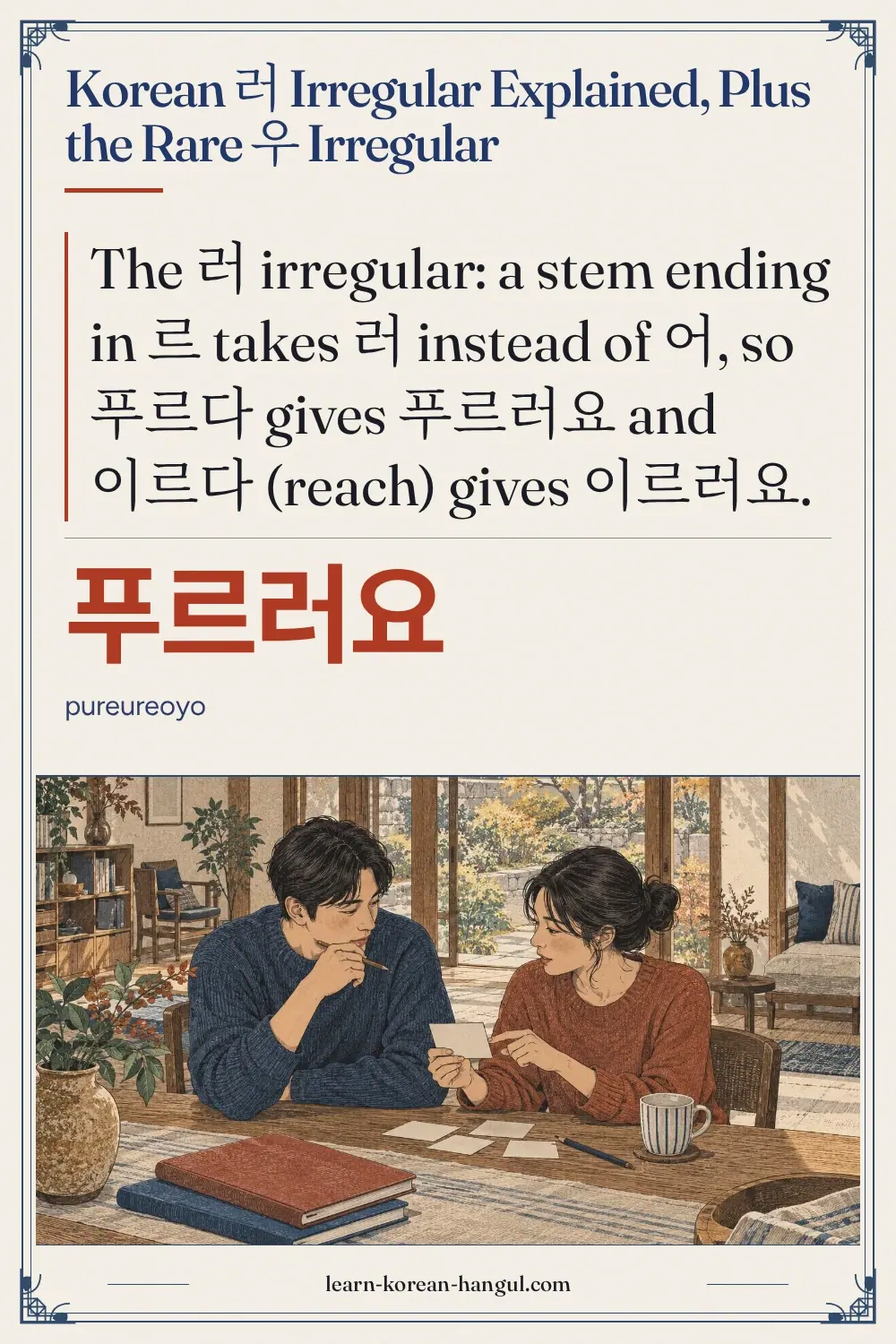
The 러 irregular (러 불규칙, reo bulgyuchik) is a class of verbs and adjectives whose stem ends in 르 and whose ending 어 changes to 러. A stem is the verb without the dictionary ending -다: the stem of 푸르다 is 푸르. In a regular verb the polite ending -어요 attaches directly to the stem. In a 러 irregular verb the ending turns into -러요: 푸르 + 어요 gives 푸르러요, not 푸러요.
The class is tiny. On this site, only two entries belong to it: 푸르다 (to be blue-green, like fresh leaves or a clear sky) and 이르다 in the sense "to reach". The standard spelling rules (한글 맞춤법, Article 18) describe it as a small set of exceptions. Grammar references also list the colour words 누르다 and 노르다 (a yellowish colour) in this class, but you will meet those in literature, not in conversation. Do not confuse the colour 누르다 with 누르다 meaning to press, which is an ordinary 르 irregular verb and gives 눌러요.
| Form | 푸르다 (be blue-green) | 이르다 (reach) | Rule |
|---|---|---|---|
| Polite present | 푸르러요 | 이르러요 | 르 + 러요 |
| Polite past | 푸르렀어요 | 이르렀어요 | 르 + 렀어요 |
| Polite future | 푸를 거예요 | 이를 거예요 | stem + ㄹ 거예요 |
| Formal present | 푸릅니다 | 이릅니다 | stem + ㅂ니다 |
| Because / and then | 푸르러서 | 이르러서 | 르 + 러서 |
| If | 푸르면 | 이르면 | stem + 면 |
| Describing a noun | 푸른 | 이르는 | adjective -ㄴ, verb -는 |
Look at the pattern. Wherever the ending would begin with 어 or 았/었, the 러 version appears: 푸르러요, 푸르렀어요, 푸르러서. Wherever the ending begins with a consonant or with 으, the stem is regular: 푸릅니다, 푸르면, 이르면. The rule is short: if the ending starts with 어, add 러 to the 르 stem. The adjective takes -ㄴ in the modifier form (푸른), as in 푸른 하늘 (a blue sky), and that form is the one you will see most often.
The sound is straightforward: 푸르러요 is said as written, [푸르러요], and 푸르렀어요 is [푸르러써요], with the final ㅆ moving to the next syllable. Revised Romanization writes them pureureoyo and pureureosseoyo.
Full tables with audio:
푸르다
| Form | Korean | Romanization | Rule |
|---|---|---|---|
| Polite present | 푸르러요 | pureureoyo | 푸르 + 러요 |
| Polite past | 푸르렀어요 | pureureosseoyo | 푸르 + 렀 + 어요 |
| Formal present | 푸릅니다 | pureumnida | 푸르 + ㅂ니다 |
| Because | 푸르러서 | pureureoseo | 푸르 + 러서 |
| Modifier | 푸른 | pureun | 푸르 + ㄴ |
이르다
| Form | Korean | Romanization | Rule |
|---|---|---|---|
| Polite present | 이르러요 | ireureoyo | 이르 + 러요 |
| Polite past | 이르렀어요 | ireureosseoyo | 이르 + 렀 + 어요 |
| Formal present | 이릅니다 | ireumnida | 이르 + ㅂ니다 |
| Because | 이르러서 | ireureoseo | 이르 + 러서 |
| Modifier | 이르는 | ireuneun | 이르 + 는 |
Why Can 일러요 and 이르러요 Both Be Forms of 이르다?
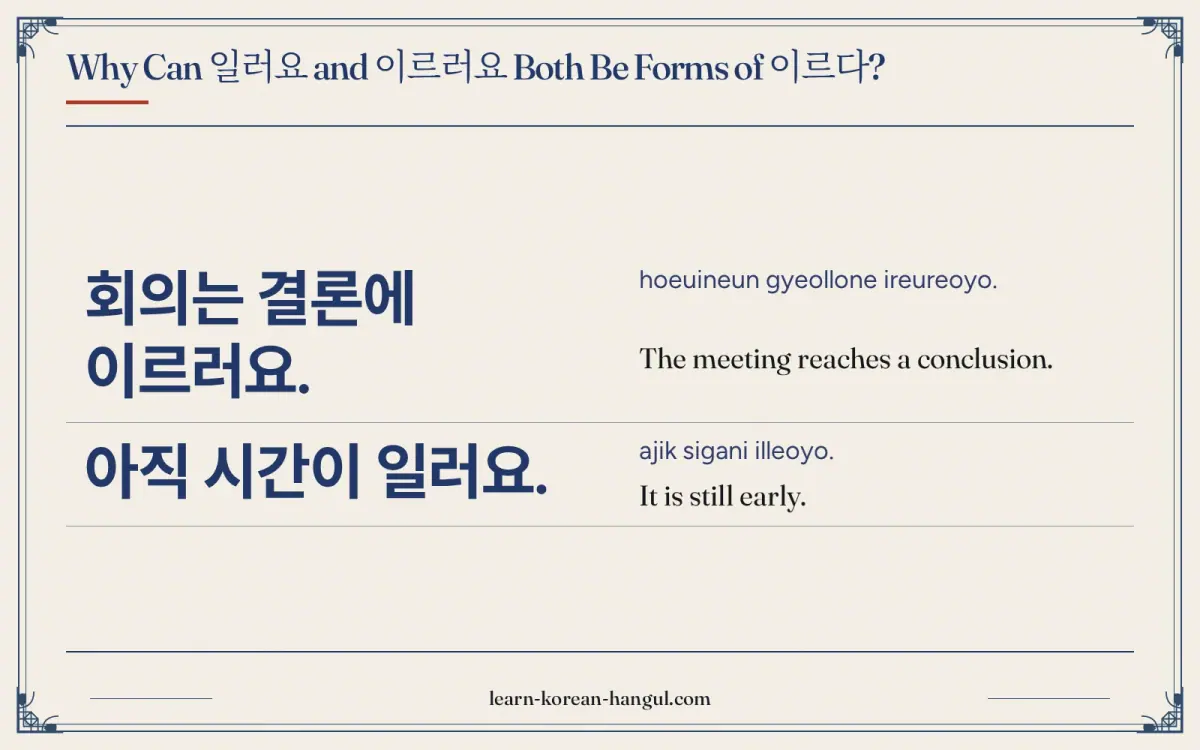
이르다 is three different words that share one spelling. Only one of them is a 러 irregular. The other two are 르 irregulars, and they give 일러요. This is the first trap. The meaning decides the form.
| Meaning | Part of speech | Class | Polite present | Example |
|---|---|---|---|---|
| to reach; to arrive at | verb | 러 | 이르러요 | 회의는 결론에 이르러요. (The meeting reaches a conclusion.) |
| to be early | adjective | 르 | 일러요 | 아직 시간이 일러요. (It is still early.) |
| to tell; to tell on | verb | 르 | 일러요 | 친구가 선생님께 일러요. (My friend tells the teacher.) |
회의는 결론에 이르러요.
hoeuineun gyeollone ireureoyo.
The meeting reaches a conclusion.
아직 시간이 일러요.
ajik sigani illeoyo.
It is still early.
우리는 산 정상에 이르렀어요.
urineun san jeongsange ireureosseoyo.
We reached the summit.
The "reach" sense is formal and written. It appears in news and speeches, in phrases such as 결론에 이르다 (to reach a conclusion) and 정상에 이르다 (to reach the summit). In daily speech, people say 도착하다 for arriving at a place. The early sense is common, and you will say 일러요 more often than 이르러요. Because the written forms look alike, ask which meaning you want before you conjugate. The 르 irregular hub explains why 르 stems usually double the ㄹ.
How Is the 러 Irregular Different from the 르 and ㅡ Irregulars?
Three classes end in 르 or look as if they do, and all three produce -러요 or -라요 in some forms. Learners confuse them. The table puts the three side by side with a regular-looking verb for comparison. Look at the ending of each polite present and at whether the letter 르 survives.
| Verb | Class | Stem + 어요 | Polite present | What happens |
|---|---|---|---|---|
| 푸르다 | 러 | 푸르 + 어요 | 푸르러요 | 르 stays; 어 becomes 러 |
| 모르다 | 르 | 모르 + 어요 | 몰라요 | ㅡ drops; ㄹ doubles; the ending is 라 after ㅗ (몰라요) |
| 부르다 | 르 | 부르 + 어요 | 불러요 | ㅡ drops; ㄹ doubles (불러요) |
| 치르다 | ㅡ | 치르 + 어요 | 치러요 | ㅡ drops; the ㄹ joins 어 (치러요) |
| 들르다 | ㅡ | 들르 + 어요 | 들러요 | ㅡ drops (들러요) |
Two details separate them. In a 러 verb the letter 르 stays in the form: 푸르러요 has both 르 and 러. In a 르 verb the ㅡ disappears and the ㄹ doubles, so no 르 remains: 몰라요. Verbs like 치르다 and 들르다 are ㅡ irregulars, not 러 irregulars: 치르 + 어 becomes 치러 because the ㅡ drops. This is why 들러요 and 푸르러요 are not the same pattern, even though both have 러. If you meet a new verb with 르, check the dictionary. The full decision tree is in how to recognize irregular verbs.
A Quick Test for a 르 Stem
- Is the verb 푸르다 or 이르다 (reach)? Then use 러: 푸르러요, 이르러요.
- Is it one of the few ㅡ irregulars such as 치르다, 들르다 or 따르다? Then the ㅡ simply drops: 치러요, 들러요, 따라요.
- Is it any other verb ending in 르 where the syllable before 르 has a ㅏ or ㅗ vowel (모르다, 고르다)? Then it is 르 irregular with -라: 몰라요, 골라요.
- Is it any other verb ending in 르 where the syllable before has a different vowel (부르다, 흐르다)? Then it is 르 irregular with -러: 불러요, 흘러요.
The test works because steps 1 and 2 catch the short lists of exceptions first, and those lists have to be memorised. Everything else ending in 르 falls into the 르 class. For the 르 class in depth, read the 르 irregular lesson.
What Is the 우 Irregular in Korean?
The 우 irregular is a class with one member: 푸다 (puda), meaning to scoop or ladle. Its ㅜ drops before 어, so 푸 + 어요 becomes 퍼요, not 푸어요 and not 풔요. A regular verb whose stem ends in ㅜ joins the ㅜ with the next vowel and gives 워: 배우다 becomes 배워요, and 주다 becomes 줘요. 푸다 is the exception: it drops the ㅜ and takes the vowel ㅓ alone.
| Verb | Class | Polite present | Past | Formal present | Meaning |
|---|---|---|---|---|---|
| 푸다 | 우 | 퍼요 | 펐어요 | 풉니다 | to scoop; to ladle |
| 주다 | regular | 줘요 | 줬어요 | 줍니다 | to give |
| 배우다 | regular | 배워요 | 배웠어요 | 배웁니다 | to learn |
| 비우다 | regular | 비워요 | 비웠어요 | 비웁니다 | to empty |
| 쓰다 | ㅡ | 써요 | 썼어요 | 씁니다 | to write; to use |
푸다 is used for rice, soup and water: 밥을 푸다 (to scoop rice) and 국을 푸다 (to ladle soup). The forms are short. The polite present 퍼요, the past 펐어요 (said [퍼써요]), the connecting form 퍼서 and the formal 풉니다. Notice also that the future 풀 거예요 looks exactly like the future of 풀다 (to untie, to solve): context decides. Revised Romanization writes 퍼요 as peoyo and 펐어요 as peosseoyo.
엄마가 밥을 퍼요.
eommaga babeul peoyo.
Mom scoops out the rice.
국을 그릇에 펐어요.
gugeul geureuse peosseoyo.
I ladled the soup into a bowl.
밥을 퍼서 드세요.
babeul peoseo deuseyo.
Scoop out some rice and eat.
Read the single-word page for 푸다 for its other forms and for confusables such as 담다 (to put into) and 붓다 (to pour). The verb is also a good example of why the polite present alone does not tell you the class: 퍼요 looks like a spelling mistake until you know the rule.
푸다
| Form | Korean | Romanization | Rule |
|---|---|---|---|
| Polite present | 퍼요 | peoyo | 푸 + 어요 = 퍼요 |
| Polite past | 펐어요 | peosseoyo | 푸 + 었 + 어요 = 펐어요 |
| Formal present | 풉니다 | pumnida | 푸 + ㅂ니다 |
| Because | 퍼서 | peoseo | 푸 + 어서 = 퍼서 |
| Modifier | 푸는 | puneun | 푸 + 는 |
Are These Classes Worth Learning Now?
For most learners, no. A beginner can skip the 러 and 우 classes and come back at B1 or B2, for three reasons. First, there are only three entries on this site: 푸르다, 이르다 (reach) and 푸다. Second, the forms that matter most are easy to recognise from context: 푸른 (blue-green, in 푸른 하늘) is the modifier form and is spelled the regular way. Third, the sentences you need at A1 and A2 never need them, and the irregular classes that do matter (ㅂ, ㄷ, ㅅ, 르, ㅎ, ㅡ, ㄹ) cover far more words.
| Class | Entries on this site | Priority |
|---|---|---|
| ㅂ, ㄹ, 르, ㅡ, ㅎ | many | Learn early. |
| ㄷ, ㅅ | a handful | Learn at A2 to B1. |
| 러 | 2 | Skip until B1; recognise 푸른 and 이르러. |
| 우 | 1 | Skip until B2; recognise 퍼요 in cooking. |
If you only want one habit from this page, learn this: when you see 러 where you expect 어 (푸르러, 이르러), it is the 러 irregular. When you see 퍼 where you expect 푸어, it is the 우 irregular. Finally, the whole class system is on one chart in the irregular verbs chart, which marks these two as rare classes.
Where Will You See These Forms in Real Korean?
You will meet the forms in three places. The first is nature writing, songs and slogans, where 푸르다 is common and the modifier 푸른 appears in phrases such as 푸른 하늘 (blue sky) and 푸른 숲 (green forest). The second is news and speeches, where 이르다 (reach) turns up in 결론에 이르다 (reach a conclusion) and 정상에 이르다 (reach the summit). The third is the kitchen, where 푸다 is the everyday verb for serving rice and soup. In all three, the stem is short and the change is small, so the quickest way to learn them is to hear them in a sentence.
This short story uses all three verbs. Read each line aloud and then listen.
여름에 가족과 산에 갔어요.
yeoreume gajokgwa sane gasseoyo.
In summer we went to the mountain with my family.
산이 아주 푸르러요.
sani aju pureureoyo.
The mountain is very green.
한 시간 뒤에 정상에 이르렀어요.
han sigan dwie jeongsange ireureosseoyo.
An hour later we reached the summit.
아버지가 도시락에 밥을 퍼요.
abeojiga dosirage babeul peoyo.
Dad scoops rice into the lunch box.
푸른 하늘을 봤어요.
pureun haneureul bwasseoyo.
We saw the blue sky.
Practice: Say the Form
Cover the answer column, say the form aloud, then check. The prompts give the stem and the ending.
| Prompt | Answer |
|---|---|
| 푸르- + 어요 (polite present) | 푸르러요 |
| 푸르- + 었어요 (past) | 푸르렀어요 |
| 푸르- + 어서 (because) | 푸르러서 |
| 이르- (reach) + 었어요 (past) | 이르렀어요 |
| 이르- (early) + 어요 (polite present) | 일러요 |
| 푸- + 어요 (polite present) | 퍼요 |
| 푸- + 었어요 (past) | 펐어요 |
| 푸- + 습니다 / ㅂ니다 (formal) | 풉니다 |
If you got six or more right, the rule is working. If you missed the pair 이르러요 and 일러요, reread the table of three meanings above and decide the meaning first.
What Mistakes Do Learners Make with 러 and 우 Irregulars?
| Wrong | Right | Why |
|---|---|---|
| 푸러요 | 푸르러요 | 푸르다 is a 러 irregular: the stem keeps 르 and adds 러. |
| 결론에 일러요 | 결론에 이르러요 | The reach sense is 러 irregular; 일러요 is the early or tell sense. |
| 시간이 이르러요 | 시간이 일러요 | Early is a 르 adjective, so it doubles the ㄹ. |
| 밥을 푸어요 | 밥을 퍼요 | The ㅜ of 푸다 drops before 어. |
| 밥을 풔요 | 밥을 퍼요 | 푸다 does not follow the regular 워 pattern of 배우다. |
| 들러요 as 러 irregular | 들르다 is ㅡ irregular | Check whether 르 survives in the form. |
Quick Check: Six Questions
Choose the best answer, then read the explanation.
Practice · 6
What is the polite present of 푸르다 (to be blue-green)?
Show answer
푸르러요
푸르다 is a 러 irregular: 푸르 + 러요.
Which form means "They reached a conclusion" (이르다, to reach)?
Show answer
이르렀어요
The reach sense is the 러 irregular, so the past is 이르렀어요.
What is the polite present of 푸다 (to scoop)?
Show answer
퍼요
푸다 is the only 우 irregular: the ㅜ drops before 어.
Which polite present belongs to 이르다 meaning "to be early"?
Show answer
일러요
Early is a 르 adjective, so it gives 일러요.
Which verb is a ㅡ irregular, not a 러 irregular?
Show answer
치르다
치르 + 어 gives 치러 because the ㅡ drops.
Which is the correct modifier form of 푸르다 in "a blue sky"?
Show answer
푸른 하늘
Adjectives take -ㄴ/은 in the modifier form: 푸른.
What Should You Learn after the Rare Irregulars?
Go to the irregular verbs chart to see all classes on one page. To drill the forms, use the Korean verb conjugator. If the 르 class still feels shaky, return to the 르 irregular lesson. For the 하다 verbs, which have their own contraction, read 하다 to 해요.
What this page does not cover. It does not cover the seven main irregular classes in depth, the full conjugation of every honorific form, or the colour words 누르다 and 노르다 beyond a mention.
About this page. Last updated 2026-10-09. The Korean text and example sentences were drafted with AI assistance and cross-checked with the site's rule-based conjugation engine; a Korean reviewer checks every lesson before it is marked as reviewed.
Frequently Asked Questions
What Is the 러 Irregular in Korean?
The 러 irregular is a small class in which a stem ending in 르 takes 러 instead of 어 before an ending that begins with 어. 이르다 (to reach) becomes 이르러요 and 푸르다 (to be blue-green) becomes 푸르러요. Before consonants the stem is regular.
What Is the 우 Irregular in Korean?
The 우 irregular has one verb: 푸다 (to scoop). Its ㅜ drops before 어, so the polite present is 퍼요, the past is 펐어요 and the formal present is 풉니다.
Why Does 이르다 Have Two Polite Forms?
Because it is more than one word. 이르다 meaning "to reach" is a 러 irregular and gives 이르러요. 이르다 meaning "to be early" or "to tell" is a 르 irregular and gives 일러요. The meaning decides the form.
Do I Need to Learn the 러 and 우 Irregulars as a Beginner?
No. Only three words belong to the two classes on this site, and the daily forms rarely need them. Recognise 푸른 (blue-green) and 퍼요 (scoops) when you see them, and learn the full forms at B1 or later.
How Do I Know Whether a 르 Verb Is 러, 르 or ㅡ Irregular?
Check whether it is 푸르다 or 이르다 (reach): those two are 러. Verbs like 모르다 and 부르다 are 르 irregulars and double the ㄹ (몰라요, 불러요). Verbs like 치르다 and 들르다 are ㅡ irregulars and drop the ㅡ (치러요, 들러요).