Korean Verb Conjugator: Find a Form in Three Steps
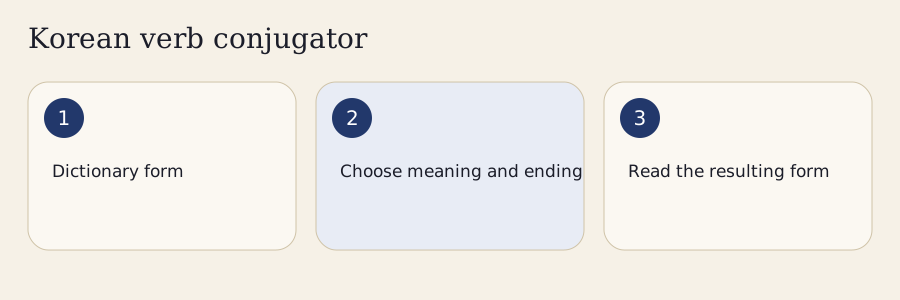
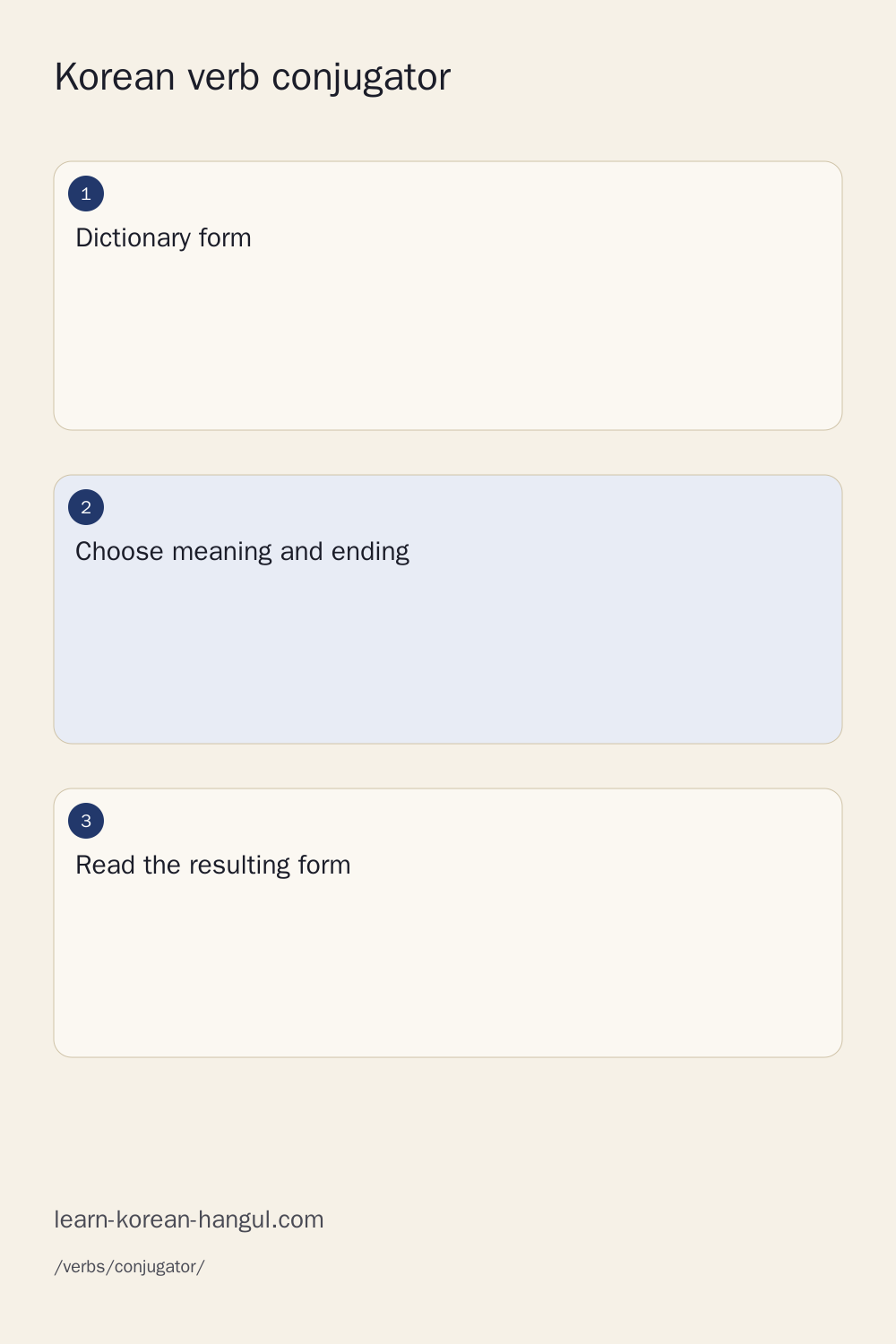
Start with one word rather than an entire sentence. Enter 먹다, its stem 먹, or the English meaning eat, and press Conjugate. The result opens with the everyday polite present form 먹어요. The next line supplies the past form 먹었어요 and formal form 먹습니다 so that you can make a quick comparison without searching through a long chart. Choose another construction from Form to replace the main result. Copy transfers only that result to your clipboard.
When the spelling has several meanings, choose the meaning before using a result. This step matters even when two meanings happen to generate the same letters. A saved entry keeps the selected sense as well as the form, so your study list can distinguish a question from something buried in the ground. More contains the full catalog, explanations, comparison, speech, lists and export. Open one mode at a time to keep your immediate task clear.
Can I Enter an English Meaning or a Conjugated Word?
Yes, where the local word list has an exact matching meaning. Meaning search returns candidates; it cannot infer everything you intend from an English sentence. If a meaning has no match, use the Korean spelling from a dictionary. A conjugated input such as 들어요 can return more than one base. Choose between them using the surrounding context. Recognized romanized dictionary forms also search the entries, but romanization is a lookup aid rather than a guarantee of unique Korean spelling.
Do not treat a successful match as a sentence correction. The conjugator does not decide whether your subject, particle, object or intended social tone is appropriate. Keep the original sentence beside the result and consider the ending's meaning. For sentence-level work, separate the predicate you want to investigate from the words around it. Copying a complete sentence into the box does not silently send it to an external analysis service.
What Is the Korean Dictionary Form?
The dictionary form conventionally ends in 다. Remove that ending to locate the stem: 먹다 has 먹, 가다 has 가, and 공부하다 has 공부하. This is a useful first step, but a stem is not necessarily the form you should use in conversation. In a polite everyday statement, a speaker normally needs an appropriate conjugated ending. The dictionary form identifies the entry; the selected construction determines how that entry appears in a sentence.
Preserve meaningful spaces in compound expressions. A space may separate an auxiliary predicate from the main predicate, and removing it can obscure the construction you are trying to learn. Modern Hangul entered with decomposed Unicode letters is normalized for matching. Isolated compatibility letters are different from complete syllables, so use a Korean keyboard or the site's Korean keyboard to compose them. Unknown input stays visible so you can correct it without retyping everything.
Why Can the Same Spelling Have Different Conjugations?
묻다 demonstrates why a spelling alone cannot settle lexical identity. The asking sense uses the ㄷ alternation and gives 물어요. The burying and staining senses retain ㄷ and give 묻어요. Before the consonant-starting connective 고, the asking sense still gives 묻고. It would therefore be misleading to attach a single irregular label to every occurrence of the spelling or to change every final ㄷ mechanically.
The same problem occurs with 걷다 and 이르다. Walking gives 걸어요, while a regular sense of 걷다 gives 걷어요. Reaching with 이르다 gives 이르러요; telling gives 일러요. The adjective meaning early has its own grammatical behavior. Compare senses side by side when a dictionary lists several entries. The chooser never ranks a meaning as most frequent without evidence. Use the verb dictionary for fuller meaning and usage context.
Do Korean Adjectives Conjugate Like Verbs?
Korean descriptive predicates can finish sentences with tense and speech-level endings, so the conjugator includes adjectives as well as action verbs. English word categories do not map perfectly onto Korean categories. A word translated as an English adjective may belong to a Korean predicate construction with special aspect or usage. Read the selected part of speech and meaning together; a translation alone cannot determine every compatible ending.
The difference becomes particularly clear before a noun. An action verb commonly uses 는 for a present modifier, whereas a descriptive predicate commonly uses 은 or a final ㄴ. Existing and absent predicates use their own pattern: 있다 gives 있는 and 없다 gives 없는. These are grammatical modifiers rather than complete polite sentences. For a fuller introduction, read verbs versus adjectives before selecting a modifier solely from its English label.
Present Modifiers: 적은 and 적는
The spelling 적다 includes different lexical meanings. The descriptive meaning few or little produces 적은, whereas the action meaning write down produces 적는 in the present modifier slot. The noun that follows supplies essential context. A chart that silently treats every 적다 as an action verb would hide this distinction and could produce an inappropriate modifier for your intended meaning.
Keep modifiers and sentence endings in separate practice groups. For a useful exercise, make one column for dictionary forms, one for everyday polite statements, and one for noun modifiers. Explain aloud whether each entry describes a quality or an action. Then inspect the sense choice, rather than memorizing a rule that every word with the same final syllable behaves alike. The comparison mode helps preserve this distinction when you change the ending while holding the meaning constant.
Choose Tense, Aspect and Speech Level
The main selector contains everyday polite, casual, formal and plain constructions as well as advanced endings. These labels describe different dimensions. Politeness toward a listener differs from formality; subject honorification differs from both. Korean predicates do not conjugate by English or Spanish person rows such as I, you and he. Changing the subject does not automatically require a different person ending in the way it would in many European languages.
Use the beginner filter for a short reference list, then expand to intermediate or advanced constructions when you have a sentence in mind. Present, past and prospective forms are useful starting points, but a chart cannot decide whether an event is completed, ongoing or being inferred. Some forms refer to recollection or a resulting state. Treat their labels as prompts to ask what the sentence means. The polite present recipe explains the basic stem and ending sequence in more detail.
Are -겠어요 and -(으)ㄹ 거예요 the Same Future Tense?
No single English future label captures both constructions. The prospective form with 거예요 often points toward a future event, expectation or plan. The 겠 construction can express intention, willingness or inference, depending on context. Both may appear in sentences translated with will, but that shared translation does not make them interchangeable. The catalog therefore keeps them in separate rows and gives them distinct construction identifiers.
For practice, first state what the speaker knows. Is the speaker making a commitment, describing a planned action, or reacting to evidence? Next choose the construction that suits that purpose, and check the whole sentence in a lesson or dictionary example. Replacing every occurrence of an English future with 겠 would erase useful meaning. Conversely, automatically replacing 겠 with a prospective phrase would lose some inference and intention uses. A conjugator supplies forms; context supplies the choice.
Honorific -시- Versus Listener Politeness
The Honorific setting adds a grammatical layer associated with the subject. It is separate from the level used to address the listener. A polite ending such as 요 does not by itself mean that the subject is honored. Similarly, a subject-honorific form can occur inside more than one speech level. Identify the person being described and the person listening before deciding which dimensions need to change.
Some lexical choices require more than insertion of 시. Eating, drinking, sleeping and being present can involve special honorific vocabulary, and humble vocabulary can place the speaker or an action toward someone respected in a different relationship. Do not infer that every respectful sentence requires the same substitution. The generated regular honorific pattern is a useful grammatical reference, while lexical honorific and humble choices require a meaning-specific dictionary check. Social guidance remains contextual rather than a fixed age-based command.
How Do Irregular Korean Verbs Change?
An irregular class is a lexical property associated with an entry or sense. The final consonant may suggest a question to ask, but it cannot reliably assign the class. Many words that look alike use different alternations. The ending also matters: an alternation triggered before a vowel may not appear before a consonant. Compare at least a polite vowel-ending form, a conditional and a formal or connective form before deciding that you understand a class.
The engine treats Hangul syllables as structured initial, vowel and final components. It changes the components needed by the selected pattern and then composes a new complete syllable. This avoids handling Korean spelling as arbitrary Latin letters. The ㅂ irregular lesson and ㅎ irregular lesson explain two families where the surface form can differ substantially from the dictionary spelling. Always keep the sense and trigger alongside the result.
ㄷ and ㅅ: Change the Stem Only When the Sense Allows It
For the asking sense of 묻다, a vowel-starting construction produces the ㄹ alternation seen in 물어요. A consonant-starting connective preserves the spelling seen in 묻고. In a ㅅ irregular pattern, the final ㅅ disappears before the relevant vowel ending: 짓다 produces 지어요. The resulting two vowels do not automatically contract just because another class permits contraction. Apply the lexical operation before considering the ending's written form.
Regular look-alikes are just as useful as famous irregulars. When you compare words, keep a regular example beside each irregular one. A student who learns only a list of exceptional outputs may begin applying the exception to every matching spelling. Ask whether the dictionary describes this particular sense as irregular, whether the ending triggers the operation, and whether an accepted full form accompanies the contraction. Those three questions catch more mistakes than a broad statement that final ㄷ or ㅅ always changes.
ㅂ, 르, 러, ㅎ and Vowel Changes
The ㅂ pattern commonly replaces the final consonant with a vowel-bearing form before the appropriate vowel ending. Some lexical choices lead to 와 rather than 워. The 르 pattern adds a ㄹ to the preceding syllable before the relevant 아 or 어 sequence; the 러 pattern is different, as the reaching sense of 이르다 illustrates. Do not collapse 르 and 러 into one class because their dictionary forms look similar.
Color adjectives also need precise vowel handling. The dark-vowel color pattern produces 퍼레요 rather than a blanket application of 애. The demonstrative family has a different contraction, including 그래요. The ㅡ pattern consults the preceding syllable where appropriate, giving different outcomes from stems whose last vowel alone would suggest 어. These contrasts are useful worked examples of why “remove 다 and add 요” is an insufficient recipe. For spelling authority, consult NIKL's orthography explanation.
How Do I Make a Negative Form?
Short 안 negation and long 지 않다 negation can express non-action or a negative description. 못 and 지 못하다 normally concern inability or a failure to accomplish something rather than simply choosing not to do it. The prohibition construction with 지 말다 serves another purpose. Select the negative meaning you need, rather than cycling through negative rows as if their English translations were identical.
Negatives also expose compatibility differences. A description is not automatically a controllable action, and a result-state word may need an aspectual interpretation. Copula negation uses 아니다 with the appropriate particle, producing 학생이 아니에요 and 의사가 아니에요 in the examples. The spelling 아니에요 differs from the common learner error 아니예요. Treat noun-plus-copula input as its own construction; inserting 안 in front of every positive sentence is not a universal method of Korean negation.
Where Does 안 Go with 하다 Compounds?
The lexical structure of a 하다 predicate matters. With an activity noun construction, 공부 안 해요 is a useful common pattern. 안 공부해요 should not be rejected by a universal rule simply because another order is often a more suitable beginner example. Preferred phrasing depends on emphasis and context. The tool retains the whole-predicate alternative where supplied, while keeping the split pattern distinct in the sense metadata.
좋아하다 and 깨끗하다 should not be handled by blindly splitting every spelling before 하다. The forms 안 좋아해요 and 안 깨끗해요 illustrate whole-predicate negation. More complex words such as 잘하다 and 못하다 also have conventional meanings that affect what a negative phrase communicates. For a careful explanation, read negation with 하다 verbs and consider the lexical meaning rather than treating written 하다 as evidence that an independent activity noun must precede it.
Questions, Commands and Suggestions
Questions, requests, commands and proposals are different constructions even when a surface form can overlap. An everyday polite statement and question may share their written ending while punctuation and intonation distinguish the immediate function. Formal questions have another ending. A plain question may sound direct or blunt in a context where an everyday polite question would be more suitable. Choose the function first, then the speech level.
Action-oriented commands and proposals are not mechanically available for every adjective. When a construction is incompatible with a descriptive sense, the tool shows an explanation instead of presenting the result as a usable paradigm. This is a compatibility decision about the selected construction, not a declaration that the word can never appear in any request, wish or special discourse context. Distinguishing those cases helps learners avoid both overgeneration and an equally misleading blanket ban.
Why Is 행복하세요 Possible?
A wish for happiness provides a context in which 행복하세요 is legitimate. It does not mean that every adjective takes every ordinary action-command construction. The catalog therefore separates the wish construction from general command rows. An English translation such as be happy can hide this grammatical and pragmatic distinction, so identify whether the speaker is wishing someone well or ordering an action.
When a tool says to choose another form, investigate the reason before assuming that the dictionary word is wrong. The restriction may concern the construction rather than the lemma. A contextual example can clarify the intended speech act, but its existence should not be generalized into a license to combine arbitrary adjective stems with arbitrary requests. Keep exceptional wishes in a separate practice group and compare their social purpose with ordinary action requests.
Connectives, Modifiers and Auxiliary Patterns
Connectives join clauses through relationships such as sequence, cause, contrast, condition and simultaneity. The catalog includes 고, 아/어서, conditional endings, while constructions and other common reference patterns. Their exact implications depend on clause order, tense and context. Search within the catalog by the English label or Korean letters, and use the level filter to reduce visual clutter. Select a row to bring its form into the main result panel.
Noun modifiers can describe a current action, a completed event, a prospective event or recollection. Those meanings should not be reduced to a single set of English tense names. Nominal forms with 기 and 음 or final ㅁ have a different function again. The tool supplies separate rows so that exporting a study chart does not collapse a modifier into a complete sentence ending. Add a noun or surrounding clause in your own notes to show how you intend to use the form.
Build a Phrase without Combining Incompatible Endings
Auxiliary patterns include wanting, ability, obligation, permission, attempts and resulting states. They are useful reference constructions, but a menu of endings is not permission to chain every pair. A progressive construction normally needs a suitable action meaning. A result-state construction requires a compatible lexical or contextual interpretation. Passive and causative meanings may belong to separate dictionary entries; they cannot all be derived by appending one universal suffix.
Plan a compound phrase in stages. Identify the lexical predicate, specify the auxiliary's meaning, then conjugate the appropriate final predicate at the desired level. Preserve spaces where the construction requires them. If your intended chain is not supported, examine each layer in a dictionary or grammar lesson rather than accepting an attractive-looking generated string. The current catalog gives individual reference patterns; meaning-sensitive arbitrary auxiliary chaining and lexical relation expansion require further verified data.
Can This Tool Recover the Dictionary Form?
Reverse lookup checks supported generated forms and retains each compatible lexical sense. 들어요 can match 듣다 and 들다, so a single answer would be misleading. The chooser presents candidate meanings, and each candidate is linked to a construction that regenerates the entered spelling. Matching an exact form gives a useful morphological hypothesis; it does not identify the speaker's intended meaning with certainty.
Unknown inflected input may belong to a word outside the available local entries, an unsupported contraction, a differently spaced phrase or an input error. Try a dictionary spelling and consult the surrounding sentence. Very long input receives a clear limit message without silently cutting off text. The engine does not infer a word's lexical irregularity from the final consonant alone and then present a guessed lemma as a verified dictionary result. Reverse ambiguity is a normal language feature, not a failure to be hidden.
Pronunciation, Romanization and Audio
Written Hangul, pronounced Hangul and Revised Romanization answer different questions. For 먹습니다, the written form remains 먹습니다, the pronunciation reference is 먹씀니다, and standard RR is meokseumnida. Writing meoksseumnida as if every tense sound were doubled in standard RR would conflate a pronunciation hint with the official romanization system. Keep the three labels visible in your notes whenever a sound change creates a tempting respelling.
The browser speech option is a synthetic fallback. It depends on the Korean voices installed on the device and may be unavailable offline even when conjugation works. Choose a slower playback speed if that helps you hear the sequence, but do not treat synthetic playback as an owned teacher recording or an assessment of your pronunciation. No microphone is needed for this tool. For longer text, use the romanization converter and consult NIKL's RR rules.
Save Forms and Print a Study Chart
Save stores the selected sense and construction in a named local list. It does not award mastery or a streak merely because you looked up a word. Copy Share Link places the public selection in a URL fragment so another learner can reopen that choice. Private notes are not included. List export makes a portable JSON backup; import validates recognized entries before restoring them. Browser storage restrictions can affect persistence, so retain a backup for important study lists.
Export offers Unicode CSV, TSV and JSON. A blank chart removes the answer column contents for practice. The print view includes your heading and optional pronunciation; the browser's print dialog controls paper size, orientation and PDF saving. Batch export accepts up to one hundred lines. Unresolved words remain in the output with a reason instead of disappearing silently. Use print preview before distributing a chart, and keep the answer version nearby for checking. These are local files, and no account or paid conversion service is required.
How Are These Forms Checked?
The program generates forms deterministically from lexical metadata and construction rules. Regression checks cover explicit spelling examples, homograph distinctions, accepted contractions, Unicode normalization and reverse regeneration. Automated success does not establish that every lexical sense, social use or example has been approved by a Korean specialist. The site does not label generated data as human-reviewed merely because the code produces a stable result.
Authoritative spelling and romanization rules come from NIKL; dictionary references help distinguish lexical senses. The current entries originate in the project's existing candidate registry, with additional sense records retained for audit. Do not interpret the size of that local list as the size of a licensed, reviewed national dictionary. Licensed inventory expansion, full pronunciation coverage and human audio remain separate evidence requirements. Report a suspected problem with the exact lemma, sense, selected construction and intended context so a correction can target the right record.
Frequently Asked Questions
Can I export a chart without pronunciation columns? Yes. Open More, select Export and turn off Include Pronunciation before printing. CSV and other text exports preserve Korean spelling; choose TSV for a simple spreadsheet table or JSON for structured records. Preview the selected forms and keep a separate answer version when producing a blank worksheet for students.
Will my favorite forms remain available offline? Favorites are stored in the browser on this device. The loaded generator can continue producing local forms without a network connection, but reopening an uncached page may require connectivity. Browser speech also depends on installed voices. Export a list backup before clearing browser data or moving to another device.
Can I share a particular meaning of a homograph? Yes. Select its meaning and construction, then choose Copy Share Link in Save. The URL fragment carries the sense identifier, form and honorific setting. Another person opening the same supported version can restore that selection. A shared link contains public study settings and does not carry your private list name.
Does entering a whole sentence send it to a server? No. The conjugator performs its ordinary matching and generation in the browser. It does not submit the box contents to a translation or analysis API. A full sentence may have no lexical match, because this tool investigates supported predicates and forms. Visit another tool deliberately when you want sentence-level analysis.
Why does a saved card change after a dictionary correction? A saved selection identifies a sense and construction rather than freezing every future rule forever. A corrected generator can therefore display a corrected spelling or explanation when that record is restored. Keep a dated exported copy if a teaching handout needs a fixed snapshot, and recheck it before distributing it again.
Continue Learning with the Korean Verb Conjugator
Use the Korean verb conjugator to investigate one specific grammatical question, then return to connected speech and reading. Choose a meaning, compare two endings and explain the difference in your own words. The present-tense recipe, irregular lessons and verb dictionary help turn a copied result into understanding. Practice a small selection repeatedly rather than treating a large exported chart as proof that you can use every construction naturally.