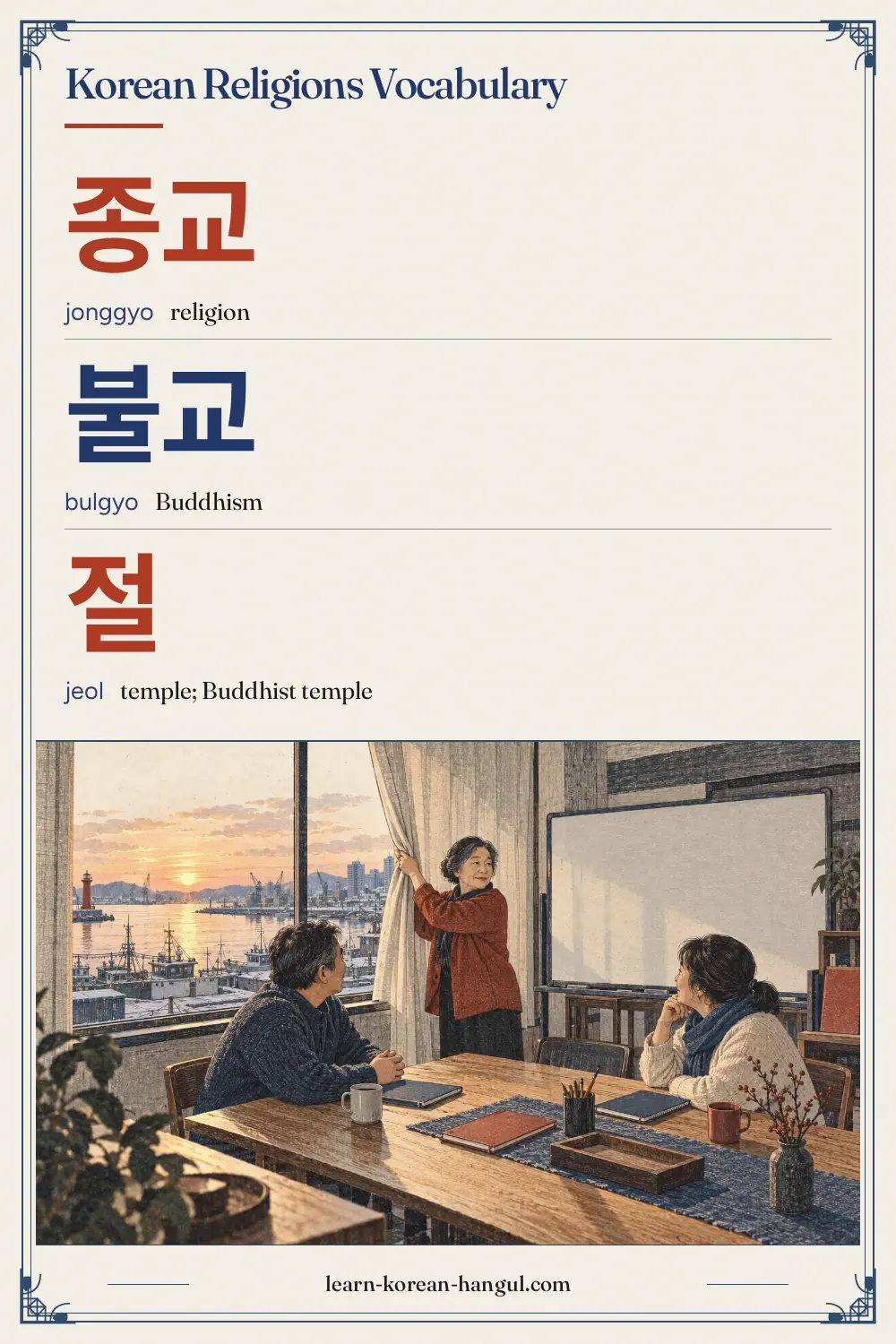
Korean Religions Vocabulary at a Glance
Korean religions vocabulary lets you read a street sign, follow a news item and ask a friend a polite question without saying anything wrong. Most religion names end in 교, which means teaching or religion: 불교 is Buddhism, 기독교 is Christianity and 유교 is Confucianism. Places of worship have their own words, and so do the people who lead services. This page holds 30 words in five groups, and it describes beliefs and does not rank them.
| Group | Words | Use |
|---|---|---|
| Main religions | 8 | Naming the religions on signs and in the news |
| Places of worship | 5 | Reading signs and giving directions |
| People and roles | 6 | Naming religious leaders and believers |
| Rituals and festivals | 6 | Talking about services and holidays |
| Beliefs | 5 | Talking about gods, spirits and the soul |
The list belongs to Korean Culture Words. Religion also appears in old history, and the history list has the temple and heritage terms. The next section says where to start.
Which Religion Words Should You Learn First?
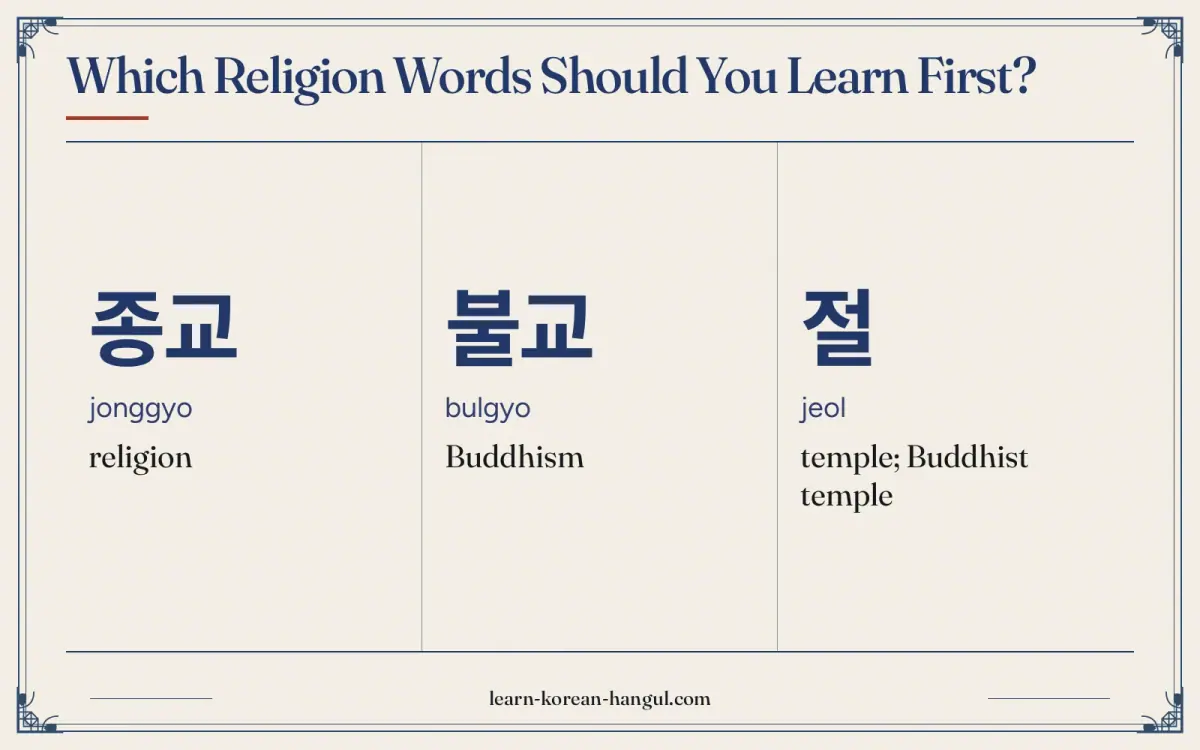
Learn 종교, 불교, 기독교, 천주교, 절 and 교회 first. They are the words you will see on maps and signs, and they let you answer the common question 종교가 있어요? (Do you have a religion?). Then add the people and the ceremonies.
- Day one. 종교, 불교, 기독교, 개신교, 천주교 and 이슬람교.
- Day two. The places: 절, 사찰, 교회, 성당 and 모스크.
- Day three. The people: 스님, 목사, 신부, 수녀, 신자 and 무당.
- Day four. The ceremonies, festivals and beliefs.
At 8 to 10 words a day, the list takes three to four days plus review. This scene puts eight of the words on one picture.
Word · 8
- 1
종교
jonggyo
religion
- 2
불교
bulgyo
Buddhism
- 3
절
jeol
temple; Buddhist temple
- 4
교회
gyohoe
church (Protestant)
- 5
성당
seongdang
Catholic church; cathedral
- 6
모스크
moseukeu
mosque
- 7
스님
seunim
Buddhist monk or nun
- 8
목사
moksa
Protestant pastor
By origin, the list has 23 Sino-Korean words, 2 native words, 2 loanwords, 2 mixed words and 1 phrase. Sino-Korean words dominate because religious terms came into Korean with Chinese characters. The native words are 절 and 하나님, while 모스크 and 미사 are loanwords. 이슬람교 combines a loanword with 교, and 스님 is usually traced to Sino-Korean 승 (monk) plus the honorific 님. The origin column in each table marks them.
Main Religions
Religion in general is 종교. The names of the main religions end in 교. Buddhism is 불교, Confucianism is 유교, and Islam is 이슬람교. Christianity has three words: 기독교, 개신교 for Protestantism and 천주교 for Catholicism. Korea also has a folk tradition called 무속, which is often described in English as shamanism.
| No. | Hangul | Revised Romanization | Origin | Meaning | Example sentence | Audio assetId |
|---|---|---|---|---|---|---|
| 1 | 종교 | jonggyo | Sino-Korean | religion | 저는 종교가 없어요. (I have no religion.) | au-pg-vocabulary-culture-religions-1; example: au-pg-vocabulary-culture-religions-31 |
| 2 | 불교 | bulgyo | Sino-Korean | Buddhism | 불교는 한국에서 오래된 종교예요. (Buddhism is an old religion in Korea.) | au-pg-vocabulary-culture-religions-2; example: au-pg-vocabulary-culture-religions-32 |
| 3 | 기독교 | gidokgyo | Sino-Korean | Christianity | 기독교는 예수님을 믿는 종교예요. (Christianity is the religion that believes in Jesus.) | au-pg-vocabulary-culture-religions-3; example: au-pg-vocabulary-culture-religions-33 |
| 4 | 개신교 | gaesingyo | Sino-Korean | Protestantism; Protestant Christianity | 개신교 교회에서 일요일에 예배를 드려요. (Protestant churches hold a service on Sunday.) | au-pg-vocabulary-culture-religions-4; example: au-pg-vocabulary-culture-religions-34 |
| 5 | 천주교 | cheonjugyo | Sino-Korean | Catholicism | 천주교 신자는 성당에 가요. (Catholics go to a cathedral or Catholic church.) | au-pg-vocabulary-culture-religions-5; example: au-pg-vocabulary-culture-religions-35 |
| 6 | 이슬람교 | iseullamgyo | mixed | Islam | 한국에도 이슬람교 신자가 있어요. (There are Muslims in Korea too.) | au-pg-vocabulary-culture-religions-6; example: au-pg-vocabulary-culture-religions-36 |
| 7 | 유교 | yugyo | Sino-Korean | Confucianism | 유교는 제사 문화와 관련이 있어요. (Confucianism is connected with the culture of ancestral rites.) | au-pg-vocabulary-culture-religions-7; example: au-pg-vocabulary-culture-religions-37 |
| 8 | 무속 | musok | Sino-Korean | muism; Korean folk religion; shamanism | 무속은 오래된 민간 신앙이에요. (Musok is an old folk belief.) | au-pg-vocabulary-culture-religions-8; example: au-pg-vocabulary-culture-religions-38 |
Notice the two words for Christianity. In everyday Korean, 기독교 often means Protestant Christianity, and 천주교 means the Catholic Church, though formally 기독교 covers both. If you want to be exact, say 개신교 for Protestant and 천주교 for Catholic. To ask about religion politely, use 종교가 있으세요? and be ready for the answer 없어요, which is a normal reply.
Example Sentences
Each example is a short polite sentence. Most follow the pattern place + 에 + 가요 (go to a place) or subject + 이/가 + verb. The sentences about belief use 믿어요 (believe). Say each one aloud and swap the noun: 일요일에 교회에 가요 becomes 일요일에 성당에 가요 when you replace 교회 with 성당.
Start with 종교가 없어요, because it is the sentence you will use most often. The places come next.
How Do You Say Places of Worship in Korean?
Each tradition has its own word for its building. A Buddhist temple is a 절, or more formally a 사찰. A Protestant church is a 교회, and the Catholic church or cathedral is a 성당. A mosque is a 모스크. Learn the difference between 교회 and 성당, because English uses church for both.
| No. | Hangul | Revised Romanization | Origin | Meaning | Example sentence | Audio assetId |
|---|---|---|---|---|---|---|
| 9 | 절 | jeol | native | temple; Buddhist temple | 주말에 절에 가요. (I go to a temple on weekends.) | au-pg-vocabulary-culture-religions-9; example: au-pg-vocabulary-culture-religions-39 |
| 10 | 사찰 | sachal | Sino-Korean | Buddhist temple (formal word) | 이 사찰은 산속에 있어요. (This temple is in the mountains.) | au-pg-vocabulary-culture-religions-10; example: au-pg-vocabulary-culture-religions-40 |
| 11 | 교회 | gyohoe | Sino-Korean | church (Protestant) | 일요일에 교회에 가요. (I go to church on Sunday.) | au-pg-vocabulary-culture-religions-11; example: au-pg-vocabulary-culture-religions-41 |
| 12 | 성당 | seongdang | Sino-Korean | Catholic church; cathedral | 성당 종소리가 들려요. (I hear the church bell.) | au-pg-vocabulary-culture-religions-12; example: au-pg-vocabulary-culture-religions-42 |
| 13 | 모스크 | moseukeu | loanword | mosque | 서울에도 모스크가 있어요. (There is a mosque in Seoul too.) | au-pg-vocabulary-culture-religions-13; example: au-pg-vocabulary-culture-religions-43 |
The syllable 절 has a second meaning, a deep bow, as in 큰절. Context separates them: 절에 가요 means I go to a temple, and 절을 해요 means I bow. Many temple names end in 사, as in 불국사 (Bulguksa), and signs near temples use the words 절 and 사찰.
People and Roles
Religious leaders are always called with the honorific 님. A Buddhist monk or nun is a 스님. A Protestant pastor is a 목사, and a Catholic priest is a 신부. A Catholic nun is a 수녀. An ordinary believer is a 신자. A shaman, who leads rites in the folk tradition, is a 무당.
| No. | Hangul | Revised Romanization | Origin | Meaning | Example sentence | Audio assetId |
|---|---|---|---|---|---|---|
| 14 | 스님 | seunim | mixed | Buddhist monk or nun | 스님이 절에서 살아요. (The monk lives in the temple.) | au-pg-vocabulary-culture-religions-14; example: au-pg-vocabulary-culture-religions-44 |
| 15 | 목사 | moksa | Sino-Korean | Protestant pastor | 목사님이 교회에서 일해요. (The pastor works at the church.) | au-pg-vocabulary-culture-religions-15; example: au-pg-vocabulary-culture-religions-45 |
| 16 | 신부 | sinbu | Sino-Korean | Catholic priest | 신부님이 성당에서 기도해요. (The priest prays at the church.) | au-pg-vocabulary-culture-religions-16; example: au-pg-vocabulary-culture-religions-46 |
| 17 | 수녀 | sunyeo | Sino-Korean | nun (Catholic) | 수녀님은 성당에서 봉사해요. (The nun does volunteer work at the church.) | au-pg-vocabulary-culture-religions-17; example: au-pg-vocabulary-culture-religions-47 |
| 18 | 신자 | sinja | Sino-Korean | believer; follower | 그는 불교 신자예요. (He is a Buddhist.) | au-pg-vocabulary-culture-religions-18; example: au-pg-vocabulary-culture-religions-48 |
| 19 | 무당 | mudang | Sino-Korean | shaman; practitioner of folk religion | 무당이 굿을 해요. (The shaman performs a ritual.) | au-pg-vocabulary-culture-religions-19; example: au-pg-vocabulary-culture-religions-49 |
Always add 님 when you speak to or about a religious leader: 스님, 목사님, 신부님, 수녀님. The bare words are used only when you talk about the role in general. The table below shows which words belong together.
| Tradition | Name | Place | Leader | Service |
|---|---|---|---|---|
| Buddhism | 불교 | 절 | 스님 | 법회 |
| Protestantism | 개신교 | 교회 | 목사 | 예배 |
| Catholicism | 천주교 | 성당 | 신부 | 미사 |
| Islam | 이슬람교 | 모스크 | 이맘 | 예배 |
The row for Buddhism has 법회, a gathering for teaching and chanting, which is not in the main list. The last row uses 이맘, the loanword for imam.
How Do You Say Rituals and Festivals in Korean?
Each tradition has a main service. Protestants hold an 예배, and Catholics attend a 미사. Praying is 기도. Many families also hold a 제사, a ritual to remember ancestors, which has Confucian roots. Two religious days are public holidays: 부처님 오신 날 (Buddha's Birthday) and 성탄절 (Christmas Day).
| No. | Hangul | Revised Romanization | Origin | Meaning | Example sentence | Audio assetId |
|---|---|---|---|---|---|---|
| 20 | 예배 | yebae | Sino-Korean | worship service (Protestant) | 일요일 아침에 예배를 드려요. (I attend the worship service on Sunday morning.) | au-pg-vocabulary-culture-religions-20; example: au-pg-vocabulary-culture-religions-50 |
| 21 | 미사 | misa | loanword | Mass (Catholic service) | 성당에서 미사를 드려요. (I attend Mass at the church.) | au-pg-vocabulary-culture-religions-21; example: au-pg-vocabulary-culture-religions-51 |
| 22 | 기도 | gido | Sino-Korean | prayer | 저는 매일 기도해요. (I pray every day.) | au-pg-vocabulary-culture-religions-22; example: au-pg-vocabulary-culture-religions-52 |
| 23 | 제사 | jesa | Sino-Korean | ancestral rite | 추석에 제사를 지내요. (We hold an ancestral rite at Chuseok.) | au-pg-vocabulary-culture-religions-23; example: au-pg-vocabulary-culture-religions-53 |
| 24 | 부처님 오신 날 | bucheonim osin nal | phrase | Buddha's Birthday | 부처님 오신 날에는 절에서 연등을 달아요. (On Buddha's Birthday, people hang lotus lanterns at temples.) | au-pg-vocabulary-culture-religions-24; example: au-pg-vocabulary-culture-religions-54 |
| 25 | 성탄절 | seongtanjeol | Sino-Korean | Christmas Day (formal name) | 성탄절은 12월 25일이에요. (Christmas Day is 25 December.) | au-pg-vocabulary-culture-religions-25; example: au-pg-vocabulary-culture-religions-55 |
The verbs differ by ritual. You hold a service with 드리다 (예배를 드려요), you hold an ancestral rite with 지내다 (제사를 지내요), and you pray with 하다 (기도해요). In everyday speech many people say 크리스마스 for Christmas, and 성탄절 is the formal name that appears on many calendars. The public holiday's name in government regulations is 기독탄신일.
Beliefs and Traditional Faith
The last group names beliefs. 신 is a god or deity in general. Protestants call God 하나님, and Catholics call God 하느님, which is also the standard dictionary form. 천사 is an angel, 영혼 is a soul, and 귀신 is a ghost or spirit, common in folk stories.
| No. | Hangul | Revised Romanization | Origin | Meaning | Example sentence | Audio assetId |
|---|---|---|---|---|---|---|
| 26 | 신 | sin | Sino-Korean | god; deity | 그는 신을 믿어요. (He believes in God.) | au-pg-vocabulary-culture-religions-26; example: au-pg-vocabulary-culture-religions-56 |
| 27 | 하나님 | hananim | native | God (Protestant usage) | 하나님께 기도해요. (I pray to God.) | au-pg-vocabulary-culture-religions-27; example: au-pg-vocabulary-culture-religions-57 |
| 28 | 천사 | cheonsa | Sino-Korean | angel | 아기가 천사 같아요. (The baby looks like an angel.) | au-pg-vocabulary-culture-religions-28; example: au-pg-vocabulary-culture-religions-58 |
| 29 | 영혼 | yeonghon | Sino-Korean | soul; spirit | 영혼은 죽지 않는다고 믿어요. (I believe the soul does not die.) | au-pg-vocabulary-culture-religions-29; example: au-pg-vocabulary-culture-religions-59 |
| 30 | 귀신 | gwisin | Sino-Korean | ghost; spirit | 귀신이 무서워요. (I am afraid of ghosts.) | au-pg-vocabulary-culture-religions-30; example: au-pg-vocabulary-culture-religions-60 |
The word 신 has several homophones. It also means shoes (신발 is the usual word) and new, as in 신랑. Context decides. When speaking about someone's belief, say 믿어요 (believe) and avoid asking directly which religion is right.
How Do You Pronounce These Words?
Religion words are mostly said as they are spelled, but several change. The table lists the ones that learners most often miss.
| Spelling | Pronunciation | What happens |
|---|---|---|
| 기독교 | [기독꾜] | The ㄱ after a final ㄱ becomes a tense ㄲ |
| 목사 | [목싸] | The ㅅ after a final ㄱ becomes tense |
| 교회 | [교회/교훼] | The vowel ㅚ can be said as a diphthong, [we] |
| 절에 | [저레] | The final ㄹ moves onto the vowel ㅔ, so 절에 sounds like jeo-re |
| 신을 | [시늘] | The final ㄴ moves onto the vowel ㅡ of 을 |
| 귀신이 | [귀시니] | The final ㄴ moves onto the vowel of 이 |
The rules come from the Standard Pronunciation rules (표준 발음법) of the 국립국어원.
Audio and Slow Playback
Each word has a normal clip, and 5 key words also have a slow clip at 0.8 times the speed: 종교, 불교, 기독교, 천주교 and 부처님 오신 날. Nothing plays until you press a button.
Listen to 기독교 first. You should hear a tense 'kk' at the start of the last syllable, [기독꾜], with no puff of air.
What Mistakes Do Learners Make with Religion Words?
- Using 기독교 for the Catholic Church only. 천주교 is the Catholic Church, and 기독교 covers Christianity as a whole.
- Calling every Christian building a 교회. A Protestant church is a 교회, and a Catholic church is a 성당.
- Confusing 절 (temple) with 절 (bow). Context decides: 절에 가요 is I go to a temple.
- Leaving off 님 with religious leaders. Say 스님, 목사님, 신부님 and 수녀님.
- Treating 하나님 and 하느님 as the same everywhere. Protestants say 하나님, and Catholics say 하느님.
The first mistake changes the meaning, and the others change the register or sound. Religion is personal, so ask about it only when the other person starts the topic. The next section turns the list into practice.
Practice: Flashcards and Worksheet
Drill these words with the vocabulary flashcard decks. A printable worksheet for these words (word list, matching, writing practice, fill-in-the-blank exercises and answer key) is available in A4 and US Letter from the download card on this page. Progress in the decks is saved only in your browser.
Korean Religions Vocabulary Worksheet
Try this five-question check, then say the 30 words aloud once more.
Practice · 5
What does 불교 mean?
Show answer
Buddhism
불교 (bulgyo) means Buddhism.
What does 절 mean?
Show answer
temple; Buddhist temple
절 (jeol) means temple; Buddhist temple.
What does 스님 mean?
Show answer
Buddhist monk or nun
스님 (seunim) means Buddhist monk or nun.
What does 제사 mean?
Show answer
ancestral rite
제사 (jesa) means ancestral rite.
What does 천사 mean?
Show answer
angel
천사 (cheonsa) means angel.
For one word at a time, see the religion in Korean entry.
Where to Go Next
This list sits inside Korean Culture Words. After Korean religions vocabulary, many learners move on to history words that mention temples and kings.
Frequently Asked Questions
How Do You Say Religion in Korean?
Religion is 종교 (jonggyo). Most religion names end in 교, as in 불교 (Buddhism) and 기독교 (Christianity). To say you have no religion, use 저는 종교가 없어요 (jeoneun jonggyoga eopseoyo). To ask someone, say 종교가 있으세요? with a rising end. Press the audio button to hear the word.
How Do You Pronounce 불교 (bulgyo)?
불교 is said bul-gyo, in two beats. The first syllable 불 ends in a light ㄹ, made by touching the tongue just behind the upper teeth. The second syllable 교 starts with a soft g and has the glide yo. Use the slow clip to match the rhythm, and keep the two syllables even.
How Many Religion Words Should I Learn First?
Learn six first: 종교, 불교, 기독교, 천주교, 절 and 교회. That takes one day. Then add the people and the ceremonies. The whole list of 30 takes three to four days at 8 to 10 words a day, with review on the fifth day.
Where Can I Practise Religion Words with Flashcards?
Use the vocabulary flashcard decks, which list every deck with audio. A deck for these words is planned. Progress stays in your browser. The history list covers the heritage terms on temple signs, so review it together with this page if you plan to visit a temple.
Is the Romanization on This Page Official?
It follows the Revised Romanization of Korean, which South Korea officially adopted on 7 July 2000 and whose rules the National Institute of Korean Language (국립국어원) publishes. It is a learning aid that does not mark every sound change, so learn the Hangul and use the audio to hear the real sound.
Is There a Printable Worksheet for Religion Words?
A printable worksheet for these words (word list, matching, writing practice, fill-in-the-blank exercises and answer key) is available in A4 and US Letter from the download card on this page. For practice, copy the tables above by hand: write the Hangul, cover the English column, and check your answers against the page.