Korean Royal Palaces Vocabulary at a Glance
Korean royal palaces vocabulary starts with the five grand palaces of Seoul, called 궁궐, and then moves outward to the people who lived in them and the history around them. A visit to 경복궁 or 창덕궁 gives you the first group in real life, while the sign boards give you the second and third. Almost every word is Sino-Korean, so the endings repeat: 궁 means palace, 왕 means king, and 전 means hall. This page holds 35 words in five groups.
| Group | Words | Use |
|---|---|---|
| The five palaces | 8 | Reading palace names and tickets |
| Royal titles | 8 | Naming the king, the family and the court |
| Dynasties and eras | 8 | Naming periods of Korean history |
| War and independence | 5 | Reading about wars and national days |
| Heritage terms | 6 | Reading museum and site signs |
The list belongs to Traditional Culture. If you are planning a trip, the tourist attractions list has the words for tickets and sightseeing, and palace in Korean covers the single word. The next section says where to start.
Which Palace and History Words Should You Learn First?
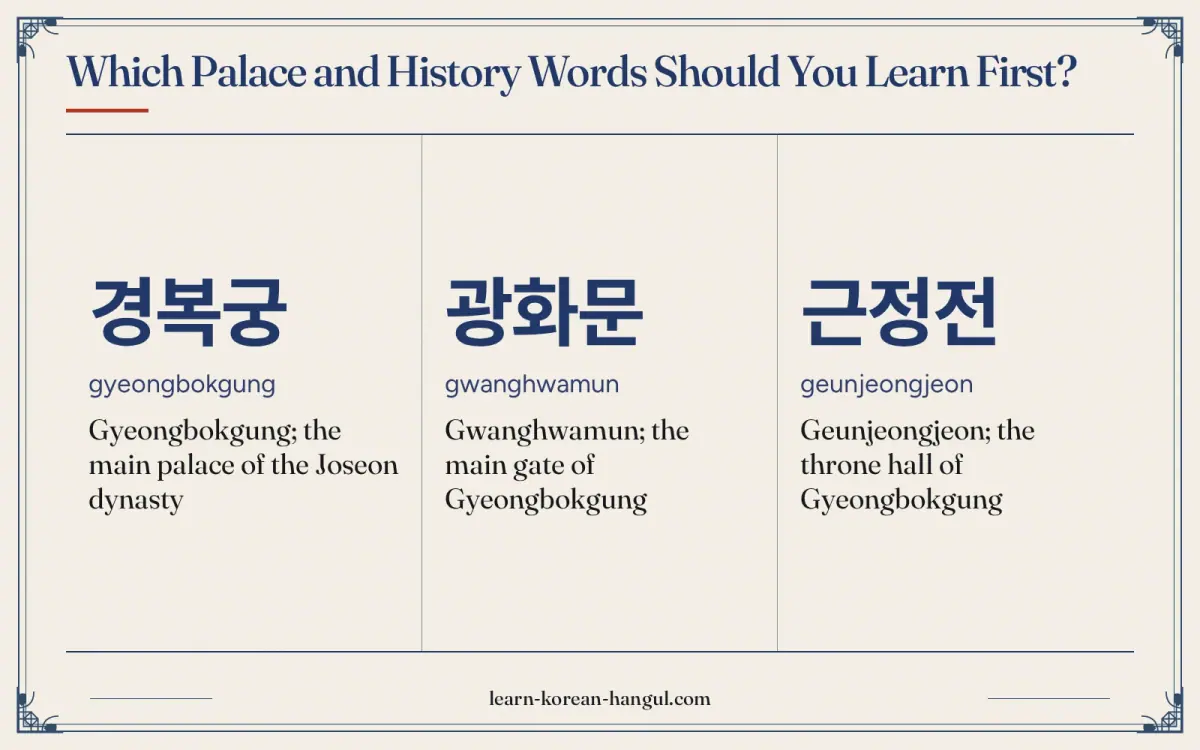
Learn 궁궐, 경복궁, 왕, 조선 and 역사 first. They let you read a palace ticket, understand a guide's first sentence and ask where something is. Then add the titles, because they appear on every sign inside the palace grounds.
- Day one. The five starter words, plus 창덕궁, 광화문 and 근정전.
- Day two. 창경궁, 덕수궁 and 경희궁, and the royal titles 임금, 왕비, 세자, 왕자, 공주, 궁녀 and 신하.
- Day three. The eras and 전쟁: 삼국시대, 신라, 고려, 대한제국, 일제강점기, 시대 and 전쟁.
- Day four. The other war and independence words, and the heritage terms.
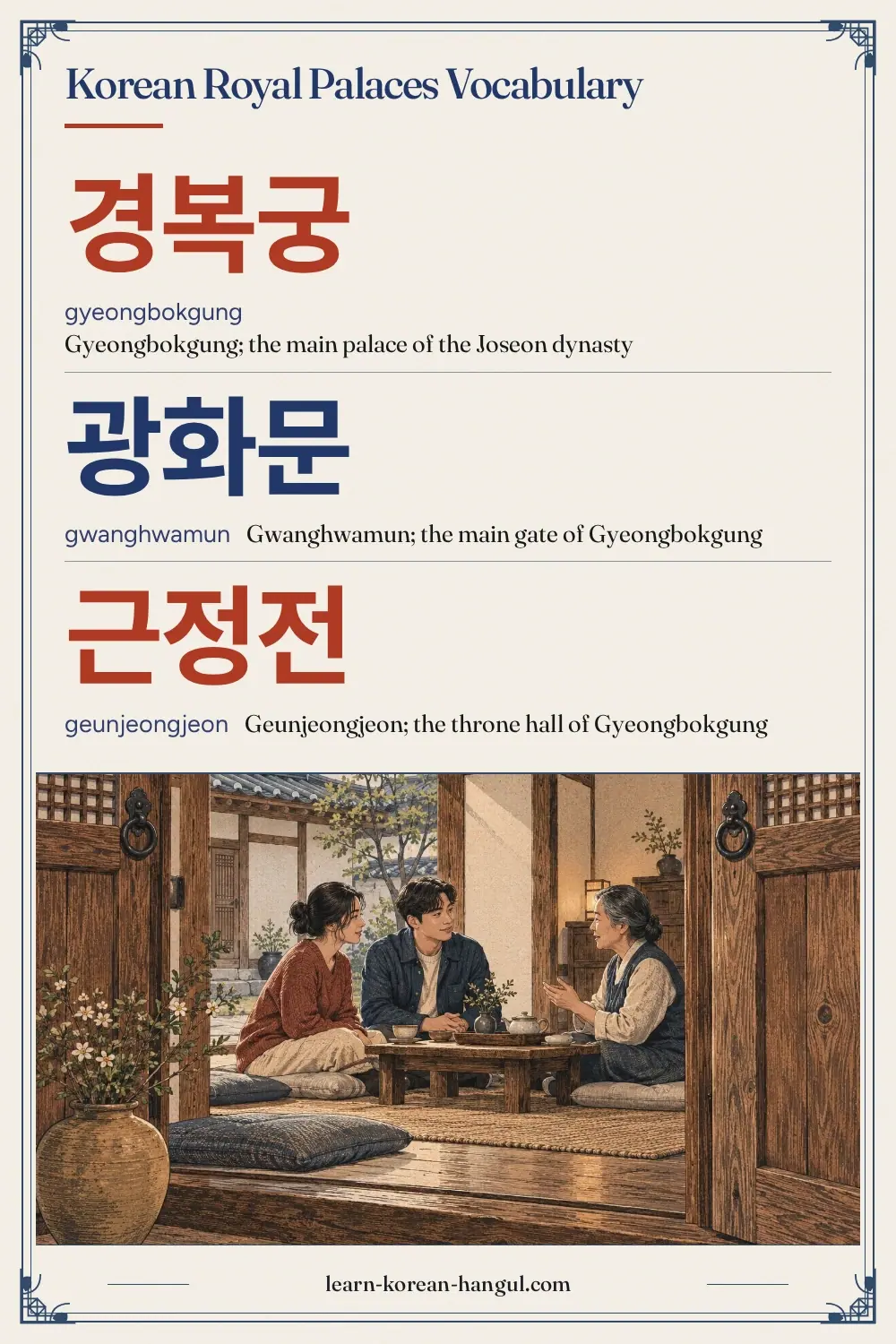
At 7 to 10 words a day, the list takes four days plus review. The words on days three and four are longer, so give them extra time. This scene puts eight of the words on one picture.
Word · 8
- 1
경복궁
gyeongbokgung
Gyeongbokgung; the main palace of the Joseon dynasty
- 2
광화문
gwanghwamun
Gwanghwamun; the main gate of Gyeongbokgung
- 3
근정전
geunjeongjeon
Geunjeongjeon; the throne hall of Gyeongbokgung
- 4
왕
wang
king
- 5
왕비
wangbi
queen; king's wife
- 6
궁녀
gungnyeo
court lady; palace maid
- 7
신하
sinha
royal official; subject of a king
- 8
국보
gukbo
national treasure
By origin, the list has 33 Sino-Korean words, 1 native word and 1 mixed word. Sino-Korean words dominate because palace and history terms were written in Chinese characters for centuries. The one native word is 임금, an older word for king. The origin column in each table marks them.
The Five Palaces
Seoul has five grand palaces from the Joseon dynasty, and each name ends in 궁 (palace): 경복궁, 창덕궁, 창경궁, 덕수궁 and 경희궁. The general word for a royal palace is 궁궐. Inside 경복궁 you walk through the main gate 광화문 and reach the throne hall 근정전.
| No. | Hangul | Revised Romanization | Origin | Meaning | Example sentence | Audio assetId |
|---|---|---|---|---|---|---|
| 1 | 경복궁 | gyeongbokgung | Sino-Korean | Gyeongbokgung; the main palace of the Joseon dynasty | 경복궁에서 사진을 찍어요. (I take photos at Gyeongbokgung.) | au-pg-vocabulary-culture-traditional-palaces-history-1; example: au-pg-vocabulary-culture-traditional-palaces-history-36 |
| 2 | 창덕궁 | changdeokgung | Sino-Korean | Changdeokgung; a palace known for its rear garden | 창덕궁은 후원이 유명해요. (Changdeokgung is famous for its rear garden.) | au-pg-vocabulary-culture-traditional-palaces-history-2; example: au-pg-vocabulary-culture-traditional-palaces-history-37 |
| 3 | 창경궁 | changgyeonggung | Sino-Korean | Changgyeonggung; the palace next to Changdeokgung | 창경궁은 창덕궁 옆에 있어요. (Changgyeonggung is next to Changdeokgung.) | au-pg-vocabulary-culture-traditional-palaces-history-3; example: au-pg-vocabulary-culture-traditional-palaces-history-38 |
| 4 | 덕수궁 | deoksugung | Sino-Korean | Deoksugung; a palace near Seoul City Hall | 덕수궁은 시청 근처에 있어요. (Deoksugung is near City Hall.) | au-pg-vocabulary-culture-traditional-palaces-history-4; example: au-pg-vocabulary-culture-traditional-palaces-history-39 |
| 5 | 경희궁 | gyeonghuigung | Sino-Korean | Gyeonghuigung; the fifth of the grand palaces | 경희궁에 갔어요. (I went to Gyeonghuigung.) | au-pg-vocabulary-culture-traditional-palaces-history-5; example: au-pg-vocabulary-culture-traditional-palaces-history-40 |
| 6 | 궁궐 | gunggwol | Sino-Korean | palace; royal palace complex | 서울에는 궁궐이 다섯 개 있어요. (There are five palaces in Seoul.) | au-pg-vocabulary-culture-traditional-palaces-history-6; example: au-pg-vocabulary-culture-traditional-palaces-history-41 |
| 7 | 광화문 | gwanghwamun | Sino-Korean | Gwanghwamun; the main gate of Gyeongbokgung | 광화문은 경복궁의 정문이에요. (Gwanghwamun is the main gate of Gyeongbokgung.) | au-pg-vocabulary-culture-traditional-palaces-history-7; example: au-pg-vocabulary-culture-traditional-palaces-history-42 |
| 8 | 근정전 | geunjeongjeon | Sino-Korean | Geunjeongjeon; the throne hall of Gyeongbokgung | 근정전은 경복궁의 정전이에요. (Geunjeongjeon is the main hall of Gyeongbokgung.) | au-pg-vocabulary-culture-traditional-palaces-history-8; example: au-pg-vocabulary-culture-traditional-palaces-history-43 |
The five names look alike, so learn them by their first syllable: 경복, 창덕, 창경, 덕수, 경희. 궁 on its own also means palace, as in 궁에 가요, but 궁궐 is the usual general word, and inside a name 궁 is always the ending. The table below gives one fact to attach to each name.
| Palace | Hangul | A fact to attach to the name |
|---|---|---|
| Gyeongbokgung | 경복궁 | The main palace of Joseon, with the gate 광화문 and the hall 근정전 |
| Changdeokgung | 창덕궁 | A UNESCO World Heritage Site, known for its rear garden 후원 |
| Changgyeonggung | 창경궁 | Stands beside Changdeokgung |
| Deoksugung | 덕수궁 | Stands near Seoul City Hall |
| Gyeonghuigung | 경희궁 | A smaller palace in central Seoul |
Opening days and hours differ by palace and change from time to time, so check each palace's official website before a visit.
Example Sentences
Each example is a short sentence in the polite 해요 style, in the present or the past. Most follow the pattern place + 에서 + action (do something at a place), as in 경복궁에서 사진을 찍어요, or subject + 은/는 + noun + 이에요 (X is Y). The historical examples use the past form, such as 이었어요 and 있었어요, because they describe the past. Say each one aloud and swap the noun.
Learn the five palace names as a block, then use them in the first sentence form. The titles come next.
How Do You Say Royal Titles in Korean?
Palace signs and historical dramas use a set of titles. The king is 왕, or the older native word 임금. His wife is the 왕비, his sons are 왕자, and the heir is the 세자. His daughters are 공주. The staff of the palace include 궁녀 (court ladies), and the officials who advised the king are 신하.
| No. | Hangul | Revised Romanization | Origin | Meaning | Example sentence | Audio assetId |
|---|---|---|---|---|---|---|
| 9 | 임금 | imgeum | native | king; ruler (older native word) | 옛날에는 임금이 나라를 다스렸어요. (In the old days a king ruled the country.) | au-pg-vocabulary-culture-traditional-palaces-history-9; example: au-pg-vocabulary-culture-traditional-palaces-history-44 |
| 10 | 왕 | wang | Sino-Korean | king | 세종은 조선의 왕이었어요. (Sejong was a king of Joseon.) | au-pg-vocabulary-culture-traditional-palaces-history-10; example: au-pg-vocabulary-culture-traditional-palaces-history-45 |
| 11 | 왕비 | wangbi | Sino-Korean | queen; king's wife | 왕비는 왕의 부인이에요. (The queen is the king's wife.) | au-pg-vocabulary-culture-traditional-palaces-history-11; example: au-pg-vocabulary-culture-traditional-palaces-history-46 |
| 12 | 세자 | seja | Sino-Korean | crown prince; heir to the throne | 세자는 다음 왕이에요. (The crown prince is the next king.) | au-pg-vocabulary-culture-traditional-palaces-history-12; example: au-pg-vocabulary-culture-traditional-palaces-history-47 |
| 13 | 왕자 | wangja | Sino-Korean | prince; son of a king | 왕자는 왕의 아들이에요. (A prince is the king's son.) | au-pg-vocabulary-culture-traditional-palaces-history-13; example: au-pg-vocabulary-culture-traditional-palaces-history-48 |
| 14 | 공주 | gongju | Sino-Korean | princess; daughter of a king | 공주는 왕의 딸이에요. (A princess is the king's daughter.) | au-pg-vocabulary-culture-traditional-palaces-history-14; example: au-pg-vocabulary-culture-traditional-palaces-history-49 |
| 15 | 궁녀 | gungnyeo | Sino-Korean | court lady; palace maid | 궁녀는 궁궐에서 일했어요. (Court ladies worked in the palace.) | au-pg-vocabulary-culture-traditional-palaces-history-15; example: au-pg-vocabulary-culture-traditional-palaces-history-50 |
| 16 | 신하 | sinha | Sino-Korean | royal official; subject of a king | 신하가 왕에게 말했어요. (The official spoke to the king.) | au-pg-vocabulary-culture-traditional-palaces-history-16; example: au-pg-vocabulary-culture-traditional-palaces-history-51 |
Notice the pattern: 왕 is the root, and 왕비, 왕자 and 왕릉 are built from it. 임금 is the older native word, and you hear it in historical dramas as well as in 임금님. A few famous kings also get the title 대왕 (great king), as in 세종대왕.
Dynasties and Eras
Korean history is taught as a series of states and eras. The 삼국시대 (Three Kingdoms period) is the time of the kingdoms of 고구려, 백제 and 신라. After them came 고려, then 조선, then the 대한제국, and then the 일제강점기. The two general words are 시대 for an era and 역사 for history.
| No. | Hangul | Revised Romanization | Origin | Meaning | Example sentence | Audio assetId |
|---|---|---|---|---|---|---|
| 17 | 삼국시대 | samguksidae | Sino-Korean | Three Kingdoms period | 삼국시대에는 세 나라가 있었어요. (In the Three Kingdoms period there were three states.) | au-pg-vocabulary-culture-traditional-palaces-history-17; example: au-pg-vocabulary-culture-traditional-palaces-history-52 |
| 18 | 신라 | silla | Sino-Korean | Silla; one of the Three Kingdoms | 신라는 경주가 수도였어요. (Gyeongju was the capital of Silla.) | au-pg-vocabulary-culture-traditional-palaces-history-18; example: au-pg-vocabulary-culture-traditional-palaces-history-53 |
| 19 | 고려 | goryeo | Sino-Korean | Goryeo; the dynasty before Joseon | 고려의 수도는 개경이었어요. (The capital of Goryeo was Gaegyeong.) | au-pg-vocabulary-culture-traditional-palaces-history-19; example: au-pg-vocabulary-culture-traditional-palaces-history-54 |
| 20 | 조선 | joseon | Sino-Korean | Joseon; the dynasty that ruled from 1392 to 1910 | 조선은 오백 년 넘게 이어졌어요. (Joseon lasted more than five hundred years.) | au-pg-vocabulary-culture-traditional-palaces-history-20; example: au-pg-vocabulary-culture-traditional-palaces-history-55 |
| 21 | 대한제국 | daehanjeguk | Sino-Korean | Korean Empire (1897 to 1910) | 대한제국은 1897년에 시작됐어요. (The Korean Empire began in 1897.) | au-pg-vocabulary-culture-traditional-palaces-history-21; example: au-pg-vocabulary-culture-traditional-palaces-history-56 |
| 22 | 일제강점기 | iljegangjeomgi | Sino-Korean | the period of Japanese colonial rule (1910 to 1945) | 일제강점기는 1910년부터 1945년까지였어요. (The colonial period lasted from 1910 to 1945.) | au-pg-vocabulary-culture-traditional-palaces-history-22; example: au-pg-vocabulary-culture-traditional-palaces-history-57 |
| 23 | 시대 | sidae | Sino-Korean | era; period | 그 시대의 생활이 궁금해요. (I am curious about life in that era.) | au-pg-vocabulary-culture-traditional-palaces-history-23; example: au-pg-vocabulary-culture-traditional-palaces-history-58 |
| 24 | 역사 | yeoksa | Sino-Korean | history | 한국 역사를 공부해요. (I study Korean history.) | au-pg-vocabulary-culture-traditional-palaces-history-24; example: au-pg-vocabulary-culture-traditional-palaces-history-59 |
Notice that 조선 refers to the historic dynasty in South Korean usage. The same word is also part of the official name of North Korea, but in this list it means the dynasty. The table below puts the main periods in order, with dates.
| Period | Hangul | Dates |
|---|---|---|
| Goryeo | 고려 | 918 to 1392 |
| Joseon | 조선 | 1392 to 1910 |
| Korean Empire | 대한제국 | 1897 to 1910 |
| Japanese colonial period | 일제강점기 | 1910 to 1945 |
| Liberation | 광복 | 1945 |
| Korean War | 한국전쟁 | 1950 to 1953 |
The dates for the Three Kingdoms and Silla are not in the table because the start and end years depend on how historians count them. The word 일제강점기 is the standard Korean term in textbooks. It joins 일제 (Imperial Japan) and 강점 (forced occupation) with 기 (period).
How Do You Say War and Independence in Korean?
This group is short, because it names only the most common terms. 전쟁 is the general word for war. The 임진왜란 was the Japanese invasions of Korea that began in 1592. The 한국전쟁 is the Korean War of the early 1950s. Two words name the end of colonial rule and the goal behind it: 광복 and 독립.
| No. | Hangul | Revised Romanization | Origin | Meaning | Example sentence | Audio assetId |
|---|---|---|---|---|---|---|
| 25 | 전쟁 | jeonjaeng | Sino-Korean | war | 전쟁이 끝났어요. (The war ended.) | au-pg-vocabulary-culture-traditional-palaces-history-25; example: au-pg-vocabulary-culture-traditional-palaces-history-60 |
| 26 | 임진왜란 | imjinwaeran | Sino-Korean | the Imjin War; the Japanese invasions of 1592 | 임진왜란은 1592년에 시작됐어요. (The Imjin War began in 1592.) | au-pg-vocabulary-culture-traditional-palaces-history-26; example: au-pg-vocabulary-culture-traditional-palaces-history-61 |
| 27 | 한국전쟁 | hangukjeonjaeng | Sino-Korean | the Korean War | 한국전쟁은 1950년에 일어났어요. (The Korean War broke out in 1950.) | au-pg-vocabulary-culture-traditional-palaces-history-27; example: au-pg-vocabulary-culture-traditional-palaces-history-62 |
| 28 | 광복 | gwangbok | Sino-Korean | liberation; the restoration of national sovereignty | 한국은 1945년에 광복을 맞았어요. (Korea welcomed liberation in 1945.) | au-pg-vocabulary-culture-traditional-palaces-history-28; example: au-pg-vocabulary-culture-traditional-palaces-history-63 |
| 29 | 독립 | dongnip | Sino-Korean | independence | 그들은 나라의 독립을 위해 싸웠어요. (They fought for the country's independence.) | au-pg-vocabulary-culture-traditional-palaces-history-29; example: au-pg-vocabulary-culture-traditional-palaces-history-64 |
광복 and 독립 are close but not the same. 광복 (liberation) names the event of 1945 and has its own national day, 광복절. 독립 (independence) names the goal and the movement, as in the 독립운동 independence movement. Both words are neutral terms in school textbooks, and wars are described plainly, without opinion.
Heritage Terms
Heritage terms are the words on the signs next to old buildings and objects. 문화재 is cultural property in general. The state ranks the most important items as 국보 (national treasure) and 보물 (treasure), and a protected place can be a 사적 (historic site). Changdeokgung and the Joseon royal tombs, called 왕릉, are on the UNESCO list, called 유네스코 세계유산.
| No. | Hangul | Revised Romanization | Origin | Meaning | Example sentence | Audio assetId |
|---|---|---|---|---|---|---|
| 30 | 문화재 | munhwajae | Sino-Korean | cultural property; cultural heritage item | 문화재를 소중히 지켜요. (We protect cultural heritage carefully.) | au-pg-vocabulary-culture-traditional-palaces-history-30; example: au-pg-vocabulary-culture-traditional-palaces-history-65 |
| 31 | 국보 | gukbo | Sino-Korean | national treasure | 국보는 가장 중요한 문화재예요. (A national treasure is the most important cultural property.) | au-pg-vocabulary-culture-traditional-palaces-history-31; example: au-pg-vocabulary-culture-traditional-palaces-history-66 |
| 32 | 보물 | bomul | Sino-Korean | treasure; a designated cultural property | 이 책은 보물로 지정됐어요. (This book was designated a treasure.) | au-pg-vocabulary-culture-traditional-palaces-history-32; example: au-pg-vocabulary-culture-traditional-palaces-history-67 |
| 33 | 사적 | sajeok | Sino-Korean | historic site | 경복궁은 사적이에요. (Gyeongbokgung is a historic site.) | au-pg-vocabulary-culture-traditional-palaces-history-33; example: au-pg-vocabulary-culture-traditional-palaces-history-68 |
| 34 | 유네스코 세계유산 | yuneseuko segyeyusan | mixed | UNESCO World Heritage Site | 창덕궁은 유네스코 세계유산이에요. (Changdeokgung is a UNESCO World Heritage Site.) | au-pg-vocabulary-culture-traditional-palaces-history-34; example: au-pg-vocabulary-culture-traditional-palaces-history-69 |
| 35 | 왕릉 | wangneung | Sino-Korean | royal tomb | 조선 왕릉도 세계유산이에요. (The Joseon royal tombs are also World Heritage.) | au-pg-vocabulary-culture-traditional-palaces-history-35; example: au-pg-vocabulary-culture-traditional-palaces-history-70 |
A good rule: 문화재 is the category, and 국보 and 보물 are two ranks inside it. Older signs add a number, as in 국보 제1호 (national treasure no. 1), but official designations no longer use these numbers. Official usage has also moved toward the newer umbrella term 국가유산 (national heritage), while 문화재 is still the everyday word. The designation lists are kept by the state, so check the official heritage website for the current status of any item.
How Do You Pronounce These Words?
Palace and history words contain many tense-consonant changes, because a final ㄱ is followed by another consonant in Sino-Korean compounds. The table lists the changes that learners most often miss.
| Spelling | Pronunciation | What happens |
|---|---|---|
| 경복궁 | [경복꿍] | The ㄱ after the final ㄱ of 복 becomes a tense ㄲ |
| 덕수궁 | [덕쑤궁] | The ㅅ after a final ㄱ becomes tense |
| 경희궁 | [경히궁] | After a consonant, ㅢ is said as ㅣ, so 희 sounds like 히 |
| 삼국시대 | [삼국씨대] | The ㅅ after a final ㄱ becomes tense |
| 한국전쟁 | [한국쩐쟁] | The ㅈ after a final ㄱ becomes tense |
| 왕릉 | [왕능] | After a final ㅇ, the ㄹ is said as ㄴ |
| 독립 | [동닙] | After ㄱ the ㄹ is said as ㄴ, and the ㄱ then becomes ng before that ㄴ |
| 일제 (in 일제강점기) | [일쩨] | In a Sino-Korean word, a final ㄹ makes a following ㅈ tense |
| 국보 | [국뽀] | The ㅂ after a final ㄱ becomes tense |
The rules come from the Standard Pronunciation rules (표준 발음법) of the 국립국어원. The audio is generated with text-to-speech and checked by a Korean teacher before publication.
Audio and Slow Playback
Each word has a normal clip, and 5 key words also have a slow clip at 0.8 times the speed: 경복궁, 창덕궁, 임진왜란, 일제강점기 and 유네스코 세계유산. Nothing plays until you press a button.
Listen to 경복궁 first. You should hear a tense 'kk' at the start of the last syllable, as if the word were spelled 경복꿍, with no puff of air.
What Mistakes Do Learners Make with Palace and History Words?
- Reading 경복궁 as gyeong-bok-gung. The spoken form is [경복꿍], with a tense ㄲ.
- Reading 경희궁 as gyeong-hui-gung. After a consonant, 희 is said as 히, so it is [경히궁].
- Mixing up 광복 and 독립. 광복 names the 1945 liberation, and 독립 names independence and the movement for it.
- Taking 임진왜란 as a single event in one year. It names a war that began in 1592 and lasted several years.
The third mistake changes the meaning, and the others change only the sound or the usage. The next section turns the list into practice.
Practice: Flashcards and Worksheet
Drill these words with the vocabulary flashcard decks. A printable worksheet for these words (word list, matching, writing practice, fill-in-the-blank exercises and answer key) is available in A4 and US Letter from the download card on this page. Progress in the decks is saved only in your browser.
Korean Palaces and History Vocabulary Worksheet
Try this five-question check, then say the 35 words aloud once more.
Practice · 5
What does 경복궁 mean?
Show answer
Gyeongbokgung; the main palace of the Joseon dynasty
경복궁 (gyeongbokgung) means Gyeongbokgung; the main palace of the Joseon dynasty.
What does 왕비 mean?
Show answer
queen; king's wife
왕비 (wangbi) means queen; king's wife.
What does 고려 mean?
Show answer
Goryeo; the dynasty before Joseon
고려 (goryeo) means Goryeo; the dynasty before Joseon.
What does 광복 mean?
Show answer
liberation; the restoration of national sovereignty
광복 (gwangbok) means liberation; the restoration of national sovereignty.
What does 국보 mean?
Show answer
national treasure
국보 (gukbo) means national treasure.
History words are sensitive for some readers, so this page uses the standard textbook terms and states dates plainly.
Where to Go Next
This list sits inside Traditional Culture. After Korean royal palaces vocabulary, many learners move on to Hanok and Ondol Vocabulary for the houses of ordinary people, or to Korean Leisure Places Vocabulary for modern Korea.
Frequently Asked Questions
How Do You Say Gyeongbokgung in Korean?
Gyeongbokgung is 경복궁 (gyeongbokgung), the main palace of the Joseon dynasty in Seoul. The last syllable is said with a tense sound, [경복꿍], as in an ordinary spoken name. To say you are going there, use 경복궁에 가요 (gyeongbokgung-e gayo), which means I go to Gyeongbokgung.
How Do You Pronounce 창덕궁 (changdeokgung)?
창덕궁 is said [창덕꿍], with three beats: chang-deok-kkung. The vowel ㅓ in 덕 is made with unrounded lips, and the final ㄱ of 덕 is a closed sound with no release. The last syllable 궁 is tense, as if spelled 꿍. Use the slow clip to match the rhythm, and keep the syllables even.
How Many Palace and History Words Should I Learn First?
Learn five first: 궁궐, 경복궁, 왕, 조선 and 역사. That takes one day. Then add the other palace names, the royal titles and the eras. The whole list of 35 takes four days at 7 to 10 words a day, with review on the fifth day.
Where Can I Practise Palace and History Words with Flashcards?
Use the vocabulary flashcard decks, which list every deck with audio. A deck for these words is planned. Progress stays in your browser. The tourist attractions list has the practical words for tickets and tours, so review it together with this page before a palace visit.
Is the Romanization on This Page Official?
It follows the Revised Romanization of Korean, which South Korea officially adopted on 7 July 2000 and whose rules the National Institute of Korean Language (국립국어원) publishes. It is a learning aid that does not mark every sound change, so learn the Hangul and use the audio to hear the real sound.
Is There a Printable Worksheet for Palace and History Words?
A printable worksheet for these words (word list, matching, writing practice, fill-in-the-blank exercises and answer key) is available in A4 and US Letter from the download card on this page. For practice, copy the tables above by hand: write the Hangul, cover the English column, and check your answers against the page.