
Key facts
- Format: PDF with 10 exercise pages plus 1 answer-key page, in A4 and US Letter.
- Pages 1 to 4 cover 19 consonants, pages 5 to 7 cover 21 vowels, pages 8 and 9 cover 20 blocks and page 10 is a self-check.
- All 40 letters (19 consonants and 21 vowels) are in dictionary order.
- Level A0; about 10 to 15 minutes per page, free for personal and classroom use.
- Korean text on the sheets is machine-generated and was reviewed and signed off by Min-ji Park on 15 October 2026.
Download the Hangul Practice Sheets
Hangul Practice Sheets Pack
Download PDF (A4) PDF (US Letter)
Preview
Consonants ㄱㄲㄴㄷㄸ
Choose A4 or US Letter on the card. You can print the whole pack or any single page.
Why Practice All 40 Letters in This Order?
The pack moves from consonants to vowels to whole syllables, and within each group the letters follow South Korean dictionary order (ㄱ ㄲ ㄴ ... ㅎ, then ㅏ ㅐ ㅑ ... ㅣ). Hangul is an alphabet in which letters combine into blocks, so a learner needs the letters before the blocks. The Korean alphabet has 40 letters, 19 consonants plus 21 vowels, which the how many letters page counts in detail.
| Stage | Pages | What you write | Why it comes here |
|---|---|---|---|
| Consonants | 1 to 4 | ㄱ to ㅎ, 19 letters | Every block starts with a consonant, so these come first |
| Vowels | 5 to 7 | 아 to 이, 21 blocks with silent ㅇ | A vowel never stands alone, so it gets a placeholder ㅇ |
| Blocks | 8 to 9 | 20 starter syllables | First practice of combining the two kinds of letter |
| Self-check | 10 | 20 sound prompts | Retrieval: write from sound, not from a model |
The silent ㅇ deserves a note. At the start of a block, ㅇ has no sound, so 아 is just the vowel ㅏ written inside a block. Pages 5 to 7 print that ㅇ in light grey so you learn it as a placeholder and not as part of the vowel. Hear four examples before you begin: 가, 나, 아 and the letter name 기역.
The next section walks through the ten pages.
What Is on Each Page?

Pages 1 to 4: 19 Consonants, Tracing Then Free-Writing
Each page has four or five rows, one per letter. A row shows the letter name (for example 기역 for ㄱ), a 22 mm model with stroke arrows, three dotted copies and four empty boxes. At the foot of every page is a free-writing line: write that page's letters in order from memory. The pages split the consonants as ㄱ ㄲ ㄴ ㄷ ㄸ, then ㄹ ㅁ ㅂ ㅃ ㅅ, then ㅆ ㅇ ㅈ ㅉ ㅊ, then ㅋ ㅌ ㅍ ㅎ.
Pages 5 to 7: 21 Vowels with Silent ㅇ
Each page has seven vowel rows in the same format. Page 5 starts at 아 and ends at 여, page 6 runs from 예 to 우 and page 7 runs from 워 to 이.
Pages 8 and 9: 20 Starter Blocks
These two pages hold ten blocks each: 가 나 다 라 마 바 사 아 자 차 on page 8, then 카 타 파 하 거 너 도 무 스 기 on page 9. You write each block three times. The set mixes vertical-vowel blocks such as 가, 거 and 기 with horizontal-vowel blocks such as 도, 무 and 스, so you practise both block shapes.
Page 10: Self-Check Grid
Page 10 gives 20 Roman-letter prompts (g, n, d, m, b, s, j, ch, k, p, a, eo, o, u, eu, i, ae, e, ya, yeo). You write the Hangul letter that matches each one without looking back. This page is the honest test of whether the earlier pages worked.
Page 11: the Answer Key
The key shows reference models of all 40 letters with names, the 20 starter blocks and the 20 self-check answers.
How Do I Use This Sheet?

Plan a ten-day schedule: one page a day, about 10 to 15 minutes.
- Keep the model visible. Trace first, with the model in view. Checkpoint: your traced letter matches the model's stroke count.
- Say the sound aloud as you write. Say the letter name or its sound once per box.
- Close the pack and fill the free-writing line. Checkpoint: you can write the page's letters without peeking.
- Use page 10 on day ten, not before. Mark it with the key only afterwards.
- Redo missed letters. Rewrite each wrong answer three times.
Pair the pack with the korean alphabet flashcards so that you also hear each letter. Spacing your sessions over ten days is more effective than finishing in one sitting, because recall improves when you revisit a letter after a gap.
What Is the Answer Key For?
The key lets you check page 10 and compare your handwriting with reference letters and stroke arrows. Look at it only once you have finished all ten pages. Treat a wrong answer as information: if you wrote ㄱ for the sound "k", you have found a pair (ㄱ and ㅋ) to revisit.
Print Settings
| Setting | Value |
|---|---|
| Paper | A4 or US Letter; the download card gives both sizes |
| Scale | 100 percent ("actual size"), not "fit to page" |
| Colour | Black and white is enough; the dotted tracing letters are light grey |
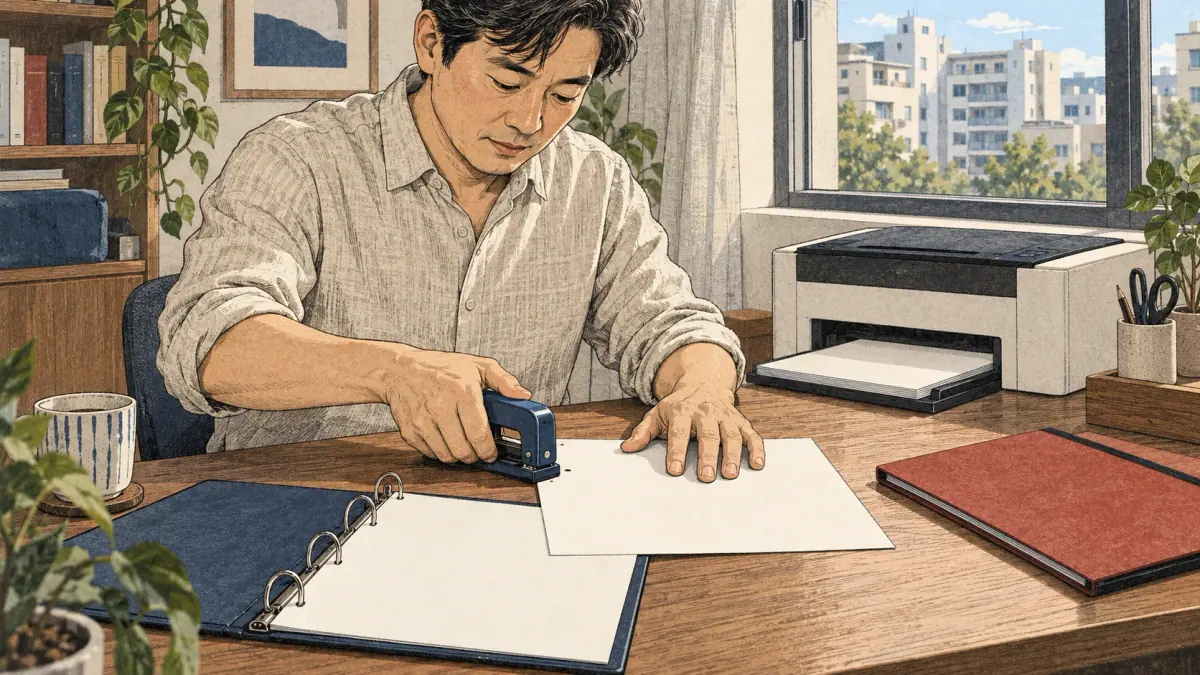
| Margins | 12 mm on every side, wide enough for a hole punch |
| Pages to print | Pages 1 to 10, plus the key as page 11 |
| Sides | Single-sided works best; the key can be printed on its own sheet |
Mistakes to Watch For

- Skipping the silent ㅇ. A vowel written alone is not a complete block. Fix: write ㅇ every time on pages 5 to 7.
- Writing too quickly. Speed makes shapes sloppy and teaches nothing. Fix: one box per breath.
- Not saying the letter aloud. Silent copying trains the hand but not recall of the sound. Fix: say each letter once per box.
- Peeking at the key. Early checking removes the test. Fix: keep the key face down until page 10 is done.
What This Pack Does Not Cover
The pack covers the 40 letters and 20 starter blocks. It does not cover final consonants (batchim), full syllable charts, sound changes or real reading practice. Those live on separate sheets: the hangul syllable chart worksheet and the how to write korean pages. Its Korean is generated and was reviewed and signed off by Min-ji Park on 15 October 2026, and the pack-versus-separate-sheets structure is still an open design decision.
What Should I Practice Next?

Once the ten pages are done, use the hangul practice sheets as a reference and move on:
- Test recall with the hangul alphabet quiz.
- Revise on one page with the korean alphabet practice sheet.
- Read the Korean alphabet overview for the bigger picture.
This pack is part of the hangul worksheets collection.
Frequently Asked Questions
How many pages does the pack have?
The pack has 10 exercise pages plus one answer-key page. Pages 1 to 4 are consonants, pages 5 to 7 are vowels with silent ㅇ, pages 8 and 9 are starter blocks and page 10 is a self-check grid. The key is an extra final page, printed on its own sheet.
Can I print selected pages?
Yes. Every page works on its own, so print the pages you need with your printer's page-range setting, for example 5 to 7 for the vowels only. Keep the scale at 100 percent so the boxes keep their size. Print the key separately and give it to learners after the work.
Are the hangul practice sheets free?
Free for personal and classroom use. Teachers may print copies for their students. No reselling or republishing online.
Are there answers for the self-check page?
Yes. The final key page lists the answer to each of the 20 prompts on page 10 and shows reference models of all 40 letters with stroke arrows. Check only after you finish page 10, then rewrite each miss three times and try the page again a few days later.
How long does the whole pack take?
Plan on about two hours in total: 10 to 15 minutes for each of the 10 pages. A good schedule is one page a day for ten days. Short sessions spread over several days help you remember letters better than one long sitting, and they keep your handwriting careful.
May I use these worksheets in class?
Free for personal and classroom use. Teachers may print copies for their students. No reselling or republishing online.
Free for personal and classroom use. Teachers may print copies for their students. No reselling or republishing online.