Key facts
- Modern Hangul has 24 basic letters and 40 when double consonants and compound vowels are counted separately.
- Each modern syllable block contains an initial consonant, a vowel and an optional final consonant.
- The default practice set contains ten items; the original thirty-question checkpoint remains available through More.
- Progress saving is optional and local to this browser. Export a file to move saved records yourself.
- Visual recognition, spelling recall and assisted answers describe different kinds of performance.
- Practise with written Hangul questions. Audio recordings and picture questions are unavailable.
How Do You Use the Hangul Alphabet Quiz?
Start with the visible ten-item practice set, or open Setup to choose known letters and an exercise mode. Check each answer, read the component explanation, then deliberately move to the next item. A finished session separates independent answers from answers completed with a hint.
- Choose your scope. Letters practise individual shapes; open blocks combine an initial and vowel; finals add the bottom slot; words use a small explicitly labelled text vocabulary set. Expect only exercises whose prerequisites match your selected letters.
- Commit an answer. Tap a choice or use the arrow keys inside the radio group. Check evaluates the current choice once, while changing a choice before checking has no effect on the score.
- Inspect the explanation. A changed initial, vowel or final identifies a specific reading problem. The explanation shows the target components rather than asking you to interpret a colour alone.
- Retry useful misses. The result screen offers a retry set using the same prompt IDs. Treat that second pass as additional practice, since recently seeing an answer makes it different from the first attempt.
Untimed practice is the default. A recording, Korean keyboard or account is unnecessary for component selection. Use the smaller scope whenever a mixed set makes it difficult to remember what each question asks. The next section helps choose that scope.
Choosing Letters, Blocks and Word Practice
The four units differ in the amount of information held in one target. Letter exercises show an isolated symbol. Open blocks add a relationship between two positions. Written-final exercises add a third position. Word exercises require reading several blocks without losing their order.
| Practice unit | Main task | Useful preparation |
|---|---|---|
| Letters | Recognize individual consonant and vowel shapes | Know the selected letter inventory |
| Open blocks | Separate the initial and vowel | Recognize both component shapes |
| Written finals | Identify the bottom consonant slot | Read open blocks comfortably |
| Real words | Keep blocks in order and recall an explicitly given meaning | Know every letter in the selected words |
Mixed practice combines eligible units. A word gloss describes the sense used by that item; a decoding block has no promised dictionary meaning. Unicode can construct a valid block without making it a Korean word. The block questions practise decoding letter combinations rather than dictionary meanings.
Which Letters Should a Beginner Practise First?
Begin with letters already introduced in a lesson, then expand after several unassisted answers. The default basic set contains fourteen consonants and ten vowels, but the paged known-letter selector lets you remove unfamiliar symbols instead of accepting the entire set.
A limited selection changes both targets and distractors. With only ㄱ, ㄴ and ㅏ selected, open-block practice can use 가 and 나; a choice containing ㅋ would introduce a letter outside that scope. A short eligible pool produces a shorter session, with an explicit notice, rather than invented vocabulary. For the first introduction to these shapes, learn the Korean alphabet and return with a familiar set.
How Are Hangul Syllable Blocks Read?
Read the initial consonant first, the vowel second and any written final last. A block's shape changes with its vowel, while those component roles remain the same. Reading the whole block requires following position as well as identifying individual strokes.
A vertical vowel such as ㅏ sits beside its initial: 가 contains ㄱ and ㅏ. A horizontal vowel such as ㅗ sits below the initial: 고 contains ㄱ and ㅗ. A compound vowel such as ㅘ uses a combined arrangement: 과 contains ㄱ and the single vowel slot ㅘ. A written final goes at the bottom of any of these arrangements.
A block without an initial consonant sound still needs its initial position filled. Initial ㅇ serves that role in 아; final ㅇ has a different function in 강. The trainer's labelled components help prevent carrying a positional explanation into the wrong slot.
The modern Unicode formula is U+AC00 + ((initial index × 21) + vowel index) × 28 + final index. The final index is zero when there is no final. This arithmetic describes the encoding of modern blocks, not the pronunciation or meaning of every result. The Unicode Hangul algorithm defines this encoding; the separate lesson explains how Hangul blocks are built.
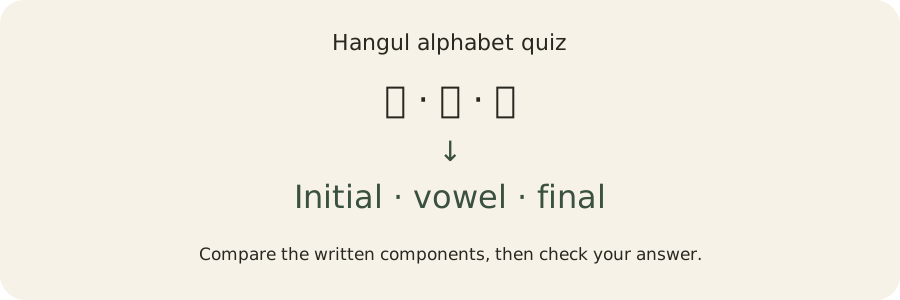
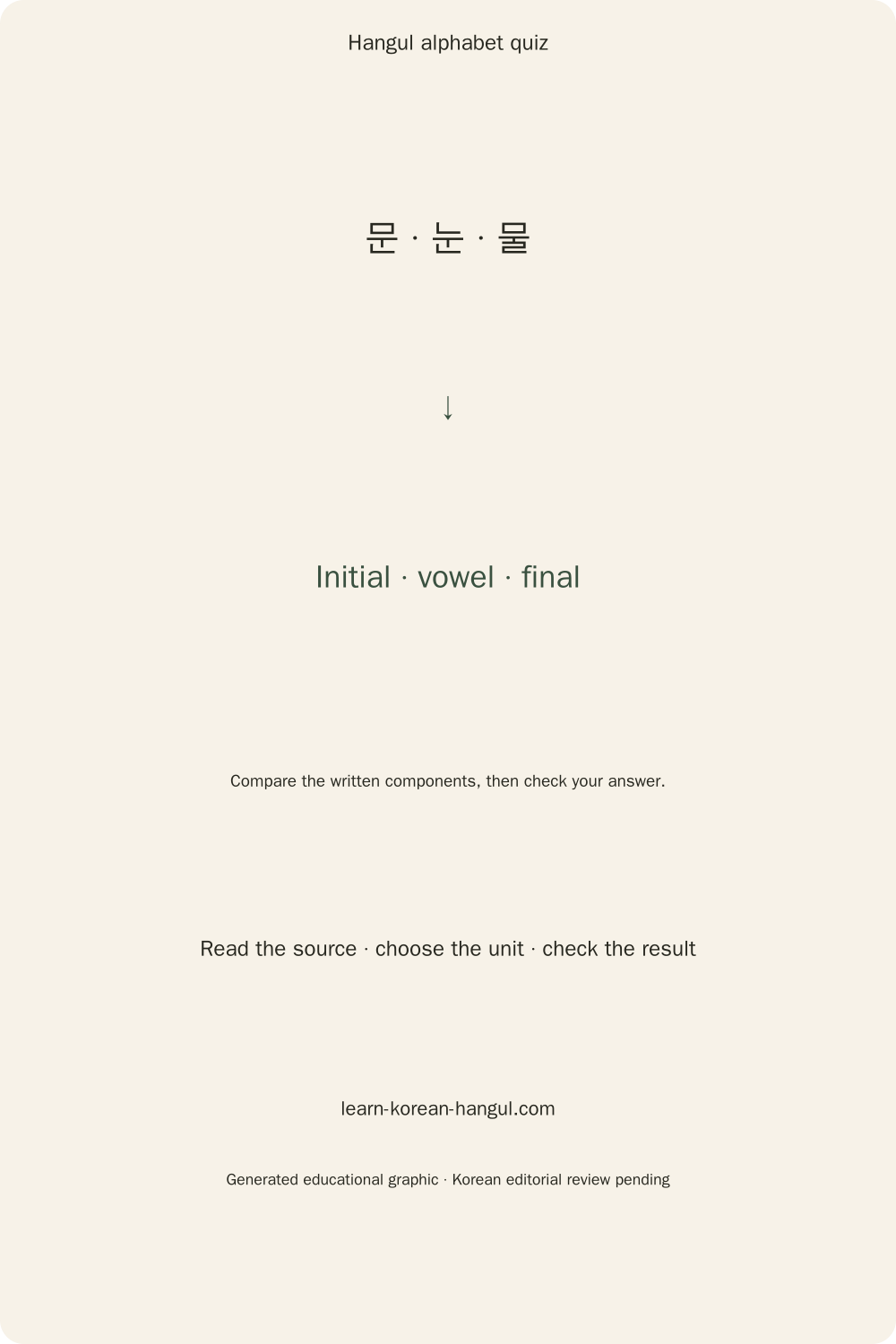
Reading 문, 눈 and 물
Compare 문, 눈 and 물 by marking one component at a time. 문 contains initial ㅁ, vowel ㅜ and final ㄴ. 눈 changes the initial to ㄴ while leaving the vowel and final unchanged. 물 keeps the initial and vowel of 문 but changes the final to ㄹ.
| Target | Initial | Vowel | Final |
|---|---|---|---|
| 문 | ㅁ | ㅜ | ㄴ |
| 눈 | ㄴ | ㅜ | ㄴ |
| 물 | ㅁ | ㅜ | ㄹ |
Choosing 눈 for 문 is therefore an initial-position error. Choosing 물 for 문 is a final-position error. A single wrong answer need not mean every part of the block is unfamiliar. During retry, name the changed slot before choosing an option, then check whether the other two slots really stayed the same.
Reading 가, 고 and 과
Keep the initial ㄱ constant while comparing 가, 고 and 과. The vowel changes from ㅏ to ㅗ to ㅘ. The examples demonstrate vertical, horizontal and mixed arrangements without introducing a new initial or final.
A reconstruction exercise treats ㅘ as one vowel selection. Its teaching decomposition into smaller shapes does not create a second vowel slot inside the block. Similarly, the letter pad's Add Block action composes one initial, one vowel and one optional final into a modern syllable. Try the same comparison with another familiar initial in the syllable builder.
Batchim Practice with Real Korean Words
Batchim is the written final position at the bottom of a syllable block. Identify that position visually before adding a pronunciation rule. A question about which letter is written and a question about which sound is heard can have different answer formats.
Finals can be a single consonant or a consonant cluster. 읽 contains initial ㅇ, vowel ㅣ and final ㄺ. The cluster ㄺ occupies one final slot; a component task should not score it as two independent bottom positions. The same distinction applies to the final ㅄ in 값.
Enable single finals to introduce that extra slot without immediately adding every cluster. Enable all finals when the cluster inventory is part of your study. The known-letter selector continues filtering the actual symbols used in each target; enabling finals alone does not silently mark every final as learned.
Word exercises retain sense labels. The text gloss for 문 is door, the gloss for 물 is water, and a selected 눈 item uses the snow sense. Korean words can have other senses, so a meaning question must establish the intended one. A valid encoded block without an authored gloss stays a decoding exercise.
Why Can Written Finals Sound Alike?
Different written finals can correspond to the same final sound in a given pronunciation environment. A spelling task must still distinguish the written letters; a sound-only task needs enough context to support its intended answer.
꽃 contains ㄲ, ㅗ and written final ㅊ. Identifying that final does not require changing the printed character to a sound label. Conversely, selecting a written final from an isolated recording can be ambiguous. Use the seven final consonant sounds lesson for the sound categories, and keep written-component practice separate from listening evidence.
What Do the Different Quiz Scores Mean?
An independent-recall score counts correct first answers completed without a hint or revealed answer. Assisted answers, skips and timeouts appear separately. The denominator describes the session that actually occurred, including a shortened session when too few eligible items exist.
For a six-item session with four independent correct answers, one hinted correct answer and one skip, independent recall is four of six. Answered accuracy without hints is four of four. These two fractions answer different questions: one describes the whole session and the other describes the unhinted answers actually submitted.
A skip is not evidence that a learner pronounces the item incorrectly. A timeout is recorded as unanswered; a visible countdown cannot measure spoken accuracy. A reveal is useful study behaviour but does not earn an independent-recall point. The first checked answer locks the question so repeated Check actions cannot add extra credit.
Mode labels matter when comparing scores. Selecting components checks visual recognition; typing Hangul checks spelling recall under that prompt; a romanization choice checks a written label. None certifies fluency, conversation ability, TOPIK performance or a CEFR level. Record the mode and hint policy when saving or discussing a result.
Correct Answers after a Hint
A hint changes what the learner has already seen. Even when the final answer is correct, the session puts it in the hinted-correct count rather than quietly adding it to independent recall.
Use that distinction to choose the next round. A correct assisted answer may suggest practising the same shape again with the hint hidden. Several independent answers on different words provide a better reason to reduce romanization than repeatedly selecting one recently revealed target. The learner controls the aid settings and can restore them whenever the task becomes frustrating.
Romanization, Audio and Spelling
Romanization represents Korean with Latin letters under a stated convention. It can help label a written pattern, but a Latin label is not an audio recording or a complete pronunciation lesson. Keeping the label removable encourages attention to the Hangul target itself.
The official vowel labels include eo for ㅓ, o for ㅗ, eu for ㅡ and u for ㅜ. The two-letter spellings eo and eu are labels in Revised Romanization, not instructions to pronounce separate English vowels in succession. A reverse-label exercise is constrained to its own eligible answer set because a Latin string alone may not uniquely determine Korean spelling.
The trainer offers romanization off, on or after answering. Component feedback always shows the Hangul pieces needed to explain the visual error. A text decoding label must not be interpreted as a sound-change transcription for a generated word. Word-level pronunciation requires its own verified record and context.
Audio is unavailable for these questions. The Audio button explains this and keeps visual practice available. No recording plays automatically, and a visual answer does not contribute to a listening score. You can use the written prompt, answer choices and optional hint to complete every visual question. The official Revised Romanization rules provide the underlying convention.
Can Audio Distinguish Every Korean Vowel Spelling?
Audio cannot safely distinguish every written vowel contrast without context and suitable recordings. Some speakers merge contrasts such as the vowels represented in 애 and 에, so a visual spelling question can be meaningful even when a sound-only choice would not identify a unique spelling.
An approved listening item needs an exact recording target, appropriate distractors and a explanation of any accepted alternatives. A failed or unavailable recording must not reduce a listening score. Until those records exist, visual practice provides an explicit alternative rather than treating silence or a loading failure as a learner error.
How Does Targeted Mistake Review Work?
Targeted review increases the chance of eligible items associated with recent mistakes or a due review date. The sampler filters known letters first, then applies its weights. A teacher's fixed seed uses a reproducible order independent of personal history.
The current personal weighting is a product rule: start with weight one, add two for each recent wrong response up to three, add two when due and add one when unseen. Those numbers define the application, not a measured learning-effect estimate. Sampling occurs without replacement within a session, so a target does not immediately recur simply because its answer was wrong.
Optional local review uses five boxes. An independent correct response advances its visual record by one box, capped at five. A wrong independent response returns that record to box one. The due intervals are ten minutes, one day, three days, seven days and twenty-one days. Revealing a card or using a hint does not qualify as independent retrieval for an advance.
Confusion descriptions retain component positions. An initial error should not quietly become a listening weakness, and a visual result should not advance a separate listening record. The export includes concrete local review records; the result screen shows the recorded initial, vowel or final changes. Revisit the relevant lesson before interpreting repeated misses as a need for longer sessions.
Teacher Assignments and Printable Review
A teacher assignment copies a hash-only configuration link containing the chosen letters, unit, mode, length, hint policy and seed. The URL carries settings rather than answers or student names. A fixed seed produces the same eligible targets without consulting each student's local error history.
Open More to set a teacher seed, copy the assignment link or download a printable review sheet. The sheet uses the current target IDs and places the answer key on a separate page. The browser's print dialogue can save the downloaded HTML as a PDF. The retry-sheet option selects missed targets from the current session.
The local classroom panel accepts rows containing a pseudonym, score and total. Comparison requires the same assignment, mode and hint policy; the displayed fraction alone cannot establish those conditions. Remove individual rows or reset the imported list when the classroom activity ends.
For a class assignment, copy the settings link so that everyone starts with the same letter selection and exercise mode. A printable sheet provides an untimed alternative. Separate answer pages let students try the exercise before checking. Save the link or file somewhere you can find it for your next practice session.
Local Progress, Offline Use and Privacy
Optional saving stores trainer records in this browser. It does not send answers to a server or create an account. A copied assignment link shares configuration, while a progress export deliberately creates a separate file under the learner's control.
Export progress before clearing site data or moving to another device. Import checks the version, settings and record bounds before replacing local review information. A file declaring a newer unsupported schema produces an error so the existing records remain recoverable. The tool does not pretend that a new phone automatically contains the old phone's scores.
Storage can be denied, full or removed by the browser. Practice continues in memory and the page explains when progress cannot be saved. Reset Progress asks before deleting stored records. Turning saving off stops subsequent persistence; use Reset when you also want existing saved records removed.
Loaded text practice continues if the connection disappears because its calculations run locally. A first visit still needs the page and scripts to load. Audio downloads are unavailable or promise durable offline caching across browser eviction. Keep a printable sheet or exported progress file when a network-independent hand-off is necessary.
The private text drill accepts bounded plain Hangul text for local spelling practice. Pasted lyrics remain private, are labelled as the learner's text and receive no guessed translation or pronunciation grade. Use material you own or are permitted to study; no text is automatically published or included in a share summary.
Common Reading Errors and Their Next Lessons
A useful correction identifies the part that changed and the lesson that addresses it. A general instruction to study more does not distinguish a vowel-shape confusion from a final-position confusion.
| Reading symptom | Component check | Next practice |
|---|---|---|
| Mixing ㅓ and ㅗ | Check which direction the short stroke points | A small selected vowel set |
| Mixing ㅡ and ㅜ | Check whether the downward stroke is present | Two-vowel blocks with one fixed initial |
| Treating initial and final ㅇ alike | Identify the slot before recalling its role | Open blocks followed by final blocks |
| Splitting ㄺ into two final slots | Keep the cluster inside one labelled final position | Component reconstruction with all finals |
| Choosing the wrong word sense | Read the supplied sense label | Meaning exercises with explicit glosses |
For shape errors, review Korean vowel shapes before increasing the session length. For positional errors, compare two blocks where only the problematic slot differs. A small contrast gives a concrete checkpoint: the learner can say which slot changed and which slots remained constant.
Correct typing can use canonically decomposed Hangul. The answer comparison normalizes NFC and trims outside whitespace, so a conjoining-jamo representation of 문 can match its precomposed character. Compatibility letters ㄱㅏ are not silently treated as typed 가; use Add Block to construct the intended syllable first.
When Should You Use Another Practice Tool?
Use another surface when the task needs instruction or evidence beyond short visual recognition. An alphabet quiz is useful for isolating component mistakes, but it cannot inspect tongue position, assess spontaneous speech or teach a passage's grammar from one score.
The preserved alphabet explorer provides a separate place to explore a letter with audio and strokes, with its available audio and stroke examples. The builder supports arbitrary composition rather than selecting a constrained quiz answer. Longer reading belongs in graded Hangul reading sets, where several words can be practised in sequence.
Font transfer is another specific task. Setup offers site serif, site sans and system choices, with target and options using the same font within a question. Start a separate round after changing the font so the learner knows which visual condition changed. A new typeface should be an explicit practice choice rather than a hidden reason for losing points.
Frequently Asked Questions
Can I practise without a Korean keyboard installed?
Yes. Component-choice questions use taps or keyboard selection, so no Korean input method is required. Typed mode includes a letter pad with labelled initial, vowel and final selectors. Add Block inserts the composed syllable into your answer. A hardware or phone Korean keyboard is useful, but it is a separate choice.
Will my saved score move to another phone?
Saved progress belongs to the browser where saving was enabled. Export Progress downloads a file that you can move yourself, then import on another device. No account sync is shipped in this wave. Keep the original file until the receiving browser confirms its import and displays the expected local records.
Why does a fixed teacher assignment differ from adaptive practice?
Fixed assignments use the selected settings and seed to give classmates a reproducible set. Personal practice can also use recent errors, due review dates and unseen items when sampling. Those weights help select local practice, so two learners with different histories can receive different personal sets without changing the shared teacher assignment.
Can a daily quiz still be opened after midnight?
An active daily session keeps its selected items when the UTC date changes. Starting another daily session uses the new UTC day with the practice settings to calculate its seed. Keep an assignment link if you need a fixed repeat of a particular configuration rather than the next daily selection.
What happens if a recording will not play?
Visual practice stays available and an unheard recording cannot count as a listening error. Audio recordings are unavailable, so Audio explains the written alternative. Use visual questions to practise reading while audio is unavailable.
Continue after the Hangul Alphabet Quiz
Continue after the Hangul alphabet quiz by choosing one specific weakness from the result, reviewing its lesson and taking a smaller unhinted set. A session with several initial errors suggests consonant recognition; repeated vowel errors suggest a limited shape contrast; final errors suggest careful attention to the bottom slot.
The original thirty-question checkpoint remains a broader check after those narrower skills feel familiar. Its retained text wording still needs Korean review and should not be mistaken for a certified examination. Compare results only when the mode, selected letters and hint policy match. A higher assisted score is useful practice information, while an independent score describes a different condition.
If a question seems confusing, send a correction through the site’s contact channel with the displayed letter or block, the answer choices and the feedback sentence. Leave private pasted text out of the message. After a missed answer, read the explanation, rebuild the block if needed, and try a fresh question to practise recalling it.