What you will learn
- Choose the level of prompt that matches what you can write now.
- Write to a prompt with a target length and a time limit.
- Score your own text with a four-criterion rubric.
- Recognise the polite style of A1 and A2 prompts and the formal style of B1 prompts.
Before you start: you should have tried Write a Paragraph in Korean or the shorter sets before it. Time: 5 to 20 minutes per prompt.
Key Facts
- There are thirty prompts in three levels: ten at A1, ten at A2 and ten at B1.
- Target length grows from 3 to 5 sentences at A1, to 5 to 7 at A2 and to 8 to 10 at B1.
- The rubric has four criteria: task, vocabulary, accuracy and register, each scored 0 to 3.
- 좋아하는 계절은 무엇입니까? is a B1 prompt in the formal style, and the answer keeps that style.
- The rubric is a self-study aid and is not the scoring system of any exam.
*Last updated: 2026-10-09. The Korean text, romanization and audio on this page are AI-assisted drafts.
What Are Korean Writing Prompts by Level?
Korean writing prompts by level are tasks that tell you what to write about and are sorted by the grammar you need to answer them. An A1 prompt asks for facts in the present tense. An A2 prompt asks for the past or the future. A B1 prompt asks for reasons, comparisons and opinions.
Sorting by level keeps the task fair. A prompt that needs a comparison is frustrating if you cannot yet write a past sentence, and a prompt about your name is too easy once you can write a paragraph. The grammar for each level is listed in the Korean grammar list. The forms follow the Hangul Orthography (한글 맞춤법) of the National Institute of Korean Language (국립국어원), and the spoken forms follow its Standard Pronunciation Rules (표준 발음법). Next, see why prompts are hard to use well.
Why Are Prompts Hard to Use Well?
Prompts are hard to use well because the learner chooses the level, the length and the way of checking. Without a plan, learners pick a prompt that is too hard, write for hours and never check the result. Three habits fix that: pick by level, write to a time and length, and score with a fixed rubric.
English speakers also meet one language difficulty: Korean prompts change style by level. A1 and A2 prompts use the polite -세요 ending (쓰세요, 소개해 주세요), and B1 prompts use the formal -십시오 ending (쓰십시오) and -ㅂ니까 questions (무엇입니까?). The answer should match the style of the prompt. The next section shows how the set is built.
How Does the Writing Prompt Set Work?
The set works in a loop: choose a prompt, write to the target length, score with the rubric and move up or down. The table summarises the three levels.
| Level | Prompts | Target length | Time | Style of prompt | Grammar you need |
|---|---|---|---|---|---|
| A1 | 1-10 | 3 to 5 sentences | 5 minutes | polite -세요 | present tense, 은/는, 이/가, 을/를, 에 |
| A2 | 11-20 | 5 to 7 sentences | 10 minutes | polite -세요 | past, future, 에서, -고 싶다 |
| B1 | 21-30 | 8 to 10 sentences | 20 minutes | formal -십시오 | connectors, reasons, comparison |
Do ten prompts at your level, one a day, before you move up. The prompts themselves follow.
What Are the Tasks and Prompts?
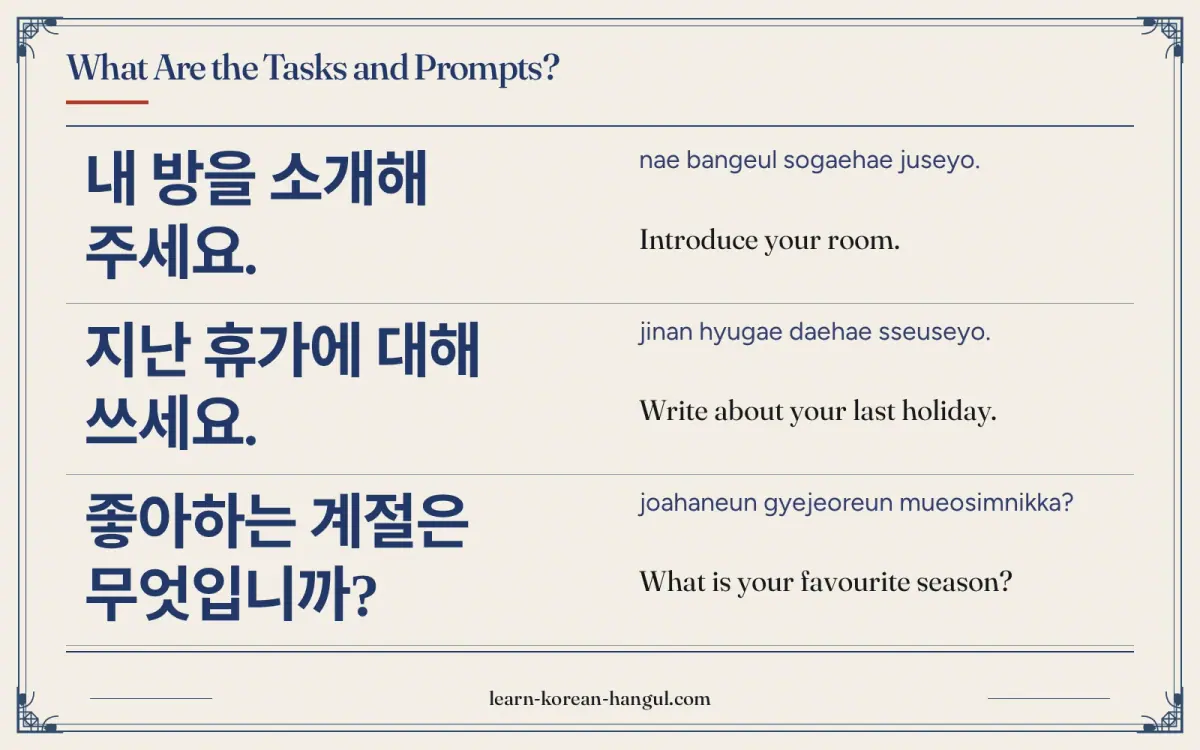
Write one prompt a day. Time yourself, and stop at the limit even if the text feels unfinished.
A1 Prompts: 3 to 5 Sentences, 5 Minutes Each
| # | Prompt | Meaning | Length | Time |
|---|---|---|---|---|
| 1 | 내 이름과 나라를 쓰세요. | Write your name and country. | 3 to 5 | 5 min |
| 2 | 내 가족을 소개해 주세요. | Introduce your family. | 3 to 5 | 5 min |
| 3 | 내 방을 소개해 주세요. | Introduce your room. | 3 to 5 | 5 min |
| 4 | 오늘 아침에 무엇을 먹었어요? | What did you eat this morning? | 3 to 5 | 5 min |
| 5 | 좋아하는 음식을 쓰세요. | Write about a food you like. | 3 to 5 | 5 min |
| 6 | 주말에 보통 무엇을 해요? | What do you usually do at weekends? | 3 to 5 | 5 min |
| 7 | 우리 집 근처에 무엇이 있어요? | What is near your home? | 3 to 5 | 5 min |
| 8 | 내 친구를 소개해 주세요. | Introduce a friend. | 3 to 5 | 5 min |
| 9 | 오늘 날씨는 어때요? | How is the weather today? | 3 to 5 | 5 min |
| 10 | 한국어를 왜 공부해요? | Why do you study Korean? | 3 to 5 | 5 min |
A2 Prompts: 5 to 7 Sentences, 10 Minutes Each
| # | Prompt | Meaning | Length | Time |
|---|---|---|---|---|
| 11 | 지난 휴가에 대해 쓰세요. | Write about your last holiday. | 5 to 7 | 10 min |
| 12 | 어제 하루를 쓰세요. | Write about your day yesterday. | 5 to 7 | 10 min |
| 13 | 내 고향을 소개해 주세요. | Introduce your hometown. | 5 to 7 | 10 min |
| 14 | 친구에게 생일 초대 메시지를 쓰세요. | Write a birthday invitation to a friend. | 5 to 7 | 10 min |
| 15 | 내가 좋아하는 영화를 소개해 주세요. | Introduce a film you like. | 5 to 7 | 10 min |
| 16 | 식당에서 음식을 주문한 경험을 쓰세요. | Write about ordering food at a restaurant. | 5 to 7 | 10 min |
| 17 | 이번 주말 계획을 쓰세요. | Write your plan for this weekend. | 5 to 7 | 10 min |
| 18 | 내가 사고 싶은 물건을 쓰세요. | Write about something you want to buy. | 5 to 7 | 10 min |
| 19 | 요즘 배우고 있는 것을 쓰세요. | Write about something you are learning these days. | 5 to 7 | 10 min |
| 20 | 한국에서 가 보고 싶은 곳을 쓰세요. | Write about a place in Korea you want to visit. | 5 to 7 | 10 min |
B1 Prompts: 8 to 10 Sentences, 20 Minutes Each
| # | Prompt | Meaning | Length | Time |
|---|---|---|---|---|
| 21 | 좋아하는 계절은 무엇입니까? 그 이유를 쓰십시오. | What is your favourite season? Give the reason. | 8 to 10 | 20 min |
| 22 | 혼자 사는 것의 좋은 점과 나쁜 점을 쓰십시오. | Write the good and bad points of living alone. | 8 to 10 | 20 min |
| 23 | 우리 동네의 장점과 단점을 쓰십시오. | Write the strengths and weaknesses of your neighbourhood. | 8 to 10 | 20 min |
| 24 | 온라인 수업과 학교 수업을 비교하여 쓰십시오. | Compare online classes and school classes. | 8 to 10 | 20 min |
| 25 | 내가 존경하는 사람에 대해 쓰십시오. | Write about a person you respect. | 8 to 10 | 20 min |
| 26 | 10년 후 나의 모습을 쓰십시오. | Describe yourself ten years from now. | 8 to 10 | 20 min |
| 27 | 환경을 위해 내가 할 수 있는 일을 쓰십시오. | Write what you can do for the environment. | 8 to 10 | 20 min |
| 28 | 외국어를 배울 때 가장 중요한 것은 무엇입니까? | What is most important when learning a foreign language? | 8 to 10 | 20 min |
| 29 | 가장 기억에 남는 하루에 대해 쓰십시오. | Write about the most memorable day you have had. | 8 to 10 | 20 min |
| 30 | 한국 문화에서 인상 깊었던 것을 쓰십시오. | Write about what impressed you in Korean culture. | 8 to 10 | 20 min |
Hear one prompt from each level. The spoken form of 무엇입니까 is [무어심니까].
내 방을 소개해 주세요.
nae bangeul sogaehae juseyo.
Introduce your room.
지난 휴가에 대해 쓰세요.
jinan hyugae daehae sseuseyo.
Write about your last holiday.
좋아하는 계절은 무엇입니까?
joahaneun gyejeoreun mueosimnikka?
What is your favourite season?
Which level should you start at? The next section gives a rule.
Which Level Should You Start At?
Start at the level whose grammar you can write without looking anything up. The table gives one test for each level.
| If you can write... | Start at |
|---|---|
| A polite present sentence with a topic, an object and a place, such as 저는 집에서 밥을 먹어요 | A1 |
| A past sentence and a future plan, such as 어제 친구를 만났어요 and 내일 갈 거예요 | A2 |
| A paragraph with connectors and a reason, such as 왜냐하면 ... -기 때문이다 | B1 |
If two rows fit, choose the lower level and aim for a score of 10 or more before moving up. Writing a lower-level prompt well is better practice than writing a higher-level prompt badly. Now the rubric that tells you how well you wrote.
How Do You Score Your Own Writing?
Score your writing on four criteria, from 0 to 3 for each, for a total of 12. Score each criterion on its own, because a text can be strong on vocabulary and weak on accuracy.
| Criterion | 3 | 2 | 1 | 0 |
|---|---|---|---|---|
| Task | Answers the prompt and reaches the target length | Answers the prompt but is one or two sentences short | Answers only part of the prompt | Off topic |
| Vocabulary | Words fit the topic and the level, with little repetition | Mostly fit, with some repeated words | Few topic words, and many repeats | Mostly English or unrelated words |
| Accuracy | No errors in particles, endings, spelling or spacing | One or two errors | Three to five errors | More than five errors |
| Register | One style from the first sentence to the last, matching the prompt | One slip | Two or three slips | Mixed styles |
Read the total: 10 to 12 means move to the next prompt or level, 7 to 9 means repeat one more prompt at the same level, and 0 to 6 means go back one set. This rubric is this set's own self-study guide. It is not the scoring system of TOPIK or any other exam, whose current criteria are published at topik.go.kr. The models show what a high score looks like.
Model Answers
Each level has one model, and the models answer prompts 3, 11 and 21. The tables give the Revised Romanization (RR), a learning aid that follows the letters, and the spoken form in brackets where it differs from the spelling.
Model for Prompt 3 (A1)
| # | Korean | RR and spoken form |
|---|---|---|
| 1 | 제 방은 작아요. | je bangeun jagayo. [제 방은 자가요] |
| 2 | 침대와 책상이 있어요. | chimdaewa chaeksangi isseoyo. [침대와 책쌍이 이써요] |
| 3 | 창문 옆에 책장이 있어요. | changmun yeope chaekjangi isseoyo. [창문 여페 책짱이 이써요] |
| 4 | 저는 제 방을 좋아해요. | jeoneun je bangeul joahaeyo. [저는 제 방을 조아해요] |
Translation: My room is small. There are a bed and a desk. There is a bookshelf next to the window. I like my room.
제 방은 작아요.
je bangeun jagayo.
My room is small.
Model for Prompt 11 (A2)
| # | Korean | RR and spoken form |
|---|---|---|
| 1 | 지난여름 휴가에 제주도에 갔어요. | jinannyeoreum hyugae jejudoe gasseoyo. [지난녀름 휴가에 제주도에 가써요] |
| 2 | 친구와 함께 비행기를 타고 갔어요. | chinguwa hamkke bihaenggireul tago gasseoyo. [친구와 함께 비행기를 타고 가써요] |
| 3 | 첫날에는 바닷가에서 수영했어요. | cheonnareneun badagaeseo suyeonghaesseoyo. [천나레는 바다까에서 수영해써요] |
| 4 | 둘째 날에는 한라산에 올라갔어요. | duljjae nareneun hallasane ollagasseoyo. [둘째 나레는 할라사네 올라가써요] |
| 5 | 날씨가 좋아서 경치가 정말 아름다웠어요. | nalssiga joaseo gyeongchiga jeongmal areumdawosseoyo. [날씨가 조아서 경치가 정말 아름다워써요] |
| 6 | 그래서 사진을 많이 찍었어요. | geuraeseo sajineul mani jjigeosseoyo. [그래서 사지늘 마니 찌거써요] |
| 7 | 다음 휴가에도 또 가고 싶어요. | daeum hyugaedo tto gago sipeoyo. [다음 휴가에도 또 가고 시퍼요] |
Translation: Last summer I went to Jeju Island on holiday. I flew there with a friend. On the first day I swam at the beach. On the second day I climbed Hallasan. The weather was good, so the scenery was really beautiful. So I took a lot of photos. I want to go again on my next holiday.
지난여름 휴가에 제주도에 갔어요.
jinannyeoreum hyugae jejudoe gasseoyo.
Last summer I went to Jeju Island on holiday.
Model for Prompt 21 (B1, formal style)
| # | Korean | RR and spoken form |
|---|---|---|
| 1 | 제가 좋아하는 계절은 가을입니다. | jega joahaneun gyejeoreun gaeurimnida. [제가 조아하는 계저른 가으림니다] |
| 2 | 가을에는 날씨가 시원하고 하늘이 맑습니다. | gaeureuneun nalssiga siwonhago haneuri makseumnida. [가으레는 날씨가 시원하고 하느리 막씀니다] |
| 3 | 또한 단풍이 아름다워서 산에 가기 좋습니다. | ttohan danpungi areumdawoseo sane gagi joseumnida. [또한 단풍이 아름다워서 사네 가기 조씀니다] |
| 4 | 그래서 저는 가을마다 친구들과 등산을 합니다. | geuraeseo jeoneun gaeulmada chingudeulgwa deungsaneul hamnida. [그래서 저는 가을마다 친구들과 등사늘 함니다] |
| 5 | 이 계절에는 먹을 것도 많습니다. | i gyejeoreneun meogeul geotdo manseumnida. [이 계저레는 머글껃또 만씀니다] |
| 6 | 특히 사과와 감이 맛있습니다. | teuki sagwawa gami masitseumnida. [트키 사과와 가미 마싣씀니다] |
| 7 | 반면에 여름은 너무 덥고 비가 많이 옵니다. | banmyeone yeoreumeun neomu deopgo biga mani omnida. [반며네 여르믄 너무 덥꼬 비가 마니 옴니다] |
| 8 | 따라서 저는 가을이 일 년 중에 가장 좋습니다. | ttaraseo jeoneun gaeuri il nyeon junge gajang joseumnida. [따라서 저는 가으리 일련 중에 가장 조씀니다] |
Translation: My favourite season is autumn. In autumn the weather is cool and the sky is clear. The autumn leaves are also beautiful, so it is a good time to go to the mountains. So I go hiking with friends every autumn. There is also a lot to eat in this season. Apples and persimmons are especially tasty. In contrast, summer is too hot and has a lot of rain. Therefore autumn is the best time of the year for me.
제가 좋아하는 계절은 가을입니다.
jega joahaneun gyejeoreun gaeurimnida.
My favourite season is autumn.
The B1 model uses the formal -ㅂ니다 style because the prompt does. Next, see how scoring works on a real sample.
Worked Example: Score a Sample Answer
Scoring a sample takes four steps. Here is a learner's answer to prompt 3: 내 방은 작아요. 침대와 책상 있어요. 저는 방을 좋아요.
- Task. The prompt asks to introduce the room. The text has three sentences, which reaches the A1 minimum, but it gives only size and two objects. Score: 2.
- Vocabulary. 방, 침대 and 책상 fit the topic, and there is little repetition. Score: 2.
- Accuracy. There are two errors. 책상 있어요 needs the subject particle: 책상이 있어요. 저는 방을 좋아요 mixes the adjective 좋다 with an object: write 저는 방을 좋아해요 or 방이 좋아요. Score: 2.
- Register. Every sentence is polite. Score: 3.
The total is 9, so the learner repeats one more prompt at A1, using the model as a guide, and focuses on particles. You will know it worked when you can name the weakest criterion and one concrete fix. The next section lists common mistakes.
What Mistakes Do Learners Make Here?
Learners repeat five mistakes with prompts. Each one has a cause.
- Mistake 1: choosing a prompt that is too hard. Learners often assume a harder prompt teaches more. Actually a prompt above your level makes you guess, and guessing repeats errors.
- Mistake 2: writing in English first. Learners often translate word by word. Actually Korean puts the verb last, so a word-by-word translation of the English order fails. Start with the nouns and their particles, and finish with the verb.
- Mistake 3: ignoring the length. Learners often stop at one sentence or write fifteen. Actually the target length trains control, and it makes scoring fair.
- Mistake 4: scoring only for accuracy. Learners often count mistakes and nothing else. Actually the rubric also rewards finishing the task and keeping one style.
- Mistake 5: mixing styles. Learners often answer a formal prompt in -요. Actually a B1 prompt in -십시오 calls for a formal answer, and mixing -요 and -ㅂ니다 in one text is a register slip.
Expert tip: re-write the same prompt a week later without the model. If the score rises by two points, the practice is working. Test yourself now.
Practice and Answer Key
Write your answers before you open the key.
- Name the level and the style of this prompt: 우리 동네의 장점과 단점을 쓰십시오.
- Write a prompt in Korean: "Write about your friend."
- Score the register of this text: 저는 학생입니다. 한국어를 공부해요.
- Answer prompt 4 (오늘 아침에 무엇을 먹었어요?) in one sentence.
Answer key
- B1, formal style: the prompt is prompt 23, and -십시오 is the formal imperative.
- 친구에 대해 쓰세요. RR: chingue daehae sseuseyo. (친구를 소개해 주세요 is also correct.)
- 1 or 0: the first sentence is formal (-ㅂ니다) and the second is polite (-요), so the text mixes two styles. Choose one: 저는 학생입니다. 한국어를 공부합니다. or 저는 학생이에요. 한국어를 공부해요.
- 빵과 우유를 먹었어요. (I ate bread and milk.) RR: ppanggwa uyureul meogeosseoyo. [빵과 우유를 머거써요].
Three or four correct means you can pick your own prompts. The last section shows where to go.
Where to Go Next
After Korean writing prompts by level, apply your writing to real messages in Messages, Emails and Letters, where the reader and the style change. To rehearse the paragraph structure, return to Write a Paragraph in Korean. For exam-style tasks, see TOPIK writing. The other sets are in Korean writing prompts, and spelling and spacing checks are in Korean spelling rules and Korean spacing rules.
This set covers thirty prompts from A1 to B1 with a self-study rubric. It does not cover levels above B1 or exam scoring.
Frequently Asked Questions
How do I score my own writing? Score four criteria from 0 to 3: task, vocabulary, accuracy and register. Add them for a total of 12. Ten or more means move up, seven to nine means repeat a prompt at the same level, and below seven means go back one set. The rubric is a self-study guide, not an exam standard.
Which level should I start at? Start at the level whose grammar you can write without help. If you can write a polite present sentence with 은/는, 을/를 and 에, start at A1. If you can also write past and future sentences, start at A2. If you can join sentences with connectors and give a reason, start at B1.
How long should I write? Follow the target for the level: three to five sentences in five minutes at A1, five to seven in ten minutes at A2, and eight to ten in twenty minutes at B1. These are this set's own guides. Stop at the time limit, then score the text as it is.
Should I use formal style? Match the prompt. A1 and A2 prompts end in -세요, so answer in the polite -요 style. B1 prompts end in -십시오 or -ㅂ니까, so answer in the formal -ㅂ니다 style, or in the plain -다 style if your teacher asks for it. Keep one style from the first sentence to the last.