
What Is on the TOPIK Writing Section?
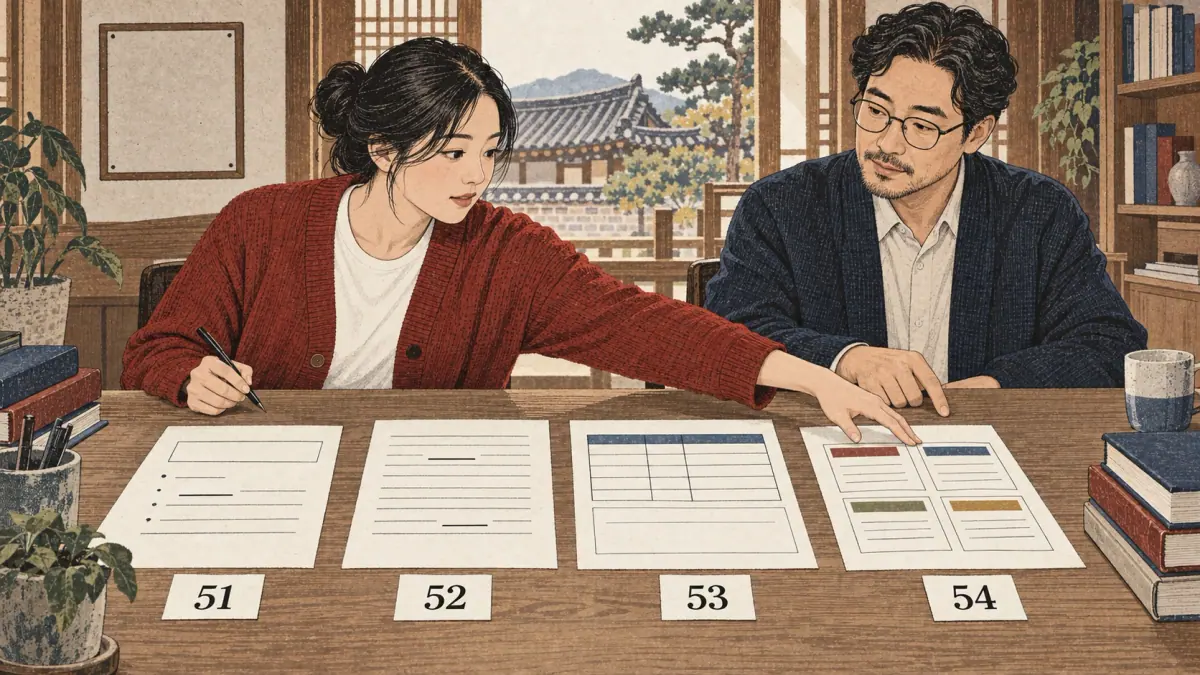
The TOPIK writing section has four tasks that grow from completing two sentences to writing a full argumentative essay. Writing is worth as much as listening or reading, a third of the TOPIK II total, but it has only 4 questions against 50 in each of the other sections. Each writing question therefore carries far more points than any multiple-choice item.
| Question | Task | Text type | Length | Points | Suggested time |
|---|---|---|---|---|---|
| 51 | Fill two blanks | Practical text: notice, invitation, message, email | one sentence per blank | 10 | about 5 minutes |
| 52 | Fill two blanks | Short explanatory paragraph | one sentence per blank | 10 | about 5 minutes |
| 53 | Describe data | Chart, graph or survey results in one paragraph | 200-300 characters | 30 | about 15 minutes |
| 54 | Write an essay | Opinion on a set topic, with guiding questions | 600-700 characters | 50 | about 25 minutes |
The point values and lengths follow the commonly published breakdown; check the current official guide on topik.go.kr before your test. The suggested times are an editorial plan, explained in the timing section below.
What a Question 51 Blank Looks Like
Question 51 gives a short practical text with two gaps, ㉠ and ㉡, and you write one sentence for each that fits both the meaning and the style. Here is a short example written in the same pattern:
이번 주 토요일에 저희 집에서 집들이를 합니다. 시간이 있으면 ( ㉠ ). 집 근처에 주차장이 없습니다. 그러니까 ( ㉡ ).
"We're having a housewarming at our place this Saturday. If you have time, ( ㉠ ). There is no car park near the house. So ( ㉡ )."
Good answers are ㉠ 꼭 와 주세요 (kkok wa juseyo, "please be sure to come") and ㉡ 대중교통을 이용해 주세요 (daejunggyotongeul iyonghae juseyo, "please use public transport"). 집들이 (jipdeuri, "housewarming") is said [집뜨리]. The second gap is answered by the sentence before it: no parking, so take public transport. Reading the sentences around each gap is the core skill of questions 51 and 52.
The Written Style for Questions 53 and 54
Questions 53 and 54 are marked partly on register, and graders expect the written plain style (한다체, handache), which ends sentences in -다. A sentence you would say as 요즘 1인 가구가 늘고 있어요 (yojeum irin gaguga neulgo isseoyo) ("single-person households are increasing these days") becomes 최근 1인 가구가 늘고 있다 (choegeun irin gaguga neulgo itda) in an answer. 1인 (one person) is read 일인, said [이린]. Polite -요 endings do not change the meaning, but they are the wrong register for a report or an essay. The TOPIK exam format page shows the four tasks next to the listening and reading question types.
Pages in This Subhub
Eight pages cover TOPIK writing: one for each question, then four on rules, style, tips and model answers. Read the question pages in order, because each task builds on the one before.
The Four Questions
- TOPIK question 51. Filling two blanks, ㉠ and ㉡, in a practical text such as a notice, email or advert, keeping the text's own polite style.
- TOPIK question 52. Completing a short explanatory passage in the plain -다 style, using connectors such as 그러나 and 따라서 to find what each blank must do.
- TOPIK question 53. Describing a chart or survey in 200-300 characters with a four-part frame: what was surveyed, the main results, a comparison and a summary.
- TOPIK 54 essay. Planning and writing a 600-700 character opinion essay that answers every guiding question, with a timed plan and an annotated model answer.
Rules, Style, Tips and Samples
- TOPIK writing rules. How the manuscript grid (원고지) works: one syllable per square, spaces and paragraph indents, digits and punctuation, and how length is counted. The general rules behind it are in Korean word spacing and Korean punctuation.
- TOPIK writing style. The written plain style (-ㄴ/는다) explained, with conversions from spoken forms and the spoken words, such as 근데 and 진짜, that break the register.
- TOPIK writing tips. Fifteen ranked tips for before, during and after writing, with two time plans and a self-marking checklist.
- TOPIK writing examples. Original annotated model answers for questions 51 to 54, including a weak and a strong question 54 essay compared criterion by criterion.







Two more pages help outside the exam format. To practise building connected sentences, use write a paragraph in Korean. If you will sit the computer test, practise the 2-beolsik keyboard layout until you can type 600 characters comfortably. For real tasks, the official TOPIK past papers include the writing questions.
How Should You Split the 50 Minutes?
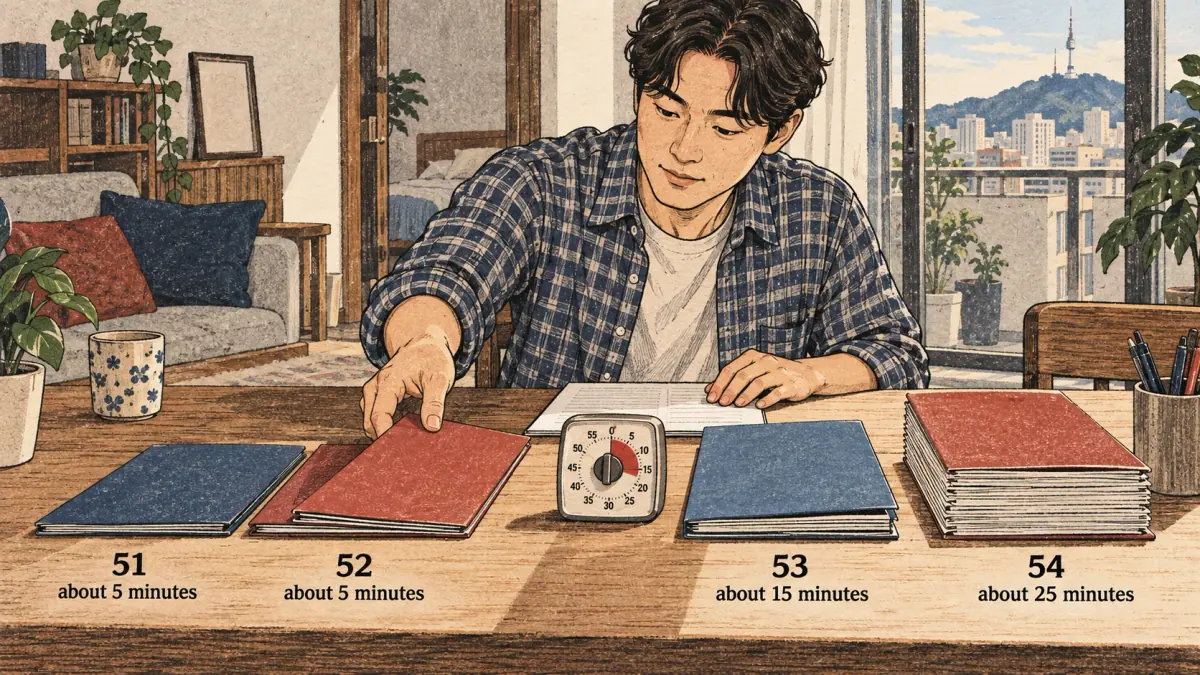
Split the 50 minutes roughly in proportion to the points: about 5 minutes each for questions 51 and 52, 15 for question 53 and 25 for question 54. That budget gives every question about two points per minute, so no task is starved. The plan is editorial, not an official rule.
| Question | Points | Minutes | Points per minute | What to do in the time |
|---|---|---|---|---|
| 51 | 10 | 5 | 2 | Read the whole text, write both blanks, check style |
| 52 | 10 | 5 | 2 | Find the logic around each gap, write both blanks |
| 53 | 30 | 15 | 2 | 2 minutes reading the chart, 11 writing, 2 checking |
| 54 | 50 | 25 | 2 | 3 minutes outlining, 20 writing, 2 checking |
| Total | 100 | 50 |
Two adjustments help most candidates. First, if you aim for Level 3, make sure questions 51 to 53 are complete before you start question 54; they carry half the points and are easier to finish. Second, if you aim for Level 4 or higher, outline question 54 before you write, because corrections on grid paper are slow. If questions 51 to 53 go quickly, you can give question 54 up to 30 minutes, the longer plan used on the TOPIK 54 essay page. On the paper test, listening and writing share one 110-minute period, so the writing clock starts when the listening audio ends.
The writing level you need depends on your target. The TOPIK level 3 page explains why short writing is often enough there, and TOPIK level 4 explains why the essay starts to matter. How the writing score combines with the other sections is on the TOPIK score page.
What Is Not Covered Here?
This subhub covers the writing section of TOPIK II only. Listening and reading have their own subhubs, and the whole test is described in TOPIK II. Typing on the computer-based test is explained on the TOPIK IBT page. TOPIK I has no writing, so if you are preparing for levels 1 and 2, go to TOPIK 1 instead. For every other TOPIK page, return to the TOPIK hub.
Frequently Asked Questions
Is TOPIK writing handwritten?
On the paper test, yes. You write all four answers by hand on a separate answer sheet, and questions 53 and 54 go on manuscript grid paper (원고지), one syllable per square. On the computer-based TOPIK IBT, you type the answers in Korean instead. Check which format your test centre offers.
What happens if my answer is too short?
You will usually lose points. Questions 53 and 54 state a length, 200-300 and 600-700 characters, and an answer well below it cannot fully complete the task, which is one of the marking criteria. The exact deduction is not published for candidates, so aim for the middle of the range and check the current guide on topik.go.kr.
How is TOPIK writing marked?
Trained raters mark the answers by hand against published criteria. For questions 51 and 52 they check whether each blank fits the content and the style of the text. For questions 53 and 54 the criteria commonly published cover content and task completion, organisation, and language use, including grammar, vocabulary and the written style.
Does TOPIK I have writing?
No. TOPIK I has listening and reading only, and every question is multiple choice. Writing appears only on TOPIK II, the paper for levels 3 to 6. If you plan to move from TOPIK I to TOPIK II, start practising questions 51 and 52 a few months before you switch.