
I Love You in Korean Flashcards: Study the 24 Cards
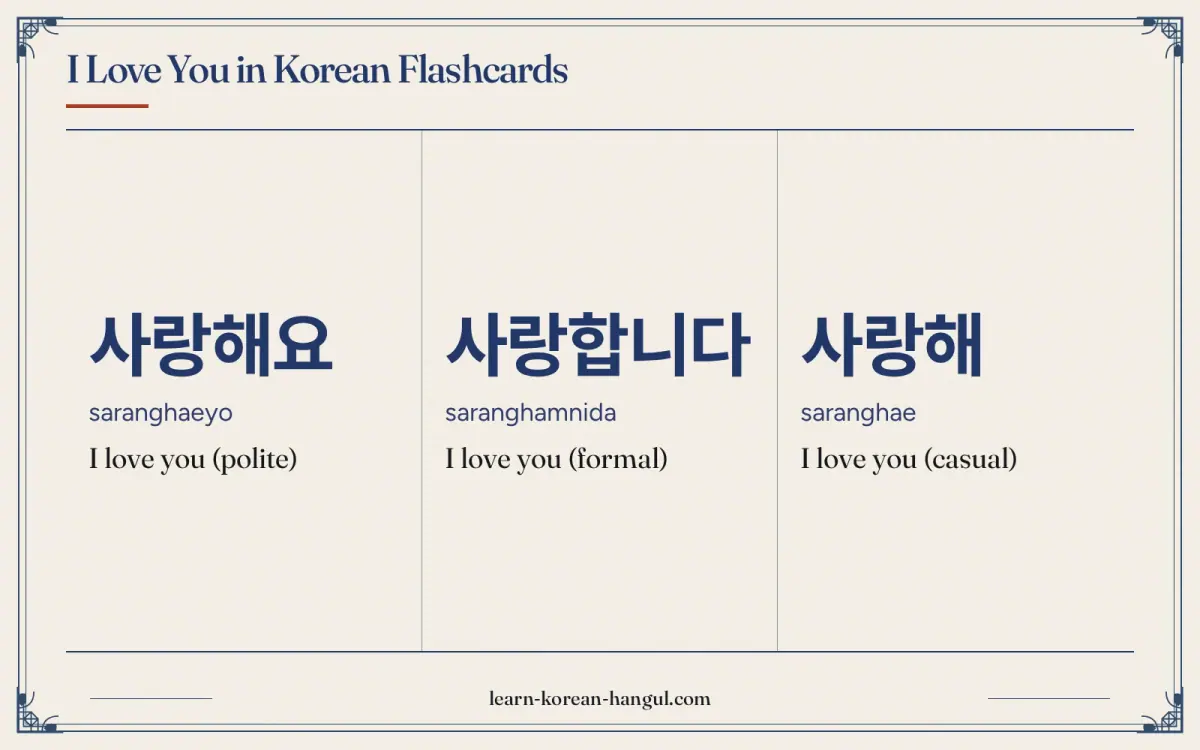
Korean has no single way to say I love you, because the ending of the verb sets how formal you sound. The lesson behind this deck is Korean love phrases, so read it first if a card is new.
How Do I Use These Flashcards?
Use the deck above in four steps. It works with tap, click or keyboard, and nothing plays until you press an audio button.
- Choose a mode. Start with recognition (Hangul to meaning). Switch to recall (meaning to Hangul) or listening (audio to meaning) once recognition feels easy.
- Show the answer. Think of the answer first, then press Show answer (or Space). Say the phrase aloud before you reveal it, and check the politeness label in the meaning, such as polite or casual. Turn on the romanization toggle only if you need it; the 24-card table below always shows it.
- Grade yourself. Press Got it if you answered correctly without help, or Not yet if you hesitated or guessed.
- Finish the session. A session holds up to 20 cards (you can set 10, 20 or 40). With 24 cards, a first-time learner can split the deck over three days, using the default limit of 10 new cards a day.
The Three Study Modes
Recognition shows the Hangul and asks for the meaning, which trains reading. Recall shows the meaning and asks for the Hangul, which trains remembering; you may type the answer with your Hangul keyboard or just recall it in your head. Listening plays a clip and hides the letters, which trains the ear. Listening mode only uses a card once its audio is approved, and cards without approved audio are skipped in that mode with a note.
Got It and Not Yet
Got it moves a card up one Leitner box, so it comes back later. Not yet sends the card back to box 1, so it returns in the same session or within 10 minutes. The grades are your own judgement; the deck does not score you or claim fluency.
Deck Scope: What Is and Is Not Covered
The deck covers 24 phrases in five groups: declarations (cards 1 to 12), pet names (13 to 15), compliments (16 to 18), falling in love (19 and 20) and dating questions (21 to 24). Each phrase is a full sentence or a ready-made name, and the Meaning column names the register: polite, formal or casual. The polite -요 forms are the safe default, and the casual forms are for partners and close friends.
What Is Left out of This Deck?
General feelings, such as happy or sad, are in the Korean feelings phrases flashcards, and celebration phrases are in their own deck. Self-introductions are in the introduce yourself in Korean flashcards. The lesson page Korean love phrases holds the longer list.
All 24 Cards in One Table
All 24 cards appear below in deck order. The table is plain HTML, so you can use it as a drill without the deck: cover the Meaning column, say each entry aloud, then uncover it.
| # | Hangul | Revised Romanization | Meaning | Note | Audio assetId |
|---|---|---|---|---|---|
| 1 | 사랑해요 | saranghaeyo | I love you (polite) | Warm and weighty; usually kept for serious relationships. | au-pg-flashcards-love-phrases-flashcards-1 |
| 2 | 사랑합니다 | saranghamnida | I love you (formal) | Said [사랑함니다]; for speeches, letters and public messages. | au-pg-flashcards-love-phrases-flashcards-2 |
| 3 | 사랑해 | saranghae | I love you (casual) | Between couples, close friends and family. | au-pg-flashcards-love-phrases-flashcards-3 |
| 4 | 좋아해요 | joahaeyo | I like you (polite) | Said [조아해요]; the usual first confession. | au-pg-flashcards-love-phrases-flashcards-4 |
| 5 | 많이 좋아해요 | mani joahaeyo | I like you a lot (polite) | Said [마니 조아해요]; ㅎ is silent before a vowel. | au-pg-flashcards-love-phrases-flashcards-5 |
| 6 | 보고 싶어요 | bogo sipeoyo | I miss you (polite) | Literally I want to see you; said [보고 시퍼요]. | au-pg-flashcards-love-phrases-flashcards-6; slow: au-pg-flashcards-love-phrases-flashcards-25 |
| 7 | 보고 싶었어요 | bogo sipeosseoyo | I missed you (polite) | Said when you meet again; [보고 시퍼써요]. | au-pg-flashcards-love-phrases-flashcards-7 |
| 8 | 보고 싶어 | bogo sipeo | I miss you (casual) | Drop 요 only with partners and close friends. | au-pg-flashcards-love-phrases-flashcards-8 |
| 9 | 나도 사랑해 | nado saranghae | I love you too (casual) | 도 means too; 나 is the casual I. | au-pg-flashcards-love-phrases-flashcards-9 |
| 10 | 저도 사랑해요 | jeodo saranghaeyo | I love you too (polite) | 저 is the humble I. | au-pg-flashcards-love-phrases-flashcards-10 |
| 11 | 너무 사랑해요 | neomu saranghaeyo | I love you so much (polite) | 너무 adds so much. | au-pg-flashcards-love-phrases-flashcards-11 |
| 12 | 영원히 사랑해요 | yeongwonhi saranghaeyo | I love you forever (polite) | 영원히 means forever. | au-pg-flashcards-love-phrases-flashcards-12 |
| 13 | 자기야 | jagiya | honey (pet name) | Casual; dating and married couples. | au-pg-flashcards-love-phrases-flashcards-13 |
| 14 | 여보 | yeobo | honey; dear (spouses) | Used between married partners; not for a boyfriend or girlfriend. | au-pg-flashcards-love-phrases-flashcards-14 |
| 15 | 내 사랑 | nae sarang | my love | An affectionate name for a partner. | au-pg-flashcards-love-phrases-flashcards-15 |
| 16 | 예뻐요 | yeppeoyo | you are pretty (polite) | Usually said to a woman; 멋있어요 is the usual compliment for a man. | au-pg-flashcards-love-phrases-flashcards-16 |
| 17 | 멋있어요 | meosisseoyo | you are cool; handsome (polite) | Said [머시써요]. | au-pg-flashcards-love-phrases-flashcards-17 |
| 18 | 귀여워요 | gwiyeowoyo | you are cute (polite) | ㅂ-irregular, from 귀엽다. | au-pg-flashcards-love-phrases-flashcards-18 |
| 19 | 첫눈에 반했어요 | cheonnune banhaesseoyo | I fell for you at first sight (polite) | Said [천누네 반해써요]. | au-pg-flashcards-love-phrases-flashcards-19; slow: au-pg-flashcards-love-phrases-flashcards-26 |
| 20 | 사랑에 빠졌어요 | sarange ppajyeosseoyo | I fell in love (polite) | Past tense for a state that began and continues. | au-pg-flashcards-love-phrases-flashcards-20; slow: au-pg-flashcards-love-phrases-flashcards-27 |
| 21 | 저랑 사귈래요? | jeorang sagwillaeyo | Will you go out with me? (polite) | 사귀다 is to date; 랑 means with. | au-pg-flashcards-love-phrases-flashcards-21 |
| 22 | 사귀자 | sagwija | Let's go out (casual) | Casual -자 ending; peers only. | au-pg-flashcards-love-phrases-flashcards-22 |
| 23 | 제 여자 친구가 되어 주세요 | je yeoja chinguga doeeo juseyo | Please be my girlfriend (polite) | Formal and dramatic; use 남자 친구 for boyfriend. | au-pg-flashcards-love-phrases-flashcards-23 |
| 24 | 결혼해 줄래요? | gyeolhonhae jullaeyo | Will you marry me? (polite) | 줄래요 asks a favour. | au-pg-flashcards-love-phrases-flashcards-24 |
Reading the Table
Hangul is the phrase. Revised Romanization (RR) is a learning aid, so read the Hangul first and check RR afterwards. RR follows the sound of the phrase, which is why 좋아해요 is written joahaeyo even though the spelling has ㅎ. The Meaning column gives the English gloss and the register, and the Note column gives a use or sound hint. The last column lists the audio assetId; a second ID marks a slow clip. Cards 6, 19 and 20 have slow clips because their linking sounds are easy to miss.
Usage Notes for These Cards
사랑해요 is warm but weighty. It is usually kept for serious relationships, whereas 좋아해요 is the standard first confession of liking someone. Think of 좋아해요 as I like you and 사랑해요 as I love you.
Couples mostly use the casual 사랑해. The casual form is natural between partners, but 사랑해요 is the correct form to parents or elders, and 사랑합니다 suits speeches and letters.
보고 싶어요 means both I want to see you and I miss you. It is the everyday phrase for missing someone. Use the past form 보고 싶었어요 when you meet again after time apart, meaning I missed you.
Ask someone out with 저랑 사귈래요? The phrase means Will you go out with me? It is a polite way to ask. 사귀자 ends in the casual -자, so it only suits a peer you are already close to.
Reply with 나도 사랑해 or 저도 사랑해요. The particle 도 means too. Use 나도 사랑해 with a partner and 저도 사랑해요 in a polite setting.
Pick the compliment by who you are talking to. 예뻐요 is usually said to a woman, and 멋있어요 is the usual compliment for a man.
Which Sounds Do Not Match the Spelling?
좋아해요 is said [조아해요]. The ㅎ of 좋 is silent before a vowel, so the phrase sounds like jo-a-hae-yo.
많이 is said [마니]. The ㅎ in ㄶ is silent before a vowel, and the ㄴ moves to the next syllable.
첫눈에 is said [천누네]. The final ㅅ of 첫 is pronounced as ㄷ, and the ㄷ turns into ㄴ before the ㄴ of 눈. Then the ㄴ links to the vowel of 에.
사랑합니다 is said [사랑함니다]. The ㅂ before ㄴ is read as ㅁ (nasalization).
What Mistakes Do Learners Make with Love and Romance Phrases?
- Using 사랑해요 on a first date. 좋아해요 is the usual step before it.
- Leaving out 요 to someone older, such as 보고 싶어, which sounds too familiar.
- Using 예뻐요 about a man. 멋있어요 is the usual compliment.
- Using 여보 for a boyfriend or girlfriend. It belongs to married couples, while dating couples use 자기야.
The register labels cause most of the slips, so give cards 1 to 3 extra passes in recall mode.
How Does the Review Schedule Work?
The deck uses a simplified Leitner system with five boxes. A new card starts in box 1. Each Got it moves it up one box, and each Not yet returns it to box 1. The box sets how long the card waits before it is due again.
| Box | Wait until the next review |
|---|---|
| 1 | same session or 10 minutes |
| 2 | 1 day |
| 3 | 3 days |
| 4 | 7 days |
| 5 | 21 days |
Each session shows due cards first, oldest due first, and then up to 10 new cards a day by default. A deck of 24 cards is introduced over three days at the default of 10 new cards a day, and the later boxes bring each card back at longer gaps. Progress is saved only in this browser, so clearing site data deletes it. Use the export button to save a small JSON file with card IDs, boxes and due dates, and import it on another device. No account is needed.
Cultural and Practical Context
In Korean romance culture there is a clear line between 좋아해요 (I like you) and 사랑해요 (I love you), and many couples mark anniversaries by day counts such as 100 days. Both are part of ordinary dating talk.
Limits of This Deck
The deck holds 24 cards and teaches whole phrases, so it does not explain the grammar inside them. Casual forms such as 사랑해 and 사귀자 are for close relationships only. The anniversary remark is general.
Next Steps after This Deck
After this deck, move on to the Korean feelings phrases flashcards to keep the same routine. Go back to the introduce yourself in Korean flashcards for earlier material. The Korean love phrases lesson holds the longer list, the Korean phrases flashcards page lists every other phrase deck, and the Korean flashcards hub lists all topics.
Frequently Asked Questions
Is 사랑해요 Too Strong to Say Early?
Often, yes. 사랑해요 carries the weight of a serious relationship, so many people wait until they are sure. 좋아해요 is the normal early confession. If you are not sure, use 좋아해요, and move to 사랑해요 when you both feel it.
What Is the Difference between 좋아해요 and 사랑해요?
좋아해요 means I like you and is the soft first step. 사랑해요 means I love you and is deeper. A couple usually passes through 좋아해요 first, then 사랑해요. Both end in -요, so they are polite forms.
How Do I Ask Someone out in Korean?
Say 저랑 사귈래요? (Will you go out with me?). If you already know the person well and are the same age, 사귀자 is a casual alternative. A longer, more dramatic request is 제 여자 친구가 되어 주세요 (Please be my girlfriend).
Which Register Do Couples Really Use?
Couples mostly use the casual forms 사랑해 and 보고 싶어 with each other. They keep the polite 사랑해요 for parents, elders and other formal moments. A formal 사랑합니다 is for speeches and letters.
Is My Progress Saved If I Close the Page?
Yes, in the same browser on the same device. Card boxes and due dates are stored locally and nothing is sent to a server. Clearing site data, using a private window or switching browsers removes them, so use the export button to keep a backup file. No account is needed.