Korean Feelings Phrases Flashcards: Study the 24 Cards
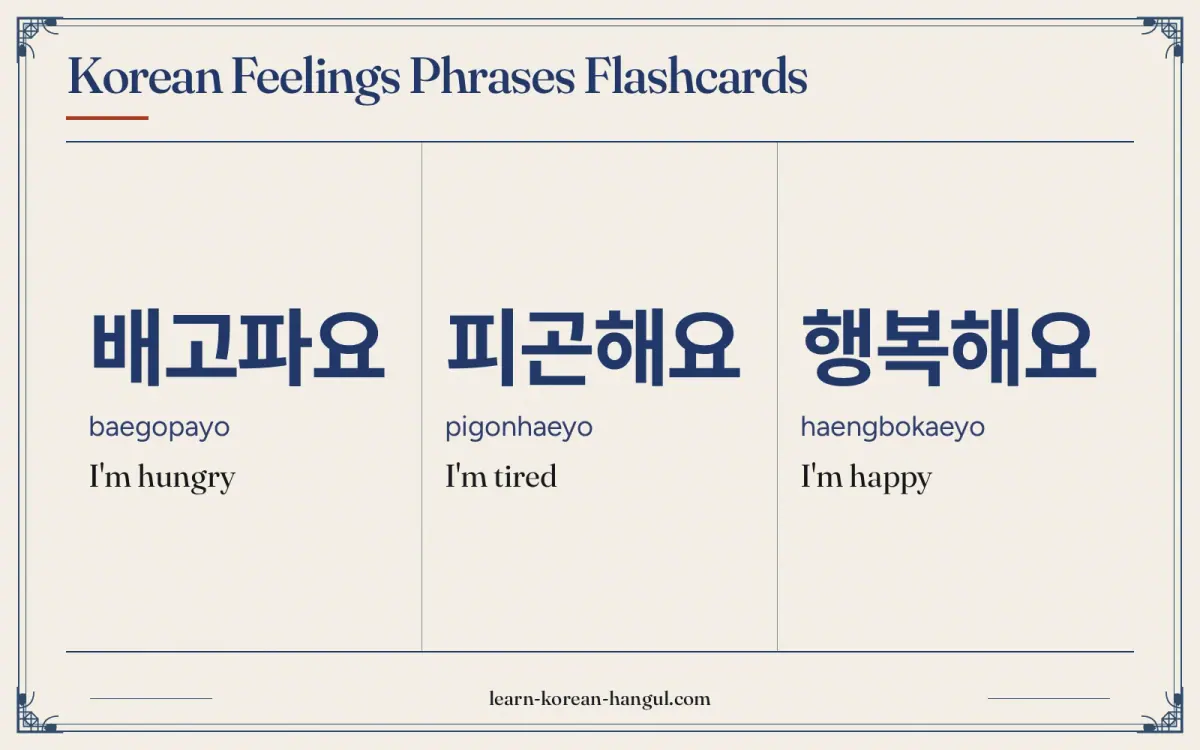
The deck above holds the same 24 cards as the table further down the page. Each card is a whole phrase or a key word, so you practise saying and recognising it, not just spelling it. Nothing plays until you press an audio button.
How Do I Use These Flashcards?
Use the deck in four steps. It works with tap, click or keyboard.
- Choose a mode. Start with recognition (Hangul to meaning). Switch to recall (meaning to Hangul) or listening (audio to meaning) when recognition feels easy.
- Show the answer. Think of the answer first, then press Show answer (or Space). Turn on the romanization toggle only if you need it; the card table below always shows it.
- Grade yourself. Press Got it if you answered correctly without help, or Not yet if you hesitated or guessed.
- Finish the session. A session holds up to 20 cards (you can set 10, 20 or 40). With 24 cards, one session reviews the whole deck once, and a second pass picks up the cards you missed.
What Do the Three Modes Do?
Recognition shows the Hangul and asks for the meaning, which trains reading. Recall shows the meaning and asks for the Hangul, which trains remembering; you may type the phrase with your Hangul keyboard or recall it in your head. Listening plays a clip and hides the letters, which trains the ear. Listening mode only uses a card once its audio is approved, and cards without approved audio are skipped in that mode with a note.
What Do Got It and Not yet Do?
Got it moves the card up one Leitner box, so it returns later. Not yet sends the card back to box 1, so it returns in the same session or within 10 minutes. The grades are your own judgement; the deck does not score you or claim fluency.
Deck Scope: What Is and Is Not Covered
The deck covers about two dozen feeling, body-state and encouragement sentences in the polite 요 style. It does not cover emergency pain or doctor talk, romantic feelings, and slang reactions. Each card uses the same Korean as the matching phrase guide, and the phrase flashcards list has the other decks.
What Is Left out of This Deck?
Left out: emergency pain or doctor talk, romantic feelings, and slang reactions. For related topics, see the Korean emergency phrases flashcards and I love you in Korean flashcards decks. The full lesson is the korean feelings phrases guide, and the Korean flashcards hub lists every deck, including Hangul, vocabulary, grammar and TOPIK decks.
All 24 Cards in One Table
All 24 cards are listed below. The table is plain HTML and works without the deck.
| # | Hangul | Revised Romanization | Meaning | Note | Audio assetId |
|---|---|---|---|---|---|
| 1 | 배고파요 | baegopayo | I'm hungry | Polite style. The vowel ㅡ drops from 배고프다 before the ending. | au-pg-flashcards-feelings-phrases-flashcards-1; slow: au-pg-flashcards-feelings-phrases-flashcards-25 |
| 2 | 피곤해요 | pigonhaeyo | I'm tired | Tired body or mind. 힘들어요 says that something is hard. | au-pg-flashcards-feelings-phrases-flashcards-2 |
| 3 | 행복해요 | haengbokaeyo | I'm happy | Sounds like [행보캐요]: ㄱ and ㅎ merge into ㅋ. | au-pg-flashcards-feelings-phrases-flashcards-3; slow: au-pg-flashcards-feelings-phrases-flashcards-26 |
| 4 | 슬퍼요 | seulpeoyo | I'm sad | Plain sadness. 속상해요 means upset about something that went wrong. | au-pg-flashcards-feelings-phrases-flashcards-4 |
| 5 | 화났어요 | hwanasseoyo | I'm angry | Past form, because the anger has already arisen. Take care with seniors. | au-pg-flashcards-feelings-phrases-flashcards-5 |
| 6 | 걱정돼요 | geokjeongdwaeyo | I'm worried | Sounds like [걱쩡돼요]: ㅈ after ㄱ is tense. | au-pg-flashcards-feelings-phrases-flashcards-6; slow: au-pg-flashcards-feelings-phrases-flashcards-27 |
| 7 | 졸려요 | jollyeoyo | I'm sleepy | You want to sleep right now. 피곤해요 means tired. | au-pg-flashcards-feelings-phrases-flashcards-7 |
| 8 | 아파요 | apayo | I'm sick; it hurts | 아프다 covers illness and pain. Say where it hurts: 머리가 아파요. | au-pg-flashcards-feelings-phrases-flashcards-8 |
| 9 | 외로워요 | oerowoyo | I'm lonely | The ㅂ of 외롭다 changes to 우 before the ending. | au-pg-flashcards-feelings-phrases-flashcards-9 |
| 10 | 무서워요 | museowoyo | I'm scared | Same ㅂ change as 외롭다, from 무섭다. | au-pg-flashcards-feelings-phrases-flashcards-10 |
| 11 | 긴장돼요 | ginjangdwaeyo | I'm nervous | Tension before an exam or a talk. 돼요 fits a state that happens to you. | au-pg-flashcards-feelings-phrases-flashcards-11 |
| 12 | 심심해요 | simsimhaeyo | I'm bored | You have nothing to do. 지루해요 is for something dull. | au-pg-flashcards-feelings-phrases-flashcards-12 |
| 13 | 바빠요 | bappayo | I'm busy | The vowel ㅡ drops from 바쁘다. Also a polite way to decline. | au-pg-flashcards-feelings-phrases-flashcards-13 |
| 14 | 추워요 | chuwoyo | I'm cold | Polite form of 춥다, with the ㅂ-to-우 change. | au-pg-flashcards-feelings-phrases-flashcards-14 |
| 15 | 더워요 | deowoyo | I'm hot | Polite form of 덥다, with the ㅂ-to-우 change. | au-pg-flashcards-feelings-phrases-flashcards-15 |
| 16 | 싫어요 | sireoyo | I don't like it | Sounds like [시러요]. A blunt refusal, so soften it with strangers. | au-pg-flashcards-feelings-phrases-flashcards-16; slow: au-pg-flashcards-feelings-phrases-flashcards-28 |
| 17 | 좋아요 | joayo | I like it | Sounds like [조아요]: the ㅎ is silent before a vowel. | au-pg-flashcards-feelings-phrases-flashcards-17; slow: au-pg-flashcards-feelings-phrases-flashcards-29 |
| 18 | 잘했어요 | jalhaesseoyo | Good job | Praises a result. Do not use it to grade a boss or an elder. | au-pg-flashcards-feelings-phrases-flashcards-18 |
| 19 | 힘내세요 | himnaeseyo | Cheer up | The 세요 ending belongs to the listener. Friends hear 힘내. | au-pg-flashcards-feelings-phrases-flashcards-19 |
| 20 | 파이팅 | paiting | Fighting! (go for it) | A cheer borrowed from English before a match, exam or hard task. | au-pg-flashcards-feelings-phrases-flashcards-20 |
| 21 | 행운을 빌어요 | haenguneul bireoyo | I wish you good luck | Sounds like [행우늘 비러요]: the final ㄴ-sound links to the next syllable. | au-pg-flashcards-feelings-phrases-flashcards-21; slow: au-pg-flashcards-feelings-phrases-flashcards-30 |
| 22 | 걱정하지 마세요 | geokjeonghaji maseyo | Please don't worry | Verb stem + 지 마세요. 걱정 sounds like [걱쩡]. | au-pg-flashcards-feelings-phrases-flashcards-22; slow: au-pg-flashcards-feelings-phrases-flashcards-31 |
| 23 | 울지 마세요 | ulji maseyo | Please don't cry | The same 지 마세요 pattern. Friends hear the shorter 울지 마. | au-pg-flashcards-feelings-phrases-flashcards-23 |
| 24 | 포기하지 마세요 | pogihaji maseyo | Please don't give up | Pairs with 힘내세요 and 파이팅 for a full encouragement set. | au-pg-flashcards-feelings-phrases-flashcards-24 |
How Do I Read the Table?
Hangul is the phrase or word. Revised Romanization (RR) is a learning aid from the South Korean government system of 2000, and it does not show every sound change, so learn the Hangul first. The Meaning column gives the English sense, and the Note column gives a sound or usage tip. The last column lists the audio assetId for the normal-speed clip, with a second ID where a slow clip (0.8x) exists for a sound-focus card.
Usage Notes for These Cards
Korean uses adjectives as complete sentences, so 피곤해요 alone already means "I'm tired". There is no separate word for "I" and no word for "am". The subject is dropped whenever it is clear, so 걱정돼요 can mean "I'm worried" or "it worries me", depending on the situation.
Add 너무 (very) or 정말 (really) before the adjective to make it stronger, as in 너무 피곤해요 ("I'm so tired"). For another person's mood, use 보여요 ("looks") to stay safe: 슬퍼 보여요 means "he looks sad". Stating someone else's inner feeling flatly can sound presumptuous.
Hunger and fullness are body states in Korean: 배고파요 is literally "the stomach is hungry". Four of the last six cards use a different shape. 힘내세요, 걱정하지 마세요, 울지 마세요 and 포기하지 마세요 are messages to another person, so they carry the listener ending 세요. Never use 세요 about yourself.
Which Sounds Do Not Match the Spelling?
Spelling and sound differ in Korean. Brackets show the sound. The standard pronunciation rules of the National Institute of Korean Language (국립국어원) describe these changes, and the audio shows them.
- 걱정돼요 is spoken [걱쩡돼요]. The ㅈ after ㄱ is tensified under the standard pronunciation rules (국립국어원, 표준 발음법).
- 행복해요 is spoken [행보캐요]. A final ㄱ meeting ㅎ merges into the aspirated ㅋ.
- 싫어요 is spoken [시러요] and 좋아요 is spoken [조아요]. The letter ㅎ is silent before a vowel.
- 행운을 is spoken [행우늘]. The final ㄴ of 운 moves onto the empty ㅇ of 을 (liaison).
What Mistakes Do Learners Make with Feelings Phrases?
- Writing 나는 피곤해요 in every sentence. The subject can be left out.
- Using 세요 for yourself, such as 피곤하세요. Say 피곤해요 about your own state.
- Using 슬퍼요 for "sorry". It means sad, not apologetic.
- Refusing with a bare 싫어요. It is blunt, so soften it in shops and at dinners.
- Using casual lines such as 배고파 with a boss. It sounds too familiar, so keep the 요.
How Does the Review Schedule Work?
The deck uses a simplified Leitner system with five boxes. A new card starts in box 1. Each Got it moves it up one box, and each Not yet returns it to box 1. The box sets how long the card waits before it is due again.
| Box | Wait until the next review |
|---|---|
| 1 | same session or 10 minutes |
| 2 | 1 day |
| 3 | 3 days |
| 4 | 7 days |
| 5 | 21 days |
Each session shows due cards first, oldest due first, and then up to 10 new cards a day by default. A deck of 24 cards fits in two or three short sessions. Progress is saved only in this browser, so clearing site data deletes it. Use the export button to save a small JSON file with card IDs, boxes and due dates, and import it on another device. No account is needed.
Cultural and Practical Context
Korean has body-and-mood words, such as 속상해요 and 힘들어요, with no tidy English twin, and learners often meet them in dramas. Telling a friend that you are 힘들어요 is a normal way to share a hard day. Encouragement is part of daily talk: people say 힘내세요 or 파이팅 before exams, matches and long workdays.
Limits of This Deck
The deck teaches 24 cards, not every phrase on the topic. Revised Romanization is a reading aid and does not show every sound change. All Korean text on the page is generated and was reviewed and signed off by Min-ji Park on 15 October 2026.
Next Steps after the Korean Feelings Phrases Flashcards
When these cards feel easy, move on to the korean airport phrases flashcards for travel lines, or to the i love you in korean flashcards for romantic feelings. Browse more topics in the korean phrases flashcards list, or open the Korean flashcards hub for every deck.
Frequently Asked Questions
Why Is There No Word for "I" in These Sentences?
Korean drops the subject when the context is clear. 피곤해요 alone means "I'm tired", and the same words as a question, 피곤해요?, mean "are you tired?". Add 저는 (jeoneun, "as for me") only to contrast yourself with someone else.
What Is the Difference between 슬퍼요 and 속상해요?
슬퍼요 is plain sadness. 속상해요 means you are upset about something that went wrong, such as a bad exam result. 속상해요 sounds like [속쌍해요], with a tense ㅅ after ㄱ.
Can I Use These about Other People?
Use 보여요 ("looks") for another person's feeling, as in 슬퍼 보여요. The 세요 phrases at the end of the deck (힘내세요, 울지 마세요) are meant for another person, so they are fine to say to a friend, a coworker or an elder.
How Do I Make a Feeling Stronger or Weaker?
Put 너무 or 정말 before the adjective to strengthen it, as in 너무 피곤해요. Put 좀 (a little) before it to weaken it, as in 좀 피곤해요. These small words are not on the cards, but they work with every adjective in the deck.
Is My Progress Saved If I Close the Page?
Yes, in the same browser on the same device. Card boxes and due dates are stored locally and no account is needed. Clearing site data, using a private window or switching browsers removes them, so use the export button if you want a backup file to import later.